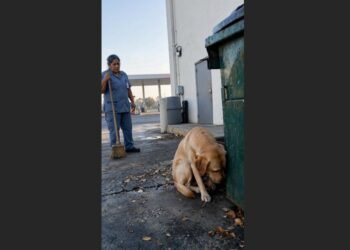
When rescuers first found Cavalete, he was lying on his side, completely motionless.
There was no shelter over his head. No familiar person sitting beside him. No indication that anyone had been looking after him.
His legs were stiff, his body was rigid, and he couldn’t even shift his weight to make himself more comfortable.
At first, the rescue team feared they were looking at a dog who might not survive another night.
Then someone noticed his eyes.
They were moving.
While the rest of his body remained frozen, Cavalete’s eyes slowly followed the people approaching him.
He was conscious.
He could see them.
He appeared to know they were there.
But he couldn’t get up to greet them or move away if he was frightened.
He couldn’t lift a paw.
He couldn’t turn his head.
He was trapped inside a body that had almost completely stopped responding.
The rescuers didn’t know what had happened to him or how long he’d been lying there.
They only knew he needed help immediately.
So they carefully lifted him and took him to a veterinary hospital.
They couldn’t have known that the dog they were carrying would spend nearly three months fighting to regain the simplest movements.
Or that one day, the sight of a single paw twitching would mean more to them than almost anything else.
Cavalete was believed to be about four years old.
He should have been in the prime of his life, with the strength to walk, run, and enjoy the ordinary activities of a healthy adult dog.
Instead, his body was locked in an unnatural position.
His muscles were so tightly contracted that even small movements appeared impossible.
At the veterinary clinic, doctors began examining him.
The diagnosis was severe tetanus.
Tetanus is an uncommon but potentially life-threatening disease in dogs. It occurs when toxins produced by certain bacteria interfere with the nervous system’s ability to control muscles.
As the condition progresses, muscles can become painfully rigid.
Spasms may develop.
And in severe cases, stiffness can spread through much of the body, affecting essential functions such as swallowing and breathing.
For Cavalete, the disease had already progressed dangerously far.
His muscles were locked in constant contraction.
He couldn’t stand or reposition himself.
Even eating had become difficult.
The veterinary team knew the seriousness of what they were seeing.
Recovery from severe tetanus can require intensive treatment and weeks or months of nursing care.
Some dogs do not survive.
And because Cavalete’s condition was so advanced, nobody could promise the rescuers a happy ending.
The possibility of euthanasia was discussed.
It was a painful conversation, but one that veterinarians sometimes must have when an animal is critically ill and suffering.
The rescue team listened.
They understood how serious his condition was.
Then they looked at Cavalete again.
His body remained still.
But his eyes followed them.
And as long as the veterinary team believed treatment offered him a reasonable chance, they wanted to try.
They decided to continue.
Treatment began immediately.
Cavalete received antibiotics to address the bacterial infection, along with medications intended to control the painful muscle spasms.
But medication was only part of what he needed.
His environment had to be carefully managed.
Dogs suffering from severe tetanus can become extraordinarily sensitive to stimulation.
A sudden noise, bright light, or unnecessary handling may trigger or worsen muscle contractions.
Even something as ordinary as moving around a hospital room can become difficult for an animal whose nervous system is already under enormous strain.
So Cavalete’s caregivers worked to make his surroundings as calm as possible.
The lights were kept low.
People approached quietly.
His handling was gentle and carefully planned.
The team monitored him closely while trying to avoid anything that might cause additional distress.
For an active, healthy dog, a quiet room might simply be a place to rest.
For Cavalete, that quiet environment was an essential part of his treatment.
And because he couldn’t move himself, he depended on the people caring for him for nearly everything.
They helped him receive nourishment.
They repositioned him carefully when appropriate.
They monitored his breathing and comfort.
And they watched for any sign that the treatment was beginning to work.
The days were long.
Progress was painfully difficult to see.
Sometimes the rescuers visited and found him looking much as he had before.
Still lying down.
Still rigid.
Still unable to move.
They spoke softly to him and continued following the veterinary team’s recommendations.
There was little else they could do.
Recovery couldn’t be rushed.
His body would have to respond in its own time.
Near the end of the second week, something happened that changed the mood around Cavalete’s bed.
One of his back paws moved.
It was barely noticeable.
Just a tiny twitch.
The kind of movement that might have escaped attention under ordinary circumstances.
But nothing about Cavalete’s circumstances was ordinary.
For days, his caregivers had watched a dog who could do little more than move his eyes.
Now, one paw had moved.
They couldn’t immediately know whether the twitch was voluntary or simply a reflex.
And it certainly didn’t mean the danger had passed.
But it was a change.
After so much stillness, even the smallest movement was worth noticing.
The caregivers continued watching him.
They didn’t push him to move more.
They didn’t expect him to suddenly stand.
They simply kept caring for him, grateful for that small sign while understanding how much recovery still lay ahead.
It was the beginning of a new kind of hope.
Not the certainty that he would recover.
Just the possibility that his condition might finally be improving.
During the following weeks, Cavalete remained dependent on intensive care.
Feeding was still a challenge.
His muscles remained stiff, and he needed assistance with basic daily needs.
The caregivers continued helping him receive soft food, providing treatment, and carefully repositioning him.
As his condition allowed, gentle physical rehabilitation became part of the plan.
Everything had to be done cautiously.
A body that had endured prolonged muscle rigidity could not simply be expected to start moving normally.
Even as the tetanus began to improve, Cavalete needed time to regain comfortable movement and strength.
His legs had been held stiff for so long.
His neck had barely moved.
And ordinary activities required an effort that healthy dogs never have to consider.
But little by little, the team began seeing changes.
Around the third week, Cavalete reached an important milestone.
He could swallow soft food on his own.
For most dogs, eating is an uneventful part of the day.
They approach a bowl, take their food, and move on to whatever interests them next.
But for Cavalete, swallowing had become something his caregivers watched with enormous concern.
Being able to manage soft food independently was a meaningful step forward.
It reduced one of the difficulties that had made his care so complicated.
And it showed that some of the functions affected by the disease were beginning to improve.
Then another small moment arrived.
His tail moved.
It wasn’t an enthusiastic wag.
There was no whole-body excitement or bouncing around the room.
Just a faint movement against his bedding when someone familiar came near.
But the people who had cared for him through those frightening first weeks noticed.
They’d spent days watching a dog unable to respond physically to much of anything around him.
Now his tail was moving.
He could show a little more of himself.
And after everything he’d endured, that mattered.
As the weeks passed, Cavalete’s progress became more noticeable.
He began regaining movement in his neck.
He could turn his head more comfortably.
Eventually, he was able to sit upright for short periods.
These were important milestones, but they weren’t easy ones.
His body had been through a severe illness.
The muscles that had once held him rigid needed time to recover.
And each new movement had to be approached carefully.
There were still difficult days.
Periods when progress seemed slow.
Times when the caregivers had to remind themselves how far he’d already come.
But Cavalete was no longer the completely motionless dog they’d first carried to the hospital.
He could swallow.
His tail could move.
His head could turn.
And he was gradually beginning to regain control of his body.
For the people working with him, those changes were deeply encouraging.
They had seen him at his worst.
They remembered the frightening stillness.
The eyes moving in a body that couldn’t respond.
And the uncertainty of those early veterinary conversations.
Now they were watching him reclaim abilities that the illness had taken away.
One small improvement at a time.
Then came day seventy-two.
By that point, Cavalete had spent more than ten weeks receiving treatment and rehabilitation.
His caregivers had watched him progress from complete rigidity to small movements, then gradually to greater control of his body.
But there was one thing he still hadn’t done.
Stand.
That changed on the seventy-second day.
With his caregivers nearby, Cavalete began trying to push himself upward.
His legs trembled beneath him.
His body was unsteady.
And the effort required was obvious.
Nobody wanted to frighten or rush him.
The people around him remained quiet while he gathered his strength.
Slowly, he lifted himself.
His legs straightened.
And for the first time since his rescue, Cavalete stood.
Only for a few seconds.
Then he needed to rest.
But he’d done it.
The dog who had once been unable to shift his own body was standing on his own legs.
It wasn’t the end of his recovery.
He still needed rehabilitation.
Still had to regain coordination and endurance.
And standing for a few seconds was very different from walking comfortably.
But the significance of that moment was impossible to miss.
For weeks, his caregivers had hoped to see his body begin responding again.
Now they were watching him support his own weight.
The progress that began with one tiny twitch had carried him all the way to his feet.
After that, Cavalete continued improving.
Standing gradually led to cautious steps.
At first, walking required patience and careful support.
His muscles needed to regain strength, and his movements were understandably awkward after such a prolonged illness.
But he kept progressing.
A few steps became more.
His balance improved.
And as his recovery continued, he grew increasingly comfortable moving around.
Nearly ninety days after his ordeal began, Cavalete’s life looked remarkably different.
The dog who had once been unable to move was walking.
And eventually, he was running.
For the rescue team, seeing him move freely was almost difficult to believe.
They remembered how he looked when they found him.
Lying outdoors.
Rigid.
Unable to lift his head.
His eyes following them because that was almost the only movement he could manage.
Now he could cross a yard on his own.
He could play.
He could approach familiar people.
And he could greet his caregivers with a wagging tail that no longer struggled to move.
He wasn’t merely surviving the illness anymore.
He was enjoying life again.
There is something especially moving about watching an animal regain an ability that most of us never think about.
Walking across a room.
Turning toward a familiar voice.
Eating without assistance.
Getting up from a comfortable place when something interesting happens outside.
We see dogs do these things every day.
They seem so ordinary that we rarely notice them.
But Cavalete spent weeks unable to do any of them.
For him, the simple act of lifting his head was a milestone.
Swallowing food became a reason for cautious celebration.
A movement of his tail meant the people caring for him could see another part of his personality beginning to emerge.
And the day he stood, even briefly, marked the beginning of a freedom he had been without for far too long.
His recovery wasn’t the result of one dramatic treatment or one remarkable afternoon.
It came from medical care, careful nursing, time, and the effort of people who continued looking after him even when progress was difficult to see.
There were no shortcuts.
No way to make ninety days pass more quickly.
The team could only give him the care he needed and allow his body time to heal.
And slowly, it did.
What makes Cavalete’s story particularly remarkable is how little anyone knew about his chances when he was first rescued.
He was estimated to be four years old.
He had a severe disease affecting nearly his entire body.
And he had already reached the point where ordinary movement was impossible.
The rescuers couldn’t know whether treatment would succeed.
They couldn’t promise that he would walk again.
And they certainly couldn’t have predicted that he would eventually run across a yard.
But they sought veterinary care, listened to the medical team, and continued treatment while recovery remained a possibility.
That decision gave Cavalete a chance.
The veterinarians then provided the treatment he needed.
Caregivers maintained the quiet environment that helped reduce painful spasms.
They assisted with feeding and repositioning.
And later, they supported his gradual rehabilitation.
Each part mattered.
Cavalete couldn’t have recovered through determination alone.
He needed skilled medical treatment and ongoing nursing care.
And he was fortunate to have people willing to provide both.
Today, Cavalete is a lively dog who can move freely.
He runs across the yard.
He plays.
He approaches people who care for him.
And when he sees someone familiar, his bright eyes and enthusiastic tail tell a very different story from the one his rescuers encountered on that first frightening day.
The contrast is extraordinary.
Once, his eyes were almost the only part of him that moved.
Now his whole body can respond.
He can turn his head.
Stand.
Walk.
Run.
And enjoy the freedom of movement that had seemed so far away during the worst of his illness.
His recovery doesn’t mean every dog with severe tetanus will have the same outcome.
The disease is serious, and the chances of recovery depend on many medical factors.
But Cavalete’s experience shows what can sometimes be achieved when an animal receives timely veterinary treatment and sustained care.
For the people who helped him, the most rewarding part is seeing him enjoy an ordinary dog’s life again.
There is no need for a dramatic gesture.
Watching him run is enough.
The story of Cavalete’s rescue was documented by the people behind the o.cavalete account and shared through the Pets In Love YouTube channel.
The footage follows his journey from those early days of terrible muscle rigidity through the gradual milestones of his recovery.
It’s difficult to reconcile the dog at the beginning with the one shown later.
At first, there is almost no movement.
Just those alert eyes following the people around him.
Then the smallest signs begin to appear.
A paw twitching.
A little movement.
The ability to eat more comfortably.
A tail wag.
And eventually, the moment he stands.
By the end, Cavalete is moving with an ease that once seemed impossible.
His journey is a reminder of how gradual recovery can be.
Sometimes improvement doesn’t arrive in a way that everyone immediately recognizes.
Sometimes it begins with something as small as a single muscle moving.
And sometimes, that small change is the first sign of a much larger recovery still to come.
I think the most memorable part of Cavalete’s story will always be the beginning.
Not because of how frightening he looked.
But because of what his rescuers noticed.
A dog lying helplessly outdoors.
Unable to stand.
Unable to turn his head.
Unable to move himself into a more comfortable position.
Yet his eyes were still alert.
He followed the people approaching him.
And they recognized that he was still there, aware of the world around him and in desperate need of medical care.
They couldn’t know how the story would end.
They only knew they had to help.
Weeks later, when his back paw twitched, that same attention to small details allowed them to recognize a change.
The movement was brief.
It could have been a reflex.
But it was something different from the stillness they’d been watching for so long.
And from that point onward, the milestones slowly accumulated.
Food he could swallow himself.
A tail that moved.
A head that could turn.
A body that could sit upright.
Legs that could finally support his weight.
Until the day he stood.
And eventually, ran.
Cavalete’s recovery took nearly three months.
Seventy-two days passed before he could stand for the first time.
For much of that period, he relied on other people for the most basic care.
But he wasn’t left to struggle alone.
The rescue team and veterinary staff continued treating him, monitoring his condition, and helping him through each stage of recovery.
And today, the dog who once seemed frozen in place can run freely.
When Cavalete was found, his body was so rigid from severe tetanus that he could barely move anything except his eyes.
Nearly two weeks later, one of his back paws twitched. It was a tiny movement, but it was the first sign that something might be changing.
On day seventy-two, he stood.
And after nearly ninety days of treatment and rehabilitation, he regained the ability to move through the world on his own.
The dog who once could only watch people approaching is now able to run toward them.
He can play.
He can greet his caregivers.
And he can enjoy all the simple pleasures that severe illness nearly took away from him.
For Cavalete, the turning point wasn’t a dramatic leap or a sudden return to health.
It was a tiny twitch of one back paw.
A movement so small that someone might easily have missed it.
But the people caring for him were watching.
And they continued giving him the time and treatment he needed.
Today, Cavalete doesn’t have to lie still and watch the world go by.
He can get up and be part of it.