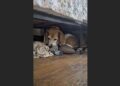
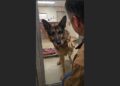
For eight months, Buddy rarely came to the front of his kennel.
The old Dalmatian had once responded when footsteps approached. During his first weeks at the shelter, he would lift his head, stand, and watch visitors through the metal gate.
As the months passed, that changed.
Families walked along the kennel row looking for a dog to take home. Some stopped briefly when they saw Buddy. They noticed his spotted coat, the gray around his muzzle, and the slower way he moved.
Then most continued toward younger dogs.
At first, Buddy still rose when people came close.
Eventually, he simply watched from the back.
His food arrived. His bedding was changed. Shelter workers spoke to him and cared for him. Yet whenever unfamiliar visitors appeared, Buddy usually remained where he was.
Then, on a rainy afternoon, an elderly woman wearing a pale blue cardigan entered the hallway.
She took one look at the Dalmatian behind the gate and stopped walking.
Eleven Years Earlier, Buddy Had Been a Puppy
Her name was Eleanor.
Long before the shelter, before the gray muzzle and stiff legs, Buddy had been the puppy she carried into her home.
That was eleven years earlier.
He had grown from an energetic young Dalmatian into a familiar part of Eleanor’s household. Like most long relationships with dogs, theirs had been built less on dramatic moments than ordinary repetition.
Morning routines.
Meals.
Doors opening and closing.
Walks taken at familiar times.
A dog settling nearby while life happened around him.
Buddy learned the sounds of Eleanor’s home and the rhythm of the people inside it.
Then Eleanor’s husband died.
After that loss, Buddy’s presence became even more noticeable.
He followed Eleanor through the house. When she moved from one room to another, he often went with her. At night, he slept beside her bed.
He could not understand human grief in the way Eleanor did. Still, his routine offered something steady during a period when much of her life no longer felt familiar.
He was simply there.
For Eleanor, that mattered.
One Fall Changed Their Life Together
Years later, Eleanor suffered a serious fall.
The injury changed what she could safely do on her own. Doctors determined that she needed rehabilitation, and Eleanor was moved into a facility where she could recover.
The center did not allow animals.
Suddenly, the practical question of what would happen to Buddy became unavoidable.
Eleanor’s relatives could not care for him.
There was no simple temporary arrangement available, and Eleanor did not know how long her recovery would last.
Eventually, she had to make the decision she had hoped to avoid.
Buddy went to the shelter.
For an elderly woman who had shared eleven years with the same dog, surrendering him was not a casual decision. Yet Eleanor’s injury had left her with few realistic alternatives.
On the day they separated, she bent toward him.
She touched her forehead to his.
“Wait for me,” she whispered.
Buddy could not understand the promise in the way a person would.
What he knew was that a familiar person was there.
And then she wasn’t.
Recovery Took Longer Than Eleanor Expected
Eleanor had hoped rehabilitation would be temporary.
Instead, progress came slowly.
Learning to move safely again required time. Strength had to return. Balance had to improve enough that she could manage daily life without putting herself at immediate risk of another fall.
Days became weeks.
Weeks became months.
Meanwhile, Buddy remained at the shelter.
Eleanor’s original apartment did not wait for her indefinitely. By the time she was ready to begin living more independently again, that home was gone.
That created another problem.
It was not enough for Eleanor to leave rehabilitation. She needed housing where she could live safely, manage her mobility, and keep a dog.
For someone determined to bring home an older Dalmatian, that last requirement mattered.
She searched.
Several possibilities did not work.
Then Eleanor found a senior community that offered her a small home.
Dogs were allowed.
For the first time in months, the plan she had carried with her became possible.
She Called the Shelter Before Unpacking
When Eleanor finally received the keys to her new home, she did not begin with boxes.
She did not arrange the kitchen or decide where the furniture would go.
Instead, she called the shelter.
Buddy was still there.
Eight months had passed since Eleanor surrendered him.
He was older now, although eight months can look especially significant on a dog already well into his senior years. His legs were stiff. His face showed more gray.
Most importantly, nobody else had adopted him.
That fact meant Eleanor still had a chance to do what she had hoped to do since leaving rehabilitation.
She could go back.
So on a rainy afternoon, wearing a pale blue cardigan, Eleanor entered the shelter hallway.
Then she saw him.
Buddy Was Still Near the Back
The kennel looked much different from Eleanor’s old home.
Concrete floor.
Metal gate.
Shelter sounds echoing down a long hallway.
Behind the bars sat the dog she had known for eleven years.
Buddy did not immediately rush toward her.
Instead, he remained motionless.
Eleanor pressed both hands against her chest.
Only a few feet separated them.
For months, unfamiliar people had stopped at that same kennel and looked at Buddy. Most eventually moved on.
Now Eleanor stood there.
Buddy stared through the gate.
Several quiet seconds passed.
The shelter worker nearby did not rush the moment.
Then Eleanor spoke.
“Buddy, it is me.”
His ears lifted.
His tail moved once.
It was a small response, but Eleanor saw it.
The worker reached for the latch.
Eleanor Lowered Herself Carefully
Before the kennel opened, Eleanor began lowering herself toward the floor.
Eight months earlier, a serious fall had forced her into rehabilitation. Even now, movement required more care than it once had.
Still, she wanted to be closer to Buddy’s level.
The shelter worker opened the gate.
Eleanor waited.
Nobody dragged Buddy into the corridor.
Nobody pushed him toward her.
For a dog who had spent months choosing the back of his kennel, giving him time mattered.
At first, Buddy remained where he was.
Then he stood.
The movement came slowly.
Age had changed the way his body worked. His joints were no longer those of the puppy Eleanor had carried home eleven years before.
One careful step followed another.
Buddy entered the corridor.
Halfway Across the Floor, He Stopped
Buddy did not run.
He moved slowly over the concrete on stiff legs.
Partway toward Eleanor, he stopped.
His nose lifted.
Dogs depend heavily on scent, and familiar smells can remain meaningful even after long periods apart. They also recognize voices, movements, and routines connected to people they have known well.
We cannot know exactly what Buddy recognized first.
Perhaps it was Eleanor’s scent.
Perhaps her voice contributed.
Perhaps the combination of sound, smell, posture, and years of familiarity made the person in front of him increasingly recognizable.
Whatever prompted the change, his behavior shifted.
The hesitation disappeared from his movement.
Buddy began walking directly toward Eleanor.
He Put His Head Under Her Chin
A moment later, the old Dalmatian reached her.
He moved into Eleanor’s arms and pushed his head beneath her chin.
She wrapped both arms around him.
Buddy leaned against her.
Because of his size, Eleanor could feel much of his weight pressing into her body. She held him while her hands trembled against his spotted coat.
For months, she had been recovering somewhere else while Buddy lived behind a shelter gate.
Now the same dog was leaning into her as she knelt on the hallway floor.
“I told you I would come back,” Eleanor whispered.
Buddy could not know what those words meant as a promise fulfilled.
But he knew the woman holding him.
His response made that much clear.
Eight Months Had Not Erased Familiarity
Long separations can change relationships, but dogs are capable of remembering familiar people through combinations of scent, voice, and previous experience.
Buddy had spent most of his life with Eleanor.
Eleven years of daily routines had come before the eight-month separation.
There had been thousands of mornings, evenings, meals, footsteps, and nights beside her bed.
That history did not guarantee how Buddy would respond.
Yet it gave him an enormous amount of familiar information to draw from when Eleanor appeared again.
At first, he had watched.
Then his ears moved.
His tail gave a small response.
He stepped into the hallway.
Finally, he approached.
The reunion did not need to be explained as something supernatural.
The observable behavior was moving enough.
An old dog who had spent months staying toward the back of his kennel had chosen to come forward for someone he had known most of his life.
Going Home Still Required a Decision
The reunion was emotional, but Eleanor still had practical responsibilities ahead of her.
Buddy was now a senior dog.
He had stiff legs and would need a home that did not make ordinary movement unnecessarily difficult. Slippery floors, stairs, and long walks might require adjustment as he aged.
Eleanor was also older and recovering from a serious injury.
Their new life could not simply recreate the one they had shared before her fall.
Both had changed.
The difference was that Eleanor now had housing where dogs were permitted.
She had spent months working toward enough independence to leave rehabilitation safely. Her new home was small, but it gave her what the previous facility could not.
A place for Buddy.
Later that afternoon, Eleanor completed the adoption paperwork.
This time, when she left the shelter, Buddy went with her.
The New Home Was Smaller
Eleanor’s new place was not the apartment Buddy had known.
The rooms smelled different.
Furniture stood in unfamiliar locations. The sounds outside were new, and the route to the door had changed.
For an older dog, adjusting to a new environment can take time.
Buddy needed to learn the layout.
Eleanor also needed to think about his age.
A senior Dalmatian may move more slowly after resting. Hard floors can become difficult for older joints. Shorter, easier walks may replace the longer outings of younger years.
Eleanor’s own mobility had changed too.
Her rehabilitation had ended, but the fall remained part of her physical reality.
So their reunion did not restore the past exactly as it had been.
Instead, they began again under different circumstances.
Buddy was older.
Eleanor moved more carefully.
The home was new.
What remained familiar was each other.
That Evening, Buddy Found the Bed
The first evening was quiet.
After leaving the shelter and entering Eleanor’s new home, Buddy explored at his own pace.
There were unfamiliar corners to investigate and new smells to process.
Eventually, night came.
For eleven years before their separation, Buddy had slept beside Eleanor’s bed.
That had been one of their most consistent routines.
Eleanor prepared for sleep in a home neither of them had lived in before.
Then Buddy settled beside her bed.
He chose nearly the same kind of place he had occupied for years.
No one needed to direct him there.
The gesture did not mean Buddy understood everything that had happened during the previous eight months.
He could not know about rehabilitation centers, housing rules, lease changes, or the search Eleanor had gone through before finding a place where dogs were allowed.
Still, familiar routines can survive major changes.
And on his first night back with Eleanor, Buddy returned to one of theirs.
The Promise Meant Something Different to Each of Them
When Eleanor surrendered Buddy, she had touched her forehead to his and said, “Wait for me.”
To Eleanor, those words had been a promise.
She knew what she intended to do.
She wanted to recover.
She wanted to find suitable housing.
Most of all, she wanted to return for the dog who had spent eleven years sharing her home.
Buddy could not hold that future plan in the same way.
He did not know how long eight months would last or why Eleanor had disappeared from his daily life.
Yet the shelter staff could observe what happened during those months.
He stopped regularly coming forward for visitors.
He stayed farther back.
Then Eleanor returned.
His behavior changed.
That is the part of the story that needs no embellishment.
A Familiar Place Beside the Bed
Later that night, Eleanor looked down from her bed.
Buddy was there.
The old Dalmatian had curled into the space beside her just as he had done for years before the fall separated them.
His body was older now.
His movements were slower.
Eleanor’s life had changed too.
Neither had returned to the exact home they once shared.
But after eight months apart, the ordinary nighttime routine had found its way back.
There was no metal kennel gate between them.
No rehabilitation center rule keeping Buddy somewhere else.
No housing search still waiting to be solved.
Just a small room in a senior community, an elderly woman in a new bed, and the spotted dog settled close beside her.
Eleanor had remembered the promise she made before leaving him.
Whatever Buddy understood about the long separation, the years they had shared had clearly left something familiar behind.
That evening, he chose the place beside her bed again.
And for the first time in eight months, that was where he stayed.
Editor’s Note: The characters in this story are fictional. Through these stories, we hope to share the intelligence, loyalty, compassion, and loving nature of dogs with people everywhere.