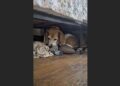
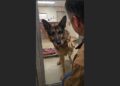
The first night Hazel had an entire house available to her, she chose the smallest place she could find.
Rachel had prepared everything carefully.
A thick dog bed sat in the living room.
Fresh water waited nearby.
The hallway had been cleared so an older German Shepherd with weak hind legs would not have to navigate around boxes or furniture.
There were rugs over slippery sections of floor.
A blanket had been folded beside the bed.
The lights were low.
Nothing in the house was asking much of her.
Hazel walked past all of it.
She moved slowly through the hallway, paused near the laundry room, and found a narrow gap between the washing machine and the wall.
Then she backed herself into it.
Rachel stood several feet away.
For a moment, she considered coaxing Hazel toward the bed.
Instead, she sat down on the floor.
“You can sleep there tonight,” she said.
Hazel lowered herself carefully.
And that was where she spent her first night outside confinement.
Hazel Had Been Found Behind an Abandoned Motel
The roadside motel in southern Missouri had been empty long enough for weeds to push through cracks in the parking lot.
A maintenance worker had been sent to clear the property before it was listed for sale.
Most of what he expected to find was ordinary neglect.
Broken furniture.
Old signage.
Trash.
Water damage.
Then he reached a locked storage shed behind the main building.
When he pulled the door open, he heard something scrape across the floor.
At first, he thought an animal had become trapped inside recently.
Then his eyes adjusted.
There was a makeshift pen in the back of the shed.
Shipping pallets had been fastened together to form walls.
Inside was a German Shepherd.
Older.
Thin.
Trying to get up.
The Pen Barely Allowed Her to Turn Around
Nobody could say exactly how long Hazel had lived there.
There were no reliable records.
No owner waiting nearby.
No note explaining how she had come to be inside a storage shed behind an abandoned motel.
The physical space told its own limited story.
Empty feed bags were stacked to one side.
A plastic bucket held the last of her water.
The enclosure was so small that moving required care.
Hazel’s nails were badly overgrown.
Her hindquarters looked weak.
She did not rush the opening when the worker approached.
She stayed inside.
Watching him.
He Did Not Reach for Her
That may have been the best thing he could have done.
The worker crouched outside the pallet enclosure.
Hazel stared.
He waited.
Eventually, he opened the makeshift gate and stepped backward.
Hazel did not move.
He waited longer.
Still nothing.
So he placed a bowl of water just beyond the opening.
Hazel stretched her neck toward it.
Her nose reached forward.
Her body did not.
All four paws remained inside the pen.
The worker looked at her.
Then at the bowl.
He moved it closer.
Hazel drank.
That was how the first interaction began.
Not with a dramatic rescue from the enclosure.
With a water bowl moved several inches toward a dog who was not ready to step out.
Getting Hazel Out Took Time
The worker called for help.
People arrived.
They did not drag Hazel from the pen.
They gave her space.
A slip lead was introduced carefully.
A blanket was used to support her body when necessary.
When Hazel finally crossed the edge of the pallet enclosure, she did so slowly.
Her legs shook.
The open space of the shed seemed almost as difficult as the physical weakness.
She stopped repeatedly.
Nobody knew whether that hesitation came from pain, fear, unfamiliarity with open areas, or all three.
They did not need to decide immediately.
The first goal was simpler.
Get her somewhere safe.
At the Veterinary Clinic, Standing Was Hard
Hazel was underweight.
Her nails had grown long enough to affect the way her feet contacted the floor.
Her coat was dull.
Her rear legs lacked strength.
There were no dramatic wounds.
No single injury that explained everything.
Instead, she showed the accumulated effects of inadequate care, limited movement, and age.
The staff helped her stand.
They placed thick bedding beneath her.
They moved slowly.
When too many people entered the room at once, Hazel pressed herself toward the corner.
When the room became quiet, she ate.
That pattern taught the staff something important.
She was capable of engaging.
She simply did better when the environment asked less of her.
Nobody Called Her “Broken”
Rachel would later say that word bothered her.
Hazel was frightened.
Deconditioned.
Underweight.
Uncertain.
She had learned habits that made sense in the environment where she had been living.
None of that made her broken.
A dog who spends a long time in a restricted space may not immediately understand what to do with freedom.
A room can feel too large.
A yard can feel exposed.
A soft bed in the middle of a living room can be less appealing than a narrow corner with walls on two sides.
What looks sad to a human may feel safer to the dog.
So the people caring for Hazel tried to resist the urge to make her behave like a “normal” dog immediately.
Rachel Took Her Home Several Days Later
Rachel had fostered older dogs before.
She lived in a small bungalow outside town.
There were no stairs inside.
The yard was fenced.
The rooms were quiet.
She prepared the living room before Hazel arrived.
Dog bed.
Water.
Non-slip rugs.
Clear pathways.
A place near the wall where Hazel could rest if the center of the room felt too exposed.
Rachel thought she had anticipated most things.
Then Hazel walked past the bed and chose the washing machine.
That taught Rachel more than all the preparation had.
Hazel needed control over distance.
So Rachel gave it to her.
The Cramped Spaces Continued
The next morning, Rachel found Hazel beneath the kitchen table.
Later, behind an armchair.
Another afternoon, beside the laundry basket where the wall narrowed.
She kept choosing places that partially enclosed her body.
Rachel left the proper dog bed in the living room.
She did not move it into Hazel’s preferred hiding place.
She also did not repeatedly carry Hazel onto it.
The bed remained available.
Hazel remained free not to use it.
That distinction mattered.
The First Trip Into the Backyard Lasted Less Than a Minute
Rachel opened the back door.
Hazel stood behind her.
The patio was only a few feet away.
Beyond it was grass.
A fence.
Flowerpots.
A tree.
Open sky.
Rachel stepped outside.
Hazel followed.
One paw.
Then another.
She reached the edge of the patio.
Lowered her nose toward the grass.
Stopped.
Then turned around and hurried back inside as quickly as her stiff body allowed.
Rachel did not bring her back out.
That was enough for one morning.
The Next Day, Rachel Changed the Plan
Instead of making the yard an activity, she made it background.
She brewed coffee.
Opened the door.
Sat on the bottom step.
Hazel stood inside the doorway.
Rachel did not call her.
She drank.
Birds moved in the hedge.
A truck passed somewhere down the road.
Hazel watched.
Rachel finished half the cup.
Then she felt something touch her elbow.
A nose.
Hazel had stepped outside.
Rachel Did Not Celebrate
Not visibly.
She wanted to.
Instead, she kept her body relaxed.
Hazel sniffed the edge of the step.
Then Rachel’s sleeve.
Then the air.
After less than two minutes, she went back inside.
Rachel finished her coffee.
The next morning, they did it again.
This became their routine.
Open door.
Coffee.
Step.
Wait.
The Mornings Slowly Became Longer
At first, Hazel stayed near the doorway.
Then she stood on the patio.
A few days later, one paw touched the grass.
She pulled it back.
Another morning, both front paws went down.
Rachel stayed on the step.
Hazel sniffed.
That was enough.
Nobody measured progress by distance alone.
The more important change was that Hazel began returning to the yard voluntarily.
One Morning, She Walked to the Fence
Rachel noticed almost too late.
She had been looking into her coffee cup.
When she looked up, Hazel was farther away than she had ever been.
Halfway across the yard.
Then farther.
All the way to the fence.
Hazel’s nose moved along the grass.
She found a fallen leaf.
Investigated it thoroughly.
Moved toward a flowerpot.
Checked beneath it.
Then followed a scent trail along the base of the fence.
Rachel stayed seated.
She did not follow with a camera.
She did not call anyone.
She simply watched.
Hazel Came Back on Her Own
After several minutes, she turned.
Walked toward the patio.
Rachel expected her to continue into the house.
Instead, Hazel stopped beside the step.
Circled once.
Then lowered herself onto the ground.
She stretched out.
Completely.
Front legs forward.
Back legs extended.
Body no longer curled tightly against a wall.
Rachel had never seen her take up that much space.
She turned her head away because she was suddenly crying.
Hazel slept in the sun.
That Was the First Time Rachel Understood the Goal Differently
The goal was not to teach Hazel to stop liking corners.
The goal was to give her enough choices that she no longer needed corners all the time.
That was very different.
Safety could include small spaces.
It could also gradually include open ones.
There was no reason to take one away before the other became comfortable.
Her Physical Strength Improved Too
The veterinarian had expected some weakness after so much restricted movement.
Hazel began with very short walks.
Sometimes only several minutes.
Her nails were trimmed gradually rather than all at once.
Her weight improved.
Muscle returned slowly to her hind legs.
Rugs stayed on the floor because slick surfaces remained difficult.
Rachel learned to watch Hazel’s body rather than the clock.
If she seemed tired, they turned back.
There was no prize for making an older dog walk farther than she wanted.
Hazel Began Eating With Rachel Nearby
At first, she preferred an empty room.
Rachel respected that.
Then one morning, Hazel started eating before Rachel had completely left the kitchen.
Rachel froze.
Not wanting to make a big event of it, she continued walking.
Several days later, she remained farther across the room.
Hazel ate.
Eventually, meals became ordinary.
That was the point.
Ordinary was progress.
She Began Sleeping in Less Protected Places
The gap beside the washing machine remained available.
Hazel still used it occasionally.
But she also started sleeping under the table with more of her body exposed.
Then beside the armchair instead of behind it.
One afternoon, Rachel found her lying in the hallway.
Completely in the way.
Rachel smiled.
A dog willing to become a minor household inconvenience was a dog whose world was getting bigger.
The Living Room Bed Remained Untouched
Weeks passed.
Hazel sniffed it once.
Then walked away.
Rachel refused to take it personally.
“I bought it for you, but apparently I have terrible taste,” she told her.
Hazel continued toward the laundry room.
The bed stayed.
Adoption Was Not Rushed
Rachel could have kept Hazel permanently.
Part of her wanted to.
But fostering existed because one home could help more than one dog over time.
And Hazel was becoming stable enough that a carefully chosen permanent home might work.
The rescue began reviewing applications.
Not simply anyone who thought Hazel’s story was sad.
She needed someone patient.
A quiet household.
A home where mobility would be manageable.
Someone willing to allow her preferences instead of treating every fear as a challenge to overcome.
Then Elaine applied.
Elaine Was a Retired School Cafeteria Cook
She had spent decades feeding children.
She was practical.
Direct.
Warm without being overwhelming.
She wanted an older dog because, as she explained, “I am not interested in being outsmarted by a puppy at this stage of my life.”
Rachel liked her immediately.
Elaine lived in a small house.
Fenced garden.
Covered porch.
Very few stairs.
No other animals.
She understood that Hazel might never become a social butterfly.
She still wanted to meet her.
Their First Meeting Happened on the Patio
Rachel deliberately chose the place where Hazel had become comfortable.
Elaine sat beside her.
They talked.
Not about Hazel constantly.
Weather.
Gardening.
Food.
Old school stories.
Hazel wandered around the yard.
She sniffed the fence.
Checked the usual flowerpot.
Passed near them.
Moved away.
Elaine never reached.
Eventually, Hazel came back.
She stopped beside Elaine.
Then leaned one shoulder lightly against the woman’s shoe.
Elaine looked at Rachel.
Rachel smiled.
“Just stay still.”
So she did.
Hazel Stayed There Long Enough for Elaine’s Foot to Go Numb
Ten minutes.
Then fifteen.
Elaine shifted carefully once.
Hazel remained.
Finally, Elaine whispered:
“I can’t feel my toes.”
Rachel laughed.
“You can move.”
“I don’t want to ruin it.”
“You won’t.”
Elaine waited another minute anyway.
Then she looked down at Hazel.
“When can I take her home?”
Rachel Made Her Think About That Too
The rescue wanted the placement to last.
Hazel was older.
Her mobility might decline.
Veterinary expenses would likely increase over time.
She might always prefer certain hiding places.
She might never enjoy crowds.
She could regress temporarily after another move.
Elaine listened.
Then asked better questions.
What flooring was easiest?
What type of bed did Hazel ignore?
What kind of bed might she actually use?
How far did she walk comfortably?
Did she prefer morning or evening?
Rachel knew then that Elaine was not trying to rescue an idea.
She was preparing for Hazel.
Moving Day Came Quietly
There were no balloons.
No crowd.
Hazel wore a secure harness.
Her familiar blanket went with her.
So did the dog bed she had never used.
Rachel insisted.
“You paid for it,” Elaine said.
“I am determined to prove it wasn’t a complete waste of money.”
Hazel climbed into the vehicle with help.
Rachel watched them drive away.
Then cried after they turned the corner.
Fostering was complicated that way.
Success often left a room emptier.
Elaine Prepared Her House Differently
She knew better than to assume Hazel wanted to sleep in the middle of the living room immediately.
So she created options.
A covered corner.
A bed near the wall.
An open bed in the living room.
A folded blanket beneath a side table.
Hazel chose the space beneath the table.
Elaine let her.
The next night, Hazel slept near the porch door.
Then under the kitchen table.
The open dog bed remained unused.
Elaine laughed when she sent Rachel the update.
“Your expensive bed is still decorative.”
Morning Became Their Shared Ritual
Elaine opened the back door.
Then waited.
No pulling Hazel outside.
No schedule demanding a full walk.
Some mornings, Hazel walked into the garden.
Others, she stood on the porch.
Sometimes she decided the weather was unacceptable and went back inside.
Elaine respected the decision.
On better days, they walked to the end of the street.
On especially good mornings, a little farther.
The pace belonged to Hazel’s body.
Her Legs Stayed Stiff
Age did not disappear because life improved.
Some mornings, Hazel took time getting up.
Elaine learned to wait.
She used rugs.
Kept Hazel lean.
Followed veterinary advice.
Shortened walks when necessary.
Strength and confidence improved.
But Hazel remained an older German Shepherd.
A loving home did not make her young again.
That was never the goal.
Hazel Discovered the Covered Porch
It became one of her favorite places.
Shade in the afternoon.
A view of the garden.
A protected wall behind her.
Enough openness to watch the world without feeling surrounded by it.
Elaine put a mat there.
Hazel used that one immediately.
Rachel received a photograph.
Hazel was asleep on the porch with her front legs stretched out.
Rachel texted back:
Apparently she only hates beds I buy.
Elaine replied:
Correct.
Months Passed
Hazel’s world became predictable.
Elaine in the kitchen.
Morning door.
Garden.
Breakfast.
Rest.
Walk if the weather and her legs agreed.
Afternoon sun.
Dinner.
Television.
Sleep.
No one forced her into the center of anything.
So, slowly, she began choosing the center herself.
Then One Evening, Elaine Saw Her on the Living Room Bed
She almost spoke.
Then stopped.
Hazel had climbed onto the same wide, soft bed that had followed her from Rachel’s house.
She circled once.
Then twice.
Lowered herself.
At first, she curled tightly.
Elaine remained in her chair.
The television played quietly.
After several minutes, Hazel’s body loosened.
One front leg extended.
Then the other.
Her back legs stretched out.
Eventually, she lay completely on her side.
Taking up almost the entire bed.
Elaine turned the television volume down.
She Stayed in Her Chair Longer Than Usual
Not because Hazel needed supervision.
Because Elaine did not want to disturb her.
The dog was sleeping deeply.
Out in the open.
No wall pressed against her spine.
No furniture covering her.
No narrow gap holding her body in place.
The living room stretched around her.
Hazel slept anyway.
Elaine watched for a while.
Then quietly took a photograph.
She sent it to Rachel.
No caption.
None was necessary.
Rachel Cried When She Saw It
Not because Hazel had finally “learned how to be a dog.”
Hazel had always been a dog.
Not because she had conquered fear completely.
She had not.
Hazel still sometimes slept beneath the table.
Unexpected visitors could make her seek a quieter room.
Storms were difficult.
Her body was stiff.
Some days she wanted less.
What moved Rachel was the choice.
Hazel had many places available.
That evening, she chose the open bed.
Choice Had Been the Thread Through Everything
The water bowl near the pallet opening.
The decision not to drag her from the pen.
The washing machine gap.
The backyard doorway.
The patio.
The fence.
The flowerpot.
Rachel’s step.
Elaine’s shoe.
The living room bed.
At every stage, someone had allowed Hazel to move when she was ready.
Not because dogs should never be encouraged through uncertainty.
But because Hazel’s particular history suggested that control over space mattered deeply to her.
Giving her that control helped make larger spaces usable.
People Sometimes Asked Why Hazel Preferred Cramped Places
There was no way to know with certainty.
Maybe enclosed spaces felt protected.
Maybe years of limited movement had made them familiar.
Maybe physical weakness made wide rooms feel harder to navigate.
Maybe all of those explanations played a role.
The important thing was not to force one dramatic interpretation.
Hazel showed a preference.
The people caring for her responded.
As her environment became more predictable, the preference softened.
That was enough.
She Was Never Made to “Face Her Fear”
Rachel disliked that phrase too.
Recovery was not a contest between Hazel and open space.
Nobody needed to win.
Instead, she was exposed gradually to choices she could retreat from.
A doorway.
A step.
A patio.
Grass.
A yard.
A quiet visitor.
A new home.
When Hazel said no with her body, the answer was respected when possible.
That made later yeses meaningful.
Today, Hazel Still Chooses
Every morning, Elaine opens the back door.
Hazel gets up at her own speed.
Some days she walks into the garden.
Some days she finds the sunny patch beside the steps.
Some mornings, especially when her hips are stiff, she looks outside and decides against it.
Then she turns around.
Walks back into the living room.
And climbs onto her bed.
The wide one.
The soft one.
The one she once ignored completely.
Elaine Never Moves Her When She Stretches Across It
Even when Hazel occupies every inch.
Especially then.
Sometimes the dog sleeps with her back toward the room.
Sometimes on her side.
Occasionally flat enough that Elaine checks her breathing from across the room before reminding herself not to be dramatic.
Hazel sleeps deeply.
That is the privilege she has earned through nothing more than survival and time.
The Space Between the Washing Machine and the Wall Is Far Behind Her
But Rachel still remembers it.
The first night.
A whole house.
A beautiful bed.
And Hazel backing herself into the smallest possible gap.
At the time, it looked heartbreaking.
Now Rachel understands it differently.
Hazel was not rejecting comfort.
She was defining comfort according to everything she knew then.
Nobody argued with her.
Nobody dragged her into the middle of the room.
They simply kept offering more options.
Eventually, Hazel discovered that a wide room could be safe too.
The Story Was Never About Teaching Her to Take Up Space
Hazel already knew how to exist.
What she needed was enough safety to stop making herself smaller.
That did not happen in a single breakthrough.
It happened through ordinary mornings.
Coffee on a step.
A nose against an elbow.
Grass beneath paws.
A fallen leaf.
A patient woman willing to let her foot go numb.
A back door opened without pressure.
A bed left in the same place for months.
Then, one evening, Hazel stretched out across it.
Not cautiously.
Not halfway.
All the way.
Elaine Still Thinks About That Evening
She remembers the soft sound of the television.
The lamp beside her chair.
Hazel breathing.
One paw hanging slightly over the edge of the bed.
Elaine could have gotten up.
Could have washed the dishes.
Could have moved around the room normally.
Instead, she stayed seated.
Just a little longer.
Because an old German Shepherd who had once lived inside a pallet pen was sleeping in the middle of a living room with nothing surrounding her but open space.
And for the first time, Hazel seemed to know she did not have to make herself fit inside anything smaller.
Editor’s Note: The characters in this story are fictional. Through these stories, we hope to share the intelligence, loyalty, compassion, and loving nature of dogs with people everywhere.