I First Knew Them as the Pair Across the Street
My name is Élodie.
I was thirty-two when I moved into a quiet neighborhood and began noticing the elderly man who lived directly across from me.
His name was Mr. Laurent.
Most mornings, he sat on his porch with an aging golden Labrador named Max.
They had an easy routine.
Mr. Laurent drank something warm while Max rested near his chair. Sometimes the old man stroked the dog’s head without looking down.
Other mornings, Max leaned against his leg while they watched the street together.
At first, they were simply part of the view from my front window.
Then we began exchanging greetings.
A wave.
A comment about the weather.
A few words while collecting mail.
I learned very little about Mr. Laurent’s private life.
But I quickly understood one thing.
Max was rarely far from him.
Max Was an Old Dog Living an Old Man’s Life
The Labrador moved at the pace of a senior.
He no longer bounced off the porch when someone walked past.
He rose carefully.
Sometimes his back legs needed an extra second beneath him.
His muzzle had faded almost completely to gray.
Mr. Laurent adjusted naturally.
He waited when Max was slow.
Their walks around the block were short.
On colder mornings, they sometimes skipped them altogether and remained on the porch.
Nothing about their relationship looked dramatic.
That was what made it memorable.
They had the kind of companionship built from thousands of ordinary days.
Breakfast.
Porch.
Walk.
Rest.
Evening.
Repeat.
I Began Noticing That Mr. Laurent Looked Tired
Not sleepy.
Worn down.
Some mornings, he seemed thinner than he had when I first moved in.
The porch visits became shorter.
Mail accumulated for a day or two before disappearing.
Once, I helped him carry a grocery bag because his hands were shaking.
He thanked me and changed the subject.
I did not press.
People deserve dignity, including the dignity of deciding what they want neighbors to know.
Still, I worried.
Max seemed to notice changes too, though not in the human sense of understanding finances or illness.
He simply stayed close to the person around whom his entire routine had been built.
Then Mr. Laurent Knocked on My Door
It was an autumn evening.
I opened the door and immediately knew something was wrong.
Mr. Laurent stood on the step with Max beside him.
His hands trembled.
His eyes were wet.
He took several seconds before speaking.
Then the story came out in pieces.
His financial situation had deteriorated.
Rent had fallen behind.
Other debts had accumulated.
He had reached the point where he could no longer maintain his current housing arrangements.
A move had been arranged for the following morning to a residential care setting.
Whether the placement would be temporary or longer term was still uncertain.
But the facility could not accommodate Max.
That was the part that broke his composure.
He Was Less Afraid of Losing the House Than Losing the Dog
“I can manage somewhere else,” he told me.
Then he looked down.
Max stood against his leg.
“But I don’t know what happens to him.”
There was no family member nearby who could take the Labrador.
No friend able to assume responsibility for an elderly dog.
Mr. Laurent had apparently tried.
The available care facility had pet restrictions, and there was no immediate option that allowed Max to go with him.
Housing and care rules vary widely, and a pet restriction in one setting does not mean every residential program makes the same decision.
For Mr. Laurent, however, the immediate reality was simple.
He was leaving in the morning.
Max could not go.
He Asked Me to Take Max to a Shelter
The request came quietly.
Not because he wanted to surrender him.
Because he was trying to make sure the dog would not be left outside or passed casually from stranger to stranger.
“Can you take him somewhere safe?” he asked.
“A shelter. Somewhere that can find him a home.”
I looked at Max.
He had no idea what we were discussing.
He knew voices.
Tone.
The familiar man beside him.
He did not understand eviction, residential care, unpaid rent, or surrender.
I promised Mr. Laurent that Max would be safe.
At that moment, I believed that meant taking him to a reputable shelter.
I did not know I was about to spend the next several days questioning that promise.
The Transport Vehicle Arrived the Next Morning
Mr. Laurent was ready.
Or at least as ready as anyone can be for a move they do not really want.
A few bags sat near the front door.
Max moved around them slowly.
When the transport arrived, Mr. Laurent knelt as far as his body comfortably allowed.
He put both hands along Max’s face.
Spoke quietly.
Then stayed there longer than anyone waiting seemed willing to interrupt.
Eventually, someone helped Mr. Laurent toward the vehicle.
Max followed several steps.
I held his leash.
The old dog watched the door close.
Then the vehicle pulled away.
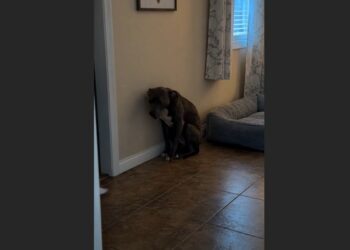
Max stood facing the street.
He remained that way after it disappeared.
I Brought Max Across the Road
My plan was temporary.
One night with me.
Perhaps two.
Then I would contact the shelter and arrange intake properly.
I put out water.
Food.
A thick blanket.
I made a quiet place for him inside.
Max investigated almost none of it.
He returned to my front door.
Then he lay down.
His muzzle rested between his paws.
His eyes stayed oriented toward the street.
Whenever a vehicle slowed nearby, his ears moved.
Sometimes he raised his head.
Then the vehicle passed, and he settled again.
It was impossible not to attach a human story to it.
He’s waiting for Mr. Laurent.
Perhaps he was.
More precisely, he was repeatedly orienting toward the direction in which a deeply familiar person had disappeared.
The First Night, Max Ate Very Little
That concerned me.
Senior dogs can lose appetite because of stress, but appetite changes can also have medical causes.
Pain.
Dental disease.
Gastrointestinal illness.
Kidney problems.
Medication effects.
Many possibilities.
I watched him carefully.
He drank.
He ate small amounts.
He was responsive.
His behavior had changed sharply after Mr. Laurent’s departure, but I knew better than to call it heartbreak and ignore his physical condition.
I kept his environment quiet and made sure food and water remained available.
Mostly, Max slept near the entrance.
Not on the bed I had prepared.
Not beside the couch.
At the door.
The Next Morning, He Returned to the Same Position
The routine repeated.
A car approached.
Max lifted his head.
Footsteps outside.
He listened.
Then silence.
He eventually ate a little.
I took him for a slow walk.
He moved willingly but turned his head toward the street several times.
When we returned, he went directly back to the door.
I had promised to take him to a shelter.
Yet every time I looked at the leash, I hesitated.
Not because shelters are inherently cruel.
A good shelter could provide safety, medical attention, and adoption support.
But Max had just lost nearly every familiar part of his life at once.
His home.
His porch.
His routine.
Most importantly, Mr. Laurent.
I kept wondering whether another abrupt transition was truly the only available answer.
Max Did Not Understand What Had Happened
That became important for me to remember.
He did not know Mr. Laurent had financial problems.
He did not know his owner had moved into care.
He could not understand that humans had created a plan for his future.
All he had were patterns.
Mr. Laurent was usually present.
Now he was absent.
The last place Max had seen him was the road outside my house.
So Max watched it.
That did not mean he was making a conscious decision to “wait forever.”
It meant a long-established routine had broken, and the old dog was still orienting toward familiar cues.
The distinction did not make the scene easier to watch.
On the Third Day, I Began Thinking About the Housing Problem Instead
Until then, I had treated Mr. Laurent’s departure as fixed.
He had moved.
Max needed another home.
End of problem.
But was it actually fixed?
I started asking myself what had caused the move in the first place.
The source of the crisis was financial.
Unpaid housing costs.
Debt.
An inability to keep the current arrangement going.
If those obstacles could be addressed, was returning home possible?
Not automatically.
Residential care placements can involve medical, functional, legal, and safety considerations far beyond rent.
A person should not simply be removed from a care facility because someone pays a bill.
Any return would require appropriate coordination and confirmation that living at home remained safe and permitted.
Still, I realized I had been assuming there was no alternative without checking.
I Had Savings
For years, I had been putting money aside.
It was meant for something personal.
A purchase I had wanted for a long time.
Not essential.
But significant enough that I had saved carefully.
That evening, I sat at the kitchen table with the numbers in front of me.
Across the room, Max was again near the door.
I looked at the balance.
Then at him.
I did not suddenly decide money could solve every part of Mr. Laurent’s situation.
It could not.
But perhaps it could remove one major barrier.
I began making calls.
Paying the Arrears Was More Complicated Than Handing Someone Cash
There was a landlord.
There were outstanding housing costs.
There were other bills.
There was also the question of whether Mr. Laurent’s tenancy could actually continue.
I needed his permission to discuss details.
The landlord needed to be willing to resolve the arrears rather than proceed with ending the tenancy.
And Mr. Laurent’s care team needed to determine whether returning home was appropriate.
Those conversations took time.
The solution was not simply:
Debt paid. Old man goes home.
Real life rarely works that neatly.
But the more people talked, the more possible the situation became.
I Used the Money I Had Been Saving
It was enough to address the immediate financial crisis.
Not to make Mr. Laurent wealthy.
Not to guarantee that he would never struggle again.
But enough to help clear the arrears that had pushed his housing situation to the edge.
Other arrangements had to be made for ongoing support.
His ability to manage safely at home had to be reviewed.
The landlord agreed to continue the tenancy once the outstanding issues were resolved.
The care team worked through what support Mr. Laurent would need after discharge.
For the first time since he left, the possibility of coming home became real.
I did not tell him over the phone.
I went to see him.
He Looked Smaller in the Care Facility
Mr. Laurent was sitting beside a window when I arrived.
Without Max, I barely recognized the scene.
For as long as I had known him, the dog had been within a few feet.
Now there was only a chair.
A small table.
A bag of belongings.
We talked for several minutes before I explained what I had done.
The housing arrears had been addressed.
The landlord was willing to continue the arrangement.
The necessary people were discussing how to make a safe return possible.
Mr. Laurent stared at me.
He seemed unable to process the information immediately.
Then he began crying.
I Did Not Tell Him Everything Was Solved Forever
That would not have been honest.
He still needed support.
The financial problems that had developed over time required more than one payment.
His health needed consideration.
There would be follow-up.
Services.
Practical assistance.
But the immediate loss of his home no longer appeared inevitable.
He kept trying to thank me.
I finally interrupted.
“There’s something else you should know.”
He looked at me.
“Max is safe.”
His face changed.
Then I said the sentence I had been waiting to say.
“Max is waiting for you.”
Bringing Mr. Laurent Home Took Coordination
It did not happen five minutes later.
His care team needed to approve the transition.
Transportation had to be arranged.
Home support had to be considered.
There were practical questions about medications, appointments, meals, and how he would manage day to day.
That part mattered.
Returning someone to a house without adequate support would not have been kindness.
Eventually, however, the arrangements were completed.
Mr. Laurent was coming home.
I knew the date.
Max did not.
That Morning, Max Was Near the Door Again
By then, he had become a little more comfortable in my house.
He ate better.
He sometimes rested farther from the entrance.
But the road still captured his attention.
When a vehicle stopped across the street, Max raised his head.
People began moving around Mr. Laurent’s house.
I attached the leash.
We went outside.
At first, Max walked slowly.
Then he heard a voice.
His entire posture changed.
Mr. Laurent had come through the gate.
“Max.”
The Labrador stopped.
His head rose.
Then his tail began moving.
Max Went Toward Him as Fast as His Old Body Allowed
The original story says he rushed forward.
In reality, “rushed” is relative when a dog is elderly.
His legs were stiff.
His body was not designed for sprinting anymore.
But he moved with more urgency than I had seen all week.
Mr. Laurent bent toward him.
Max pressed against his legs.
His tail kept moving.
He sniffed his hands.
His coat.
His trousers.
Then returned to his hands again.
That was enough for me.
I did not need to say Max understood where Mr. Laurent had been.
He recognized him.
Familiar scent.
Familiar voice.
Familiar movement.
After days of absence, those familiar signals were suddenly present again.
Mr. Laurent Sat Down With Him on the Porch
Exactly where I had first noticed them months earlier.
Max stood beside his chair.
Then lowered himself carefully onto the porch.
Mr. Laurent rested one hand on his head.
Neither did much else.
The reunion looked less dramatic after the first minute.
That made it better.
The point was not the excitement.
The point was that their routine could begin again.
Not perfectly.
Not exactly as before.
Mr. Laurent had more support now.
His circumstances had changed.
But Max was beside him.
For the old Labrador, the porch once again contained the person around whom so much of his life had been organized.
I Did Not Regret the Money
People who heard the story later focused heavily on that part.
The savings.
The purchase I gave up.
The sacrifice.
I never liked that framing very much.
I made a choice.
I had resources that could address a specific problem.
I used them.
That did not make me extraordinary.
And it would be dangerous to suggest that individual generosity can solve every housing or elder-care crisis.
Many people face problems far larger than one neighbor’s savings account can fix.
Mr. Laurent’s situation happened to contain a solvable financial component, a cooperative landlord, and a path back home that his care team considered appropriate.
Those conditions mattered.
Max’s Story Was Not About a Dog “Saving” His Owner
He did not.
And I did not save Mr. Laurent either.
Professionals helped.
Housing arrangements changed.
Support was organized.
Multiple people made the return possible.
Max’s behavior did something different.
It made me question the assumption that surrender was the only remaining path.
Watching him orient toward the road every day forced me to look more carefully at the human problem behind the dog’s situation.
That was his role.
Not hero.
Not miracle worker.
A dog whose disrupted routine made the consequences of one housing crisis impossible for me to ignore.
Mr. Laurent Needed More Than Max
That is another part people sometimes miss.
A dog can provide companionship.
Routine.
Motivation to get up.
A familiar presence.
But Max was not a caregiver.
He could not manage medication.
Arrange transportation.
Monitor Mr. Laurent’s health.
Handle bills.
Prepare every meal.
Human systems still had to support the old man.
Returning Max to him made sense only because the broader situation could also be made safer.
Love between a person and a dog should never be used to pretend practical care is unnecessary.
The goal was not simply reunion.
It was sustainable reunion.
Max Needed Support Too
He was an aging Labrador.
That meant joint care.
Appropriate exercise.
Monitoring.
A comfortable place to sleep.
Regular veterinary attention.
Mr. Laurent’s attachment to him did not eliminate those responsibilities.
We talked about that.
Neighbors helped where appropriate.
I remained involved.
If Mr. Laurent needed assistance getting Max to an appointment, there were people he could call.
I did not want another crisis to depend on someone noticing from across the street.
The best version of compassion is the one that becomes a system before the next emergency.
Their Morning Routine Returned Gradually
The first week home, Mr. Laurent spent less time on the porch than before.
He tired easily.
Max did too.
So their mornings became shorter.
A cup.
A chair.
A dog beside it.
Sometimes ten minutes.
Sometimes twenty.
On warmer days, longer.
I could see them from my window again.
Mr. Laurent’s hand often rested on Max’s neck.
Max usually faced the street.
The sight looked almost identical to the one I remembered.
But I knew how close it had come to disappearing.
That changed the way I saw it.
Max Eventually Stopped Watching Every Vehicle
Not immediately.
Even after Mr. Laurent returned, the Labrador sometimes lifted his head when certain engines approached.
Perhaps the sound had become important during the days of separation.
Perhaps he had always done that and I had only started noticing.
Dogs develop associations quickly, especially around emotionally intense disruptions.
Over time, the behavior became less frequent.
His old routines reasserted themselves.
Sleep.
Food.
Porch.
Slow walks.
Mr. Laurent.
Predictability returned.
That was probably more valuable to him than any explanation humans could have given.
I Still Thought About the Shelter
There was nothing shameful about the promise I had initially made.
If Mr. Laurent truly could not care for Max and no safe alternative existed, a responsible shelter placement could have been far better than abandonment or neglect.
Sometimes surrender is the humane choice.
Sometimes keeping a dog at all costs is not.
What changed was not my opinion of shelters.
What changed was my understanding of the available options.
Before separating a deeply familiar human-animal pair, it can be worth asking whether practical support might preserve both safety and the relationship.
In this case, the answer happened to be yes.
I Never Bought the Thing I Had Been Saving For
At least not then.
Months passed.
My priorities shifted.
The missing money became less noticeable in everyday life.
Across the street, Max grew older.
His muzzle became whiter.
Mr. Laurent moved more slowly too.
Nothing I had done could stop time.
That was never the point.
The goal was to give them more ordinary days.
Days on the porch.
Days in the same house.
Days when Max did not have to learn an entirely new home because of a financial crisis his owner could not manage alone.
They received those days.
That was enough.
The Most Valuable Part Was Not the Reunion
It was what came after.
Bills still had to be managed.
Appointments still happened.
Some mornings were difficult.
Mr. Laurent needed help occasionally.
Max needed care too.
There was no magical restoration of the life they had before.
There was simply a more stable version of it.
That distinction matters.
A dramatic act can solve an immediate problem.
Long-term support keeps the same crisis from returning.
I learned to check in.
Other people did too.
Mr. Laurent, who had been isolated enough for his financial situation to deteriorate quietly, now had more people paying attention.
Not intrusively.
Just enough.
Max Never Knew What I Had Done
He did not know about my savings.
He did not know I had planned to buy something else.
He did not know about negotiations with the landlord or conversations with care staff.
That was fine.
Dogs do not need to understand sacrifice for it to benefit them.
What Max experienced was concrete.
Mr. Laurent disappeared.
For several days, life became unfamiliar.
Then the familiar man returned.
The porch returned.
The routine returned.
That was his version of the story.
And perhaps it was the better one.
Months Later, I Looked Across the Street One Morning
Mr. Laurent was sitting in his usual chair.
Max lay beside him.
The Labrador’s eyes were partly closed in the morning sun.
Every so often, Mr. Laurent’s fingers moved across the top of his head.
Neither seemed interested in doing anything else.
I stood at my window longer than necessary.
Months earlier, I had promised to help Max find another home.
Instead, circumstances allowed us to preserve the one he already knew.
That outcome had depended on far more than sentiment.
Money.
Housing cooperation.
Care planning.
Ongoing support.
Timing.
And luck.
But the reason I had looked for another path in the first place was lying on that porch.
Max Had Never Needed a Grand Gesture
He needed familiarity.
A safe place.
An old man he knew.
Mr. Laurent needed much the same.
Not rescuing.
Support.
Enough stability to remain connected to the parts of his life that still mattered.
That morning, they sat together exactly as they had when I first moved into the neighborhood.
Max beside the chair.
Mr. Laurent’s hand resting on his head.
Traffic passing.
Nothing dramatic happening at all.
I had once imagined that giving Max to a shelter would be the kindest thing available.
Sometimes it would have been.
This time, there was another option.
And every morning afterward, when I saw that aging Labrador resting beside Mr. Laurent instead of watching the road from my doorway, I was reminded that the best solution is not always finding someone a new home.
Sometimes it is making it possible for them to keep the one they already love.
Editor’s Note: The characters in this story are fictional. Through these stories, we hope to share the intelligence, loyalty, compassion, and loving nature of dogs with people everywhere.