For an Entire Day, He Waited Outside the Same Door
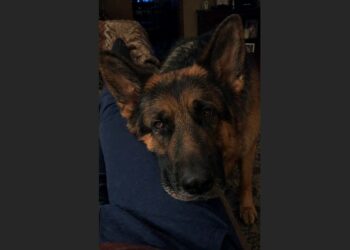
At first, everyone in the apartment building assumed someone would come back for the German Shepherd.
He sat in the hallway directly outside a recently vacated apartment.
The unit was empty.
The former tenant was gone.
But the dog remained.
He did not wander through the building looking for food.
He did not scratch continuously at neighbors’ doors.
Mostly, he stayed beside the apartment where he had once lived.
Occasionally, he cried.
The sound was not loud enough to be called barking.
It was a low, strained whine that carried down the hallway whenever the building became quiet.
By evening, people had started noticing.
By the following morning, the dog was still there.
Nobody had returned for him.
One Neighbor Had Been Hoping It Wasn’t His Problem
The man living several doors away had heard the whining during the night.
At first, he tried to explain it away.
Maybe the owner was loading a truck.
Maybe someone was coming back later.
Maybe a relative had been delayed.
There were dozens of reasonable explanations that did not involve him suddenly becoming responsible for a large German Shepherd.
So he waited.
The dog waited too.
Hours passed.
The apartment door never opened.
Eventually, the man stepped into the hallway and approached.
The Shepherd lifted his head.
Then looked back toward the closed door.
He Seemed More Interested in the Apartment Than the Neighbor
The dog wore a collar but had no useful identification attached.
He looked cared for enough that the neighbor assumed he had been living indoors until very recently.
There was no obvious injury.
No blood.
No sign of a fight.
Just a dog sitting in front of a place that no longer contained the person and routines he knew.
It was tempting to say he believed his owner would return.
There was no way to know exactly what the dog understood.
What could be observed was simpler.
The doorway was familiar.
The hallway was familiar.
The neighbor was not.
So the Shepherd stayed close to the place carrying the strongest connection to his previous life.
Finally, the Man Opened His Own Door
He brought out water first.
The dog drank a little.
Food was less successful.
The Shepherd sniffed it, then turned away.
The neighbor sat nearby.
He did not try to pull the dog immediately.
Eventually, after enough time had passed with no one returning, he decided the hallway was no longer a safe place to leave him.
He opened his apartment door.
The dog hesitated.
Then followed.
That was the first step.
It did not solve anything.
Inside, the Dog Went Straight to a Corner
The man had expected the Shepherd to explore.
He did not.
Instead, the dog found a quiet corner and curled tightly beside an old yellow pillow.
It was one of the few soft things the man had placed near him.
The dog rested his head against it.
Then stayed there.
When spoken to, he sometimes moved his eyes.
When the man crossed the room, the dog’s ears shifted.
But he rarely stood unless necessary.
He did not seek contact.
He showed little interest in toys.
Food remained untouched.
The neighbor quickly realized this was more than a simple case of giving a hungry dog dinner and waiting for him to relax.
The First Night Was Almost Completely Silent
The German Shepherd barely slept.
At least, not deeply.
He would lower his head.
Then lift it again at a noise in the hallway.
Footsteps made his ears rise.
An elevator opening caused him to look toward the door.
Each time, his attention sharpened briefly.
Then faded.
The man put water nearby and left the dog alone enough to avoid overwhelming him.
He did not know the dog’s name.
So he used a temporary one.
“Buddy.”
The Shepherd barely reacted.
By morning, the food still had not been eaten.
The Second Day Was Worse
The dog drank.
That was reassuring.
But he continued refusing meals.
The man tried a different food.
Then something softer.
The Shepherd sniffed and turned away.
He began worrying about dehydration, illness, and whether the dog might have a medical problem unrelated to whatever had happened in the apartment hallway.
He also wondered whether taking the dog inside had made things worse.
Maybe a shelter would be better equipped.
Maybe animal control should handle the situation.
Maybe he had gotten involved in something beyond his ability.
Then he looked at the Shepherd curled around the yellow pillow.
He decided the first thing he needed was medical advice.
Three Days Without Eating Was Not Something to “Wait Out”
By the third day, the man took the dog to a veterinarian.
That was the correct step.
Loss of appetite can occur with stress, but prolonged refusal to eat can also signal pain, gastrointestinal disease, infection, obstruction, dental problems, or many other medical conditions.
A dog’s emotional history should never be used to skip a physical examination.
The veterinarian examined him carefully.
There was no obvious serious physical illness explaining the refusal to eat.
The dog’s hydration and overall condition were assessed.
The conversation then turned toward stress.
The Veterinarian Couldn’t Diagnose “Heartbreak”
That is a human word.
Dogs do not understand moving away, betrayal, or abandonment in the abstract way people do.
But dogs can experience significant stress when familiar people, environments, and routines disappear suddenly.
Appetite can decrease.
Sleep can change.
Activity can drop.
Some dogs become restless.
Others become unusually still.
This Shepherd appeared withdrawn and highly unsettled by the abrupt change in his life.
The veterinarian gave the man instructions about monitoring food and water intake and warned him about signs that would require further care.
The message was simple.
Do not force the dog emotionally.
But do not ignore the body either.
The Man Went Home With a Different Plan
He stopped trying to make the Shepherd “cheer up.”
That had been his first instinct.
Call him.
Pet him.
Encourage him.
Offer toys.
Try to create a reaction.
Instead, he simplified everything.
The food bowl went in the same place.
The water stayed nearby.
Walks were short and quiet.
The yellow pillow remained in the corner because the dog seemed to prefer it.
The man reduced unnecessary visitors.
He spoke softly.
And then he did something that looked like nothing.
He stayed.
He Took Time Off Work
Not indefinitely.
Just enough to get through the most uncertain days.
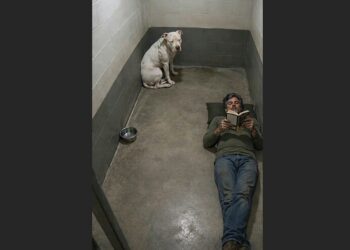
He sat in the room without insisting the dog come closer.
Sometimes he read.
Sometimes he watched television at low volume.
Sometimes he worked on his phone.
The Shepherd could move toward him or remain in the corner.
Most of the time, he chose the corner.
The man resisted the urge to interpret that as rejection.
A frightened or stressed dog does not owe gratitude to the person providing safety.
Trust cannot be demanded as repayment for rescue.
So the neighbor waited.
The First Change Happened in the Dog’s Eyes
It was small.
The man stood to refill the water bowl.
The Shepherd followed him with his gaze.
Before that, the dog had often seemed barely interested in what happened around him.
Now his eyes tracked the movement.
The man returned to his chair.
The dog kept watching.
Nothing else happened.
It would not have looked meaningful to anyone else.
To the person who had spent days watching the Shepherd retreat into stillness, it mattered.
The dog was paying attention again.
Then He Started Responding to a Name
The man had begun calling him Phoenix.
He did not choose the name because he believed one dramatic moment would transform the dog.
He simply needed something to call him.
At first, the name meant nothing.
Of course it did.
Dogs learn names through repetition and association.
But after several days, Phoenix began lifting his head when he heard it.
Not every time.
Sometimes his ears moved first.
Then his eyes.
Later, his head.
The man did not turn that response into a command.
He simply noticed.
Another small change.
The Yellow Pillow Became Part of the Routine
Phoenix slept beside it.
Or tried to.
He often rested with his head across one edge.
The man eventually placed a proper dog bed nearby.
Phoenix ignored it.
So the bed stayed.
The pillow stayed too.
A dog who has experienced a sudden environmental change may choose objects and locations for reasons humans cannot fully identify.
Texture.
Scent.
Position.
Enclosure.
Familiarity.
The man did not need to know why the pillow mattered.
If Phoenix felt comfortable beside it, that was enough.
Physical Contact Came Later
For days, the man avoided reaching toward Phoenix unless necessary.
If he needed to attach the leash, he moved slowly.
If the dog turned away, he gave him an extra moment.
One afternoon, the man sat on the floor nearby.
Phoenix watched.
Then shifted.
His nose moved toward the man’s hand.
The hand stayed still.
Phoenix sniffed.
He did not immediately ask for petting.
So the man did not give any.
The dog settled again.
A few minutes later, however, Phoenix moved closer.
Then lowered his head.
It rested against the man’s fingers.
The Man Barely Moved
He was afraid of ruining the moment.
So he let his hand remain where Phoenix had placed himself.
After a while, he moved his fingers gently beneath the dog’s jaw.
Phoenix did not retreat.
There was no dramatic tail wag.
No sudden transformation.
The Shepherd simply stayed.
That was enough.
The man continued sitting on the floor until Phoenix moved away on his own.
Later, he would remember that afternoon as the first time the dog had actively chosen contact.
Not the day Phoenix was “fixed.”
The day he made one small choice.
The Sixth Day Brought the Change Everyone Had Been Waiting For
Food.
The veterinarian had already emphasized how important it was to keep monitoring Phoenix closely.
The man had continued offering appropriate meals without repeatedly pushing the bowl toward him.
That afternoon, he sat nearby with a small bite of food in his hand.
Phoenix smelled it.
Turned away.
Then looked back.
The man waited.
Finally, Phoenix leaned forward.
He took it.
One bite.
Slowly.
The man did not cheer.
He did not immediately offer a handful.
He kept everything calm.
A minute later, Phoenix accepted another.
Eating Again Was a Medical Improvement, Not Proof of Love
It was easy for the man to interpret the moment emotionally.
Phoenix trusts me now.
Phoenix has decided to live.
Phoenix knows I’m staying.
Those ideas sounded beautiful.
They also went beyond what anyone could know.
What mattered was observable.
The dog was eating.
His interest in the environment was increasing.
He had begun voluntarily approaching.
He was resting more deeply.
Those changes suggested his stress was decreasing.
Trust, to the extent it could be seen behaviorally, was developing through repeated experiences.
The man remained predictable.
Food appeared.
Walks happened.
Nobody forced contact.
The apartment stayed quiet.
Day after day, Phoenix gathered evidence that this new environment was not immediately threatening.
He Began Sleeping Properly
The man noticed it one evening.
Phoenix was on his side.
Not curled tightly.
Not lifting his head at every hallway sound.
His legs were stretched away from his body.
His breathing had deepened.
The elevator doors opened outside.
Phoenix’s ear twitched.
His head did not rise.
That was one of the most reassuring changes yet.
Sleep requires a degree of vulnerability.
A dog who feels the need to monitor every sound does not rest the same way as one who can allow the environment to continue without constant supervision.
Phoenix was beginning to let himself sleep.
The Hallway Still Had Power Over Him
Especially in the beginning.
Whenever they left the apartment for a walk, Phoenix looked toward his former door.
Sometimes he stopped.
The man allowed him a moment.
He did not drag him past.
He also did not encourage Phoenix to remain there indefinitely.
They moved on when the dog was ready.
The old apartment had been part of Phoenix’s routine.
It smelled familiar.
It represented a location he had known far longer than this neighbor’s living room.
That connection would not disappear because someone had offered six days of kindness.
New familiarity takes time.
The Man Learned More About What Had Happened
Neighbors confirmed that Phoenix’s previous owner had moved.
The dog had been left behind.
Exactly why remained less clear.
People had theories.
The man refused to turn those theories into facts.
He knew enough.
A dog had been left outside an empty apartment.
Whatever circumstances produced that decision, Phoenix was now his responsibility unless a legal owner or animal authority determined otherwise.
He contacted the appropriate local services to report the situation and make sure the dog was not simply being kept without documentation.
That part was less emotional than sitting beside Phoenix.
It was also necessary.
Helping an abandoned animal includes handling ownership and veterinary details correctly.
Two Weeks Later, Phoenix Looked Different Without Actually Becoming Different
His coat was the same.
The ears were the same.
The large Shepherd body had not changed.
But his posture had.
He stood more often.
His head stayed higher.
He ate regular meals.
He began following the man through the apartment occasionally.
Not constantly.
Sometimes Phoenix remained on the floor when the man entered another room.
That was encouraging too.
Security does not require permanent attachment at the hip.
A dog who can remain resting when a person walks away may be learning something useful.
People can leave rooms.
And come back.
Evenings Became Their Best Time
The man sat on the couch.
Phoenix eventually chose the floor nearby.
At first, there was several feet between them.
Later, less.
One evening Phoenix rested his body against the man’s ankle.
Another night, he slept with his head near the man’s foot.
The contact was never demanded.
That was the rule.
Phoenix could choose distance.
He could choose proximity.
The man was beginning to understand that staying was not always about physically touching the dog.
Sometimes staying meant being in the room without asking Phoenix to perform gratitude.
Phoenix Was Not “Saved by Love Alone”
That version would have been too simple.
He benefited from veterinary assessment.
Monitoring.
Food.
Water.
Exercise suited to his state.
Quiet.
Predictability.
And time.
If his refusal to eat had continued, he would have needed further medical intervention.
If his withdrawal had worsened, professional behavioral support would have been appropriate.
Caregiving worked because the man did not assume kindness replaced expertise.
Affection mattered.
But affection was part of a larger structure of safety.
The Neighbor Eventually Decided Phoenix Wasn’t Temporary
By then, the dog had been living with him for more than two weeks.
What began as an emergency arrangement was becoming a household routine.
The man had not planned to get a dog.
He had not bought supplies in advance.
He had never walked into a shelter intending to adopt.
Phoenix had simply appeared outside a door across the hall.
Now there was dog food in the kitchen.
A leash by the entrance.
Veterinary paperwork on the counter.
A yellow pillow in the corner.
And a German Shepherd sleeping beside the couch.
The man stopped referring to him as “the neighbor’s dog.”
He was Phoenix.
There Were Still Difficult Moments
Recovery did not erase the previous weeks.
A suitcase rolling down the hallway once caused Phoenix to stand abruptly and stare at the front door.
When a moving cart passed, he became restless.
The man did not claim the dog understood those objects as symbols of being left behind.
They may simply have been associated with unusual activity in the hallway.
Still, he paid attention.
Phoenix was allowed to observe.
Then settle.
Over time, those reactions became smaller.
Ordinary life was becoming stronger than the event that had disrupted it.
Trust Looked Less Dramatic Than People Expected
It looked like eating while the man remained in the room.
Sleeping on his side.
Taking a treat without hesitation.
Walking past the old apartment door.
Choosing to lie near the couch.
Allowing the man to touch his chest without stiffening.
Following him into the kitchen once, then returning alone to the living room.
These were the behaviors that mattered.
Not a cinematic moment when Phoenix suddenly understood he would never be abandoned again.
Dogs cannot be given that kind of abstract guarantee.
They learn from what keeps happening.
The man kept coming home.
That repetition became the promise.
The Name Phoenix Eventually Felt Right
At first, it had been chosen because the man needed something better than “Buddy.”
Later, friends heard the name and immediately connected it to rebirth.
The man was careful with that metaphor.
Phoenix had not died inside.
He was not a shattered animal brought magically back to life.
He had been stressed.
Withdrawn.
Displaced.
He had stopped eating long enough to cause serious concern.
Then, with care and veterinary oversight, his behavior began changing.
The story did not need to make him less real in order to make him moving.
He was a dog adapting to a new home after an abrupt loss.
That was enough.
He No Longer Sleeps in the Corner Every Night
Sometimes he does.
The yellow pillow is still there.
The proper dog bed finally gets used too.
But most evenings Phoenix chooses a place closer to the couch.
He is eating normally now.
He goes outside willingly.
He notices other dogs.
He has started becoming interested in the ordinary smells of the neighborhood rather than moving through walks as though he wants to return immediately indoors.
The man has begun learning his preferences.
Phoenix dislikes motorcycles.
Loves pieces of carrot.
Does not understand why anyone would throw a perfectly good tennis ball away from themselves.
And snores more loudly than a dog that dignified should.
Those details are signs of something important.
Phoenix’s life is becoming more than the story of how he was left.
The Old Apartment Door Is Still Down the Hall
It has not disappeared.
Eventually, another tenant will probably live there.
The first time maintenance workers entered, Phoenix heard the sounds.
He walked to the man’s door.
Listened.
Then returned to the living room.
No crying.
No waiting outside.
Just a moment of attention.
Then back to the yellow pillow.
The man noticed.
He did not celebrate out loud.
He sat down.
A minute later, Phoenix walked over.
What Changed Phoenix Was Not One Grand Gesture
It was a sequence.
Someone heard him crying.
Someone finally opened a door.
Someone brought water.
Someone noticed he was not eating.
Someone took him to a veterinarian.
Someone stopped trying to force affection.
Someone sat nearby.
Then did it again.
And again.
For a dog whose recent experience had included a familiar person disappearing, consistency mattered more than speeches.
Phoenix did not understand promises.
He understood patterns.
The pattern in his new home became simple.
Morning came.
The man was there.
Evening came.
The man returned.
Food appeared.
Walks happened.
The apartment door closed, then opened again.
Now the Sound of the Key Means Something Different
At first, hallway noises brought Phoenix’s head up with visible tension.
Today, the sound that gets the strongest response is the key turning in his own front door.
The Shepherd usually stands.
Sometimes his tail begins moving before the door is fully open.
The man enters.
Phoenix approaches.
Not desperately.
Not crying.
Sometimes he carries on sleeping if the day has been particularly exhausting.
That may be the best sign of all.
He no longer needs to monitor every departure.
He no longer spends hours beside an empty door.
The Yellow Pillow Stayed
The man has considered throwing it away more than once.
It is old.
Flattened.
Not particularly attractive.
Phoenix has better beds now.
Still, the pillow remains near the corner where he spent his first days.
Sometimes Phoenix sleeps there.
More often, he lies beside the couch.
But the pillow is part of the apartment now.
Not as a monument to abandonment.
Just as an ordinary object from the beginning of their life together.
A place where a frightened German Shepherd once curled up while a stranger sat across the room and waited.
Phoenix Did Not Need Someone to Convince Him the Past Had Never Happened
It had.
A familiar home disappeared.
The person associated with it left.
The dog spent a night outside a closed door.
Then another person intervened.
Nothing about the second relationship erased the first.
Safety does not require forgetting.
It requires enough good experiences in the present that the animal no longer has to organize every moment around what went wrong before.
That is what seemed to happen with Phoenix.
Slowly.
Meal by meal.
Night by night.
These Days, He Usually Falls Asleep First
The man watches television or reads.
Phoenix settles nearby.
Sometimes his head rests across the man’s foot.
Sometimes there is no physical contact at all.
The front door remains closed.
The hallway outside becomes quiet.
The old apartment is only a few steps away.
Phoenix does not go there.
He stretches out.
Breathes deeply.
And sleeps.
The man who originally hoped someone else would deal with the dog looks down at him and remembers the first night.
A German Shepherd outside an empty door.
A soft cry in the hallway.
A yellow pillow.
A bowl of untouched food.
Two weeks later, almost everything about the room feels different.
Not because Phoenix was rescued by a perfect person.
Because one ordinary person heard him, opened the door, and then kept doing the one thing the dog needed enough time to believe.
He stayed.
Editor’s Note: The characters in this story are fictional. Through these stories, we hope to share the intelligence, loyalty, compassion, and loving nature of dogs with people everywhere.