The Crate Was Waiting Before Sunrise
The shelter employee arriving before dawn thought someone had left donations overnight.
That happened occasionally.
A bag of dog food might appear beside the entrance. Sometimes blankets. Sometimes a box of old toys with a handwritten note asking the shelter to use whatever it could.
On that chilly autumn morning, however, an old plastic travel crate sat beside the front doors.
A blanket had been draped carefully over the top.
The crate looked as though it had been used for years. Its corners were scratched, and sunlight had faded the plastic from its original color.
The employee almost walked past it.
Then she heard movement.
Not barking.
Not frantic scratching.
Just the faint sound of an animal shifting against fabric.
She stopped immediately.
Inside Was an Elderly Golden Retriever
The worker knelt beside the crate and lifted one edge of the blanket.
A pair of tired eyes looked back at her.
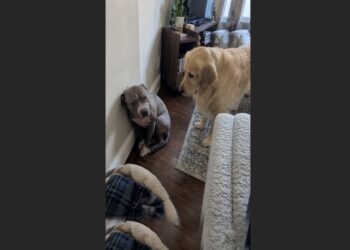
The dog was a Golden Retriever, clearly very old.
His muzzle had turned almost entirely white. His coat was still thick, but his body carried the unmistakable changes of senior age.
When he tried to adjust his position, he moved slowly.
His joints were stiff.
Around his neck was a worn blue collar.
Beside him lay a favorite chew toy, a secured water bowl, and several neatly folded blankets.
There was also a small bag containing prescription bottles with instructions written on the labels.
This was not a dog someone had dropped off with nothing.
Someone had prepared him carefully for the night.
A Note Was Attached to His Collar
It had been sealed inside a plastic sandwich bag to protect it from moisture.
Written across the front were five words:
“To whoever finds him.”
The employee removed it.
The first lines were simple.
“His name is Baxter.”
“He is fifteen years old.”
“Please don’t hate me for bringing him here.”
The employee later said that was the moment she had to stop reading for several seconds.
She had worked in animal welfare long enough to see abandonment in many forms.
This felt different.
She looked again at the blankets tucked around Baxter.
Then she continued.
Baxter Had Belonged to an 82-Year-Old Widower
His name was Harold Benson.
According to the letter, Baxter had spent the previous seven years almost constantly at Harold’s side.
They walked together.
Ate on the same schedule.
Napped in the same room.
Neighbors joked that finding one usually meant the other was close behind.
Baxter had joined Harold’s life after Harold’s wife died.
An old photograph taped to the back of the letter showed the two together.
Harold sat in a recliner.
Baxter slept heavily across his lap.
Someone had written on the back:
“The first night Grandma died, Baxter refused to leave him alone. He slept beside his chair every night for seven years.”
Then Harold Died Suddenly
Three weeks before Baxter appeared outside the shelter, Harold suffered a massive stroke.
He did not recover.
The letter had been written by Harold’s grandson.
He explained that the family had been trying to settle the estate while also figuring out what would happen to Baxter.
Harold’s daughter lived overseas.
The grandson initially intended to keep the dog.
Then his circumstances changed quickly.
He was in the military, and his deployment orders were moved forward.
His temporary housing prohibited pets.
He began calling everyone he could think of.
Relatives.
Friends.
Rescue organizations.
Private contacts.
People online.
Nothing worked.
“I Tried. I Swear I Tried.”
The final paragraph was the part several staff members later remembered word for word.
“I promised Grandpa I would take care of Baxter if anything ever happened.”
“I tried. I swear I tried.”
“I called twenty-three people.”
“I drove to three different rescues.”
“I begged strangers online.”
“I ran out of options before I ran out of love.”
By the time the first employee finished reading, two other staff members had arrived.
The shelter was beginning to open.
Someone brought Baxter inside.
No one treated the letter as proof that leaving an elderly dog outside was safe.
It was not.
Temperatures could have fallen further. Baxter had medications. At fifteen, any medical problem could have become serious quickly.
But the condition of the crate told its own quieter story.
Someone had tried to make an unsafe choice as gentle as possible.
Baxter Needed a Medical Exam First
Before anyone thought about adoption, the shelter arranged for him to be evaluated.
His age alone made that important.
The veterinary team confirmed that Baxter had significant arthritis.
His mobility was limited but functional.
He needed ongoing medication and close monitoring.
His teeth showed age-related wear.
His hearing appeared reduced.
His vision was not what it once had been.
But there was no indication that he was in an immediate end-of-life crisis.
He was simply very old.
That distinction mattered.
At fifteen, Baxter did not need anyone pretending he could become young again.
He needed comfort.
Pain management.
Soft bedding.
Short walks.
Easy access to food and water.
And a home prepared for the realities of senior care.
Baxter Spent His First Morning Watching the Entrance
Once he was settled into a quiet kennel, staff began noticing a pattern.
Baxter did not bark.
He did not pace constantly.
He accepted gentle contact.
He took treats politely.
But whenever the shelter’s front doors opened, his ears lifted.
If footsteps approached, his tail moved once or twice.
Then he settled again when the person passed.
It was easy to describe that behavior as Baxter waiting for Harold or for the grandson who had brought him.
Maybe familiar-entry sounds activated old expectations.
Maybe he was simply attentive to every newcomer in an unfamiliar place.
No one could know exactly what he thought.
Dogs do not understand death, military deployment, or estate settlement the way humans do.
What staff could see was that Baxter remained highly interested in the doorway.
Volunteers Sat With Him Without Asking Much
The shelter knew a fifteen-year-old dog did not need a parade of strangers leaning over him.
So interactions were kept quiet.
One volunteer sat on the floor and let Baxter rest his head against her knee.
Another brought a thicker blanket.
Someone moved a water bowl closer so he did not have to stand unnecessarily.
He slept, but lightly.
Every new sound brought his head up.
The staff kept the handwritten note with his intake records.
The old photograph went into a protective sleeve.
By lunchtime, nearly everyone working that day knew Baxter’s story.
By afternoon, they had decided to share it.
Senior Dogs Are Often Harder to Place
The shelter wrote honestly.
Baxter was fifteen.
He had arthritis.
He needed medication.
He moved slowly.
His remaining time could be measured in years, months, or something shorter. No one could promise.
He would need an adopter prepared for increasing mobility limitations.
There could be veterinary expenses.
There might eventually be difficult decisions about quality of life.
The shelter did not want thousands of people falling in love with the photograph and overlooking those realities.
A senior adoption should not be based only on pity.
Baxter needed someone capable of caring for the dog he actually was.
The Post Spread Faster Than Anyone Expected
By evening, Baxter’s photograph had been shared thousands of times.
People responded to the letter.
Some were angry.
Others defended the grandson.
Many shared stories about elderly relatives, housing restrictions, military orders, and pets they had struggled to place during emergencies.
Hundreds of people said they wished they could take Baxter.
Most lived too far away.
Some had dogs that would not be a good match.
Others were not prepared for senior medical care.
Then one message arrived from less than fifteen miles away.
It came from a seventy-eight-year-old retired high school librarian named Margaret Collins.
Margaret Had Been Widowed Recently Too
She lived alone in a small cottage.
Her husband had died, and the house had become much quieter afterward.
She was not looking for a puppy.
She did not want a dog that needed long hikes or hours of vigorous exercise.
What she wanted was company.
Her message was brief.
“I think Baxter and I might understand the same kind of loneliness.”
“Maybe neither of us expected to be starting over at this age.”
“But perhaps we don’t have to do it by ourselves.”
The shelter staff read it twice.
Then they called her.
They Asked Practical Questions Before Inviting Her In
Margaret’s age was not a reason to reject her.
But Baxter’s needs required planning.
Could she safely manage a large elderly dog?
What happened if he needed help standing?
Did the cottage have stairs?
Who could assist with veterinary visits?
Was there a backup caregiver if Margaret became ill?
Could she afford his medication?
Margaret had already thought about most of those things.
Her daughter lived nearby.
The cottage had only two low steps at the entrance.
A neighbor regularly drove her to appointments.
She had cared for senior dogs before.
And she was willing to install rugs and a small ramp if Baxter needed them.
The shelter invited her to meet him.
Margaret Arrived That Evening With a Canvas Bag
She looked nervous.
The bag contained a bottle of water, tissues, and a paperback book she had been carrying when the shelter called.
Staff brought her to the quiet area near Baxter’s kennel.
They explained again that she did not need to make a decision that evening.
Baxter might not approach.
He might be tired.
He might simply sleep through the meeting.
Margaret nodded.
Then she sat on the floor outside the kennel.
She did not call him repeatedly.
She did not reach through the bars.
She waited.
Baxter Lifted His Head
For several seconds, he watched her.
Margaret remained sideways to the kennel rather than facing him directly.
Someone opened the gate once the staff felt the introduction could be handled safely.
Baxter stayed where he was.
Then he stood.
Slowly.
His hind legs trembled slightly as he shifted his weight.
Margaret started to move, perhaps instinctively wanting to help.
The staff quietly asked her to wait.
Baxter took a few stiff steps forward.
Then a few more.
He crossed the kennel without being coaxed.
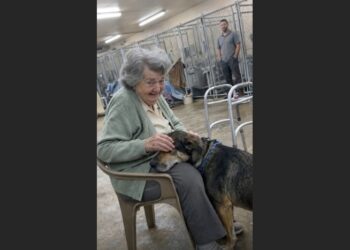
He Rested His Head in Her Lap
Margaret’s hands remained still until Baxter was close enough to choose contact.
He lowered his head.
His muzzle settled across her knees.
Margaret looked down.
Then the tears started.
She did not pull him into an embrace.
She simply placed one hand gently along the side of his neck.
Baxter stood there for a while.
Then shifted.
Lowered himself carefully beside her feet.
And rested.
His breathing slowed.
His eyes closed.
The shelter staff noticed because Baxter had slept only lightly since arriving.
This time, he appeared to settle more deeply.
That did not mean he had recognized Margaret as his future owner.
It meant he had chosen to relax beside her.
For a first meeting, that was enough.
Nobody Approved the Adoption That Minute
Emotion did not replace screening.
Margaret spent more time with him.
They discussed his medication.
Arthritis management.
Possible incontinence later in life.
Difficulty with slippery floors.
The importance of keeping walks short enough that he did not overexert himself.
They reviewed quality-of-life signs and the need for regular veterinary monitoring.
Margaret asked questions.
Good ones.
Would an orthopedic bed help?
How often should he go outside?
Was a ramp better than lifting?
What signs might mean his medication needed reassessment?
The staff became increasingly comfortable with the placement.
Baxter Went Home With Margaret After the Arrangements Were Ready
The cottage required a few changes first.
Rugs went down on the smoothest floors.
A ramp was added at the front step.
His bed was placed near Margaret’s favorite chair.
Food and water were positioned where he could reach them without navigating tight spaces.
The shelter sent his medications and records.
The blue collar stayed on him.
His old chew toy went too.
So did a copy of the photograph of Harold.
Margaret said she wanted Baxter’s past to come with him.
Not as something sad they needed to erase.
As part of his life.
The First Days Were Quiet
Baxter explored slowly.
He sniffed the living room.
The hallway.
The back door.
Then he found the bed beside Margaret’s chair.
For the first few nights, he occasionally lifted his head when a car passed.
Once or twice, he walked toward the front door.
Margaret did not pull him away.
She let him stand there.
Then, when he was ready, he returned.
There was no single moment when his previous routine disappeared.
New routines simply began forming beside it.
Breakfast in Margaret’s kitchen.
Medication in a piece of soft food.
A short morning walk.
An afternoon nap.
Evening reading.
Their Walks Were Never Far
The cottage overlooked a small lake.
Margaret and Baxter walked toward it in the mornings.
Slowly.
Some days they reached the water.
Other days Baxter turned back earlier.
Margaret let him set the pace.
His arthritis did not improve because he had found a loving home.
Age continued doing what age does.
There were stiff mornings.
Days when getting up required extra effort.
Cold weather made his joints harder to manage.
His veterinarian adjusted his care when necessary.
Margaret kept the routine flexible.
A good day did not mean the next walk should be longer.
A difficult day did not mean Baxter had lost all quality of life.
They paid attention.
Afternoons Became Nap Time
Margaret had spent decades reading books for work and pleasure.
Retirement had not changed that.
She often settled into her chair after lunch.
Baxter slept on the orthopedic bed beside her.
Sometimes his head rested against her slippers.
Sometimes he shifted close enough that one paw touched her foot.
Margaret had spent months becoming accustomed to the absence of another person’s movement in the house.
Baxter did not replace her husband.
No dog could.
But he restored routine.
A water bowl to fill.
Medication to remember.
A reason to step outside in the morning.
The sound of an old dog turning in his bed while she read.
Those things mattered.
Baxter Did Not Heal Margaret’s Grief
And Margaret did not heal Baxter’s in any magical way.
That would make their relationship smaller, not larger.
Grief does not disappear because a dog comes home.
Nor does a dog’s stress vanish because a kind person adopts him.
What companionship can do is create structure around loss.
Margaret still missed her husband.
She still had evenings when memories arrived unexpectedly.
Baxter still sometimes oriented toward doors or unfamiliar footsteps.
But they shared space.
Their days acquired rhythm.
Neither had to be transformed for the arrangement to have value.
The Shelter Kept Receiving Updates
One photo showed Baxter asleep near the fireplace.
Another showed Margaret sitting beside him on the porch.
In one, his blue collar had been replaced with a softer one because the old fabric had begun rubbing his neck.
The original collar was kept in a drawer.
Margaret reported that his appetite was good.
He tolerated his medication well.
He had learned exactly where she kept his treats.
His walks remained short.
His naps grew longer.
The staff loved the updates because they were ordinary.
There was no dramatic second youth.
Just an old dog being cared for appropriately.
Harold Was Still Part of Baxter’s Story
Margaret kept the old photograph.
She placed it on a shelf near Baxter’s bed.
Not because she believed he looked at it and remembered Harold through a photograph the way a person would.
The picture was for her.
It reminded her that Baxter had been deeply embedded in someone else’s life before he entered hers.
He had not arrived empty.
He came with routines.
Medical needs.
Objects.
Seven years of familiarity with another person.
Margaret respected that.
She did not need to be Baxter’s first great attachment to become an important one.
The Grandson Eventually Learned Baxter Was Safe
The shelter managed to reach him through the contact information he had left.
He was preparing for deployment.
When staff told him Baxter had been adopted by a retired widow nearby, there was a long pause.
Then he asked whether Baxter was comfortable.
Yes.
Whether he had a yard.
Yes.
Whether someone understood his medication.
Yes.
The shelter sent a photograph with Margaret’s permission.
The grandson replied with only a few lines.
The last one said:
“Grandpa would have been relieved.”
No one needed to turn that into a dramatic reunion.
Knowing Baxter was safe was enough.
Leaving Baxter Outside Had Still Been Dangerous
The shelter remained clear about that.
The grandson’s desperation explained the decision.
It did not make the method ideal.
A senior dog with medications should never be left overnight without confirmation that someone will find him quickly.
Weather changes.
Medical problems happen.
Crates can be stolen or disturbed.
The safer choice is always a direct surrender, emergency foster arrangement, veterinary contact, municipal shelter, animal control call, or another confirmed handoff whenever any option remains.
But sometimes stories arrive after every better decision has already failed.
The shelter could condemn the method without pretending the person behind it felt nothing.
Baxter’s Story Was Not Really About Being Abandoned
That word fit what happened physically.
He had been left.
But it did not explain everything around the act.
Someone packed his medication.
Someone secured water.
Someone folded blankets around an arthritic body.
Someone protected the note from rain.
Someone included the old photograph.
Someone wrote twenty-three names into a list of failed attempts and finally arrived at a shelter door before dawn.
Love did not make the choice safe.
But indifference did not explain it either.
Both truths could exist together.
Margaret Understood That Better Than Most
She never spoke harshly about Baxter’s grandson.
“Sometimes people reach the end of what they can do,” she once told the shelter.
She had lived long enough to understand that circumstances could change before people were prepared for them.
A stroke.
A death.
A deployment.
A housing rule.
One event follows another until a plan that seemed secure three weeks earlier disappears.
Margaret did not consider herself the person who rescued Baxter from someone bad.
She considered herself the person who happened to have room when someone else no longer did.
That difference shaped the way she talked about him.
Baxter Eventually Stopped Spending Much Time by the Front Door
Not immediately.
The change happened gradually.
The first week, he still lifted his head at unfamiliar footsteps.
Later, he remained on his bed.
Then there came a day when a delivery driver knocked and Baxter barely opened his eyes.
Margaret laughed.
“That seems like progress.”
Maybe it was.
Or maybe Baxter was fifteen and increasingly fond of uninterrupted naps.
Both explanations could be true.
By then, the sounds that mattered most were the ones inside the cottage.
Margaret opening the refrigerator.
The kettle starting.
Her chair creaking.
The soft tap of her slippers across the floor.
New familiarity had accumulated.
Neither of Them Was Starting Over From Nothing
That was perhaps the mistake people made when they shared the story.
They called it a fresh start.
It was, but only partly.
Margaret brought decades of marriage and recent grief.
Baxter brought fifteen years of life, seven of them beside Harold.
Neither abandoned the past when they met.
They simply made room for another relationship alongside it.
There was something comforting in that.
Older lives do not need to be erased before something good can happen again.
They can continue with all their history intact.
Baxter’s World Became Smaller With Age
The lake walks shortened.
The orthopedic bed became more important.
The ramp mattered more.
Margaret scheduled veterinary rechecks whenever his mobility changed.
Some afternoons, the backyard was far enough.
He would step outside.
Stand in the sun.
Sniff the air.
Then turn back toward the cottage.
Margaret never pushed for another lap because a sentimental story said Baxter had been “given a second chance.”
A second chance at fifteen is not about doing more.
Often it is about being allowed to do less comfortably.
That was the life she gave him.
Every Evening, Margaret Still Reads in the Same Chair
Baxter sleeps nearby.
His head often rests against her slippers.
The old chew toy from the crate lies near his bed.
Sometimes Margaret looks at the photograph of Harold on the shelf.
She thinks about a man she never met.
A grandson who tried to keep a promise.
A shelter employee kneeling beside a crate before dawn.
And the elderly dog breathing softly at her feet.
There was no miracle in the room.
Only a chain of imperfect people trying, one after another, to keep an old dog safe.
The Shelter Still Keeps a Copy of the Letter
Staff members occasionally show it to new volunteers when explaining why surrender stories are not always simple.
The final line remains the one people remember.
“I ran out of options before I ran out of love.”
It does not excuse every choice made in desperation.
It does remind people to look beyond the easiest judgment.
Baxter had been left outside a shelter.
He had also been packed into that crate with everything someone believed might keep him comfortable until help arrived.
By sunset the same day, another person had sat quietly beside him and offered nothing more complicated than company.
Months later, that is still what their life looks like.
Margaret in her chair.
Baxter on his bed.
A lake outside the window.
A pair of slippers beneath his white muzzle.
And an old Golden Retriever who no longer needs to watch every opening door, because the person he knows now is already in the room.
Editor’s Note: The characters in this story are fictional. Through these stories, we hope to share the intelligence, loyalty, compassion, and loving nature of dogs with people everywhere.