Most Visitors Never Saw Much of Him
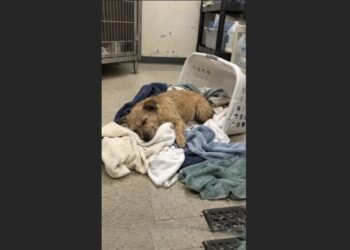
For nearly five weeks, the little terrier had occupied the same part of his kennel.
The back.
Always the back.
If someone stopped outside for more than a few seconds, his ears flattened.
His head lowered.
His body pressed toward the wall as though another few inches of distance might make him feel safer.
Visitors sometimes tried speaking to him.
A few crouched.
Others held treats through the kennel door.
The terrier rarely approached.
Eventually, most people moved on to dogs who were easier to meet.
Dogs who came forward.
Dogs who wagged.
Dogs who pushed noses against the fencing and made an immediate case for themselves.
The terrier remained on his gray blanket, watching the hallway.
Nobody Knew Exactly What Had Made Him So Cautious
The shelter had limited information about his past.
That mattered.
It would have been easy to look at his behavior and construct a story about cruelty.
Perhaps someone had hit him.
Perhaps he had been neglected.
Perhaps a specific person had frightened him.
But fearful behavior cannot tell people exactly what happened before a dog arrived.
Lack of socialization can produce fear.
So can repeated stressful experiences, pain, abrupt environmental changes, or simply an individual temperament that makes unfamiliar situations difficult.
The staff did not know the cause.
What they knew was the dog in front of them.
He avoided approaching people.
He appeared more comfortable when nobody entered his space.
And when humans tried too hard to engage him, he seemed to become more tense.
Shelter Life Did Not Make That Easier
Even good shelters are busy places.
Doors open.
Metal bowls move.
Dogs bark.
Mops splash.
Keys rattle.
People walk past all day.
New smells arrive constantly.
For a confident dog, that environment may be manageable.
For a frightened one, every ordinary event can become another thing to monitor.
The terrier learned the rhythm of the kennel hallway.
Breakfast.
Cleaning.
Walks.
Visitors.
Evening quiet.
He watched all of it from the back.
Staff made sure he ate.
They kept his bedding clean.
They allowed him time.
Still, five weeks is a long time for a dog to spend observing the world from one corner.
Frank Had Seen Him Every Day
Frank was one of the older caretakers at the shelter.
He was not the person who did behavior evaluations.
He was not a trainer.
Most mornings, he cleaned.
Mopped halls.
Changed bedding.
Carried food bowls.
Refilled water.
He knew the dogs through repetition.
Which ones barked at the mop.
Which ones hated wet floors.
Which ones tried to steal towels.
Which ones needed an extra moment before a kennel door opened.
The little terrier was the dog who stayed in the back.
Frank had learned that much without needing anyone to explain it.
He also learned something else.
The dog watched everything.
One Morning, the Kennel Door Was Already Open
Cleaning was underway.
The gate to the terrier’s run had been left open while the surrounding area was being prepared.
A dog eager to escape confinement could have walked into the hallway.
The terrier did not.
He remained on the gray blanket.
Frank pushed the mop past the opening.
The dog followed the movement with his eyes.
Frank made another pass.
Still nothing.
The open doorway was only a few feet away.
No person was blocking it.
Yet the terrier stayed where he had been staying for weeks.
Frank finished the section of floor.
Then he stopped.
He Put the Mop Against the Wall
Frank could have stepped inside.
He did not.
He could have carried the dog out.
He did not do that either.
Instead, he leaned the mop against the hallway wall.
Then he lowered himself slowly onto one knee several feet outside the kennel.
His knees were not young.
The movement took time.
The terrier watched.
Frank kept his body slightly turned instead of facing directly into the kennel.
He lowered one hand near the floor.
“Oh, you don’t have to be scared,” he said softly.
Then, after a moment:
“Come here, buddy.”
The dog did not come.
Frank Didn’t Ask Again
That became the important part.
He did not repeat the invitation every five seconds.
Did not pat the floor.
Did not reach farther inside.
Did not lean toward the dog.
He simply waited.
His hand remained low.
His shoulders stayed turned slightly away.
Direct staring and looming can feel threatening to an uncertain dog, particularly one already trying to increase distance.
Frank seemed to understand that without making a lesson out of it.
So he became still.
The shelter continued around them.
A dog barked farther down the hall.
Someone carried a stack of bowls through another doorway.
Water ran.
The terrier stayed on the blanket.
Frank stayed on one knee.
The First Movement Was Almost Too Small to Notice
The terrier shifted his front paws.
Then stopped.
Frank did nothing.
The dog raised his body.
For a few seconds, he stood.
He looked toward Frank.
Then toward the hallway.
Then back.
One front paw moved.
A single step.
He froze again.
Frank’s hand remained where it was.
There was no cheering.
No “good boy” repeated in an excited voice.
No attempt to convert one step into five.
The terrier had moved because he chose to.
Frank did not want to take that choice away.
A Few Feet Can Be an Enormous Distance
To anyone passing, the dog was barely moving.
One step.
Pause.
Another.
But distance means something different when fear is involved.
For five weeks, the back of the kennel had been the place this dog repeatedly selected.
The doorway represented openness.
Noise.
People.
Movement.
The terrier approached it slowly.
He reached the threshold.
Stopped.
Frank remained outside.
That mattered.
The dog could retreat.
No human stood behind him.
No leash tightened.
Nothing forced the decision.
Eventually, one paw crossed the doorway.
Then the other.
The little terrier walked into the hallway on his own.
Frank Still Didn’t Reach for Him
The dog came close enough to sniff.
Frank kept his fingers relaxed.
The terrier’s nose moved across them.
Slowly.
He investigated.
Then paused.
His body remained ready to step backward if necessary.
Frank waited.
There was no reason to rush.
A hand offered without pursuing is different from a hand reaching over a dog’s head.
The terrier could decide whether contact happened.
For several seconds, he simply stood there.
Then he moved his face forward.
His cheek settled against Frank’s palm.
“That’s It, Buddy”
Frank barely raised his voice.
He rubbed gently beneath the dog’s chin.
Then along the side of his face.
The terrier did not pull away.
His shoulders softened slightly.
His tail moved once.
Not a sweeping wag.
One movement.
Frank continued slowly.
The dog stepped closer.
Then closer again.
Until his chest touched Frank.
Only then did Frank move his other arm.
Not to hold him tightly.
Just enough to rest against him.
The terrier stayed.
Nobody Declared Him “Fixed”
That would have been unfair.
One voluntary approach does not erase fear.
A frightened dog can have a good morning and retreat again that afternoon.
Stress responses can return in new settings or around unfamiliar people.
Progress is often uneven.
What happened with Frank was meaningful because the dog made a choice he had not been making.
He crossed the doorway.
Approached.
Investigated.
Accepted contact.
Then remained close.
That was progress.
Not a cure.
Frank Didn’t Know Why the Dog Trusted Him That Morning
Maybe familiarity helped.
The terrier had seen him mopping the hallway for weeks.
Frank’s scent was not new.
His footsteps were not new.
His voice had probably become part of the shelter’s background.
Maybe the open kennel changed the situation.
Maybe the dog’s stress had gradually lowered.
Maybe Frank’s posture mattered.
Perhaps all of those things contributed.
Nobody could identify a single cause.
Trust is rarely created by one perfect gesture.
More often, it is the result of repeated experiences that do not go badly.
Frank may simply have been there on the morning when enough of those experiences had accumulated.
The Terrier Pressed Against His Chest
That was the moment another staff member noticed.
She stopped down the hallway.
The dog who usually stayed against the concrete wall was outside the kennel.
His body was against Frank.
His eyes were partly closed.
Frank had one hand along the side of his neck.
Neither was doing much.
The worker wisely did not come rushing over.
Too much attention could have changed the moment.
So she watched from a distance.
A few minutes earlier, the dog had been unwilling to walk through an open gate.
Now he was standing in the hallway voluntarily.
That contrast was enough.
Eventually, Frank Had Work to Do
The floor was still wet.
Kennels still needed cleaning.
Dogs still needed care.
Frank could not remain kneeling all morning.
So after a while, he withdrew his arm.
Slowly.
The terrier remained beside him.
Frank pushed himself back onto his feet.
That part took longer than getting down.
The dog looked up.
Frank reached for the mop.
Then went back to work.
No ceremony.
No attempt to lure the terrier after him.
He simply resumed cleaning.
The little dog watched every movement.
Something About the Kennel Looked Different Afterward
The gray blanket was still there.
The concrete wall had not changed.
The shelter was still noisy.
Yet staff noticed that the terrier did not immediately retreat to the farthest corner.
He remained closer to the front.
Later, he settled where he could see the hallway without pressing himself against the back wall.
That was a small change.
The shelter staff treated it that way.
Nobody started flooding his kennel with visitors.
Nobody decided he was suddenly ready for unlimited handling.
His ability to approach Frank did not mean he would approach everyone.
The lesson was not that fear had disappeared.
The lesson was that the dog was capable of choosing connection when enough pressure was removed.
Frank Became Part of His Routine
Over the following days, Frank continued working exactly as before.
He did not turn every encounter into a training session.
Sometimes he passed with the mop.
Sometimes he brought water.
Sometimes he sat outside for a minute.
The terrier began approaching him more readily.
First to sniff.
Then for brief contact.
Frank let him leave when he wanted.
That freedom mattered.
A dog learns something useful when approaching a person does not mean losing the ability to move away.
Each uneventful interaction made the next one slightly easier.
Shelter Staff Began Seeing Other Small Changes
The terrier started eating more comfortably when people remained farther away rather than requiring complete isolation.
He rested in less compressed positions.
Sometimes he lay on one hip instead of keeping his body tightly tucked.
He watched visitors without lowering his head immediately.
One afternoon, he took a treat from a staff member he already knew.
Another day, he sniffed a leash rather than retreating when it appeared.
None of those things would have made a dramatic video.
Together, they mattered more than a dramatic video ever could.
Fear recovery is often built from ordinary moments.
They Also Stopped Calling Him “Shy”
The word felt too mild.
A shy dog may hesitate briefly before joining.
This terrier had been genuinely frightened.
Using accurate language helped staff set realistic expectations for future adopters.
He was not simply waiting for someone to cuddle him hard enough.
He needed a person who understood consent and gradual exposure.
Someone willing to sit nearby without demanding affection.
Someone who would let him investigate.
Someone who would not interpret retreat as rejection.
That kind of home could help him continue what had started in the kennel hallway.
Frank Never Tried to Become the Dog’s Only Safe Person
That was important too.
If the terrier trusted only Frank, adoption would become harder.
So staff used the same general principles.
Quiet approach.
Sideways posture.
Treats placed at comfortable distances.
No reaching over his head.
No cornering.
Short interactions.
Predictable exits.
Some people progressed faster than others.
The dog had preferences.
That was normal.
The goal was not to make him greet every stranger.
It was to help him develop enough confidence that ordinary human contact no longer felt overwhelming.
Visitors Started Seeing a Different Dog
Not completely different.
The terrier still did not rush the front of the kennel.
He was never transformed into the shelter’s social butterfly.
But sometimes he stayed visible.
That alone helped.
One couple stopped outside his kennel and read his profile.
The dog watched from several feet away.
They did not call him.
The shelter employee explained his history at the facility.
Not invented trauma.
Observed behavior.
He had been very fearful.
He was improving.
He needed patience.
The couple listened.
Then they sat on the floor outside.
That response got the staff’s attention.
The Terrier Took His Time
He did not approach them immediately.
Five minutes passed.
Then ten.
The couple talked quietly with the adoption counselor.
The dog moved closer.
Paused.
Sniffed.
Retreated.
Then returned.
Nobody described it as love at first sight.
The first meeting was more cautious than that.
But the couple came back another day.
Then again.
Repetition mattered.
By the third visit, the terrier approached sooner.
The shelter began discussing what adoption would actually require.
A Quiet Home Was Only Part of the Plan
The dog needed more than kind people.
He needed structure.
A safe resting area where nobody disturbed him.
Predictable meals.
Gradual introductions to visitors.
Secure handling outdoors.
Veterinary care.
Time to learn the sounds and routines of another unfamiliar building.
The adopters were told that apparent progress at the shelter might temporarily regress after moving.
That would not mean the adoption had failed.
Changing environments can increase uncertainty even in a dog who has improved.
The couple understood.
They did not expect him to arrive and immediately sleep on the sofa beside them.
That made the shelter more confident about the match.
Frank Was There on Adoption Day
The terrier wore a harness and leash.
He looked uncertain.
The hallway was busier than usual.
Frank walked past carrying supplies.
The dog noticed him.
His body shifted toward the familiar man.
Frank stopped.
He lowered one hand.
The terrier approached and sniffed it.
Frank scratched him gently beneath the chin.
“Look at you,” he said.
There was no need to tell the dog what was happening.
The terrier could not understand adoption paperwork or permanence.
He knew familiar people were present.
He knew another set of people had been visiting repeatedly.
He knew a leash meant movement.
That was enough information for the moment.
The Dog Did Not March Out Confidently
He hesitated at the main doorway.
Outside sounds were louder.
Cars.
Wind.
Voices.
His adopter stopped.
No pulling.
They waited.
The terrier sniffed.
Then stepped through.
One paw.
Then another.
The same way he had once crossed his kennel doorway toward Frank.
Choice first.
Movement second.
The pattern suited him.
Frank Went Back to Work
After the car left, someone asked whether he was sad.
Frank shrugged.
Of course he would miss the little dog.
Caretakers become attached.
But seeing a kennel empty because a suitable home had been found was the outcome everyone wanted.
He picked up the mop.
There was another hallway to clean.
Another dog waiting for breakfast.
Another frightened animal somewhere in the building learning which people were predictable.
Frank did not consider himself responsible for saving the terrier.
He had done something simpler.
He had waited.
Waiting Is Not the Same as Doing Nothing
That distinction matters with fearful dogs.
People often feel pressure to create progress.
Move closer.
Touch.
Coax.
Expose.
Encourage.
Sometimes the most useful intervention is reducing pressure enough for the animal to make a choice.
That does not mean every frightened dog should simply be ignored indefinitely.
Some need structured behavior plans.
Some need veterinary evaluation for pain or anxiety.
Some benefit from qualified behavioral professionals.
But within those plans, voluntary approach can be extremely valuable.
Frank offered an opportunity.
The terrier decided whether to use it.
Nobody Knew How Long the Dog Would Have Needed If Frank Had Stood Up Earlier
Maybe another minute.
Maybe another day.
Maybe weeks.
That question has no useful answer.
Fear does not run on a schedule.
The important part was that Frank did not decide the dog was taking too long.
He did not interpret hesitation as stubbornness.
He did not increase pressure because patience felt unproductive.
He stayed still long enough for the terrier to gather information.
The man’s posture did not change.
His hand did not chase.
The doorway remained open.
Eventually, the dog crossed it.
Months Later, the Shelter Received a Photograph
The terrier was lying on a rug in his new home.
Not hidden.
Not pressed into a corner.
His body was stretched on one side.
A person sat several feet away reading.
That distance was deliberate.
He still liked having his own space.
His adopters respected it.
According to their update, he had begun following them from room to room occasionally.
He enjoyed short walks in quiet areas.
Visitors were still difficult.
They managed those situations carefully.
Some days remained easier than others.
The dog had not become fearless.
He had become more secure.
That was a much more realistic success.
Frank Kept the Picture Near the Staff Room
He did not tell the story dramatically.
When someone asked, he usually described the first morning in practical terms.
“The door was open.”
“He was watching me.”
“I sat down.”
“He came out.”
That was all.
Other people remembered more.
The weeks at the back of the kennel.
The lowered head.
The flattened ears.
The dog who waited for humans to leave.
Then the old caretaker kneeling on a wet shelter floor with a mop against the wall.
The First Step Belonged to the Terrier
That is what made it important.
Frank did not pull him across the threshold.
Did not reach in and carry him.
Did not prove that people were safe by forcing the dog to tolerate contact.
He offered a quiet presence.
Then left the decision where it belonged.
With the dog.
The terrier stood.
Paused.
Watched.
Walked forward.
Sniffed a hand.
And finally pressed his face into the palm of someone who had been willing to wait without asking for anything more.
A few minutes later, Frank returned to mopping the hallway.
The little dog watched him go.
But this time, he watched from near the front of the kennel.
Editor’s Note: The characters in this story are fictional. Through these stories, we hope to share the intelligence, loyalty, compassion, and loving nature of dogs with people everywhere.