I Almost Drove Past Him Too
For nearly four hours on a rainy Thursday afternoon, motorists traveling Highway 41 outside Evansville, Indiana, passed the same unusual scene.
An old golden retriever lay in a drainage ditch.
Beside him was a child’s red scooter.
The scooter was badly damaged. One handlebar hung loose. Red paint had been scraped from one side, and a peeling superhero sticker fluttered whenever trucks pushed air across the shoulder.
The dog was soaked.
Gray around the muzzle.
Mud covered the long fur along his legs and stomach.
Yet he stayed beside the scooter.
Dozens of drivers apparently saw him.
Nobody understood what the scene might mean.
At 6:15 that evening, I nearly made the same mistake.
There Had Been No Emergency Call
I was finishing the last stretch of a long patrol shift.
No one had reported a crash in that area.
There was no missing-child alert connected to the highway.
Dispatch had not received a call about an injured person.
Nothing suggested I was approaching anything more serious than a loose dog.
When I first saw him, that was what I assumed.
An elderly retriever near an abandoned object.
Maybe the scooter had been thrown away.
Maybe someone had dumped the dog.
Maybe he had wandered from a nearby home and found a sheltered place beside something that smelled interesting.
I pulled onto the shoulder because darkness was coming and I did not want him stepping into traffic.
My first radio transmission reflected exactly what I believed.
“Possible abandoned property. Loose senior dog near Highway 41. No injured parties visible.”
I remember those words because of how wrong they turned out to be.
The Dog Watched Me Come Down the Embankment
Rain had been falling steadily.
Water collected along the drainage ditch and moved around the retriever’s paws.
Cars hissed across wet pavement above us.
I approached slowly.
The dog lifted his head.
He did not bark.
He did not growl.
He did not rush me.
But his body changed.
His shoulders tightened.
He shifted his position so that more of his body sat between me and the scooter.
That made me stop.
After twelve years of handling roadside animal calls, I had learned not to assume stillness meant relaxation.
A frightened dog can freeze.
A painful dog can react suddenly.
An older dog may simply be conserving energy.
So I crouched several yards away and gave him room.
At First, I Thought He Was Guarding the Scooter
That explanation seemed obvious.
Dogs sometimes remain near familiar objects.
The scooter might have belonged to someone he knew.
Perhaps it smelled like home.
Perhaps the dog had been riding in a vehicle with a family and become separated.
I had no way to know.
What bothered me was the retriever’s position.
He was not simply lying beside the scooter because it offered shelter.
The scooter offered almost none.
He also was not tucked against the side protected from rain.
Instead, he stayed closer to the highway side.
His body lay between the damaged scooter and passing traffic.
That did not prove intention.
But it made the scene feel less random.
I started looking more carefully.
The Scooter Had Not Simply Been Left There
Its front wheel pointed sharply downhill.
The grass behind it had been disturbed.
The damaged handlebar suggested impact.
Mud had streaked one side.
Then I noticed something farther down the slope.
A shoe.
A child’s sneaker.
Only part of it was visible through the wet grass about twenty feet away.
My attention shifted immediately.
I stood.
The retriever stood too.
His rear legs moved stiffly.
He was clearly an older dog.
Yet the moment I looked downhill, he became more alert.
I radioed dispatch again.
This time my message sounded very different.
The Dog Kept Looking Toward the Tree Line
I began speaking quietly.
Not because I thought he could understand my questions.
I wanted my voice and movements to remain predictable.
“Easy, buddy.”
His eyes stayed on me.
Then he turned his head.
Toward the woods.
Back to me.
A few seconds later, he did it again.
People love to describe gestures like that as deliberate communication.
Sometimes they may be.
Sometimes humans connect meaning to ordinary animal behavior because we already know what comes next.
At that moment, I knew nothing.
Still, the repeated orientation toward the trees was enough to make me investigate.
I took one step downhill.
The retriever got up.
He Started Moving Away From the Scooter
That was the moment my original explanation stopped making sense.
If his main concern had been staying with the object, I expected him to remain there.
Instead, he walked toward the culvert.
Slowly.
His back legs were stiff from age, cold, or both.
He stopped after several yards.
Looked at me.
Then continued.
I followed.
Every few steps, the dog paused.
Whether he was checking that I remained behind him or simply evaluating the unfamiliar person following him, I could not know.
The effect was the same.
He kept moving toward the brush.
I stayed with him.
About Thirty Yards Into the Trees, I Saw the Boy
At first, I saw clothing.
Then a leg.
I moved faster.
An eight-year-old boy lay near the creek bed, partially pinned beneath fallen branches.
He was unconscious.
But he was breathing.
The ground around him was soaked.
Rainwater had run through the leaves and beneath his clothing.
His skin felt cold.
I called for emergency medical assistance immediately.
Then I began assessing what I could without moving him unnecessarily.
The retriever came close.
He did not interfere.
He remained near the boy.
Only then did I understand that the dog, the scooter, and the child were all part of the same incident.
The Boy’s Name Was Eli
Paramedics arrived.
Getting him safely out of the wet wooded slope took care.
The initial concerns included head injury, exposure, and trauma from the fall.
At the hospital, doctors diagnosed a broken wrist, mild hypothermia, and a significant concussion.
They estimated he may have been outside in the cold rain for close to five hours.
The concussion likely explained why he had not simply climbed back toward the highway or called loudly enough for passing drivers to hear him.
From road level, the vegetation hid him almost completely.
The damaged scooter was the clearest sign that something had happened.
And beside it had been the dog.
His Name Was Murphy
The family identified him quickly.
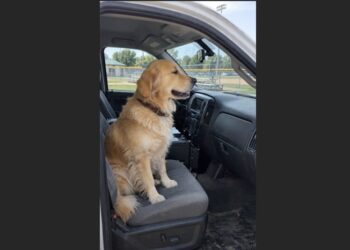
Murphy was an aging golden retriever who had originally belonged to Eli’s grandfather.
After the grandfather died the previous year, Murphy had become especially attached to the boy.
Family members described the two as nearly constant companions.
If Eli went into the yard, Murphy often followed.
If he sat outside, Murphy settled nearby.
The dog had spent much of his senior life moving between familiar family members rather than belonging to only one person.
That Thursday, he had apparently followed Eli when the boy took his scooter farther from home than he had been allowed to go.
What happened afterward was reconstructed from physical evidence and what investigators could reasonably infer.
Some details could never be known.
The Crash Appeared to Have Happened Quickly
The scooter’s path suggested the front wheel encountered loose gravel near the edge of the shoulder.
Eli likely lost control.
The scooter veered.
He went down the drainage slope and into the brush.
The scooter stopped closer to the road.
Eli continued farther.
Murphy had apparently followed.
Exactly what the dog did during the following hours was impossible to reconstruct with certainty.
Investigators later considered the possibility that he moved between the boy and the roadside.
That would have been consistent with where he was eventually found and how wet and muddy his coat had become.
But there were no witnesses to Murphy’s entire afternoon.
No one should pretend otherwise.
What We Knew Was That Murphy Stayed in the Area
He did not wander away.
He did not return home alone.
By early evening, he was beside the scooter.
When I approached, he remained closely associated with it.
When I moved toward the woods, he went in the same direction.
And that movement led me to Eli.
Whether Murphy consciously understood that the scooter was the most visible clue to the boy’s location is something no one can establish.
Dogs do not reason about roadside rescue operations the way people do.
They can, however, maintain strong associations between a familiar person, a location, and objects carrying that person’s scent.
Murphy knew Eli.
He knew the scooter was connected to him.
He knew where the boy was.
Those simpler facts were already extraordinary enough.
Later, We Learned How Many Drivers Had Seen Them
Traffic cameras showed multiple vehicles slowing slightly near the ditch.
Investigators were able to speak with several drivers afterward.
Their descriptions were remarkably similar.
Old dog.
Broken red scooter.
No visible child.
They noticed the scene.
Then they continued.
I understood why.
I almost had.
Human beings build quick explanations constantly, especially while driving.
A dog beside an object becomes “a loose dog.”
A broken scooter becomes “discarded property.”
Once that story forms, we stop searching for another one.
Nothing about those passing drivers made them uncaring.
They simply did not have the missing information.
Neither did I until I stopped.
Murphy Came With Us
Once Eli was transported, somebody had to deal with the dog.
Murphy was soaked and exhausted.
His age showed more clearly once the immediate activity slowed.
He had stiffness in his hindquarters.
His paws and lower legs were muddy.
Veterinary staff examined him.
There was no dramatic hidden injury.
Mostly he needed warmth, water, rest, and monitoring.
He was taken near the hospital rather than being immediately sent home because the family was focused on Eli.
That is where Murphy’s waiting began again.
He Stayed Near the Hospital Entrance
Murphy could not understand what was happening inside.
He did not know Eli was being evaluated for a concussion.
He did not understand X-rays, warming measures, observation, or hospital admission.
He did know the boy had disappeared through those doors.
For several hours, Murphy remained near the waiting area with family and staff.
Someone brought him a blanket.
Water.
Food.
He drank some.
He showed little interest in the meal at first.
That can happen after stress and prolonged activity.
Nobody interpreted it as a dramatic hunger strike.
He was an old dog who had spent hours in cold rain and then been moved into a completely unfamiliar environment.
Rest mattered more.
Eli Woke After Midnight
His first hours in the hospital were spent under close medical observation.
Family members stayed nearby.
When he became more alert, he was confused.
Then he asked about Murphy.
“Where’s Murphy?”
His mother started crying.
Someone told him the dog was safe.
That was enough at first.
Later, once the medical team considered it appropriate and the situation could be controlled, arrangements were made for Murphy to see him.
Nobody wanted an excited dog jumping onto an injured child.
So they brought Murphy in carefully.
What happened next was quieter than people later made it sound.
Murphy Walked to the Bed
He heard familiar voices.
Entered the room.
Approached.
His tail moved.
Then he put his head across Eli’s upper body carefully while family members and staff kept him from putting weight on the injured wrist.
Eli touched his fur.
Murphy stayed there.
His eyes closed after a while.
People watching the scene called it relief.
Maybe that is a fair human description.
From Murphy’s perspective, what could be observed was simpler.
A familiar child was present again.
The environment settled.
The dog relaxed.
After a day of rain, traffic, strange people, and separation, Murphy finally rested.
Eli’s mother cried.
One nurse did too.
The Story Spread Quickly
A senior golden retriever found beside a wrecked child’s scooter made for the kind of story people repeated.
The sheriff’s department shared a version online.
Local residents responded.
People wanted to send Murphy things.
Dog beds arrived.
Treats.
A custom collar.
Someone dropped off orthopedic bedding after hearing that Murphy had stiff joints.
Others sent senior-dog supplements, though the family wisely checked with their veterinarian before adding anything to his diet.
An elementary school class made cards.
Many were drawings.
Golden dogs.
Red scooters.
Police cars.
One envelope was addressed simply:
“The Good Boy Near Highway 41.”
The Family Appreciated It, but Murphy Did Not Become a Superhero
That distinction mattered to them.
Murphy was still an elderly family dog.
He had arthritis-related stiffness.
He slept more than he had when young.
He needed reasonable exercise.
He needed veterinary care.
He occasionally ignored people when something more interesting was available to smell.
The attention surrounding him did not change any of that.
Neither did anyone in the family claim he had planned a rescue operation.
They knew what they had actually witnessed.
Murphy stayed connected to Eli and the crash site.
His behavior contributed directly to my decision to search downhill.
That was more than enough.
The Accident Changed One Practical Problem at Home
Eli’s family lived near a road where outdoor freedom had always been complicated.
They had wanted a fenced yard for years.
They could not afford one.
Murphy therefore had to be closely supervised outdoors and, according to the story, was sometimes tethered under controlled conditions because the property was not safely enclosed.
After the rescue story circulated, an Evansville-area construction company owner heard about the family.
He contacted them privately.
Months later, workers arrived.
They installed a proper fenced backyard.
That gift mattered far more than another bag of treats.
It changed the family’s daily safety.
Murphy Finally Had a Yard Where He Could Move Without a Tether
The first few times he went outside, the family stayed with him.
A fence does not eliminate the need for supervision.
But it created room.
Murphy could wander through the grass.
Choose a sunny patch.
Sniff along the perimeter.
Then lie down.
Eli could play outside without being near the highway shoulder where the accident had happened.
The new arrangement also made exercise easier on Murphy’s aging body.
He no longer needed every outdoor moment to be a formal walk.
Sometimes he could simply step into the yard.
Sniff.
Rest.
Come back inside.
For a senior dog, that kind of access can be especially useful.
Eli Eventually Got Another Scooter
The family did not rush it.
First came recovery.
His wrist needed time.
So did the concussion symptoms.
His return to ordinary activity followed medical guidance rather than a child’s impatience to get outside.
Eventually, he was cleared for normal play.
A new scooter appeared.
Helmets and boundaries became non-negotiable.
The fenced yard gave him somewhere safer to ride.
He began making circles through the grass and along a small paved section.
Murphy often watched.
Sometimes he got up and followed.
Not fast.
Those days were behind him.
But he followed.
The Damaged Red Scooter Was Kept Too
It was repaired as well as it reasonably could be.
One handlebar remained slightly crooked.
Scratches stayed in the paint.
The superhero sticker was never quite flat again.
Someone offered to replace it completely.
Eli refused.
“Murphy guarded that one,” he said.
That was an eight-year-old’s interpretation.
Nobody corrected him.
Children use stories to make sense of frightening events.
The scooter became a physical reminder that the day had ended differently than it might have.
No one needed it restored to perfect condition.
Its damage was part of what made it recognizable.
I Saw Them Again Months Later
It happened at a community event.
I had not seen Eli in some time.
He looked healthy.
His wrist had healed.
He was taller, or perhaps I only remembered him as the small unconscious child in wet leaves.
Murphy looked older.
His face seemed even grayer.
He moved carefully.
But when Eli started riding loops through the fenced yard, Murphy got up.
The dog followed at a slow trot.
For a few moments, I was back beside Highway 41.
Rain.
Mud.
That broken scooter in the ditch.
The old retriever watching me.
I Used to Say Murphy “Knew Exactly What to Do”
I became more cautious about that afterward.
It sounds good.
It makes the story neat.
Dog sees accident.
Dog develops plan.
Dog creates roadside clue.
Dog recruits trooper.
Real animal behavior is rarely that narratively tidy.
Murphy knew Eli had fallen.
He remained nearby.
He had strong familiarity with the boy and his belongings.
He oriented toward the wooded area when I approached.
He moved in that direction when I followed.
Those are facts within the story.
The larger explanation belongs partly to us.
We do not need to give Murphy human tactical reasoning to recognize the importance of what he did.
Staying Can Be Enough
Dogs often help people without understanding the full human circumstances.
A dog can stay near an injured owner without understanding trauma medicine.
A dog can bark when routines suddenly change.
A dog can return to a familiar location.
A dog can follow scent.
A dog can become highly attentive when someone important to him is missing or motionless.
Those behaviors can sometimes have enormous consequences.
Murphy did not need to know what a state trooper was.
He did not need to know how emergency dispatch worked.
He needed to remain connected to the scene long enough for someone to look twice.
That happened.
Barely.
I Still Think About the Phrase I Used on the Radio
“No injured parties visible.”
Technically, at that exact spot, it was true.
Nobody was visible.
That was the problem.
Eli was thirty yards away, below road level, behind dense vegetation.
The highway showed us only what it could.
A damaged scooter.
An old dog.
A ditch full of rainwater.
The important part was hidden.
Murphy was the only living connection between what motorists could see and what they could not.
The Other Drivers Were Not Cruel
People sometimes hear this story and ask how dozens of motorists could pass without stopping.
The answer is uncomfortable because it is ordinary.
We categorize what we see quickly.
Especially at highway speed.
Most drivers cannot safely pull over every time they see something unusual.
A dog beside an abandoned scooter does not automatically indicate an injured child nearby.
I had professional reason and a safe opportunity to stop.
Even then, I first assumed I was handling a loose-dog call.
What changed the outcome was not extraordinary intuition.
It was staying long enough to notice that the easy explanation did not fit all the details.
The sneaker.
The scooter’s direction.
Murphy’s movement.
Together, they changed the story.
Murphy’s Body Changed After That Year
Age kept coming.
No rescue story could stop it.
His back legs became stiffer.
Long outings shortened.
The family put supportive bedding around the house.
They talked with their veterinarian about joint comfort and appropriate activity.
Eli learned that loving Murphy now meant slowing down for him.
When the dog stopped during walks, they stopped.
When he wanted to go back, they went back.
Murphy had followed Eli plenty.
Now Eli learned to match Murphy’s pace.
That seemed like a fair exchange.
In the Backyard, Murphy Usually Watches More Than He Runs
Eli rides.
Murphy lies in the grass.
Sometimes the scooter passes close enough that one ear lifts.
Sometimes Murphy gets up and walks after him.
Other days, he remains exactly where he is.
Nobody encourages the old dog to chase.
He has nothing to prove.
The fence means his job, if anyone wants to call it that, is easier now.
There is no highway shoulder.
No drainage ditch.
No wet slope disappearing into brush.
Just a boy making circles through a yard.
An old dog nearby.
And a family that understands how quickly an ordinary afternoon can change.
The Red Scooter Still Has a Crooked Handlebar
I saw it when I visited.
Eli pointed it out before I could ask.
The scratches were still there.
So was part of the sticker.
It would have been easy to throw the thing away.
Perhaps more practical too.
Instead, the family kept it.
Not because Murphy needed the reminder.
Dogs do not require monuments to their histories.
The humans did.
Objects sometimes hold a moment after the moment itself becomes difficult to describe.
That scooter held one Thursday afternoon.
The fall.
The rain.
The hours nobody knew where Eli was.
And the dog who did not go home.
Murphy Never Needed to Understand What Everyone Later Said About Him
He did not know local businesses sent presents.
He did not know children drew pictures of him.
He did not know people online called him a hero.
He did not know his behavior became a story.
His world remained much smaller.
Food.
Family.
Rest.
The fenced yard.
Eli.
That was probably for the best.
Humans turned the afternoon into a narrative about loyalty.
Murphy simply continued living the relationship that had existed before the crash.
He stayed close to the boy he was accustomed to staying close to.
I Would Still Stop if I Saw the Same Scene Tomorrow
Not because every dog beside a broken toy means somebody is injured.
Most of the time, it probably would not.
But I learned something from that ditch.
Sometimes an animal’s behavior is information.
Not mystical information.
Not proof of a human-like plan.
Just information worth observing before we decide we already understand the scene.
Murphy did not bark at traffic.
He did not drag me by the sleeve.
He did not perform some impossible rescue feat.
He stayed.
Then, when I moved in the right direction, he moved too.
That was enough.
The Last Time I Saw Them, Eli Was Riding in Circles
Murphy followed for part of the way.
His trot was slower than it must have been years earlier.
The gray around his face had spread.
After one lap, he stopped.
Eli continued around the yard.
When he came back, he slowed near the dog.
Murphy raised his head.
Eli reached down and touched him as he passed.
Then the scooter rolled on.
No highway.
No rain.
No ditch.
Murphy watched him go.
A few seconds later, the old retriever pushed himself onto stiff legs and followed again.
Not because anyone asked him to.
Not because he understood what people still said about that Thursday evening.
It was simply what Murphy had done for years.
Stay near Eli.
Watch where he went.
And, whenever his aging body allowed it, go with him.
Editor’s Note: The characters in this story are fictional. Through these stories, we hope to share the intelligence, loyalty, compassion, and loving nature of dogs with people everywhere.