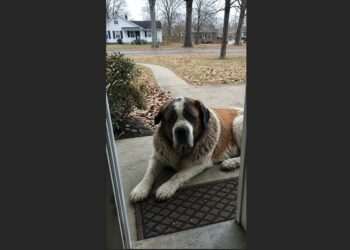
An emotional fictional story told from the perspective of Sarge’s adopter. The events have not been independently verified.
I had already made up my mind: on Monday, I was taking Sarge back to the shelter.
I hated admitting it, especially after bringing him home with every intention of making the adoption work. But three weeks with a 110-pound Great Pyrenees mix had left me exhausted, frightened for his safety, and unsure what else I could do.
Sarge wasn’t mean. He didn’t tear up the furniture or spend the night barking. In the house, he could be perfectly quiet. The trouble began whenever I left for work. Somehow, he always found a way out.
That six-foot fence I thought would keep a large dog safe meant almost nothing to him. If he couldn’t get over it, he dug underneath. When I tried to secure the gate, he worked at the latch until he could open it. I would come home thinking I had finally solved the problem, only to learn that animal control had found him miles away again.
Sometimes he was covered in dirt. Sometimes he was so tired he could barely keep going. A few times he came back limping. Every phone call reminded me that one day he might run into traffic, get hurt, or disappear for good.
Three Weeks of Trying to Keep Him Home
I kept telling myself he only needed time. Sarge had come from a shelter, and I didn’t know everything about his life before we met. A new house, unfamiliar routines, and a person who left each morning could have been difficult for him. I wanted to be patient.
But patience did not make the calls from animal control any less frightening. There were fines, too, and the growing dread of wondering where he was whenever I wasn’t home. I couldn’t give him the constant supervision he seemed to need, and the fence was failing at the one job I depended on it to do.
The hardest part was that I didn’t understand what he was looking for. He had a place to sleep. I fed him and tried to make him comfortable. Yet whenever he could, he left.
One evening, I told my sister what I had begun to believe.
“He doesn’t want to be here. He just keeps running.”
She knew how much I had wanted things to work out. I wasn’t calling because I wanted her to persuade me to keep him. I was trying to say aloud what I had been thinking for days: I might not be the right person to keep this dog safe.
Then Saturday morning came.
The Morning I Stopped Guessing
Around ten o’clock, Sarge began pacing near the door. He whined, moved away, then came back and scratched at it. I recognized the routine. It was the same restless urgency I had seen before his other escapes.
This time, though, I was home to see it from the beginning.
I stood there watching my enormous white dog, wondering what could be so important that he would risk leaving the same house over and over. I had spent three weeks trying to stop him. I hadn’t once seen where he went.
I let him out and followed.
Looking back, I know how risky that decision was. A loose dog near roads is in danger, and following one across unfamiliar ground is not a safe plan. At the time, I was more desperate for an answer than I was thoughtful about how to get it. I wouldn’t do it that way again.
Sarge did not tear off after a squirrel or veer toward a park. He put his nose close to the ground and moved forward at a steady, purposeful pace. Every so often, I had to hurry to keep up. He didn’t seem interested in exploring side streets or stopping to investigate every new smell.
He was going somewhere.
We covered more ground than I expected. The route eventually took us across a highway and through brush thick enough to catch at my clothes. I had been angry about the damage he had done beneath my fence, but now all I could think about was how easily he might have been injured making this trip alone.
For days, I’d imagined him wandering without direction. Watching him that morning, I began to wonder if I’d misunderstood the whole thing.
A Route He Seemed to Know
I couldn’t tell whether he was following an old scent, remembering a familiar route, or responding to something else. Dogs have abilities I don’t pretend to understand completely. What I could see was that this was not the aimless dash I had pictured every time animal control called.
When we finally reached a cemetery, Sarge went straight toward the perimeter fence. He slipped through a broken section, and I made my way after him.
I expected him to keep walking.
He didn’t.
The Grave in the Far Corner
I found Sarge in a quieter part of the cemetery, away from the paths most visitors used. He was stretched out in front of a small, weathered headstone. His body, which had been moving with such determination for so long, was suddenly still.
I stood a few steps away and watched him.
The dog who paced and scratched at my door every morning was lying quietly in the grass. He wasn’t searching the cemetery for another place to go. He wasn’t straining toward the road. He had stopped at this one particular grave and settled as though he had reached the end of his journey.
I approached slowly enough not to disturb him and read the headstone. It marked the resting place of an elderly man.
I did not recognize the name. The shelter had given me so little of Sarge’s history that I had no way to know whether this man had once been his owner, a familiar visitor, or someone he had never met at all.
Still, I couldn’t ignore the sight in front of me: a dog who repeatedly traveled miles from my house had come directly to a single grave and lain down beside it.
What I Knew—and What I Could Only Wonder
I wanted to believe Sarge was visiting someone he loved. It seemed to explain his urgency, the repeated escapes, and the quiet way he had stopped moving once he arrived.
But wanting an explanation does not make it a fact. I couldn’t prove that the man buried there had belonged to Sarge’s life. I didn’t know how long Sarge had been making the trip, or whether this cemetery was part of his routine before he came to me.
What I did know was that this place mattered to him in some way. I had followed him from my front door to that headstone. The difference between his restless behavior at home and his stillness beside the grave was difficult to dismiss.
I sat down in the dirt next to him and rested my hand on his tangled fur. For the first time all morning, I wasn’t trying to stop him or hurry him along.
Sarge let out a long, quiet breath and leaned his heavy head against my leg.
He was a lot of dog to hold up, even sitting down. I kept my hand on his neck and looked at the old stone while the frustration I’d been carrying for three weeks began to loosen.
I had been sure he was running away from me. Now I wasn’t sure that was true at all.
Why Monday No Longer Felt Like the Answer
On that cemetery ground, I thought about the sentence I’d said to my sister: He doesn’t want to be here.
Maybe Sarge was having trouble living in a new place. Maybe there was a bond in his past that I hadn’t understood. Either way, I could no longer treat every escape as simply a dog refusing to be part of my household.
That didn’t mean the escapes could continue. A six-foot fence, a determined digger, and a route across a highway were a dangerous combination. Caring about why he left would mean very little if I let him keep taking that risk.
But I could change how I responded.
Instead of making Monday the day I gave up, I decided to find a way to take him where he seemed to want to go without letting him run loose. That meant better equipment, careful planning, and accepting that his needs might be different from what I had imagined when I adopted him.
I wasn’t suddenly an expert on his behavior. I still had questions about the man whose grave he had chosen, and about Sarge’s history before the shelter. I could look for those answers without waiting for another dangerous escape to lead me there.
The first change was practical. I bought a strong harness and a long lead so I could keep control of him while giving him room to walk. I’d need to choose a safe route, not simply repeat the risky path we’d taken that morning. The cemetery would have to permit visits with dogs, too.
That might sound like a small solution for a problem that had consumed three weeks of my life. But it was the first idea I’d had that responded to something Sarge was showing me, instead of concentrating only on what he was doing wrong.
A Different Kind of Saturday
I had adopted Sarge expecting him to settle into my routine. I’d pictured a big, calm dog at home, content to sleep while I worked and happy to see me when I returned. When that didn’t happen, I took every new escape as proof that the adoption was failing.
Following him made me realize how little I knew about what had come before. I’d been thinking about him mainly in terms of fences, fines, and shelter paperwork. But he was a dog who had lived a whole life before walking through my front door.
I can’t say for certain that the man in the cemetery was his person. I can’t promise that weekly visits will solve every problem or that Sarge will never try to escape again. He may still need more help learning to stay safely at home. I owe him that effort, and I owe it to the people who share the roads around us.
What I can say is that Saturday changed how I saw him.
I no longer wanted to return him simply because I couldn’t understand his behavior. I wanted to understand him well enough to help, even if that meant rearranging a part of my own life.
So Monday will not be the day I take Sarge back to the shelter.
If we can make the trip safely, Saturday will be the day we go to the cemetery together. I’ll be at the other end of his lead, walking beside him instead of waiting at home for animal control to call.
I don’t know exactly who Sarge was looking for when he left my yard. But I saw where he chose to stop, and I saw how peacefully he rested once he got there.
For now, that’s enough to make me listen more closely.
I thought Sarge needed a different home. What he may have needed was someone willing to learn why he kept leaving this one.
Sometimes the most important part of loving a dog is remembering that his story didn’t begin the day he came home with you.