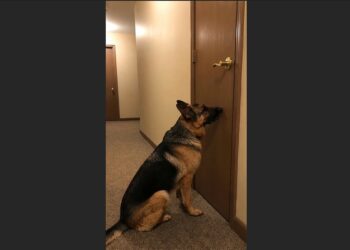
For six weeks, my Belgian Malinois mix scratched at my seven-year-old daughter’s bedroom door every night. I was exhausted, frustrated, and preparing to find her another home. Then one night, I noticed something different about her behavior—and discovered an emergency I might otherwise have missed.
I was three days away from giving up my dog when she did something I will never forget.
Her name is Lori, a four-year-old Belgian Malinois mix I adopted about a year and a half ago.
For six straight weeks, she had been waking me up almost every night.
The routine was always the same.
Somewhere between 2 and 3 a.m., Lori would leave her bed, walk down the hallway, and begin scratching softly at my daughter’s bedroom door.
She never barked.
She didn’t throw herself against the door or make a terrible racket.
She simply scratched, quietly and persistently, until I woke up.
Every time, I would get out of bed, check on my seven-year-old daughter, Lily, and find her sleeping peacefully.
Then I’d guide Lori back to her bed and try to get some sleep myself.
After weeks of interrupted nights, I was running out of patience.
I had tried exercising Lori more, changing our nighttime routine, and asking a trainer for advice.
Nothing worked.
I was so worn down that I’d started drafting a message to find her another home.
Then, at 2:47 a.m. last Thursday, Lori went to Lily’s door again.
This time, I finally understood why I needed to pay attention.
Six Weeks of Sleepless Nights
When I adopted Lori, I knew a Belgian Malinois mix might need plenty of physical activity and mental stimulation.
She was an intelligent, energetic dog, and I understood that sharing my home with her would require commitment.
What I hadn’t anticipated was the nighttime scratching.
It didn’t begin as an occasional disturbance.
Once the behavior started, it became a pattern that repeated night after night.
Lori would leave her sleeping area and head toward Lily’s closed bedroom door.
Then came that familiar sound.
Scratch. Scratch. Scratch.
Not loud enough to sound like an emergency.
Just persistent enough to wake me.
At first, I assumed she wanted attention or had developed a habit of checking on Lily.
I would get up, open the bedroom door, and look inside.
Lily always appeared to be sleeping peacefully.
There was nothing obvious that explained Lori’s behavior.
No crying.
No sign that my daughter was awake.
Nothing that made me think she needed help.
So I’d lead Lori away from the door and return to bed.
The following night, it would happen again.
When Exhaustion Starts Changing How You Feel
After a while, the interrupted sleep began affecting me.
I was tired in a way that was difficult to shake.
It wasn’t just losing a few minutes of sleep. It was waking up in the middle of the night, getting out of bed, checking the room, settling the dog, and then trying to fall asleep again.
By morning, I often felt as though I hadn’t rested properly.
The frustration gradually built.
I loved Lori, but I couldn’t understand why she kept doing the same thing.
She wasn’t behaving aggressively.
She wasn’t destroying anything.
She wasn’t even barking.
But the scratching was disrupting our nights, and I was struggling to find a solution.
I began wondering whether I had underestimated what she needed.
Perhaps she wasn’t getting enough exercise.
Perhaps something about our household routine was making her anxious.
I wanted to believe there was a straightforward explanation.
So I tried to address the behavior.
Everything I Tried Seemed to Fail
My first idea was to increase Lori’s activity.
I started taking her on long evening runs, hoping that more exercise would help her settle down at night.
It seemed reasonable.
If she was restless because she had too much energy, perhaps she would sleep better after a demanding outing.
But the scratching continued.
I tried putting up a baby gate to keep her from reaching Lily’s bedroom door.
That didn’t work either.
Lori was easily able to step over it.
I remember how defeated I felt realizing that another attempt had failed.
I wasn’t asking for anything extraordinary.
I just wanted my family to sleep through the night.
Eventually, I consulted a dog trainer.
The trainer suggested that anxiety might be contributing to Lori’s behavior and mentioned medication as something that could potentially be considered.
I took the possibility seriously.
If Lori was anxious, I wanted to understand what was troubling her.
But I still didn’t have an explanation that made sense of the repeated trips to Lily’s door.
And by then, I was exhausted.
The Decision I Almost Made
I hate admitting this part.
I began thinking about rehoming Lori.
Not because I had stopped caring about her.
Not because I wanted to abandon my responsibility.
I simply felt unable to continue with the same exhausting routine.
I’d had Lori for approximately 18 months. She was part of our household, and the decision wasn’t something I took lightly.
But six weeks of broken sleep had worn me down.
I found myself wondering whether another family might be better equipped to handle her needs.
I even started drafting the message.
I wasn’t completely finished making arrangements, but I was close enough that the possibility felt real.
Three days. That was how close I came to giving her up.
Looking back, that is the part I find hardest to think about.
Because while I was trying to decide whether Lori could stay, she was continuing to return to the same bedroom door.
And I still hadn’t understood why.
The Night Everything Changed
Last Thursday began like the previous nights.
I went to bed hoping that, somehow, Lori might finally settle down.
Then, at exactly 2:47 a.m., I heard scratching.
The familiar sound came from the hallway.
I knew where Lori was before I even got out of bed.
My first reaction was frustration.
I was tired, and I couldn’t believe we were doing this again.
I got up, prepared to lead her away from Lily’s door as I had so many times before.
But when I reached the hallway, something stopped me.
Lori was standing outside the bedroom.
Only this time, her behavior looked different.
Something About Lori’s Posture Made Me Stop
During the previous nights, I had thought of the scratching as an unwanted habit.
But now Lori seemed unusually tense.
Her body was focused toward the door.
She looked alert in a way that immediately caught my attention.
I can’t explain exactly what it was about her posture that made me hesitate.
I only know that, for the first time, I stopped thinking about how annoying the scratching had become.
I looked at Lori.
Then I opened Lily’s bedroom door.
And within seconds, my frustration disappeared.
My daughter was lying in bed, apparently asleep.
But something was terribly wrong.
I heard a faint, strained sound coming from her.
It wasn’t the sound of ordinary breathing.
It was a shallow wheeze, quiet enough that I might not have noticed it from the hallway.
Then I looked more closely at her face.
Lily’s lips had a bluish tint.
My seven-year-old daughter was struggling to breathe.
She was experiencing a severe asthma attack while still in her bed, seemingly unaware of how serious the situation had become.
Suddenly, everything else stopped mattering.
There was no time to think about the interrupted nights or the frustration I had been carrying.
My daughter needed help.
Immediately.
The Emergency That Could Have Ended Differently
I picked Lily up and called 911.
I remember how quickly my attention shifted from Lori’s behavior to my daughter’s breathing.
The scratching that had irritated me only moments earlier no longer seemed important.
All I could think about was getting help for Lily.
The paramedics arrived within minutes.
They took over the emergency response, and Lily received the medical attention she needed.
Later, we were at the hospital.
Lily was resting under medical observation, with oxygen monitoring in place.
I was finally able to sit down and begin processing what had happened.
The doctor spoke to me about the seriousness of her condition.
What he said has stayed with me.
He explained that if another 10 or 15 minutes had passed before Lily received help, the outcome could have been very different.
He was careful with those words.
He didn’t need to say anything more.
I understood.
The Thought I Couldn’t Get Out of My Head
Sitting beside Lily in the hospital, I kept thinking about the time.
2:47 a.m.
I thought about Lori standing outside her bedroom.
I remembered the way her posture had changed and how she had remained focused on the door.
Then I thought about the previous six weeks.
All those nights I had gotten out of bed feeling irritated.
All the times I had checked on Lily, found her sleeping, and guided Lori away.
I remembered the long evening runs.
The baby gate.
The conversation with the trainer.
And finally, the message I had started writing because I believed I couldn’t manage Lori’s behavior anymore.
I had been looking at the situation from only one perspective.
Lori was disturbing our sleep, and I wanted the disturbance to stop.
I hadn’t considered that there might be something important about where she kept going.
That realization was difficult to sit with.
I was grateful that Lily had received help in time.
But I couldn’t stop thinking about how close I had come to removing Lori from our home.
Was Lori Trying to Warn Me All Along?
I wish I could say that I know exactly what Lori had been noticing during those six weeks.
I don’t.
On the earlier nights, Lily had appeared to be sleeping normally whenever I checked on her.
I have no way of knowing whether Lori was responding to subtle changes in her breathing, another sound I hadn’t noticed, or something else entirely.
Dogs can be attentive to changes in the people and environments around them, but that doesn’t mean every unusual behavior has a medical explanation.
Still, what happened that Thursday was different from the other nights.
Lori’s alertness made me stop.
I opened the door.
And I discovered my daughter struggling to breathe.
Whatever had motivated Lori’s earlier behavior, that final warning led me to check on Lily when she urgently needed help.
I keep returning to that distinction.
I had spent weeks trying to stop Lori from approaching the door.
Yet on the night that mattered most, her persistence brought me into the hallway.
I don’t know whether Lori understood the danger.
I don’t know whether she recognized something in Lily’s breathing that my ears couldn’t detect from another room.
But I know what I saw.
A dog standing tensely outside a child’s bedroom.
A seven-year-old struggling through a serious asthma attack.
And a sequence of events that allowed me to call for help.
That is enough to change the way I think about Lori.
The Dog I Almost Gave Away
Before that night, I had begun to see Lori’s scratching as evidence that something wasn’t working.
I loved her, but I had become so focused on the behavior that I was losing sight of everything else about her.
After Lily’s emergency, I looked at her differently.
The frustration didn’t disappear because six weeks of interrupted sleep had suddenly become pleasant.
They hadn’t.
Those nights had been difficult, and I had genuinely struggled.
But now I understood that Lori’s repeated trips to Lily’s door deserved more attention than I had given them.
I no longer wanted to think about finding her another home.
The message I’d started drafting would never be sent.
I had come too close to making a decision I would have deeply regretted.
And while I couldn’t change how I had felt during those exhausted nights, I could decide what happened next.
Lori was staying.
Not temporarily.
Not until another difficult behavior appeared.
She was part of our family, and I intended to give her the care and commitment she deserved.
A Different Kind of Gratitude
There is something humbling about realizing that an animal may have been trying to communicate something you didn’t understand.
For weeks, I had viewed Lori’s behavior as a problem that needed fixing.
I had tried to tire her out, block her access to the hallway, and find an explanation that fit what I expected.
I never imagined that the same behavior would lead me to discover a medical emergency.
I still believe it’s important to take behavioral problems seriously and seek appropriate help.
But I also know that unusual behavior can be worth investigating carefully, especially when it continues without an obvious explanation.
In Lori’s case, I had been too exhausted to see beyond the interruption.
That doesn’t mean I could have diagnosed Lily’s asthma attack earlier.
And it certainly doesn’t mean anyone should rely on a pet instead of appropriate medical care or monitoring.
What it means is that, on one frightening night, I paid attention to Lori’s unusual alertness.
And I’m profoundly grateful that I did.
Today, Lori Sleeps Beside Lily
Lily is back where she belongs, and our home feels different now.
The experience has changed how I think about the dog I nearly gave up.
Lori still has the intelligence and energy I knew she possessed when I adopted her.
She’s still a Belgian Malinois mix with her own needs, habits, and personality.
But the image that stays with me is no longer the dog scratching at a bedroom door in the middle of the night.
It’s Lori standing in the hallway at 2:47 a.m., focused on Lily’s room.
And it’s the moment I opened that door.
Her Favorite Place Is at Lily’s Feet
These days, Lori often sleeps stretched out across Lily’s feet.
It’s become her familiar nighttime resting place.
Seeing them together brings me a kind of comfort I can’t easily describe.
I know that having Lori nearby isn’t a substitute for following Lily’s medical care plan.
And I don’t expect our dog to take responsibility for detecting future emergencies.
That responsibility belongs to the adults caring for Lily and the medical professionals guiding her treatment.
But I can appreciate the special relationship between my daughter and the dog who helped bring my attention to her bedroom that night.
Lori is no longer the dog I was preparing to rehome.
She’s the dog I look at with gratitude every time I remember what happened.
Sometimes I think about how close I came to letting her go.
Three days.
If things had happened differently, I might have sent that message and found another family for her.
Instead, I was given a reason to stop and reconsider everything.
The Night I Finally Understood My Dog
I used to hear Lori scratching and think about how much sleep I was losing.
Now, when I remember those six weeks, I think about how little I understood.
I had assumed she was restless.
I had considered anxiety.
I had tried to solve the problem through exercise and physical barriers.
All reasonable attempts, based on what I knew at the time.
But on that Thursday morning, Lori showed me that I needed to look more closely.
I don’t want to turn what happened into a claim that she possesses some extraordinary medical ability.
I can’t prove that.
What I can say is that her behavior prompted me to check on my daughter at a moment when every minute mattered.
And according to the doctor who treated Lily, those minutes were important.
That is something I will never forget.
Lori didn’t ask for praise afterward.
She didn’t know about the message I had almost sent or the decision I had been struggling to make.
She was simply our dog.
The same dog I had adopted a year and a half earlier.
The same dog who had spent six weeks returning to Lily’s door.
And the same dog who now rests at the foot of my daughter’s bed.
I used to believe I was doing my best for Lori by trying to correct a behavior I couldn’t understand.
Now I know that I also needed to listen more carefully.
I was three days away from giving her up. Instead, I found myself more grateful than ever that she was part of our family.
Some of the most important things our dogs communicate don’t come with a bark.
Sometimes, they come as a quiet scratching at a bedroom door.
And sometimes, paying attention makes all the difference.