Officer Mark Davies had worked alongside Bruno long enough to recognize the smallest changes in his partner’s behavior.
A slight movement of his ears. The way he held his body when something caught his attention. The quiet intensity that came over him when he was focused on a task.
Bruno was a five-year-old Belgian Malinois, trained for police work and accustomed to situations most family dogs would never encounter.
He was intelligent, energetic, and fiercely attentive to the officer who worked beside him.
To the department, Bruno was a K-9 officer.
To Mark, he was much more than that.
He was the familiar presence beside him in the patrol vehicle, the partner he depended on during dangerous calls, and the dog whose well-being was always somewhere in the back of his mind.
They had spent countless hours working together.
And on a rainy Tuesday night, that partnership would be tested in a way neither could have anticipated.
By the time the night was over, Mark would still be alive.
But Bruno would not.
The call came late Tuesday evening.
An armed robbery had been reported, and Officer Davies and Bruno were among those responding.
It was the kind of situation that could change in seconds.
An armed suspect was potentially dangerous, and officers had to remain alert as they approached the scene.
When the suspect fled, the situation became a pursuit.
Mark and Bruno followed.
The chase carried them away from the initial scene and into a darker part of the area, where rain had left the pavement wet and visibility was poor.
The streets were slick.
Water collected along the edges of the road.
And the narrow spaces between buildings offered plenty of places for someone to disappear.
Bruno stayed with his handler.
The dog had been trained to work in demanding environments, where noise, movement, and uncertainty were part of the job.
But training cannot eliminate every danger.
Even experienced officers cannot know what is waiting around every corner.
As Mark pursued the fleeing suspect, the chase led into a dark alley.
A dumpster stood near one of the walls.
Rainwater glistened on the pavement.
The suspect was somewhere ahead.
Mark moved forward.
And as he rounded a corner, the danger appeared almost directly in front of him.
The suspect stepped out from behind the dumpster.
He had a gun.
And he pointed it straight at Mark’s chest.
Only a few feet separated them.
There was almost no time to react.
But Bruno was there.
What happened next took only a moment.
Bruno moved before Mark could fully respond.
The Belgian Malinois launched himself forward, placing his body between the armed suspect and his handler.
A shot rang out.
The bullet struck Bruno.
In that terrible instant, the dog had put himself directly in the path of the gunfire.
His movement gave Mark the brief opportunity he needed to respond and stop the threat.
The confrontation ended.
Officer Davies survived.
But Bruno had been gravely wounded.
And the officer who had depended on him throughout their partnership was suddenly facing the possibility of losing him.
Mark dropped to the wet pavement.
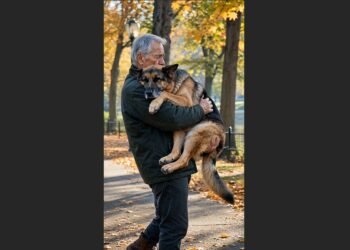
He reached for Bruno and pulled the injured dog into his arms.
Moments earlier, they had been moving together through the alley, focused on a dangerous assignment.
Now the pursuit was over.
The immediate threat had been stopped.
And Mark was kneeling beside the partner who had taken the bullet.
There was nothing ordinary about that moment.
For a K-9 handler, the working relationship with a police dog involves a degree of trust that most people rarely see.
The handler depends on the dog to respond to commands, recognize threats, and carry out demanding tasks in unpredictable environments.
The dog, in turn, relies on the handler for direction, care, and protection.
Together, they learn to work as a team.
That partnership is built through training, repetition, and countless hours spent side by side.
But no amount of preparation can make it easy to watch a partner suffer.
And Bruno was suffering.
Fellow officers arrived at the scene and found Mark on the pavement, holding his wounded dog.
Bruno’s injuries were fatal.
The five-year-old Belgian Malinois died after being struck by the gunfire.
He never returned to the patrol vehicle.
There would be no familiar routine at the end of the shift.
No chance for Mark to bring him safely back from another call.
The dog who had worked beside him was gone.
For those who knew Bruno, the loss reached far beyond the events of that single night.
Police K-9s are often seen by the public during dramatic moments: searches, pursuits, arrests, and demonstrations of their extraordinary training.
But much of a handler’s relationship with a working dog develops in quieter circumstances.
During ordinary shifts.
While preparing equipment.
Between assignments.
During the repetitive practice that allows a dog and handler to communicate effectively under pressure.
A good K-9 team learns each other’s habits.
They become familiar with small changes in behavior that might mean nothing to someone else.
They spend long hours together, including stretches when nothing especially exciting happens.
And through all of it, the partnership becomes part of daily life.
Bruno was only five.
For a working dog, he was still relatively young.
There should have been more years ahead of him.
More training.
More assignments.
More ordinary days beside the officer who knew him best.
Instead, his life ended in an alley on a rainy Tuesday night.
And Mark was left to face the loss of a partner whose final action had helped save his life.
The following morning, Officer Davies spoke about what had happened.
His grief was unmistakable.
“He knew exactly what he was doing,” Mark said tearfully. “He saw the gun, and he chose me. I’m going home to my family because he stepped in.”
Those words captured how Mark understood Bruno’s final moments.
He believed his partner had recognized the danger and moved to protect him.
No one can know precisely what a dog understands in such a sudden, violent situation.
But what Bruno did was clear.
He moved between Mark and an armed suspect.
The bullet struck him instead of his handler.
And Mark survived the encounter.
For the officer who had worked beside him, that sequence would never be simply another detail in an incident report.
It was the moment his partner was lost.
And the moment he was given the chance to return home.
There is something particularly painful about the death of a police dog.
These animals are trained to carry out work that can place them in dangerous situations, yet they depend entirely on the people responsible for their care.
They don’t understand police ranks or departmental awards.
They don’t know what it means to become the subject of a news report.
They know their training.
They recognize familiar people.
They respond to the commands and routines they’ve learned.
And they form close working bonds with their handlers.
Bruno’s role required courage and discipline, but he was still a dog.
A living animal who needed rest, food, veterinary attention, reassurance, and the companionship of the people he trusted.
He wasn’t simply equipment assigned to an officer.
He was a partner who had a personality, habits, and a place in the everyday lives of those who worked with him.
That is why the loss of a K-9 can be so deeply personal.
The handler doesn’t just lose a capable working companion.
He loses an animal whose presence has become familiar in hundreds of small ways.
The sound of movement beside him.
The sight of his partner waiting for the next instruction.
The routine of preparing for another shift together.
When that partnership ends suddenly, the absence follows the handler long after the immediate emergency has passed.
And for Mark, Bruno’s absence came with a painful knowledge.
He was alive because his dog had stepped into the path of danger.
At the station, Bruno’s collar now hangs in the locker room.
It is an ordinary object, but its meaning has changed.
A collar is something most dog owners handle without thinking.
It is part of the daily routine.
Something attached before going outside.
Something adjusted or checked to make sure it fits comfortably.
But when a beloved dog is gone, even the simplest belongings can become difficult to look at.
A leash hanging by the door.
A bed that will no longer be occupied.
A familiar toy left where it was last dropped.
For the officers who worked with Bruno, his collar has become a reminder of the partner who did not return from duty.
It represents the years of training and service.
The dangerous calls.
The partnership with Mark.
And the final moments in the alley, when Bruno moved forward as a gun was aimed at his handler.
The station will continue operating.
Calls will still come in.
Officers will report for duty.
The work of law enforcement does not stop because a department has suffered a loss.
But the people who knew Bruno will remember that one of their own is missing.
And Mark will carry a particularly personal memory of the dog who worked beside him.
It’s easy to focus on the split second when Bruno jumped forward.
That was the moment that changed everything.
But a partnership like theirs cannot be understood through one moment alone.
It takes years of consistent work to build a reliable relationship between a police officer and a K-9.
There are early training sessions when the dog is still learning what is expected.
Days when the handler must remain patient through repetition.
Times when communication improves so gradually that neither member of the team can identify the exact moment it began to feel natural.
Eventually, they become familiar with one another.
The officer learns how the dog responds to uncertainty.
The dog learns the handler’s voice and movements.
And both become accustomed to working together in situations that demand concentration.
By the time Bruno and Mark entered that alley, they were already a team.
The events of Tuesday night didn’t create their bond.
They revealed how consequential that bond could become.
When the suspect appeared with a gun, Bruno reacted.
His response gave his handler time.
And the terrible cost of that response was Bruno’s life.
For Mark, returning home after the incident carried a meaning that most people can scarcely imagine.
He had survived an encounter in which a gun was pointed at him from close range.
He would be able to see his family again.
To walk through his own front door.
To continue living the life that might have ended that evening.
But the dog who had been beside him when the pursuit began would not be coming back.
There is no simple way to separate those two realities.
Gratitude for survival.
And grief for the partner who died.
Both can exist at the same time.
A person can be thankful to be alive and still feel the terrible weight of what was lost.
Officer Davies’s words the following morning reflected that difficult combination.
He was going home because Bruno had stepped forward.
But he would be going home without Bruno.
And that was a loss no one could undo.
Bruno’s story also offers a reminder of the responsibilities people take on when they work with animals in dangerous professions.
Police dogs are capable of extraordinary tasks, but they are not invulnerable.
They can be injured.
They can experience fear and pain.
And when something goes wrong, the consequences can be devastating.
Their training may prepare them to act under pressure.
It cannot make them immune to bullets.
Bruno’s death makes that reality painfully clear.
He was a highly trained Belgian Malinois, young, capable, and experienced enough to work beside an officer responding to an armed robbery.
Yet one encounter ended his life.
The courage associated with police dogs should never cause us to forget their vulnerability.
They depend on their handlers and departments to take their welfare seriously.
And when they die in the line of duty, their loss deserves to be recognized not only because of what they accomplished, but because they were living companions whose lives mattered.
Bruno mattered before that Tuesday night.
He mattered during every ordinary shift.
And he mattered when the danger appeared.
His final action made his story known beyond the people who had worked with him.
But his value had never depended on that moment.
I keep returning to the image of Mark kneeling in the alley.
Rain on the pavement.
The pursuit over.
Other officers arriving.
And Bruno lying in his handler’s arms.
It is a heartbreaking image because the roles had suddenly changed.
For years, Bruno had accompanied Mark into uncertain situations.
They had worked together, depending on one another to do their jobs.
Now Mark could do nothing but hold the injured dog who had just protected him.
There are times when even the most experienced officer cannot control what happens next.
Training, determination, and courage cannot reverse every injury.
And in that alley, despite everything that had been done to stop the threat, Bruno could not be saved.
He died with the person who knew him best beside him.
For Mark, that memory will likely remain inseparable from the gratitude he feels for surviving.
And for the officers who arrived that night, the sight of their colleague holding his fallen partner is not something easily forgotten.
Bruno was five years old.
A Belgian Malinois.
A police K-9 trained to work beside Officer Mark Davies.
He responded to an armed robbery late on a Tuesday evening.
He followed a fleeing suspect into a rain-soaked alley.
And when a gun was pointed at his handler from only a few feet away, he moved into the path of the danger.
The bullet struck Bruno.
His handler survived.
Bruno did not.
Those are the events that define the final night of his life.
But they are not everything that defined him.
There were also the years spent training.
The long shifts.
The familiar routines.
The trust built between a dog and the officer responsible for him.
And the quiet companionship that existed when there were no dangerous calls to answer.
That was Bruno’s life too.
It deserves to be remembered.
Somewhere in a police station, his collar hangs in a locker room.
It no longer needs to be fastened before another shift.
No one will reach for it to prepare Bruno for a new assignment.
The dog it belonged to is gone.
But the people who knew him still have their memories.
And Officer Mark Davies has something more difficult to carry.
The knowledge that on the night he came face-to-face with an armed suspect, his partner moved first.
Bruno’s action allowed him the time to survive.
Mark said the next morning that he would be going home to his family because his dog had stepped in.
There are few words more powerful than those from someone who has just lost a companion.
They express gratitude.
Grief.
And the painful reality of a life saved at the cost of another.
K-9 Bruno was only five years old when he was fatally shot during an armed robbery response.
He moved between a gunman and Officer Mark Davies, giving his handler the time needed to stop the threat.
The officer lived.
His dog died.
And the collar now hanging at the station serves as a reminder of the partner who never returned from that final call.
Bruno will be remembered for the courage he showed that night.
But also for the years of loyalty, training, and companionship he shared with the officer who loved him.
For Mark, there will be no replacing that particular dog or the life they shared.
Only the memory of a trusted partner.
And the knowledge that when the danger came, Bruno was there.
Officer Davies went home to his family that night.
Bruno was the reason he could.