For months, my neighbor’s pit bull kept getting out of his yard, crossing the street, and settling himself on my front porch.
He never seemed interested in wandering around the neighborhood. He wasn’t chasing squirrels or looking for trouble.
He came straight to my house.
Then he sat beside the front door as though he had an appointment.
At first, I thought he was lost. After the second visit, I suspected his family’s gate wasn’t secure. But when it happened again and again, I began to wonder what was so interesting about my porch.
My son couldn’t make sense of it either.
The whole thing eventually became funny enough that, when I began to understand what these visits meant, I laughed.
It wasn’t the response I would have expected from myself.
Six years earlier, I had lost my husband. Since then, I had lived alone in our home in Flagstaff, Arizona, growing accustomed to the kind of quiet that follows a loss no one can prepare you for.
I hadn’t wanted another dog.
I hadn’t wanted another attachment that might someday leave me grieving.
But a broad-headed pit bull with a white chest and gentle amber eyes kept appearing at my door, apparently unconcerned with my carefully maintained distance from the world.
And somehow, without asking me to make any grand decisions, he began changing the way my house felt.
The Dog Across the Street Who Wouldn’t Stay Home
The pit bull belonged to a young family living across the street from me.
There were two parents and two boys, and their home always seemed to be the sort of place where someone had a project underway.
Every spring, the yard received attention. The couple took care of their property, and even painting the trim could become a weekend activity.
From the outside, they looked like a busy family going about the ordinary business of raising children and maintaining a home.
Their dog was part of that household.
He was a handsome, muscular pit bull with a large head, a white patch across his chest, and eyes that were much softer than his imposing appearance might have suggested.
I had never had a reason to pay particularly close attention to him.
Then he started showing up on my porch.
The first time, I assumed he had wandered away from home and ended up at the wrong house.
That seemed reasonable enough.
Dogs sometimes find their way out of a yard. Gates don’t always latch properly, and an unexpected opportunity can be difficult for a curious animal to resist.
But the next time he appeared, he was sitting in almost the same place.
And the next time, too.
He wasn’t pacing around the yard or investigating every unfamiliar smell.
He simply came up the steps and waited near my front door.
A Very Determined Visitor
After several visits, it became difficult to treat his appearances as ordinary wandering.
The pit bull seemed to have a destination.
And that destination was my porch.
His owners were understandably embarrassed. They hadn’t intended for their dog to keep showing up at someone else’s house, and retrieving him became an increasingly familiar task.
I remember one occasion when the wife came over looking slightly breathless.
She had an empty leash in her hand and the expression of someone who was tired of making the same apology.
“I’m so sorry. He got out again… and came straight here.”
I looked down at the dog.
There he was, sitting calmly in the mountain sunshine, looking entirely comfortable with the situation.
His owner was apologizing.
I was trying to understand what was happening.
And he looked as though he couldn’t imagine why anyone was making such a fuss.
There was something almost comical about it.
He wasn’t being rowdy or demanding attention. He simply seemed to have decided that my front porch was a perfectly good place to spend part of his day.
I couldn’t explain why.
But I was beginning to recognize that this wasn’t going to be a one-time occurrence.
Six Years of Living in a House That Had Become Too Quiet
To understand why those visits affected me so much, I have to explain what life had been like before they began.
My husband had been gone for six years.
Six years is a long time to live without someone who used to be part of nearly every ordinary moment of your day.
In the beginning, grief was immediate and difficult to ignore.
Later, it became quieter.
I learned to manage my days. I took care of the house, went about my responsibilities, and grew accustomed to doing things on my own.
From the outside, my life probably appeared reasonably settled.
But there were moments when the absence was still unmistakable.
One cup on the table in the morning.
One plate at dinner.
One side of the bed that remained empty.
Those weren’t dramatic reminders. They were simply the details of living alone.
The hardest part wasn’t always being by myself.
It was the absence of the easy companionship I had known for so long.
When you’ve shared a life with someone, even the smallest routines become part of that relationship.
You become accustomed to another person’s presence without consciously noticing it.
Then, one day, that presence is gone.
The house remains.
The familiar rooms are still there.
But the feeling of living in them changes.
Why I Had Resisted Getting Another Dog
People had suggested that I get a dog.
They meant well.
A dog could offer companionship, encourage a daily routine, and bring some life back into a quiet house.
I understood their reasoning.
But I wasn’t ready.
The idea of loving another living creature carried a fear I didn’t quite know how to explain.
I had already experienced the loss of someone I loved deeply.
The thought of forming another close attachment, knowing that it would eventually come with its own possibility of loss, felt overwhelming.
I knew perfectly well that loving a dog wasn’t the same as loving a husband.
One relationship couldn’t replace the other.
But grief doesn’t always respond to reasonable explanations.
Sometimes it makes you cautious about opening your life to anything you might someday lose.
I didn’t want to feel that vulnerable again.
So I kept telling myself I was fine.
I had my home.
I had my routines.
I had learned how to live quietly.
And I wasn’t looking for anything to change.
Then my neighbor’s dog started arriving on my doorstep.
The Moment I Opened the Door
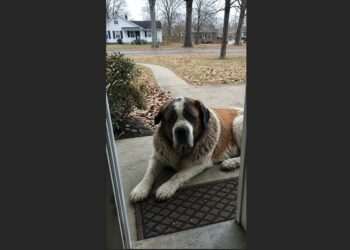
One afternoon, the pit bull was sitting on my porch again.
The Flagstaff sunshine fell across the steps, and he had settled himself near the entrance with the same calm confidence I had come to recognize.
He looked up at me with those amber eyes.
There was nothing threatening about his behavior.
He wasn’t jumping at the door or barking impatiently.
He was simply waiting.
When I opened the door, he didn’t rush inside.
Instead, he moved close enough to lean his warm body against my leg.
Then he let out a long, contented sigh.
I remember how natural the gesture felt.
There was no excitement to manage, no frantic demand for attention, and no need for me to entertain him.
He seemed perfectly satisfied to stand there beside me.
I don’t know why that small moment stayed with me so strongly.
Perhaps it was because he asked so little.
Or perhaps it was because I had spent so many years trying to convince myself that I no longer needed that kind of uncomplicated companionship.
Whatever the reason, I found myself standing in the doorway longer than I had intended.
His broad head rested close to me, and his body was warm against my leg.
For a little while, the porch wasn’t simply the place where I stood alone looking out toward the street.
There was someone beside me.
And that felt good.
A Dog Who Didn’t Need Me to Be Anything Special
There was something unexpectedly comforting about the way he visited.
He didn’t need me to explain why I sometimes preferred being alone.
He wasn’t concerned with whether I was cheerful or talkative.
He didn’t ask questions about my husband or suggest that I should have moved on by now.
Of course, he was a dog. I wasn’t imagining that he understood my grief or had made some deliberate decision to help me through it.
I couldn’t know what drew him to my porch.
Perhaps he liked the quiet.
Perhaps he enjoyed the attention.
Perhaps he had simply discovered a comfortable place and decided it was worth returning to.
The explanation might have been perfectly ordinary.
But the effect of his visits on me was real, even if his reasons remained a mystery.
I began to notice the difference between the days when I was alone and the moments when he was sitting nearby.
The house hadn’t changed.
My circumstances hadn’t changed.
My husband was still gone, and I still missed him.
But the silence seemed a little less absolute when that familiar dog was resting beside me.
When I Finally Understood What His Visits Meant
For a while, I resisted becoming too attached.
I told myself that he belonged to the neighbors and that his visits were simply an amusing inconvenience.
That was true, in a practical sense.
He wasn’t my dog.
I hadn’t adopted him, and I wasn’t responsible for making all the decisions about his care.
His family lived right across the street.
But I couldn’t ignore how much I had begun to enjoy seeing him.
At first, I thought that was precisely the problem.
I had spent years protecting myself from the possibility of another painful goodbye.
Now a dog I hadn’t asked for was becoming part of my life.
I remember thinking that I wasn’t ready for that.
And yet I didn’t want him to stop coming.
That contradiction took me some time to understand.
I wasn’t being forced into a new relationship or asked to forget the one I had lost.
I was simply discovering that companionship could return to my life in a form I hadn’t expected.
The dog didn’t replace my husband.
Nothing could.
He wasn’t filling the same role, and I didn’t need him to.
He was a friendly neighbor’s dog who enjoyed sitting on my porch.
And sometimes that was enough to make an ordinary afternoon feel better.
The Part That Finally Made Me Laugh
Eventually, the situation became too familiar to keep treating every visit as an emergency.
My neighbors knew where their dog was likely to go.
I knew whose dog was sitting outside my door.
And the dog, for his part, continued behaving as though visiting me was part of a perfectly reasonable routine.
That was when I began laughing about it.
I had spent so much time trying to decide whether I was ready to bring another dog into my life.
Meanwhile, a dog from across the street had been showing up without waiting for me to settle the question.
He didn’t seem to care about my complicated feelings.
He wanted to sit on the porch.
I enjoyed having him there.
It was almost embarrassingly simple.
My son certainly hadn’t expected this to be the answer to my years of insisting that I didn’t want another dog.
To be honest, neither had I.
I had imagined that letting companionship back into my life would require some enormous emotional decision.
Instead, it happened gradually, through a series of ordinary visits that became easier to welcome.
There was no dramatic turning point.
Just a dog who kept coming back, and a woman who slowly stopped wishing quite so hard for the world to leave her alone.
A New Understanding Between Two Households
Eventually, the dog’s family and I stopped going through the same cycle of apologies and explanations.
We began talking more comfortably about his visits.
They knew he enjoyed coming to my porch.
I had made it clear that I liked having him around.
And we all understood that repeatedly escaping and crossing the street wasn’t a sensible arrangement.
So we worked out a more manageable routine.
He could visit, and I could enjoy his company without pretending that he had somehow become my dog alone.
His family remained his family.
I was simply another familiar person who had made room for him.
There was something lovely about that arrangement.
It didn’t require anyone to give him up.
It didn’t require me to take on responsibilities I hadn’t been looking for.
And it didn’t turn his affection into something that had to belong exclusively to one household.
Instead, we found a way to let him be part of both.
He Didn’t Have to Choose Between Us
I think people sometimes imagine that a dog’s affection must be divided into neat categories.
One home.
One family.
One person who matters most.
But dogs can form relationships with more than one person.
They can enjoy different environments and become comfortable with people outside their immediate household.
Our neighbor’s pit bull seemed perfectly capable of doing that.
He belonged to the family across the street, with their busy household and two boys.
And he had also become a welcome presence at my home.
There was no competition between us.
His visits didn’t mean that his family had failed him or that he was searching for someone better.
I had no reason to believe that.
What I knew was that he had developed a habit of coming to my porch, and we had found a way to welcome him without disrupting the family he already had.
For me, it was an arrangement I never would have thought to ask for.
I hadn’t been looking to adopt a dog.
But I had been lonely.
And somehow, an unexpected friendship had found its way into my life.
The House Is Still Mine, but the Silence Has Changed
The pit bull still visits.
He still has that broad head, white chest, and gentle expression that I now recognize so easily.
He still enjoys being near my front door.
And when he leans against me, I remember the afternoon I first began to understand why his company mattered.
Six years after losing my husband, I haven’t stopped missing him.
I never expected to.
Grief doesn’t disappear because a dog comes to visit, and I wouldn’t want to suggest that companionship can erase the importance of someone we’ve lost.
My husband remains part of my life through the years we shared and the memories I carry.
Nothing about this friendship changes that.
But I’ve learned that missing someone and enjoying the company of someone else are not opposites.
I can still wish my husband were here.
And I can still smile when a familiar dog arrives at my door.
For a long time, I thought opening myself to another attachment meant inviting another loss.
Now I understand that refusing companionship has its own cost.
I had become so accustomed to protecting myself from future sadness that I sometimes forgot how pleasant an ordinary shared moment could be.
The pit bull didn’t teach me that through any grand gesture.
He simply kept showing up.
He sat on my porch.
He leaned against my leg.
He made me laugh.
And over time, I began looking forward to his company.
There is still one cup on my table most mornings.
There is still an empty side of the bed.
Those details of my life haven’t changed.
But the house no longer feels quite as closed off from the world.
Across the street, there is a family whose dog has become an unexpected part of my days.
He has a home with them, and he has a place here where he is welcome.
I can’t explain exactly why he chose my porch in the first place.
Maybe I never will.
What I do know is that his visits arrived during a time when I had almost forgotten how much comfort simple companionship could bring.
And now, when I open the door and see him waiting, I don’t wonder why he’s there.
I’m just glad he came.
He still belongs to the family across the street. But somewhere along the way, he became part of my home, too.