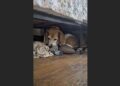
The moment we brought Rex into our house, he disappeared beneath the dining room table.
He did not sniff the furniture or wander through the hallway. Instead, the nine-year-old pit bull crossed the room, found the narrowest space beneath the heavy wooden table, and pressed his back against the wall.
Then he stayed there.
My name is Thomas. I was 34 when Rex came into our lives, and until that autumn, I thought patience simply meant waiting long enough for something to happen.
Rex taught me something different.
Real patience, at least with a frightened dog, often means giving up the expectation that anything has to happen at all.
We First Saw Rex in a Shelter Photograph
My partner, Élodie, found him while looking through the shelter’s website one evening.
She stopped scrolling and turned the laptop toward me.
“Look at this dog.”
Rex was sitting near the back of a kennel. His coat was dark, his muzzle had begun to gray, and his body seemed smaller than I expected for a pit bull his size.
What caught my attention was not his appearance.
It was the distance in his expression.
I would not call it hopelessness because a photograph cannot tell us exactly what a dog feels. Still, Rex looked withdrawn in a way that made me stop and read everything the shelter had written about him.
His History Was Difficult
According to the information available to the shelter, Rex had spent much of his life in neglectful and abusive circumstances.
Some details were incomplete.
Others were known only through the condition in which he arrived and the reports associated with his case.
What staff could observe directly was clear enough.
Rex avoided unfamiliar people.
If someone approached too quickly, he moved away.
Sudden gestures made his body tense.
Most striking of all, he often refused to eat while anyone remained nearby.
A volunteer explained it carefully when we called.
“He usually waits until the room is quiet,” she said. “Sometimes until the lights are low.”
Then she added something even more important.
“He doesn’t need someone to prove anything to him. He needs someone who can let him decide the pace.”
We Almost Talked Ourselves Out of Meeting Him
Élodie and I had adopted dogs before, but neither of us had lived with one as fearful as Rex.
We discussed the practical questions first.
Could our home stay quiet enough?
Were we prepared for slow progress?
What if he never became affectionate?
Would we still feel satisfied giving him a safe home if he preferred distance for the rest of his life?
Those questions mattered because compassion alone was not enough.
Eventually, we decided to meet him without assuming that meeting would lead to adoption.
Rex Did Not Come Toward Us
At the shelter, we sat in a quiet visiting room.
Rex stayed near the far wall.
Élodie turned slightly sideways so she would not face him directly. Meanwhile, I kept my hands in my lap and avoided staring.
For nearly twenty minutes, very little happened.
Rex watched us.
We waited.
At one point, he shifted his weight and lowered his head.
That was all.
Still, when the visit ended, neither of us felt disappointed.
In fact, the lack of drama made the situation clearer.
Rex was telling us exactly what he needed.
Space.
Bringing Him Home Did Not Make Him Feel Safe Immediately
Several days later, after the shelter completed the adoption process and reviewed his needs with us again, Rex came home.
We had prepared a quiet room.
There was a bed near one wall, fresh water, food, and an open path to the back door.
However, Rex ignored the bed.
Instead, he walked straight beneath the dining room table.
The table stood against a wall, which gave him cover behind and above.
That seemed to matter.
His body pressed so tightly into the corner that his shoulder touched the baseboard.
Élodie looked at me.
I whispered, “Leave him.”
So we did.
That First Night Changed My Plan
Before Rex arrived, I had imagined helping him learn the house.
Perhaps I would sit nearby.
Maybe offer treats.
Eventually, I assumed, he would understand that we meant no harm.
Once I saw him under the table, that entire plan felt wrong.
Rex did not need a demonstration.
He needed control.
That night, I decided that we would stop measuring success by whether he came closer to us.
Instead, we would make the house predictable and let him choose what happened next.
For Three Days, He Ate Only When We Left
We placed his food several feet from the table.
Then we walked away.
At first, Rex did not move.
Several hours later, the bowl was empty.
The next meal went the same way.
By the third day, we had learned not to linger after placing food down.
We also avoided turning mealtime into a test.
If he needed solitude to eat, he could have it.
Meanwhile, the water bowl stayed close enough that he never had to cross an open room just to drink.
On the Fourth Evening, I Sat Nearby
Not too nearby.
I chose a spot several feet from the table and sat with my back partly turned toward him.
Then I talked.
At first, I felt ridiculous.
I told Rex about my day.
I complained about a traffic jam.
Afterward, I described a broken shelf at work and the argument I had with a printer.
None of it mattered.
The point was not the content.
Instead, I wanted my voice to become something ordinary.
His Ears Began to Move
For the first few minutes, Rex remained still.
Then one ear shifted when I laughed at something I had said.
A little later, both ears moved toward me.
I kept talking.
Importantly, I did not turn around to reward the reaction with attention.
Rex had noticed me.
That was enough.
Over the next few days, I repeated the routine.
Sometimes Élodie did the same.
Gradually, our voices became part of the evening rather than a signal that someone was about to approach him.
The Seventh Night Brought a Storm
Rain started after sunset.
By nine o’clock, the wind had strengthened, and thunder rolled across the neighborhood.
Rex had spent most of the evening under the table.
Then a particularly loud crack shook the windows.
We heard a sound from beneath the wood.
A low whine.
When I looked over, Rex was trembling.
His body had drawn even tighter against the wall.
Every instinct in me wanted to crawl under the table and comfort him.
Instead, I reminded myself that comfort only works when the recipient experiences it as comfort.
Touch from me might have made things worse.
I Lay Down Several Feet Away
Very slowly, I lowered myself onto the floor.
I stayed outside the table.
Then I lay on my back and looked toward the ceiling.
My hands rested on my stomach.
I did not reach toward Rex.
Another thunderclap came.
His breathing quickened.
So I started talking.
I Told Him About Things I Had Been Afraid Of
As a child, I hated thunderstorms too.
I told Rex about hiding beneath blankets during summer storms.
Then I talked about the dark basement in my childhood home and the strange noises the furnace made.
Later, I told him about getting lost at a fair when I was seven.
Rex did not understand those stories as stories.
Still, the voice was familiar by then.
Calm.
Predictable.
Not moving toward him.
Outside, the rain continued.
Inside, I kept talking.
Then I Felt Something Against My Foot
At first, I thought I had imagined it.
A light pressure rested against my ankle.
I did not move.
After several seconds, I looked without lifting my head.
Rex had come out from beneath the table.
Only partway.
His front half was exposed while his hindquarters remained closer to his hiding place.
Then he lowered his head.
It rested against my ankle.
I stopped speaking for a second.
Immediately, I realized the silence might feel different, so I continued.
Quietly.
I Did Not Touch Him
That was difficult.
Every part of me wanted to place a hand on his head.
Instead, I stayed still.
Rex had chosen the distance.
He had chosen the contact.
Therefore, I wanted him to control how long it lasted.
Several minutes passed.
His breathing slowed.
Eventually, his eyes closed.
I remained on the floor long after my back started hurting.
Not because I believed I was witnessing a miracle.
Because Rex had made a small choice, and I did not want to turn it into something larger than he intended.
The Next Morning, He Was Back Under the Table
That surprised me less than it might have a week earlier.
Progress with a fearful dog is rarely a straight line.
The storm had ended.
Rex returned to the place that still felt safest.
So we continued exactly as before.
Breakfast.
Quiet.
Space.
No attempt to recreate the previous night.
That restraint became one of the most useful things we learned.
A good moment did not create a debt.
Rex did not owe us another one.
The Weeks That Followed Were Uneven
Some mornings, Rex stayed beneath the table until almost noon.
On other days, he emerged while we were in the room.
At first, he remained close to the furniture.
Later, he began crossing into the hallway.
Eventually, he investigated the living room when nobody was moving around.
Each new space became easier after repeated visits.
Meanwhile, we kept the household routine predictable.
Breakfast happened at roughly the same time.
Walks were offered without forcing him through the doorway.
Evenings stayed quiet.
Little by little, the house became familiar.
His First Voluntary Touch Came Weeks Later
One morning, I sat on the floor with one hand resting open beside me.
I had stopped using treats to lure him closer because I did not want him stretching beyond his comfort simply to get food.
Rex entered the room.
He paused.
Then he walked toward me.
Slowly.
His head remained low.
I kept my gaze soft and slightly away.
Finally, his nose touched the center of my palm.
He Stayed There for Several Seconds
I could feel the warmth of his breath.
His muzzle trembled slightly.
Still, he did not retreat.
I left my hand exactly where it was.
After a while, Rex stepped away on his own.
My first reaction was overwhelming gratitude.
Not because he had finally become “ours.”
He hadn’t.
Trust is not ownership.
What moved me was the fact that Rex had felt comfortable enough to make contact and then leave without anyone stopping him.
We Began Working With a Behavior Professional
Love and patience were important, but they were not the only tools Rex needed.
A qualified behavior professional helped us understand his body language more accurately.
We learned to watch for subtle signs of stress.
Lip licking.
Head turns.
Freezing.
Weight shifting backward.
Tightening around the mouth.
Those signals often appeared before obvious fear.
Because we noticed them earlier, we could give Rex distance before he felt trapped.
That made daily life easier for everyone.
We Also Changed the House
The dining table remained available.
We never blocked access to it.
However, Rex gradually gained other safe resting places.
A bed near the living room wall.
A mat beside the sofa.
Another bed in our bedroom doorway.
We added rugs to slippery flooring because he seemed less confident on smooth surfaces.
Meanwhile, visitors followed strict rules.
No reaching.
No crowding.
No bending over him.
If Rex chose another room, he was allowed to stay there.
The Garden Became His Next Challenge
At first, Rex stepped outside only when the yard was completely quiet.
He remained close to the door.
Then he returned inside.
A few days later, he sniffed the edge of the patio.
After that, he reached the grass.
Progress came in small pieces.
One morning, a bird landed near the fence.
Rex looked at it.
Then, for the first time, he trotted several steps away from the house.
Élodie and I looked at each other.
Neither of us spoke until he came back.
Months Later, He Ran
It happened so casually that I nearly missed the beginning.
Élodie was in the garden while Rex sniffed along the fence.
A leaf blew across the grass.
Rex noticed it.
He followed.
Then the wind caught it again.
Suddenly, he ran.
Not far.
Not for long.
But his gait opened.
His tail lifted.
For several seconds, the old pit bull moved across the yard without checking where either of us stood.
He was simply following something interesting.
That moment meant more to me than any forced display of affection could have.
Rex Did Not Become Fearless
Even now, sudden noises can make him startle.
If a stranger enters too quickly, Rex may leave the room.
Storms remain difficult.
Certain movements still make his body tense.
We do not treat those reactions as failures.
Nine years of experience did not vanish because several months were gentle.
Instead, Rex learned that this particular home operates differently.
That was enough.
He Began Seeking Affection on His Own
At first, physical contact remained brief.
A nose against my hand.
A shoulder near Élodie’s leg.
Then Rex started staying longer.
One evening, he approached while I was sitting on the sofa.
He rested his chin against my knee.
I scratched gently along his shoulder rather than reaching directly over his head.
He stayed.
A week later, he did it again.
Soon, that became routine.
The Table Never Completely Lost Its Meaning
Rex still goes beneath it sometimes.
Especially during storms.
At first, I viewed that as regression.
Eventually, I understood it differently.
The table is one of his safe places.
There is nothing wrong with that.
Now the difference is choice.
Rex can hide beneath the table.
He can also sleep in the hallway.
Stretch across the living room rug.
Lie in the garden.
Rest beside us.
His world has more options.
That matters far more than whether he ever stops using the old hiding place.
We Stopped Talking About “Saving” Him
People sometimes told us how wonderful it was that we had rescued Rex.
The phrase always felt incomplete.
The shelter rescued him from immediate danger.
Veterinary staff cared for his body.
Behavior professionals helped us understand him.
Élodie and I gave him a home.
Rex did the difficult work of adapting to it.
None of us single-handedly transformed him.
Moreover, he did not exist simply to teach us a lesson about kindness.
He was a dog with his own preferences, fears, and limits.
Respecting that made the relationship much healthier.
Rex Changed My Understanding of Patience
Before him, patience meant waiting for an outcome.
Wait long enough and something improves.
Wait long enough and the dog comes closer.
Wait long enough and the fear disappears.
Now I think differently.
Sometimes patience means sitting beside a table without knowing whether the dog underneath will ever approach.
It means making dinner while accepting that he may eat only after you leave.
It means lying on the floor during a thunderstorm without touching him.
Above all, it means allowing progress to belong to the dog.
Élodie Learned the Same Lesson in Her Own Way
She rarely sat on the floor as often as I did.
Instead, she created routines.
Each morning, she opened the back door and waited.
Every evening, she placed Rex’s food down and stepped away.
When she folded laundry, she talked softly without looking toward him.
Over time, Rex began following her.
First to the hallway.
Then to the kitchen.
Later, into the garden.
Their relationship developed differently from mine.
That was good.
Rex did not need to trust every person in exactly the same way.
One Evening, He Fell Asleep With His Head in Her Lap
Élodie had been sitting on the floor sorting mail.
Rex approached.
He leaned against her shoulder.
Then he lowered himself beside her.
A few minutes later, his head rested across her legs.
Élodie looked at me.
Her eyes filled.
I shook my head slightly, reminding her not to make a sudden movement.
She smiled.
Then she went back to opening envelopes.
That was how we learned to celebrate most milestones.
Quietly.
The Dog Who Once Ate Only in Darkness Now Eats Beside Us
Not always.
If the house is busy, Rex sometimes waits.
Usually, though, he eats while normal life continues around him.
Cabinets open.
Water runs.
Élodie walks through the room.
I make coffee.
Those sounds no longer automatically stop him.
Ordinary life became ordinary through repetition.
There was no shortcut.
He Has Developed Very Normal Opinions
Rex dislikes rain.
He loves warm patches of sunlight.
He believes cheese should be shared.
He dislikes the vacuum cleaner and leaves the room whenever it appears.
The couch technically belongs to us, although that arrangement is under review.
He also has a particular blanket that he rearranges several times before sleeping.
Those details make me happiest.
Fear is no longer the most interesting thing about him.
Rex gets to be complicated now.
Sometimes stubborn.
Sometimes playful.
Sometimes lazy.
Sometimes affectionate.
His Age Still Matters
At nine, Rex is not a young dog.
We monitor his joints.
His walks are appropriate for his condition.
Some mornings, he rises more slowly.
A safe home does not reverse age any more than it erases history.
Therefore, our goal is not to make up for every difficult year by filling his schedule with experiences.
He does not need constant adventures.
He needs comfort.
Consistency.
Medical care.
Choice.
And enough interesting things to keep being a dog.
I Still Remember That First Night
The dining room was quiet.
Rex was beneath the table.
His back pressed against the wall.
Food sat nearby.
I remember looking at him and feeling an almost desperate desire to prove that we were different.
Now I understand why that instinct needed to be controlled.
Trust cannot be demanded through good intentions.
If I had crawled beneath the table, Rex would not have known I was trying to comfort him.
He might only have seen another person entering the one place where he felt protected.
So I stayed outside.
That distance was the first thing I gave him.
Today, Rex Often Sleeps in the Middle of the Room
This still catches me sometimes.
He stretches onto his side.
Legs extended.
Belly partly exposed.
No furniture above him.
No wall pressed against his back.
When I walk past, one eye may open.
Usually, it closes again.
He knows the sounds of our footsteps now.
He knows which cabinet contains treats.
He recognizes the car in the driveway.
Most importantly, he knows what tends to happen next.
Nothing frightening.
Just another ordinary day.
The Change Was Never One Miracle
People like stories with one turning point.
The thunderstorm would make a convenient one.
A frightened dog crawls from beneath a table, rests his head on a man’s ankle, and suddenly everything is different.
That is not what happened.
The storm gave us one meaningful moment.
Then the next morning, Rex hid again.
Real change came afterward.
Hundreds of meals.
Hundreds of quiet voices.
Doors opening.
Doors closing.
People leaving.
People returning.
Hands that did not reach without invitation.
Days that ended without anything bad happening.
Rex Did Not Forget His Past
Nor should I pretend he did.
Some of his reactions still reflect experiences we may never fully understand.
However, the past no longer determines every choice he makes.
That is the difference I see.
The dog who once kept his entire body beneath a table now chooses between the sofa, the garden, the rug, and that same old hiding place.
Sometimes he wants company.
Sometimes he wants distance.
Both choices are allowed.
Last Night, He Came Over While I Was Reading
I was sitting on the couch.
Rex had been asleep across the room.
After a while, he stood.
He stretched.
Then he walked toward me.
Without hesitation, he placed his head in my lap.
I rested one hand along his shoulder.
A few minutes later, he fell asleep.
I thought about the first week.
About sitting several feet from the table with my back turned.
About how badly I had wanted him to understand that he was safe.
In the end, words never taught him that.
Routine did.
Patience Turned Out to Be Much Quieter Than I Expected
It was not heroic.
Most of the time, it was boring.
Sit.
Wait.
Feed.
Leave.
Return.
Repeat.
Still, those ordinary actions gave Rex something his earlier life had apparently offered far too little of.
Predictability.
A choice.
A way to say no without being punished.
And, eventually, enough safety to say yes.
Rex Still Goes Under the Table During Thunderstorms
When the sky becomes loud, he sometimes disappears beneath the same wooden table he chose on his first night.
We do not pull him out.
I may sit several feet away.
Élodie might leave a blanket nearby.
If Rex wants contact, he knows how to find us.
Sometimes he comes out.
Sometimes he stays beneath the table until the storm passes.
Either way, he is home.
That is the part that matters.
Nine difficult years cannot be erased by a few gentle months.
They do not need to be.
Rex did not have to forget everything that happened before us.
He only had to learn, day by day, that what happened next could be different.
And sometimes the most loving thing we could do was remarkably simple.
Stay nearby.
Ask for nothing.
Let him decide when the distance between us felt safe enough to cross.
Editor’s Note: The characters in this story are fictional. Through these stories, we hope to share the intelligence, loyalty, compassion, and loving nature of dogs with people everywhere.