The Trucks Left, but Rusty Stayed Behind
The family drove away on a cold, gray morning in November.
Their rented house sat along a gravel road surrounded by farmland in eastern Kentucky. By the time the sun was fully up, nearly everything that had made the place look like a home was being loaded into two pickup trucks and a rental trailer.
Beds.
Furniture.
Cardboard boxes.
Children’s bicycles.
Even the flowerpots that had once lined the porch.
Eventually, there was nothing left to carry.
The vehicles pulled onto the road and disappeared.
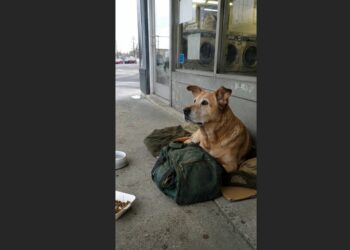
An eight-year-old mixed-breed dog remained behind.
Neighbors would later call him Rusty.
He had reddish-golden fur, a white patch across his chest, and one front paw that bent slightly from an old injury.
That morning, Rusty watched the trucks vanish.
Then he walked toward the mailbox.
And sat down.
At First, the Neighbor Thought the Family Would Return
A woman living across the road noticed Rusty later that afternoon.
She was not immediately alarmed.
Moving days are chaotic.
Maybe the family had taken one load and planned to return for another.
Perhaps someone was coming back for the dog.
So she watched.
Rusty stayed beside the mailbox.
As afternoon became evening, he remained there.
The next morning, she looked outside.
Rusty was still in nearly the same place.
He faced the road.
Another day passed.
Then another.
No truck returned.
No one came for him.
Eventually, the neighbor carried food and water across the road.
Rusty kept his distance until she went home.
Only then did he approach the bowls.
He ate.
He drank.
When he finished, he walked back to the mailbox.
Every Engine Made Him Stand
That pattern repeated.
Rusty did not disappear into the empty farmhouse.
He did not begin wandering the county road.
Instead, he stayed close to the property and returned repeatedly to the mailbox.
Whenever an engine approached, his body changed.
He stood.
His ears lifted.
Pickup trucks seemed to get the strongest reaction.
Sometimes his tail moved before the vehicle came fully into view.
Then it passed.
Rusty watched it disappear.
A few moments later, he lowered himself beside the road again.
No one could know exactly what he expected.
Dogs do not understand moving contracts, rental trailers, or a human decision to begin life somewhere else.
They do recognize vehicles, routines, familiar people, and the places where those people normally return.
Rusty’s behavior was simple enough to observe.
He kept looking down the road.
Winter Began Closing Around Him
November became December.
Rain crossed the fields.
Frost covered the grass before sunrise.
The temperature dropped.
Neighbors sometimes saw Rusty sheltering under the porch during the worst weather.
Someone left blankets.
Food appeared regularly.
Fresh water was brought when bowls froze.
But each morning, Rusty returned toward the mailbox.
His old front injury made his gait uneven.
Still, he went.
The roadside became the center of his routine.
Listen.
Look.
Stand when a vehicle approached.
Settle again when it continued past.
The people nearby grew increasingly concerned.
Yet Rusty remained wary enough that approaching him was difficult.
If someone called, he stayed back.
If they moved toward him, he created distance.
He accepted help only when people stepped away.
The Waiting Began Showing on His Body
Weeks outside took a toll.
Rusty’s coat, once thick, became rough and uneven.
His body grew thinner.
Ribs appeared.
Then his hips.
The cold and dampness irritated his skin.
Sores developed around his elbows from repeatedly sleeping on hard, frozen surfaces.
The pads of his paws cracked from gravel and exposure.
Even with neighbors leaving food, Rusty was not receiving the consistent nutrition and care he needed.
By January, the change was impossible to ignore.
He looked older.
Smaller.
Tired.
And yet, each morning, he returned to the same stretch of road.
By the time animal welfare officers were notified, eighty-one days had passed.
Rusty Weighed Only About 37 Pounds
Veterinary staff later estimated that his healthier weight would have been around sixty pounds.
He had lost close to one-third of what his body should have carried.
He was dehydrated.
Severely undernourished.
Parts of his skin were infected.
His paws were damaged.
The old injury in his front leg had never healed properly, though it was not the most urgent problem that day.
When an animal welfare officer arrived at the property, Rusty was not hidden under the porch.
He was beside the mailbox.
The officer approached slowly.
Rusty did not bark.
He did not growl.
He did not attempt to rush forward.
He simply watched.
Before he was led away, he turned toward the road once more.
To a human observer, the gesture looked painfully deliberate.
Still, no one could know what was in his mind.
Maybe he heard a vehicle.
Maybe he checked a familiar direction out of habit.
Then he followed the officer.
For the first time in almost three months, Rusty left the property.
Recovery Had to Begin Carefully
At the shelter, staff wanted to feed him immediately.
They also knew they had to be cautious.
A dog that has experienced prolonged undernutrition cannot always be given a huge meal safely.
His feeding plan was controlled.
Small portions.
Frequent meals.
Gradual increases as his body adjusted.
He received fluids.
Medication treated the skin infections.
His paws were cleaned and monitored.
For the first time since November, Rusty had soft bedding in a warm indoor space.
His body responded.
Slowly.
Weight returned.
His energy improved.
The rough coat began filling in.
He stood more comfortably.
His eyes followed people with greater interest.
Then one day, a shelter worker saw his tail move.
It was a small sign.
Nobody mistook it for complete recovery.
His Body Improved Faster Than His Behavior
Rusty’s medical progress encouraged everyone.
He ate reliably.
He gained weight.
He tolerated handling.
He showed no significant aggression.
Once he became physically stable enough, staff began considering foster care.
A home environment seemed preferable to a kennel.
The first foster family was excited to take him.
Four days later, they returned.
They felt terrible.
Rusty had not destroyed anything.
He had not snapped at anyone.
He had not barked continuously.
He simply would not settle.
He spent most of his waking hours beside their front door.
He listened to every sound outside.
He ate very little.
If a vehicle stopped nearby, he became alert.
Then he returned to waiting.
The foster family admitted they did not know how to help him.
The Second Home Saw the Same Pattern
Shelter staff tried again.
The second foster placement had a quiet household and plenty of patience.
Still, Rusty found the doorway facing the driveway.
That became his place.
When he discovered a window with a view of the street, he could spend hours there.
He seemed especially attentive to approaching vehicles.
The foster family tried treats.
Toys.
Gentle invitations to join them.
Nothing made much difference.
They did not force him.
But after ten days, they realized the arrangement was not working.
Rusty was physically safe.
Emotionally, he seemed unable to disengage from watching for something outside.
Again, it would be easy to say he was consciously waiting for the people who abandoned him.
No one could prove that.
What mattered was the behavior.
Doorways.
Roads.
Vehicles.
Vigilance.
Difficulty settling.
The pattern followed him from one home to another.
Then Margaret Lewis entered his life.
Margaret Had Spent Years With Dogs Who Needed Time
Margaret was sixty-seven.
A retired school librarian, she lived alone on twenty quiet acres outside town.
For twelve years, she had fostered dogs.
Some arrived frightened.
Some avoided touch.
Others had histories of neglect or repeated moves.
Margaret had learned something important.
Not every fearful behavior should be confronted directly.
Sometimes the safest first step is to stop trying to make the dog change.
When staff described Rusty, she listened carefully.
She heard about the mailbox.
The eighty-one days.
The two foster returns.
The front-door fixation.
Margaret did not ask how quickly she could get him interested in toys.
She asked where he liked to lie.
That answer told her what she needed to know.
She Let Rusty Have the Door
When Rusty arrived, he did exactly what everyone expected.
He investigated the house briefly.
Then he found the front entrance.
He settled there.
Margaret left him alone.
Not literally alone.
She simply did not pull him away.
She did not scatter treats through the living room and insist that he follow.
She did not repeatedly call his name.
She did not block his view.
Instead, the next morning, Margaret carried a cushion into the hallway.
She sat several feet from Rusty.
Then she opened a book.
Rusty watched the door.
Margaret read.
After a while, she made coffee.
Then returned.
The next day, she did the same thing.
Margaret Joined the Routine Instead of Fighting It
Some mornings she read novels.
Other mornings she worked crossword puzzles.
Sometimes she sat quietly and watched birds through a nearby window.
Rusty remained near the entrance.
Margaret remained nearby.
If he approached, she allowed it.
If he wanted distance, she respected that too.
She did not stare at him.
She did not reach across his body.
Nothing about the arrangement required Rusty to perform trust.
This was not neglect.
Margaret handled meals.
Walks.
Veterinary care.
Medication.
Everything practical continued.
She simply stopped treating his door-watching as something that had to disappear immediately.
One week passed.
Then two.
Then three.
Their strange hallway routine continued.
Nothing Dramatic Happened for 25 Days
That was important.
Rusty’s recovery did not arrive as one emotional scene on the first evening.
For more than three weeks, the front door remained his preferred place.
There were minor changes.
He began eating more comfortably.
He tolerated Margaret moving around him.
Sometimes he slept instead of watching continuously.
He occasionally followed her with his eyes.
But the basic pattern stayed.
Door.
Hallway.
Road beyond it.
Margaret did not become discouraged.
She had fostered enough dogs to understand that progress can be almost invisible until one day a small behavior reveals how much has changed.
That day came on the twenty-sixth morning.
Rusty Got Up and Walked Away From the Door
Margaret had just started reading.
Rusty stood.
At first, she assumed he was repositioning himself.
Instead, he walked past the usual hallway spot.
He crossed the living room.
His uneven front paw made the familiar soft rhythm against the floor.
Then he approached Margaret’s chair.
She lowered the book.
Rusty stopped beside her.
Very slowly, he rested his head against her knee.
Margaret did not immediately reach for him.
She stayed still.
The choice had been his.
A few moments later, Rusty shifted again.
He circled the blanket near Margaret’s feet.
Then he lowered himself onto it.
His body relaxed.
His breathing slowed.
And he slept.
This Time, He Slept Deeply
Margaret noticed the difference.
Rusty had slept before.
But much of that sleep had been light.
One sound outside could bring his head up.
A vehicle could pull him toward the door.
That morning, he remained down.
The front entrance was still there.
The road was still outside.
Nothing had physically changed.
Yet Rusty stayed beside Margaret’s chair.
When he woke, he did not immediately return to the hallway.
That did not mean he had suddenly “understood” that the previous family was never coming back.
Dogs do not necessarily process absence through that kind of abstract conclusion.
What Margaret could observe was enough.
For the first time since arriving, Rusty had chosen rest near her over vigilance near the door.
The Door Slowly Lost Its Importance
After the twenty-sixth morning, the change continued.
Not perfectly.
Some days Rusty still returned to the front entrance.
Certain vehicles caught his attention.
A pickup truck slowing outside could make him stand.
But the door was no longer the center of his entire day.
He started following Margaret into the kitchen.
Then into the living room.
He discovered where sunlight warmed the floor in the afternoon.
He became interested in walks across the property.
His nose spent more time investigating grass and fence lines than the county road.
He slept more deeply.
He ate without repeatedly checking the entrance.
The old vigilance did not disappear overnight.
It simply began competing with new routines.
And new routines eventually became stronger.
Margaret Never Tried to Erase What Came Before
She did not speak about Rusty’s former family with anger around him.
There was no point.
Rusty could not understand explanations about abandonment or responsibility.
She focused on what he could understand.
Breakfast came.
Water stayed available.
The same person walked past him each morning.
The same person returned after errands.
The same bed remained in the same place.
Days became predictable.
Predictability matters enormously to many dogs who have experienced sudden change.
Margaret did not need Rusty to forget a road.
She needed to show him that this home had patterns he could rely on.
So she repeated them.
Again.
And again.
Months Became a Year
Rusty stayed.
The shelter stopped calling Margaret his foster caretaker.
The arrangement had become permanent.
Physically, he continued improving.
His weight stabilized.
His coat regained much of its healthy texture.
The skin infections healed.
His cracked paw pads recovered.
The damaged front leg remained slightly crooked.
That did not change.
He walked with an uneven step but moved comfortably enough for regular activity.
Margaret adjusted distance and terrain to match him.
They walked through fields.
Along the edges of trees.
Down quiet paths where Rusty could smell for as long as he wanted.
He no longer spent those walks scanning every vehicle.
Most days, he simply behaved like a dog with interesting things to investigate.
He Began Following Margaret Around the House
This was not frantic following.
There was no panic if she stepped out of sight for a few minutes.
Rusty simply preferred being near her.
When Margaret went into the kitchen, he often settled nearby.
At night, he slept beside her bed.
If guests visited, he approached calmly once he was comfortable.
Sometimes he leaned against people.
Other times he chose distance.
Margaret allowed both.
His favorite place became the porch swing.
She liked reading there in the afternoon.
Rusty usually settled beside her.
Not at the mailbox.
Not at the gate.
Beside Margaret.
That was where he chose to spend his time.
Moving Trucks Still Caught His Attention
Even years later, some old associations remained.
Occasionally, a moving truck traveled along the county road.
Rusty noticed.
His ears lifted.
His body became tense.
For a few seconds, he watched.
Margaret never called him away immediately.
She let him look.
Then, more often than not, Rusty turned toward the house.
Or toward Margaret.
The tension eased.
That behavior did not prove he was reliving the exact morning his former family left.
Dogs can form powerful associations between sounds, vehicles, places, and previous experiences without constructing the same narrative humans would.
Still, Margaret understood what the reaction meant practically.
Something about moving trucks remained significant to Rusty.
So she gave him space to notice.
Then allowed him to choose what came next.
Nobody From the Old Household Ever Contacted the Shelter
There was no missing-dog report.
No phone call.
No online search that shelter staff could find.
No request to reclaim him.
Neighbors never reported anyone returning to the property looking for Rusty.
For eighty-one days, he had remained near the place where his old life ended.
Meanwhile, the people who left continued somewhere else.
That fact angered many people who learned his story.
Margaret chose not to build Rusty’s new life around anger at people who were no longer present.
She had something more useful to offer.
Consistency.
The past was outside her control.
The morning in front of her was not.
Rusty’s Recovery Was Built From Repetition
There was no trick.
No perfect training command.
No magical connection that transformed him in an afternoon.
Margaret sat nearby.
Meals arrived.
Walks happened.
She left the house.
She returned.
Nothing disappeared.
No furniture was loaded into trucks.
No familiar person vanished while Rusty watched from a mailbox.
One safe day became ten.
Then fifty.
Then hundreds.
Over time, the house became predictable enough that Rusty no longer needed to organize every waking hour around an entrance.
That was the real change.
Not forgetting.
Not erasing.
Adapting.
Margaret Did Not “Heal” Him by Making Him Stop Waiting
She did something more patient.
She respected the behavior long enough to understand it.
Other foster families had cared about Rusty.
They had not failed him.
Their homes simply were not able to accommodate the degree of vigilance he brought with him.
Margaret had experience.
Space.
Time.
Most importantly, she did not demand immediate evidence that her kindness was working.
For twenty-five mornings, she sat near the same door while Rusty watched it.
On the twenty-sixth, he chose to walk away.
Margaret did not call that victory.
She simply let him sleep.
These Days, Rusty Prefers the Porch Swing
Margaret reads.
Rusty rests nearby.
His red-gold coat has silver in it now.
The damaged paw still turns slightly when he walks.
Sometimes a vehicle passes on the road.
Rusty looks up.
Then he lowers his head again.
The mailbox still stands beyond the property.
It is only a mailbox now.
Not the center of his day.
Not the place where every engine might bring back something that disappeared.
Rusty has another routine.
Another house.
Another person.
And when Margaret rises from the porch swing and walks inside, Rusty usually gets up and follows.
Slowly.
One uneven paw at a time.
For eighty-one days, he waited beside a road for people who never returned.
Margaret never asked him to forget them.
She simply sat beside him long enough for another possibility to become familiar.
A person could leave the room and come back.
A door could close without ending everything.
A house could stay full.
Eventually, Rusty’s behavior changed.
Not because anyone could prove he had understood the past.
Because the present had finally become reliable enough to trust.
Editor’s Note: The characters in this story are fictional. Through these stories, we hope to share the intelligence, loyalty, compassion, and loving nature of dogs with people everywhere.