The Search Had Already Lasted Through the Night
We had been searching for nearly thirteen hours when one of our volunteers called over the radio.
At first, I thought someone had found Harper.
The call had come in late the previous evening. An eight-year-old girl had disappeared while hiking with her family near a remote lake outside Durango, Colorado. One moment she had been collecting wildflowers near the trail. The next, her family could not find her.
By midnight, temperatures in the mountains had dropped sharply.
Search teams spread out across the surrounding forest with flashlights, maps, radios, and thermal equipment. We checked established trails first, then creek crossings, side paths, abandoned campsites, and areas where a frightened child might have left the main route without realizing it.
Nothing.
The longer the night went on, the harder it became not to think about the cold.
I had coordinated volunteer search efforts in rural Colorado for almost fifteen years.
Experience teaches you to stay methodical.
It does not stop you from worrying.
By Sunrise, Everyone Was Running on Adrenaline
Morning brought more light but not much relief.
The terrain became easier to see and harder to appreciate.
Steep slopes dropped away from sections of trail.
Dense pine forest reduced visibility.
Fallen timber blocked old routes and created pockets where a person could be only a short distance away and remain hidden.
We divided the area again.
Volunteers moved slowly enough to look beneath tree cover and around natural barriers while still trying to cover ground.
People called Harper’s name until their voices became rough.
Every few minutes, someone reported something that had to be checked.
A scrap of fabric.
A footprint that turned out to be too large.
A disturbed patch of soil.
Each possibility raised hope for a few minutes, then disappeared.
Around eight in the morning, a volunteer named Sarah was checking an old service road that had not been used in years.
That was when she called.
Her voice sounded wrong.
Not excited.
Not relieved.
Shaken.
“You need to get down here,” she said. “It’s not the girl… it’s a dog.”
At First, I Could Barely Tell What We Were Looking At
It took me about ten minutes to reach Sarah.
She was standing near the remains of an old hunting blind that had partially collapsed into the brush.
Underneath it was something dark and muddy.
For a moment, I thought it was a pile of old fabric.
Then it moved.
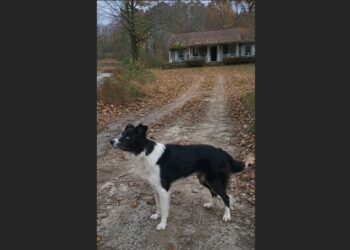
The animal underneath was a Border Collie.
Or at least, beneath the dirt, burrs, and badly neglected coat, that was what he appeared to be.
Black-and-white fur had turned brown with mud.
Burrs covered his legs and chest.
His body was painfully thin.
One rear leg had become caught in an old length of rope tangled around a rusted metal stake driven into the ground.
An overturned plastic food bowl lay nearby.
Empty.
The dog watched us but made almost no effort to move.
He did not bark.
He did not growl.
He did not pull against the rope.
That lack of reaction worried me more than barking would have.
The Dog Was Too Weak to Resist
Sarah crouched several feet away and offered water.
We were careful not to assume that a silent, exhausted dog was automatically safe to handle. Pain and fear can change behavior quickly, especially when an animal is trapped.
She poured a little water into her palm and extended it slowly.
The dog lifted his head.
He licked a few drops.
Then his head lowered back toward the dirt.
Whatever had happened at that hunting blind had not started the night before.
The condition of his body suggested a longer period of neglect.
The rope was weathered.
The food bowl had been left where it had fallen.
There was no fresh bedding, no obvious recent care, and no indication that someone was coming back for him.
Still, we did not know the full history.
We could see abandonment-like circumstances.
We could not yet prove exactly how long he had been there or who had left him.
What we did know was that the dog needed help.
Immediately.
We Still Had a Missing Child to Find
That was the conflict none of us wanted.
Every minute mattered for Harper.
The temperature had dropped overnight.
She was eight years old.
We had no confirmation that she had shelter, adequate clothing, food, or water.
Redirecting the entire search toward the dog would have been irresponsible.
Leaving him tied beneath a collapsed structure felt equally impossible.
So we divided the work.
Three volunteers stayed with the dog.
They created temporary shade and wind protection using emergency materials, offered small amounts of water, and contacted a local animal rescue group for assistance.
They did not begin feeding him heavily or attempt to treat injuries they had not assessed.
A severely undernourished animal may need controlled veterinary support rather than a sudden large meal.
The rest of us returned to the search.
At that point, the dog and Harper seemed like two unrelated emergencies.
We had no reason to think otherwise.
One Hour Later, We Found the Footprints
Shortly after nine-thirty in the morning, one of our trackers found small prints in softer ground.
They were the right size to be Harper’s.
More importantly, they appeared recent.
The trail did not lead back toward the main hiking route.
It angled toward a narrow valley where the terrain dipped between tree-covered slopes.
We changed direction.
The mood of the team changed too.
Until then, we had been searching a broad landscape.
Now we had something specific to follow.
The prints continued intermittently.
Sometimes the ground preserved them clearly.
Sometimes rock and pine needles erased them.
Each time we lost the trail, people spread out and searched for the next sign.
Then someone ahead of me stopped.
At the far end of the valley, near a fallen log, was a small figure.
Harper.
She Was Cold, Dirty, and Alive
For a few seconds, nobody moved quickly.
In search work, seeing someone at a distance does not always tell you what condition they are in.
Then Harper lifted her head.
Someone called her name.
She responded.
Everything after that happened fast.
Her father moved toward her.
Harper started crying.
By the time we reached them, she was in his arms.
She was exhausted.
Her clothes were dirty.
She was cold and frightened.
But she was alive.
The relief that passed through the team was physical.
People who had been holding themselves together for hours suddenly stopped trying.
Some cried.
Some laughed.
Others simply stood still.
Medical personnel examined Harper before anyone asked too many questions.
That part mattered.
Finding a missing child is not the end of the emergency.
Exposure, dehydration, injury, and exhaustion can remain serious even when someone is awake and talking.
Once she had been assessed and was stable enough to speak, I asked where she had spent the night.
Her answer was one word.
“Scout.”
None of Us Knew Who Scout Was
I thought she was talking about another child at first.
Then Harper explained.
After becoming separated from her family, she had wandered farther from the trail.
She had become frightened.
At some point before dark, she reached an old hunting blind.
There, tied nearby, was a black-and-white dog.
The same dog Sarah had found that morning.
Harper had named him Scout.
Or perhaps, in the logic of an eight-year-old trying to make sense of the night, that was simply the name she decided suited him.
She had stayed beside him.
The last granola bar in her backpack had been shared between them.
When darkness came and the temperature fell, she curled up near the dog.
“He kept me company,” she said.
“Every time I got scared, I’d pet him.”
Suddenly, the two emergencies we had treated separately became one story.
We Had Found the Place Where Harper Survived the Night
The hunting blind made more sense now.
So did Harper’s route.
She had reached a fixed structure rather than continuing to wander through the mountains after dark.
That alone may have reduced some risk.
Scout’s presence gave her a reason to remain there.
The dog also provided physical warmth when they rested close together.
It would be too much to claim that Scout intentionally “saved” Harper in the human sense.
We do not know what he understood.
He was trapped himself, underweight, weak, and unable to leave.
But his presence mattered.
Harper was not alone.
She had something living beside her.
Something she could touch when she was frightened.
And because she stayed with him for much of the night, she did not keep moving blindly through difficult terrain in darkness.
That may have mattered just as much as the warmth.
Harper Had Helped Scout Too
The relationship was not one-directional.
Scout had been weak when our volunteers found him.
Harper said she shared her granola bar.
That was not enough nutrition to change his overall condition, but it was food.
She also stayed near him through the coldest hours.
Shared body warmth can work both ways.
More importantly, she noticed him.
Before Harper became lost, Scout had apparently been hidden in a place few people visited.
The old service road was overgrown.
The hunting blind was partially collapsed.
Nothing about the location suggested regular traffic.
If we had not been searching the area for Harper, no one could say when the dog would have been found.
Her disappearance brought search teams into the same remote area where Scout had been left.
That fact did not make the situation fortunate.
A missing child is never a blessing in disguise.
It simply meant that two vulnerable lives intersected in an unlikely place.
We Took Harper Back to Scout That Afternoon
After Harper had been reunited with her family and cleared by medical staff, arrangements were made for her to see the dog again.
By then, rescue workers had begun handling Scout’s condition.
The rope had been removed safely.
He had access to water.
He was being prepared for veterinary treatment.
Harper approached slowly.
Scout noticed her.
For most of the morning, he had barely attempted to stand.
Now he pushed himself upward.
The movement was unsteady.
His tail began to move.
Slowly at first.
Then more clearly.
Harper dropped to her knees near him and put her arms around his neck.
The adults around them cried.
I remember the scene because it was emotionally powerful.
I also remember the dog looking physically exhausted.
The reunion did not erase that.
He still needed medical care.
Affection could not reverse malnutrition or repair an injured leg.
The next part of Scout’s story belonged to veterinarians and rescue workers.
Recovery Took More Than a Hug
Over the following week, Scout received treatment, food, hydration, cleaning, and rest.
His coat had to be dealt with carefully because of the dirt and burrs.
His body condition required monitoring.
The leg that had been trapped needed evaluation.
Nothing about his recovery was instant.
A dog can look emotionally brighter while still being medically compromised.
That distinction matters in rescue stories.
Scout began eating more reliably.
He rested.
His strength gradually improved.
The account says that within a week he was gaining weight and recovering well.
That did not mean he had fully recovered in seven days.
It meant the direction had changed.
He was no longer tied to a rusted stake beneath a collapsed hunting blind.
He was receiving care.
For the first time in an unknown period, someone was paying close attention to what his body needed.
Harper Kept Asking About Him
Children often process frightening events in ways adults do not expect.
Harper had been lost overnight in cold mountain terrain.
Her parents had spent hours not knowing where she was.
Search teams had worked through the night.
There were serious reasons to focus on her physical and emotional recovery.
Yet Harper kept asking about Scout.
Was he eating?
Could he walk?
Where was he sleeping?
Would someone stay with him?
The dog had become part of how she remembered the night.
That did not mean he should become a symbol responsible for carrying the emotional weight of the event forever.
Scout was still an animal with his own needs.
But Harper’s concern made sense.
When she had been frightened and alone, she had spent hours beside him.
For an eight-year-old, that mattered.
Two Months Later, the Family Made a Decision
By then, Scout was stronger.
The immediate medical crisis had passed.
His long-term needs were clearer.
Harper’s parents made the decision people around the rescue had quietly suspected might be coming.
They adopted him.
That decision involved more than emotion.
A rescued Border Collie needs exercise, veterinary care, training, structure, and a household capable of managing an active, intelligent dog.
Scout also came with a history that was incomplete.
He had experienced severe neglect or abandonment according to the circumstances in which he was found.
No one could know how that history might affect him in every environment.
Harper’s family accepted those practical realities.
Scout went home with them.
Not as a reward for what had happened in the mountains.
Not because the family “owed” him a home.
Because, after treatment and consideration, they were willing and able to provide one.
The Mountains Did Not Create a Perfect Dog
Stories like this often skip from rescue to happily ever after.
Real adjustment is usually less tidy.
A dog who has spent a prolonged period restrained outdoors may need time to learn household routines.
New sounds can be confusing.
Doors, stairs, appliances, visitors, cars, and confinement can all require gradual introduction.
Food behavior can change after deprivation.
Physical discomfort can affect movement and mood.
Scout’s new life did not erase what came before.
What changed was the environment around him.
Meals arrived regularly.
Water was available.
Sleep happened in a protected place.
People noticed when he limped or seemed tired.
Harper did not need him to become a heroic character every day.
Most days, he only needed to be a dog.
Harper Did Not Need Scout to Stay a Rescue Story Either
That mattered for her too.
She had been through something frightening.
The healthiest ending was not for an eight-year-old child to spend the rest of her childhood reliving the night she was lost.
Life moved forward.
School.
Family routines.
Ordinary mornings.
Homework.
Trips to the kitchen.
A dog sleeping nearby.
Scout became part of those normal days.
According to the story, he slept on a soft bed near Harper’s room.
The contrast with the hunting blind was obvious, but no one needed to repeat it constantly.
His new bed was not meaningful because suffering made him deserving.
He deserved humane care regardless.
The bed simply meant that his circumstances had changed.
People Wanted to Say They Saved Each Other
I understood why.
The phrase is emotionally satisfying.
Harper was lost.
Scout was abandoned.
They spent a cold night together.
Search teams found both.
Later, Scout joined her family.
It creates a perfect circle.
But life rarely fits perfectly into one sentence.
Scout did not single-handedly save Harper.
Search volunteers, trackers, medical teams, and her family’s quick response all mattered.
Harper did not single-handedly save Scout.
Rescue workers, veterinarians, food, hydration, treatment, and follow-up care mattered.
Still, neither was irrelevant to the other.
Scout’s presence appears to have helped Harper stay in one place and feel less alone.
Harper’s disappearance brought searchers into the area where Scout had been trapped.
Those facts are enough.
They do not need exaggeration.
I Still Think About the First Radio Call
“You need to get down here. It’s not the girl… it’s a dog.”
At the time, the sentence felt like another delay.
Another problem.
Another life needing help while our attention was already stretched thin.
I remember wondering whether keeping volunteers with the dog would cost us time we could not afford.
Search coordination often involves decisions like that.
You work with incomplete information.
You balance urgency.
You assign people where you think they are needed most.
That morning, we had no idea the dog beneath the hunting blind had already spent much of the night beside the child we were trying to find.
We thought Scout was a detour from the search.
He was part of it.
We simply did not know yet.
Harper’s Favorite Version of the Story Is Shorter
Adults tell the story with details.
The storm.
The search teams.
The service road.
The footprints.
The hunting blind.
The rope.
The medical evaluations.
Scout’s recovery.
The adoption.
Harper reduces all of it to one sentence.
Whenever people ask how she met Scout, the story says she smiles and gives the same answer.
“I got lost in the mountains, and that’s where I found my best friend.”
It is the kind of sentence only a child could make that simple.
The adults know how much fear surrounded those hours.
They know how close the situation came to ending differently.
They know Scout was not a magical protector and Harper was not his rescuer by herself.
But the sentence still contains something true.
She was lost.
He was there.
For one cold night, two frightened lives shared the same patch of ground.
Then people found them.
And neither had to stay there.
Editor’s Note: The characters in this story are fictional. Through these stories, we hope to share the intelligence, loyalty, compassion, and loving nature of dogs with people everywhere.