For weeks after the moving truck disappeared down the road, Cooper kept returning to the same place.
The end of the driveway.
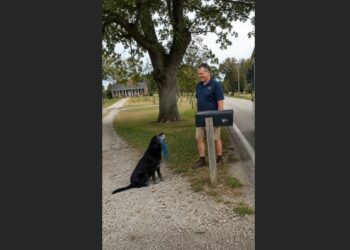
He sat facing the narrow county road outside the small rural Tennessee property where he had lived for most of his nine years.
Cars came.
Cars passed.
Sometimes Cooper stood the moment an engine appeared in the distance.
His ears lifted.
His tail moved.
Then the vehicle continued past.
Cooper sat down again.
No one could know exactly what he expected.
Dogs do not understand property sales, moving contracts, or the human promise implied by packing an entire household into a truck.
What Cooper knew was simpler.
The people who had structured his days were gone.
The house was empty.
And the road was where they had always returned from.
So he watched it.
The House Had Emptied in a Single Afternoon
The moving truck arrived on a rainy September day.
Furniture disappeared first.
Then boxes.
Curtains came down.
Even plants from the flower beds were dug up and loaded for the move.
Neighbors watched the familiar house become strangely bare.
Cooper remained on the property.
He was a nine-year-old Border Collie mix with a black-and-white coat, one cloudy eye, and a slight limp in a rear leg.
For years, people along the road had seen him beside the elderly couple who owned the house.
He followed the man into the garden.
Rode in the passenger seat of an old pickup.
Waited on the porch when the couple went into town.
Then the truck pulled away shortly after noon.
Cooper did not go with it.
At First, the Neighbors Assumed Someone Would Return
There were reasonable explanations.
Maybe Cooper had slipped out during the move.
Maybe the couple thought he was already in another vehicle.
Maybe a family member was coming back for him.
Nobody wanted to assume an elderly couple had intentionally left their dog behind.
So people waited.
Cooper waited too.
The next morning, he was near the driveway.
The following day, he was there again.
Another day passed.
Still no one came.
The new owners had not moved in yet, leaving the property entirely empty except for the dog who still seemed to consider it home.
Lisa Began Leaving Food
Lisa lived nearby.
She knew Cooper well enough to recognize him but not well enough to handle him easily.
She brought food and placed it beneath a tree near the driveway.
Cooper would not approach while she stood there.
She learned to set the bowl down and walk away.
Only then would he eat.
Afterward, he usually returned to the road.
Lisa tried sitting at a distance.
Sometimes she spoke softly.
Cooper listened.
He did not come closer.
He also did not run.
His behavior seemed less like panic than fixation on a familiar place and routine.
The driveway remained important.
September Became October
Leaves began turning across the fields and wooded hills.
The empty house looked increasingly neglected.
Cooper’s routine remained remarkably consistent.
Morning near the road.
Food when Lisa left it.
Rest somewhere on the property.
Then back toward the driveway.
When a vehicle approached, Cooper often stood.
Some drivers slowed.
Others waved.
The car passed.
His body relaxed again.
People began describing him as “waiting for his family.”
That may have been close enough for ordinary language.
Still, nobody could know exactly what Cooper believed would happen.
He was responding to a location associated with familiar people returning.
That alone explained much of what the neighbors saw.
Several People Tried Taking Him Home
Nobody wanted him living alone on an empty property indefinitely.
A neighbor coaxed him into a vehicle once.
Another family managed to bring him to their house.
Cooper was not aggressive.
He did not snap.
He did not destroy doors trying to escape.
But he remained unsettled.
When given an opportunity to leave, he did.
Within hours, he returned to the old property.
That happened more than once.
Eventually, people stopped treating it as stubbornness.
Cooper had spent most of his life in one environment.
Removing him briefly without a gradual transition did not automatically make another place feel safe or familiar.
The empty property, however unsuitable, was still predictable.
His Physical Condition Began to Change
By November, the consequences were becoming harder to ignore.
Cooper’s coat looked duller.
His ribs became easier to see.
The old limp worsened.
His cloudy eye had not improved.
Cold, wet weather made everything more difficult.
Lisa increased the food she left.
She put out water.
She tried creating a sheltered place near the house.
Cooper used it occasionally.
But he continued returning to the driveway.
The behavior that had seemed touching in September now looked dangerous.
One Cold Evening Made the Decision for Lisa
Rain moved across the fields.
Wind pushed through the trees.
The temperature dropped toward freezing.
From her kitchen window, Lisa could just make out Cooper near the edge of the property.
He was curled beneath a bush.
His body was partially protected from the rain.
His face remained turned toward the road.
Lisa watched longer than usual.
Then she stopped telling herself that food alone was enough.
The next morning, she called a rescue organization.
Cooper Did Not Fight the Rescuers
Two volunteers arrived that afternoon.
They expected the process to take time.
A dog who had repeatedly returned to the property might resist being removed from it.
Instead, Cooper watched them approach.
One volunteer crouched sideways rather than facing him directly.
The other prepared a leash.
Cooper did not bark.
He did not hide.
Eventually, he allowed them close.
As they guided him toward the vehicle, he paused.
His head turned toward the road.
Then he followed.
It was tempting to say he understood that nobody was coming back.
There was no way to know that.
What rescuers could observe was much simpler.
For the first time in months, Cooper left the property without immediately returning.
His Medical Problems Had Been Building for Years
At the rescue, veterinary staff examined him thoroughly.
The months alone had taken a toll, but not every problem was new.
He was underweight.
His skin needed treatment.
His teeth required attention.
The old leg injury had healed poorly enough to affect his gait.
His cloudy eye needed evaluation.
There was also age to consider.
At nine, Cooper was entering his senior years.
He was not a dog who would become young again once someone fed him regularly.
The goal was comfort.
Nutrition.
Pain management.
Treatment where appropriate.
Safe movement.
Routine.
His body began improving.
His behavior changed much more slowly.
The First Foster Home Had a Glass Door
That became Cooper’s preferred place.
He sat where he could see the driveway.
Meals came reliably.
The house was warm.
No one mistreated him.
There were toys.
Walks.
Soft beds.
But Cooper spent long stretches looking outside.
His foster family tried engaging him.
Sometimes he participated.
Often he returned to the door.
They began to worry that they were failing.
The rescue reassured them.
Major environmental transitions can take time, especially for an older dog whose familiar household disappeared abruptly.
Cooper did not need entertainment every waking hour.
He needed predictability.
A Second Foster Home Saw the Same Pattern
Different house.
Different driveway.
Same behavior.
Cooper learned where food appeared.
He accepted walks.
He tolerated affection.
He slept.
But windows and doors drew him repeatedly.
He seemed especially attentive to arriving vehicles.
No one could say whether he was searching for specific people or whether vehicle arrivals had simply become a deeply learned cue.
The distinction mattered.
The rescue stopped describing Cooper as emotionally “broken.”
He wasn’t.
He was an older dog displaying persistent behavior after a major disruption.
That was something to work with, not a verdict about who he had become.
Samuel Heard About Cooper Almost by Accident
Samuel was seventy-two.
A retired carpenter.
A widower.
He lived alone on a small farm outside Knoxville.
Two years earlier, his own dog had died.
Afterward, Samuel told friends he would not adopt another.
There were practical reasons.
He was older.
Dogs required time.
Veterinary bills increased with age.
He did not want another goodbye.
Then a rescue volunteer showed him Cooper’s photograph.
Samuel listened to the story.
What interested him was not the dramatic language people had begun using about abandonment.
It was the waiting.
That part felt familiar.
Samuel Had Done His Own Kind of Waiting
After his wife died, evenings became the hardest.
For decades, there had been another person in the house.
A voice from the kitchen.
A light on in another room.
Someone sitting across from him during dinner.
Then all of it stopped.
For months, Samuel found himself sitting in the same chair at roughly the same hour each evening.
Nothing was expected to happen.
Still, the routine remained.
Grief had changed the meaning of familiar spaces without changing the spaces themselves.
When the volunteer described Cooper sitting near windows and watching driveways, Samuel did not claim the dog was grieving exactly as he had.
He simply understood that familiar routines can outlive the people connected to them.
“I can meet him,” he said.
Samuel Did Not Try to Win Cooper Over
That turned out to matter.
When Cooper arrived at the farm, Samuel showed him the house.
Water.
Food.
Bed.
Back door.
Then he stopped asking for anything.
Cooper went directly to the front window.
The driveway stretched from the farmhouse toward the county road.
He sat there.
Samuel let him.
That evening, Cooper returned to the same place.
Samuel sat several feet away and read the newspaper.
Neither needed to interact.
The First Weeks Were Mostly Quiet
Cooper watched the road.
Samuel drank coffee.
Cooper slept near the window.
Samuel worked on small projects.
Sometimes Samuel spoke.
Sometimes he did not.
He never pulled Cooper away from the glass.
He did not repeatedly call him over.
He did not put a hand on the dog’s head every time he passed.
Cooper had room to decide where he wanted to be.
The dog began learning the household without being required to demonstrate gratitude.
Breakfast appeared.
Samuel went to the workshop.
Samuel returned.
Dinner came.
Lights went off.
Morning arrived.
Then it happened again.
Predictability accumulated.
Cooper Began Watching Samuel Too
At first, his attention remained mostly outside.
Then Samuel noticed small changes.
When he walked toward the kitchen, Cooper sometimes looked over.
When the back door opened, the dog’s ears moved.
If Samuel went onto the porch, Cooper occasionally followed as far as the doorway.
Nothing about the changes was dramatic enough for a photograph.
That was probably why they mattered.
Cooper was not suddenly becoming a different dog.
His world was gradually expanding.
The driveway was still important.
Now Samuel was becoming part of the environment too.
The Thunderstorm Came Nearly a Month Later
Rain had been falling most of the afternoon.
Thunder rolled across the valley.
Samuel sat in his usual chair.
Normally, bad weather did not prevent Cooper from checking the front window.
That day, he looked toward it.
Then turned away.
Samuel noticed but did not call him.
Cooper crossed the room.
Slowly.
The old leg gave his gait a slight unevenness.
He reached Samuel’s chair.
Turned once.
Then lowered himself to the floor.
Samuel kept reading.
A Paw Landed on His Slipper
Several minutes passed.
Then Samuel felt pressure against his foot.
He looked down.
Cooper’s front paw rested partly across his slipper.
The dog was already closing his eyes.
Samuel smiled.
He did not reach down immediately.
He did not turn the moment into a test.
Cooper had chosen the place.
That was enough.
Within minutes, the dog was asleep.
It was the first time Samuel had seen him settle deeply somewhere other than near the window.
There was no reason to claim Cooper had decided his old family was never returning.
A smaller change had occurred.
For that afternoon, being beside Samuel had become as comfortable as watching the road.
The Window Did Not Disappear From His Life
The next morning, Cooper was back there.
Samuel laughed.
Progress, he learned, was not linear.
The dog still watched vehicles.
Still spent time near the driveway.
But he also began leaving the position more often.
Sometimes he followed Samuel into the kitchen.
Then onto the porch.
Eventually into the workshop.
Samuel kept a blanket in one corner so Cooper could lie nearby while he worked.
The sound of tools did not bother him much.
Cooper seemed particularly interested in sawdust.
Samuel was less enthusiastic about that.
The Garden Came Next
Samuel grew tomatoes, beans, herbs, and a few flowers his wife had planted years earlier.
One morning Cooper followed him outside.
Samuel expected the dog to head toward the road.
Instead, he stayed near the garden.
Cooper sniffed the fence.
Investigated a bucket.
Then lay down in the grass.
Samuel worked.
The dog watched.
A familiar pattern had returned in a different setting.
Years earlier, neighbors had seen Cooper following his first owner through a garden.
Now he was beside another older man doing much the same thing.
No one needed to decide what Cooper thought about that similarity.
The routine itself was enough.
Samuel Understood That Attachment Was Not Replacement
Cooper’s previous life had existed.
So had Samuel’s.
Neither needed to pretend otherwise.
Samuel kept photographs of his wife around the house.
His former dog’s collar remained in a drawer.
Cooper still reacted to some passing vehicles.
There was room for all of that.
A new relationship does not erase an old one.
It adds another set of experiences.
Samuel stopped thinking of Cooper as a dog who needed to “move on.”
They were both simply living forward.
Some days that happened slowly.
The Pickup Truck Became Cooper’s Favorite Development
Samuel owned an aging pickup.
The first time he opened the passenger door and invited Cooper along, the dog hesitated.
Samuel waited.
Cooper sniffed.
Then climbed in with help.
He settled in the passenger seat.
Something about the arrangement looked instantly familiar.
Samuel remembered the rescue telling him that Cooper had once ridden beside his former owner.
He did not assume the dog was remembering those drives.
But Cooper appeared comfortable.
After that, short trips became part of their routine.
Feed store.
Hardware store.
A neighbor’s farm.
Sometimes nowhere important.
Cooper’s Body Continued Aging
The limp remained.
It always would.
His cloudy eye became more opaque.
His muzzle turned increasingly gray.
Samuel adjusted.
Non-slip rugs went onto smooth floors.
Long walks became shorter.
Veterinary care focused on pain management, mobility, dental health, and the ordinary problems of an aging dog.
Samuel resisted people who said Cooper seemed “young again.”
He didn’t.
Cooper seemed comfortable.
Interested.
Engaged.
Those were better goals than pretending age had disappeared.
Visitors Saw a Different Dog
At the rescue, Cooper had often watched from a distance.
At Samuel’s farm, he began meeting familiar visitors near the porch.
His tail moved.
Sometimes he carried an old toy.
He did not become wildly social.
That was not his personality.
But he increasingly chose interaction.
People who knew his early story called the change remarkable.
Samuel saw the smaller pieces.
Hundreds of breakfasts.
Hundreds of evenings.
Doors opening and Samuel returning.
A hand reaching for the leash.
A truck coming home to the same driveway.
Trust rarely arrived as one dramatic revelation.
It was repetition.
Moving Trucks Still Caught Cooper’s Attention
That part never completely disappeared.
Every so often, a large truck came along the county road.
Cooper’s ears lifted.
His head turned.
If the engine slowed nearby, he watched carefully.
Samuel noticed.
He never mocked him.
Never forced him away from the window.
Usually the vehicle continued.
Then Cooper did something he had not done during those months at the abandoned house.
He looked back.
Toward the room.
Toward the porch.
Toward Samuel.
Sometimes his tail moved.
Then the moment passed.
Samuel Was Careful About What That Meant
Friends liked the obvious interpretation.
“See? He knows this is home now.”
Maybe.
Dogs clearly learn familiar places, people, and routines.
Cooper had years of evidence that Samuel was part of his daily world.
But Samuel did not need to imagine a human sentence inside the dog’s mind.
The behavior itself said enough.
Once, a departing vehicle had held Cooper’s attention long after it vanished.
Now another familiar person remained behind him.
Cooper had more than the road to orient toward.
They Developed Their Own Evening Ritual
Samuel sat on the porch when weather allowed.
Cooper chose the spot beside the rocker.
Sometimes the dog slept.
Sometimes he watched the road.
Samuel read.
Or drank coffee that was probably too late in the day.
The quiet no longer felt the way it had after his wife died.
Not because Cooper replaced her.
He didn’t.
A dog cannot fill the place of a spouse.
But there was breathing beside the chair.
Tags moving when Cooper shifted.
A body getting up when Samuel went inside.
Presence changed the room.
That mattered.
Cooper Did Not Heal Samuel Either
People sometimes told the story that way.
Two lonely old souls saving each other.
Samuel disliked it.
He had not been waiting for a dog to fix grief.
Cooper had not arrived with a mission to repair him.
Their relationship was less tidy.
Samuel still missed his wife.
Some evenings remained difficult.
Cooper still watched trucks.
Some old habits remained.
What changed was the structure around those things.
There were meals to prepare.
Walks.
Veterinary appointments.
Garden mornings.
Pickup rides.
Companionship did not erase loss.
It made space around it.
Years Passed
The dog who arrived at nine became older.
Samuel did too.
They slowed together, though for different reasons.
Cooper spent more time sleeping on the porch.
Samuel spent more time in the rocking chair.
The pickup trips became shorter.
The garden became smaller.
Neither seemed bothered.
Good days were measured differently now.
Comfortable weather.
A decent appetite.
An easy walk across the yard.
Coffee.
A nap.
Nothing spectacular.
Samuel had stopped needing spectacular.
Cooper Still Patrolled the Property
“Patrolled” was Samuel’s word.
In reality, Cooper made a slow morning circuit.
Porch.
Garden.
Fence.
Driveway.
Then back toward the house.
Some mornings he skipped half of it.
The leg decided.
Samuel let him.
A senior dog does not need to complete a route simply because he did yesterday.
On good mornings, Cooper still reached the end of the driveway.
He stood there.
Looked down the road.
Then turned back.
That final turn became Samuel’s favorite part.
The Old House Was Never Visited Again
Samuel considered taking Cooper there once.
He decided against it.
What purpose would it serve?
Humans often want symbolic closure.
Dogs do not necessarily need us to recreate painful or confusing environments so we can see how they respond.
Cooper had a home.
A familiar routine.
A person he trusted.
There was no need to put him back beside an empty house and ask his behavior to tell a story for us.
The past could remain past.
The Most Important Thing Samuel Did Was Boring
He stayed predictable.
That was it.
Breakfast came.
Doors opened.
Samuel returned when he left.
The truck came back.
Evenings ended in the same house.
One day became the next.
There was no grand promise Cooper had to understand.
The evidence accumulated through experience.
Samuel was there yesterday.
Samuel was there today.
Then tomorrow happened.
He was there again.
For an animal adjusting after a major disruption, predictability can matter more than dramatic affection.
One Rainy Evening Looked Almost Like the First
Years after Cooper arrived, another storm moved across the valley.
Rain hit the porch roof.
Thunder rolled somewhere beyond the fields.
Samuel sat in his chair.
Cooper stood near the front window.
For several seconds, he watched the road.
A truck passed in the distance.
His ears lifted.
Then dropped.
Cooper turned.
He crossed the room at the slow pace age now required.
When he reached Samuel, he lowered himself beside the chair.
His paw landed near the old man’s slipper.
Not exactly the same place.
Close enough.
Samuel Reached Down This Time
He rested his hand lightly against Cooper’s shoulder.
The dog sighed.
Outside, headlights disappeared down the road.
Neither watched them go.
There had been a time when Cooper spent nearly every waking hour orienting himself toward vehicles that might return someone familiar.
That behavior had not vanished through one emotional breakthrough.
It had faded as another life became more predictable.
A farmhouse.
A garden.
An old truck.
A porch.
Samuel.
Cooper Never Needed to Forget
That was the part Samuel understood best.
The elderly couple had been Cooper’s family for years.
Whatever circumstances led to him being left behind, those years still existed in his behavior and routines.
Samuel did not need to erase them to matter.
He only needed to become another reliable part of Cooper’s life.
Over time, he did.
The road stopped being the only place worth watching.
These Days, Cooper Has More Reasons to Look Back
His cloudy eye is worse.
The limp is still there.
Gray has spread across his face.
When a moving truck passes, he sometimes notices.
For a moment, the old attention returns.
Then he often turns toward the farmhouse.
Samuel may be sitting on the porch.
Or standing in the garden.
Or walking slowly toward the pickup.
Cooper follows when he feels like it.
Sometimes he remains where he is.
He no longer needs to chase every movement down the road.
His life is already happening on this side of the driveway.
The Person Who Stayed Did Not Make a Promise Cooper Could Understand
Samuel never told him, “I will never leave.”
Even if he had, Cooper could not understand the sentence as a lifelong guarantee.
Dogs learn something more practical.
Patterns.
Who feeds them.
Who returns.
Who handles them gently.
Where they sleep safely.
What happens after a door closes.
Day after day, Samuel gave Cooper the same answer through behavior.
Home remained.
The old man remained.
The routine returned each morning.
That was enough.
Cooper’s story was never really about a dog deciding one day to stop waiting.
It was about how waiting gradually became less necessary.
Not because the past disappeared.
Because the present finally became dependable.
And sometimes that is what security looks like.
Not one dramatic rescue.
Not one perfect afternoon.
Just someone being there yesterday.
Being there today.
And showing up again tomorrow.
Editor’s Note: The characters in this story are fictional. Through these stories, we hope to share the intelligence, loyalty, compassion, and loving nature of dogs with people everywhere.