Every Evening, He Came Back to the Same Place
Just before sunset, Rusty appeared at Dock 7.
The story places his arrival at 6:42 p.m. so consistently that people along the harbor began using the dog’s appearance almost like a clock.
Same dock.
Same bench.
Same stretch of water.
The harbor sat along the edge of a fishing town on the coast of Maine, a place where working boats outnumbered tourist vessels and many people recognized one another by name.
Soon, everyone recognized Rusty too.
He was a large Chesapeake Bay Retriever with a coat the color of rusted copper. Age and weather had faded that coat, and white had spread almost completely across his muzzle.
Children waved to him.
Fishermen greeted him.
Shop owners sometimes left water nearby.
But Rusty did not behave like a dog looking for a new household.
He rarely followed anyone.
He did not remain overnight.
He tolerated brief contact from some familiar people, then moved away again.
Every evening, he faced the bay.
And every evening, he watched the ferry route.
No One Knew Exactly Where He Went After Dark
That mystery became part of Rusty’s reputation.
People knew when he arrived.
They did not know where he slept.
No one seemed certain who fed him regularly or where he spent the hours before sunset.
Some believed he belonged to someone farther inland and simply wandered to the harbor.
Others assumed workers in the district were collectively keeping him alive with scraps and water.
Rusty offered no explanation.
He appeared.
He waited.
He left.
This continued through warm evenings, rain, wind, and winter cold.
According to the story, it continued for nearly three years.
Over time, people stopped asking why.
The dog on Dock 7 became another familiar feature of the harbor.
Like the gulls.
Like the worn bench.
Like the ferry crossing the bay.
Then one harbor employee became curious enough to look backward.
Old Security Footage Showed a Different Rusty
The employee reviewed archived security recordings from years earlier.
There, before Rusty began arriving alone, was a man.
He was a middle-aged fisherman who came to the harbor with Rusty almost every afternoon.
The two spent long stretches on the bench overlooking the water.
Sometimes the fisherman ate while Rusty rested beside him.
Sometimes they watched boats return.
Sometimes they remained until sunset.
The footage did not explain their entire relationship.
It did not need to.
The repetition made the connection clear.
Rusty had not originally come to Dock 7 by himself.
The place had been part of a shared routine.
Then, one October morning, that routine ended.
The Fishing Vessel Never Came Back
A severe storm moved through the region.
The fisherman went out with his crew.
His vessel did not return as expected.
The Coast Guard searched.
Days passed.
The boat was eventually located.
The fisherman was not.
The account does not provide enough verified information to reconstruct the accident in detail, and nothing should be added to it.
What matters for Rusty’s story is what happened afterward.
Within days, the dog began appearing at Dock 7 alone.
He returned to the same bench.
He faced the same water.
People naturally interpreted the behavior as waiting.
That may have been partly true.
Dogs can form strong associations with familiar locations, routines, scents, and people. A place repeatedly linked to one person can remain important after that person disappears.
What Rusty understood about the fisherman’s death could not be known.
His behavior was easier to describe than to interpret.
He kept coming back.
The Harbor Thought It Knew His Story
For years, locals believed Rusty was simply the dog who waited.
It was a sad enough explanation that few looked for another one.
The image was easy to understand.
An old retriever.
A missing fisherman.
A harbor bench.
A horizon that never returned what had been lost.
But Rusty’s evenings at Dock 7 were only the part people could see.
The rest happened away from the bench.
The first clue came on a winter night when a dock supervisor was working later than usual.
Rusty left the harbor area and headed down a narrow service road behind an abandoned seafood warehouse.
The supervisor noticed movement behind him.
Rusty was not alone.
A young dog followed several steps back.
The Puppy Followed Him Toward an Old Boathouse
The puppy looked exhausted.
Its posture was low and uncertain.
It moved behind Rusty toward the shoreline.
The supervisor followed at a distance.
Rusty slipped beneath an old boathouse.
Inside, the man found more animals.
Three other dogs were already sheltering there.
Blankets had been dragged into corners.
Water containers were present.
Pieces of rope, canvas, and other harbor material had accumulated into crude bedding areas.
It would be too much to say Rusty had “built” the shelter in the human sense.
No one had watched him design it.
No one knew who had placed every object there.
Harbor workers or other people may have contributed without realizing the full pattern.
But one thing became difficult to ignore.
Rusty was repeatedly bringing vulnerable animals to the same protected space.
Workers Began Watching More Closely
After that night, people paid attention.
The harbor district had always attracted occasional strays.
Dogs wandered in from back roads.
Hunting dogs sometimes appeared injured or lost.
Animals were abandoned near industrial areas where there were fewer homes and less foot traffic.
Previously, those incidents seemed unrelated.
Now workers noticed Rusty near several of them.
Sometimes a frightened dog appeared near the edge of the district.
Later, Rusty was seen moving with it toward the boathouse.
Sometimes he stayed near a newcomer for long periods.
Sometimes food left for Rusty disappeared while another dog was nearby.
The story describes him lying beside frightened animals until they settled.
That behavior is plausible without assuming Rusty understood their histories.
Dogs can respond socially to other animals through proximity, scent, body language, and routine.
Rusty did not need to know why an animal was afraid to remain nearby.
Rescue Workers Started Keeping Records
Once local animal rescuers became involved, the informal observations became more organized.
The account says they documented more than sixty animals connected to Rusty’s boathouse over nearly three years.
It gives unusually precise numbers:
Twenty-seven puppies.
Eighteen adult dogs.
Seven abandoned cats.
Five injured seabirds.
Three orphaned raccoons.
Because the story is unverified, those numbers should be treated as part of the account rather than established public records.
Even so, the larger pattern is the central point.
Rusty repeatedly appeared near vulnerable animals.
Workers followed.
Rescuers were able to intervene.
Many animals were taken into care.
Some recovered.
Some were transferred.
Others, particularly wildlife, were handled according to whatever rehabilitation or release options were appropriate.
Rusty was not functioning as a trained rescue professional.
But his movements drew human attention to animals that might otherwise have remained unseen longer.
He Was Not “Saving” Them Alone
The phrase “Rusty saved more than sixty animals” makes a strong headline.
It is also too simple.
Rusty did not administer veterinary care.
He did not assess injuries.
He did not provide vaccines, medications, fluid therapy, wound treatment, or wildlife rehabilitation.
People did those things.
What Rusty appeared to provide was something narrower.
He found animals.
He remained near them.
He sometimes guided them toward a place where workers knew to look.
In some cases, that may have bought time.
In others, it may simply have made discovery easier.
That role still mattered.
A frightened dog hidden behind a warehouse can be difficult to approach.
A familiar animal moving calmly nearby can change the situation.
Rusty became, in effect, part of the harbor’s informal early-warning system.
Not because anyone trained him for it.
Because people began learning what his movements could mean.
Meanwhile, Rusty Was Growing Older in Front of Them
While the harbor learned to notice the animals Rusty led them toward, Rusty himself was changing.
His coat thinned.
His muzzle whitened.
Scars developed across pressure points along his elbows and hips.
Cold weather damaged the pads of his feet.
A shoulder problem affected his gait.
The limp became more noticeable as months passed.
His ribs became easier to see.
People had always thought of Rusty as hardy.
He was a Chesapeake Bay Retriever, a breed associated with water, cold weather, and demanding outdoor work.
But breed traits are not protection from malnutrition, arthritis, injury, or repeated exposure.
A dog can tolerate difficult conditions and still be harmed by them.
Rusty’s body was showing the cost.
Still, according to the story, he continued returning to Dock 7.
The Bench Remained Part of His Evening
No matter what else happened during the day, the harbor saw the same pattern near sunset.
Rusty approached the bench.
He settled nearby.
He watched the water.
People had learned more about his life by then, but the old routine remained.
Some locals interpreted it as loyalty to the fisherman.
Others simply stopped trying to define it.
The location had been important to Rusty for years.
That was enough.
The man who once sat there was gone.
The sensory world remained.
Salt air.
Diesel engines.
Boat horns.
Gulls.
Wet rope.
Footsteps on the dock.
The route across the bay.
All of those cues had once been part of evenings Rusty spent beside the fisherman.
Now the dog returned alone.
Then February Brought Dangerous Cold
One winter, the weather worsened sharply.
A coastal storm brought freezing rain and severe wind chills.
Harbor traffic dropped.
Most businesses closed early.
People who usually saw Rusty around Dock 7 stayed home.
The next morning, workers checked the boathouse.
They found Rusty there.
Four puppies were pressed close to him.
The puppies were alive.
Rusty was not well.
His body was cold.
He responded weakly when people called his name.
The source describes him as having kept the puppies warm through the storm.
That is a reasonable observation if they were found huddled against him, though it would go too far to claim he consciously chose to sacrifice himself in the human sense.
Animals seek shared warmth.
Group contact reduces heat loss.
Rusty’s body may have contributed significantly to the puppies’ survival.
It also placed additional strain on a dog who was already thin and physically compromised.
The Veterinary Examination Changed How People Saw Him
Rusty was taken to an emergency veterinary hospital.
The diagnosis described in the story was serious.
Severe hypothermia.
Advanced malnutrition.
Dehydration.
Arthritis affecting multiple joints.
A long-standing shoulder injury.
The veterinarian estimated Rusty was about eight years old.
People at the harbor had assumed he was much older.
His white muzzle, worn body, and slow gait had suggested a dog in his early teens.
Chronic exposure, poor body condition, and untreated orthopedic problems can make an animal appear older than its actual age.
Nothing about that meant Rusty had “aged himself” through moral sacrifice.
His condition had medical causes.
Those causes required treatment.
For the first time in years, the dog who had been part of the harbor’s evening routine was not there.
Everyone noticed.
“Where’s Rusty?”
The question moved quickly through town.
Shop owners asked.
Fishermen asked.
Children asked their parents.
The absence of one dog exposed how completely he had become part of the harbor’s rhythm.
People learned that he was hospitalized.
They learned about the hypothermia.
They learned about the puppies.
They learned how poor his overall condition had become.
The response was practical.
Harbor workers began discussing what would happen if Rusty recovered.
Returning him to the same outdoor routine made little sense.
He needed a dry place.
Reliable meals.
Veterinary follow-up.
Rest.
Management for arthritis and his shoulder.
He also needed something the harbor could provide without taking away the one place he had chosen repeatedly for years.
A view of the water.
An Unused Office Became His New Space
Several workers converted an unused harbor office overlooking the bay.
They cleared the room.
A large orthopedic bed was placed near the window.
Fresh blankets went into one corner.
Food and water could now be given on a regular schedule rather than depending on whoever happened to see Rusty outside.
The family also placed photographs of the fisherman on a nearby shelf.
No one could know whether the photographs meant anything to Rusty.
Dogs do not understand framed images the way people do.
The photographs were more for the humans.
The window was for Rusty.
From there, he could see the harbor.
Dock 7.
The ferry route.
The moving water.
The familiar landscape remained.
Only the exposure to cold and rain had changed.
No One Knew Whether He Would Stay
That question mattered.
For years, Rusty had come and gone on his own.
People did not want to turn care into confinement if it could be avoided.
His first evening back gave them an answer.
The source again places the moment at exactly 6:42 p.m.
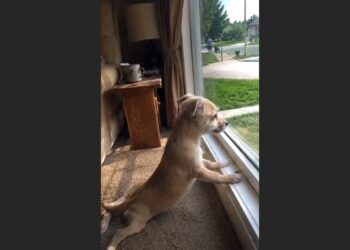
Rusty moved toward the window.
Slowly.
His gait was still affected by the shoulder and arthritis.
He climbed onto the low viewing platform and faced the bay.
He remained there for about twenty minutes.
No one interrupted him.
Then Rusty climbed down.
A volunteer stood nearby.
She placed a hand gently against his shoulder.
Rusty leaned his head against her leg.
And when evening deepened, he did not walk toward the door.
He stayed.
The Harbor Routine Changed Without Disappearing
Rusty no longer had to sleep beneath the boathouse.
He did not need to choose between shelter and the evening view.
He could rest indoors and still watch the boats.
His meals became regular.
His bed supported aging joints.
Veterinary care addressed the problems that years outdoors had allowed to accumulate.
Treatment could not make him young again.
Arthritis remained arthritis.
The damaged shoulder did not become normal because people loved him.
His walks were slower.
He slept more.
His body needed more recovery than it once had.
But his world did not become small.
The harbor still moved outside the window.
People came through the office.
And rescue animals still arrived.
Rusty Continued Approaching Frightened Dogs
The story says that when a new rescue dog came through the harbor program, Rusty often walked over.
He did not transform every frightened animal.
He did not become a therapist.
He did not understand another dog’s history in human terms.
Sometimes his role was simply presence.
A calm dog nearby.
A familiar scent.
A body that did not force contact.
For an anxious newcomer, that could be useful.
For some, it might mean nothing at all.
The rescuers did not treat Rusty as a substitute for proper behavioral assessment or veterinary care.
He was simply allowed to be himself around animals when it was safe to do so.
That was enough.
People Had Been Watching Only Half the Story
For years, the harbor thought Rusty’s life was defined by waiting.
They saw him on Dock 7 and built a story around the fisherman who never returned.
That story was not necessarily wrong.
It was incomplete.
Rusty had a routine connected to loss.
He also had another routine that led him toward living animals in trouble.
One did not cancel the other.
The dog could return to a place associated with someone important and still engage with the world around him.
Grief and continued social behavior can exist at the same time.
Humans know that.
Dogs can show their own version through patterns of attachment, searching, proximity, withdrawal, and re-engagement.
Rusty’s behavior did not require a moral lesson.
It was simply more complex than people first realized.
The Fisherman Never Returned
That fact did not change.
No later discovery brought him home.
No twist repaired the original loss.
The bench still faced the same water.
Boats still crossed the bay.
The horizon Rusty watched for years remained indifferent to whoever stood beside it.
The harbor did not try to erase that part of his history.
Instead, it changed what could still be changed.
Where Rusty slept.
How often he ate.
Whether his arthritis was managed.
Whether someone noticed when he was limping.
Whether he spent another winter exposed to freezing rain.
Those were practical acts of care.
They did not replace the fisherman.
They did not need to.
Now the Waiting Happens From a Warm Window
In the evenings, Rusty still watches the harbor.
The story says he continues to look toward the ferry route near sunset.
Maybe the view remains tied to old routine.
Maybe it is simply familiar.
No one can know exactly what he expects when he looks across the water.
What people can see is where he is now.
Indoors.
Dry.
Fed.
Resting on a bed suited to an aging dog.
Surrounded by people who know to watch his gait, his appetite, and his comfort.
His muzzle is whiter.
His steps are slower.
When a frightened rescue dog arrives, he may still rise and walk over.
Then he returns to rest.
For almost three years, people thought Rusty was only waiting for someone who would never come back.
Eventually, they realized he had been doing more than waiting.
And by the time they understood, the harbor also understood something simpler.
The dog who kept leading vulnerable animals toward help needed help himself.
This time, people noticed.
And they made sure he did not have to spend another night alone beneath the boathouse.
Editor’s Note: The characters in this story are fictional. Through these stories, we hope to share the intelligence, loyalty, compassion, and loving nature of dogs with people everywhere.