Seven months after Bruno died, Deputy Michael Hayes walked into a county courthouse carrying the leash he had once clipped to the dog’s collar every day.
The leather was worn smooth in places from years of use.
Hayes held it loosely in both hands while deputies in formal uniforms filled the rows behind him.
There was no dog at the other end.
That absence seemed to be the only thing anyone could see.
At the front of the room, officials were preparing to present the state’s Medal of Valor to Bruno, a 6-year-old Boxer who had died during an armed confrontation the previous January.
Three sheriff’s deputies had gone home that night.
Bruno had not.
For the department, the ceremony was meant to recognize a working K9 whose actions had given officers precious seconds to control an armed suspect.
For Hayes, it was something much more personal.
Before Bruno had been his police partner, he had been a frightened rescue dog nobody seemed to want.
And before that January night ended, he had become family.
Bruno Had Not Started Life as a Police Dog
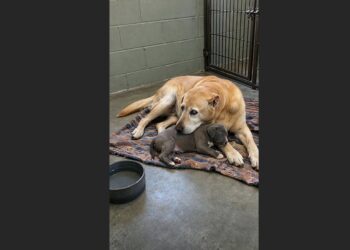
Three years before the courthouse ceremony, animal control officers responded to a neglected property near Twin Falls, Idaho.
Several animals had reportedly been left behind.
Bruno was among them.
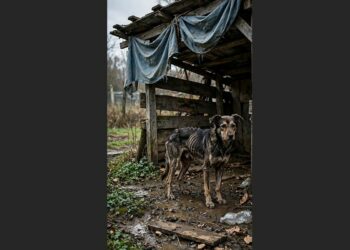
He was an adult Boxer by then, reddish brown with a white patch on his chest.
His body showed the effects of poor care.
He was severely underweight.
Several injuries had healed without proper treatment.
An old tear had left his right ear permanently misshapen.
Some people who saw the scars speculated about what might have happened to him.
Maybe fighting.
Maybe repeated abuse.
But there were no reliable records establishing those details.
The shelter staff focused instead on what they could observe.
Bruno was frightened.
He Retreated Whenever Someone Approached
When strangers came near his kennel, Bruno moved backward.
His head dropped.
Sometimes he turned his face away.
If a person reached too quickly, his body tightened.
The behavior did not prove exactly what had happened before his rescue.
It showed only that unfamiliar human contact made him uncomfortable.
So the shelter stopped pushing.
Workers sat outside his enclosure.
They tossed treats without demanding that he come closer.
They allowed him to choose the distance.
Over time, Bruno began stepping forward on his own.
The progress was small.
A treat taken from a hand.
Remaining at the front of the kennel rather than retreating.
Accepting a brief touch.
Those were the things staff noticed.
Potential adopters mostly noticed the scars.
Adult Boxers Were Already Harder to Place
Bruno was not a puppy.
He was strong.
His ear looked different.
His body still carried visible reminders of neglect.
Families walked through the shelter looking for younger dogs with uncomplicated histories.
Bruno often watched them pass.
Then Deputy Michael Hayes arrived.
Hayes occasionally assisted with behavioral assessments of rescue dogs that showed unusual stability or potential around working environments.
He was not looking for a new police K9 that day.
He was looking at Bruno as a dog.
What caught his attention was not fearlessness.
Bruno was clearly still cautious.
What interested Hayes was what happened after the fear.
The dog recovered.
He watched.
Then, if given enough space, he tried again.
Hayes Saw a Dog Who Was Learning to Trust
That mattered more to him than a scarred ear or an imperfect history.
Hayes began visiting more often.
He did not crowd Bruno.
Instead, he sat nearby.
Some days, the Boxer stayed several feet away.
Other days, he came closer.
Eventually, Bruno rested near Hayes without constantly watching for movement.
The relationship developed slowly enough that neither man nor dog had to force it.
Then Hayes made a decision.
He would adopt Bruno.
Not as a K9.
As a pet.
Police Work Was Not Part of the Plan
At home, Bruno discovered a very different life.
There were no kennels.
No rotating strangers.
No constant shelter noise.
There was a family.
Hayes had a young son, and Bruno quickly became interested in where the boy was.
If the child went into the yard, Bruno usually followed.
When he sat on the floor, Bruno often settled nearby.
The dog who had once moved away from unfamiliar hands gradually became comfortable leaning against people he knew.
He also developed less impressive habits.
Socks disappeared.
Laundry baskets required supervision.
Thunderstorms sent him looking for a quieter part of the house.
At night, Bruno often settled with his head stretched across Hayes’ boots.
For nearly two years, that was his job.
Family dog.
His White Chest Mark Got a Nickname
Bruno had a small patch of white fur on his chest.
People around the sheriff’s department began calling it his “lucky badge.”
The nickname followed him long before he received any official recognition.
To Hayes’ son, however, Bruno was simply Bruno.
The dog who stole socks.
The dog who sprawled across the floor.
The dog who followed him around the yard.
Nothing about those evenings suggested that the Boxer would eventually become part of a sheriff’s K9 team.
That possibility appeared almost by accident.
Hayes Sometimes Brought Bruno Around Training
The sheriff’s K9 unit regularly conducted exercises.
At first, Bruno was simply around some of those sessions.
Hayes noticed how he handled noise.
Loud alarms did not cause him to bolt.
Unfamiliar environments made him alert, but he did not become frantic.
When pressure increased, he tended to look toward Hayes.
That focus interested experienced handlers.
So did another behavior.
During controlled exercises, when someone approached Hayes in an intentionally threatening manner, Bruno often moved into the space between them.
He did not immediately lunge.
He positioned himself.
Then he waited.
Nobody Treated That as Enough
A dog showing protective behavior at home or during one exercise is not automatically suitable for police work.
In fact, uncontrolled defensiveness can make a dog unsafe.
So Bruno went through months of evaluation.
Handlers looked at obedience.
Environmental stability.
Recovery after stress.
Response to commands.
Ability to disengage.
Confidence around unfamiliar surfaces and noises.
His behavior around other officers also mattered.
The goal was not to create an aggressive dog.
It was to determine whether Bruno could perform specific tasks under control.
Eventually, the sheriff’s office approved him for tactical support work.
Some People Questioned the Choice
Police K9 units are often associated with German Shepherds, Belgian Malinois, and similar working breeds.
Bruno was a rescued Boxer with a visibly difficult past.
That made him unusual.
Some people wondered whether the department was taking an unnecessary chance.
The handlers who had worked with him were less concerned.
They had seen the assessments.
They had watched his training.
Most importantly, they had seen how closely he worked with Hayes.
Bruno did not need to become fearless.
He needed to remain responsive.
That was the standard that mattered.
Training Changed Their Relationship
At home, Hayes could laugh when Bruno stole a sock.
At work, expectations had to be precise.
Commands mattered.
Control mattered.
Timing mattered.
Hayes learned the small changes in Bruno’s posture that signaled rising intensity.
Bruno learned when he was expected to act and when he was expected to stop.
They repeated the same exercises until neither partner needed unnecessary movement.
That kind of repetition rarely appears in dramatic K9 stories.
Still, it is what makes the dramatic moments possible.
A dog does not simply know what to do because he loves his handler.
He works from training, conditioning, familiar cues, and the relationship built around them.
By Early 2024, Bruno Had Become an Experienced Working Dog
He had participated in dozens of assignments.
Some involved search warrants.
Others involved locating missing people.
He also assisted during arrests where officers believed weapons might be present.
Most ended without anything resembling the confrontation that would later define his public story.
That was normal.
A successful K9 deployment does not always involve biting anyone or dramatic pursuit.
Sometimes the dog’s presence helps officers maintain distance.
Sometimes the assignment is a search.
Sometimes nothing happens at all.
Bruno returned home after those shifts and resumed being the dog Hayes’ family knew.
Until January 18.
The Call Came Shortly Before Midnight
The temperature had fallen well below comfortable levels.
Snow covered the ground near a cabin outside Boise.
Deputies were responding to an armed fugitive wanted in connection with several violent felony charges.
Officers established a perimeter.
Negotiators attempted to communicate with the man inside.
For nearly an hour, they tried to persuade him to surrender peacefully.
Hayes waited with Bruno.
The Boxer had no understanding of the suspect’s charges.
He knew the environment.
His handler.
The commands he had practiced.
That was enough.
Then a Side Door Opened
The suspect emerged quickly.
According to the account later given by the department, he was holding a handgun.
The situation changed in seconds.
Officers who had been waiting through negotiations suddenly faced an immediate armed threat.
Hayes deployed Bruno.
The Boxer ran across the snow.
The man raised the weapon.
Bruno reached him before deputies could fully reposition.
He hit the suspect hard enough to knock him off balance.
Then gunfire broke the night apart.
Bruno Was Shot Twice
One bullet struck his shoulder.
Another entered his chest.
The rounds fired during the struggle did not hit the three deputies exposed nearby.
Despite his injuries, Bruno remained engaged long enough for the officers to close the distance.
They secured the weapon.
The suspect was taken into custody.
Then Hayes turned toward Bruno.
The tactical problem was over.
His partner was bleeding in the snow.
The Handler Became an Owner Again
Hayes dropped beside him.
Everything that mattered a few seconds earlier changed.
There was no longer an assignment to complete.
No suspect for Bruno to watch.
No next command.
There was simply a badly injured dog and the man who had once walked through a shelter and decided to take him home.
Bruno was still conscious.
Hayes spoke to him while other deputies arranged emergency transport.
They moved as quickly as possible toward a veterinary hospital.
Hayes stayed beside him.
Bruno died before they arrived.
He was six years old.
The Department Went Home Without One of Its Own
All three deputies survived the confrontation.
In the days afterward, people naturally described Bruno’s actions using human language.
He had sacrificed himself.
He had chosen his team over his own safety.
One phrase circulated repeatedly:
“Nobody taught him to give his life. That decision was his.”
It expressed what his colleagues felt.
Still, no one could know that Bruno understood death or sacrifice in a human sense.
He had been trained to respond to a threat under his handler’s direction.
He did that.
The consequences were fatal.
That reality required no larger claim to make it brave.
Hayes Had to Return to a House Where Bruno Was Missing
The leash came home.
Bruno did not.
So did the collar.
The food bowl.
The toys.
The boots where Bruno had often rested his head were still there.
Hayes’ son had his own questions.
Those were harder.
How do you explain to a child that the dog who followed him through the yard died doing a job most children cannot fully understand?
There was no useful way to soften the central fact.
Bruno was not coming home.
Grief Looked Different at the Sheriff’s Office
For fellow deputies, his absence appeared in other places.
The K9 vehicle.
Training.
Briefings.
The spaces where handlers gathered with their dogs.
Working animals occupy a strange position in law enforcement.
They are equipment in the legal and operational sense of certain tasks.
But nobody who spends years feeding, training, driving, and living beside one experiences the relationship as though the animal were simply a tool.
Bruno had worked shifts with them.
Then he had gone home with Hayes.
Both parts of his life mattered.
The Medal of Valor Was Approved Posthumously
In the months following Bruno’s death, the department submitted his actions for recognition.
The state had never before awarded that particular Medal of Valor to a Boxer.
The honor would be presented to his family.
A courthouse ceremony was scheduled for seven months after the shooting.
Hayes agreed to attend.
Then he decided what he would bring.
Bruno’s leash.
The Courthouse Filled With Deputies
Formal uniforms replaced tactical gear.
Rows of officers sat quietly.
Some had been present on January 18.
Others knew Bruno through training or years at the department.
Hayes sat in the front row.
The leash rested across his hands.
It had once been an ordinary object.
A piece of working equipment clipped on countless times without thought.
Now there was nothing ordinary about it.
Nobody asked to hold it.
Nobody needed to.
Photographs Played Behind the Stage
The images did not focus only on Bruno’s police work.
That was important to Hayes.
One photograph showed the Boxer sleeping near his son.
Another captured him carrying an enormous tennis ball.
There was Bruno in training with Hayes.
Then Bruno wearing a birthday hat with the profoundly unimpressed expression dogs often wear when humans decide hats are necessary.
People laughed softly at that one.
The photographs reminded everyone that the dog being honored for one terrible night had lived thousands of ordinary days first.
The Family Remembered a Different Bruno
The department knew the K9.
Hayes’ family knew the Boxer who hated thunder.
The dog who stole socks.
The dog who wanted to know where the little boy had gone.
The dog who placed his head over Hayes’ boots at night.
Bruno’s final deployment did not erase any of that.
If anything, the ceremony made Hayes more determined to remember the whole dog.
A working animal’s death can easily become the most famous thing about him.
For the family, it was only the last part.
The Sheriff Spoke About Courage
He talked about Bruno’s early fear.
The neglected dog found near Twin Falls.
The kennel where he once retreated when strangers approached.
Then he spoke about the dog Bruno became.
Not fearless.
That distinction mattered.
Courage does not require the absence of fear.
Bruno had learned to function despite it.
He had developed trust.
Then training.
Then confidence.
Years earlier, someone approaching too quickly could make him retreat.
By January 2024, he could work beside deputies during dangerous assignments while remaining responsive to his handler.
That transformation had taken time.
His Rescue Was Not a Straight Line Toward Heroism
Bruno did not leave a shelter and immediately become a police dog.
For almost two years, he was simply allowed to be a pet.
That ordinary period may have mattered more than anything that followed.
He learned that food appeared reliably.
That familiar people returned.
That hands could touch him without hurting him.
That thunderstorms were frightening but temporary.
That a little boy wandering into the yard was someone worth following.
Only later did anyone ask whether he might be capable of something else.
Trust came first.
Work came after.
Hayes Eventually Walked to the Podium
He carried the leash.
When Bruno’s Medal of Valor was presented, Hayes accepted it on behalf of the dog who could not be there.
For several seconds, he looked down at the medal.
Then at the leash.
He fastened the decoration to the worn leather.
The room remained silent.
There was no collar waiting for it.
No Boxer shifting impatiently beside his leg.
Only the medal and the leash.
Hayes took a breath.
“Your Work Is Done, Buddy”
His voice nearly failed.
A small smile appeared anyway.
“Your work is done, buddy. Rest easy.”
Then he stepped away from the microphone.
Those words were not meant to explain Bruno’s death.
They were not a claim that the dog understood medals or duty in the human sense.
They were the words of a handler saying goodbye to his partner.
And of an owner speaking to the dog he had once brought home simply because he deserved somewhere safe to live.
Outside, Snow Moved Across the Courthouse Steps
The weather reminded some deputies of January.
For a moment, nobody hurried out.
They remained in their seats while the photographs continued cycling.
Bruno with the tennis ball.
Bruno beside Hayes.
Bruno next to the child.
Bruno looking ridiculous in his birthday hat.
Those were easier images to carry home than the last one Hayes had from that freezing night.
A wounded dog in his arms.
The Most Important Part of Bruno’s Life May Have Happened Before the Badge
It happened when someone looked past a torn ear.
Past scars.
Past the way a frightened dog backed into a kennel.
Hayes did not see a future hero.
He saw an animal trying to trust.
That was enough.
He brought Bruno home.
Everything else grew from there.
The training.
The uniform.
The assignments.
The confidence of other deputies.
The medal.
None of those things existed the day Bruno left the shelter.
A family did.
Bruno Never Needed to Know He Was Overlooked
Dogs do not understand why strangers walk past their kennels.
They do not compare themselves with puppies adopted before them.
Bruno did not need a story about being rejected to make his later life meaningful.
He needed a safe home.
He got one.
Then, unexpectedly, that home opened the door to work he proved capable of doing.
The dog who once retreated from unfamiliar people learned to operate in difficult environments beside someone he trusted.
That was already remarkable before January 18.
His Last Action Was Training, Trust, and Instinct Working Together
It is tempting to make it mystical.
To say Bruno knowingly chose death so three officers could live.
No one can know that.
What happened can be described without putting human concepts into his mind.
Hayes gave the command.
Bruno moved toward the armed suspect.
The suspect raised a gun.
Bruno made contact.
He was shot.
His intervention gave the deputies time to close in and end the threat.
Three officers survived.
Bruno died.
Those facts carry enough weight.
Seven Months Later, the Leash Carried the Medal
That was the image many deputies remembered when the ceremony ended.
Michael Hayes in the front row.
The old leather leash across his hands.
Then the medal attached to it.
Years earlier, Hayes had clipped that leash to a rescued Boxer who was still learning that he could trust people.
Later, it had belonged to a working K9.
Now it held the department’s final recognition of him.
Bruno had once been the scarred adult dog potential adopters passed over.
At home, he became a companion.
Around Hayes’ son, he became a quiet shadow.
At work, he became a partner deputies trusted.
On one freezing January night, he did the job he had been trained to do when the consequences could not have been more serious.
He did not come home afterward.
But the officers he worked beside did.
At the courthouse seven months later, Hayes fastened the medal to Bruno’s leash and held it for a moment before letting his hand fall.
The chair beside him was empty.
The photographs continued moving across the screen.
And for those who had known Bruno before the uniform, one truth mattered as much as any medal.
Someone had once given a frightened dog a chance.
Bruno had spent the rest of his life showing what he could become.
Editor’s Note: The characters in this story are fictional. Through these stories, we hope to share the intelligence, loyalty, compassion, and loving nature of dogs with people everywhere.