By then, almost everyone believed the building held nothing living.
The February 2023 earthquakes had torn through southern Turkey with extraordinary force, collapsing apartment blocks in seconds and turning familiar streets into mountains of concrete.
For days, rescue crews worked without rest.
Families waited behind barriers.
Volunteers carried debris by hand.
Search dogs climbed across unstable slabs while engineers watched for movement in structures that could shift without warning.
At one four-story residential building, more than twenty people were believed to have been inside when the floors collapsed.
The human search continued for nearly two weeks.
Eventually, the site moved into another phase.
Heavy machinery arrived.
The operation became debris removal rather than rescue.
Then a volunteer heard something.
It was so faint that he almost dismissed it.
A scrape.
A breath.
Then, unmistakably, a whimper.
Deep beneath the concrete, something was still alive.
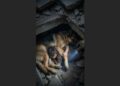
What rescuers eventually reached was a cavity barely large enough for an adult person to crawl into.
Inside lay a severely emaciated tan pit bull.
And pressed beneath his front legs was a tiny black-and-white kitten.
Both were alive.
The Sound Was Easy to Miss
The worker had been clearing pieces from what had once been the building’s lower storage area.
Generators were running.
Machines were moving nearby.
Concrete occasionally shifted with the dry grinding sound that had become familiar across the disaster zone.
Then he heard something different.
He stopped.
Listened.
Nothing.
A supervisor reportedly assumed it was debris settling.
That would have been reasonable.
Collapsed buildings continue making noise long after the initial destruction.
Water moves through damaged pipes.
Metal bends.
Concrete shifts under changing weight.
But during a break, the volunteer returned.
He crouched beside a narrow fracture between slabs.
Put his ear close to the opening.
Moved to another spot.
Then another.
On the fourth attempt, he heard it again.
A weak sound from somewhere far below.
This time, he called for help.
Rescuers Could Not Simply Start Digging
The space was buried beneath layers of unstable rubble.
Every piece mattered.
A slab weighing hundreds of pounds might be resting on a narrow support point.
Move the wrong fragment, and the void underneath could collapse.
Engineers examined the area before crews began opening a path.
Progress was painfully slow.
Some material could be lifted.
Other sections had to be stabilized first.
At times, rescuers stopped completely while structural specialists reassessed the load above the sound.
The possibility that an animal might be alive below did not justify rushing.
In a collapse zone, haste can kill the very survivor people are trying to reach.
So they worked gradually.
Then, through a narrow opening, a light finally revealed fur.
At First, They Thought the Dog Was Dead
The animal barely moved.
Concrete dust had coated his coat so completely that his natural tan coloring looked gray.
His ribs showed sharply.
His hips protruded.
One ear was torn.
There were dried injuries along a shoulder and damage to his paws.
Then his chest moved.
Slowly.
But it moved.
Someone called for quiet.
A rescuer leaned closer.
The dog was breathing.
And then the flashlight beam shifted.
Something much smaller moved beneath him.
There Was a Kitten Against His Chest
Black and white.
Tiny.
Only a few weeks old by appearance.
She was tucked between the dog’s front legs and body.
When the rescuers reached toward her, she pressed closer against him.
That reaction stayed with everyone who saw it.
Whatever had happened inside the cavity, the two animals had spent a very long time in direct contact.
The dog was in far worse condition.
The kitten was weak too, but she appeared more responsive.
Rescuers widened the opening carefully.
The dog did not resist.
He seemed to have little strength left.
Eventually, both animals were brought into the light.
The Reported Timeline Was Almost Impossible to Believe
By the account later told around the rescue, the animals had been trapped for approximately twenty-six days.
That figure made the survival extraordinary.
It also raised questions.
An animal cannot survive nearly a month without usable water under ordinary conditions.
So although no obvious water source was seen when rescuers opened the cavity, some form of moisture would almost certainly have been necessary.
A cracked pipe.
Condensation.
Water seeping through debris after rain.
Something.
The cavity itself may also have protected them from the worst temperature swings outside.
What it did not protect them from was starvation.
The dog’s body showed that clearly.
The Pit Bull Had Lost an Enormous Amount of Weight
At the veterinary hospital, the dog was described as severely malnourished and dehydrated.
His muscles had wasted.
His paws were damaged.
Several nails were torn or worn down.
His mouth was irritated by dust and prolonged exposure to debris.
The veterinary team treated him as a critical patient.
Warmth came first.
Then carefully managed fluids.
Monitoring.
Small amounts of nutrition introduced gradually.
Pain control.
Treatment for wounds.
His kidneys had been under substantial stress.
For the first several days, nobody could promise that he would survive.
His body had spent weeks using every reserve it possessed.
The Kitten Was Weak, but Her Condition Was Better
She needed warmth and hydration too.
She was underweight.
But compared with the dog, she appeared surprisingly stable.
That difference led people to wonder whether his body had helped protect her.
The most plausible explanation involved warmth.
A very young kitten has limited ability to regulate body temperature.
Pressed against a much larger dog, she would have benefited from his body heat.
Grooming may also have comforted her and helped keep dust from accumulating around her face.
However, one popular version of the story claimed that the dog’s saliva alone kept the kitten hydrated for weeks.
That would not be physiologically realistic.
Licking transfers only tiny amounts of moisture and cannot replace actual water over such a long period.
If the animals truly survived twenty-six days, both almost certainly obtained moisture from somewhere inside the rubble.
The dog’s contribution was more likely warmth, physical shelter, companionship, and protection from falling debris.
His Paws Told Another Part of the Story
The front paws were badly damaged.
Claws had been torn.
Pads were abraded.
Above the place where the dog had been lying, rescuers saw marks in broken material that appeared consistent with repeated scratching.
It was natural to imagine him trying to dig his way out.
Perhaps he had.
But nobody could know exactly when the damage occurred or what caused him to stop.
One retelling later suggested he abandoned an escape attempt because falling debris threatened the kitten.
It is a powerful image.
It is also something no witness could verify.
What could be seen was simpler.
The dog had injured his paws.
He had been trapped for weeks.
And when rescuers finally reached him, the kitten was still tucked against his body.
That fact did not need a more elaborate explanation.
They Were Taken to Veterinary Care Together
The kitten stabilized more quickly.
The pit bull did not.
For three days, his condition remained critical.
His kidneys required close monitoring.
His body temperature was low.
He was too weak to eat normally.
His veterinary team introduced fluids and nutrition carefully rather than overwhelming a body that had spent weeks adapting to deprivation.
Most of the time, he slept.
The kitten was placed nearby in a warm enclosure.
Even separated by equipment and treatment, the two remained aware of each other.
When she vocalized, the dog’s ears sometimes moved.
When staff carried her past, his head occasionally lifted.
Those small responses became encouraging signs.
One Night, He Tried to Reach Her
A technician had been working around the dog’s kennel.
At some point, the door was not fully secured.
The pit bull was still weak.
Standing took effort.
Yet when the kitten began making noise nearby, he moved.
First to the edge of the bedding.
Then onto the floor.
The IV line limited how far he could go, so the technician intervened immediately.
He was not allowed to drag himself across a hospital room or climb into medical equipment.
Instead, staff repositioned the animals safely so they could remain close without interfering with treatment.
The dog settled.
The kitten settled beside him.
The posture resembled what rescuers had seen under the rubble.
Large body curved around something tiny.
The Staff Began Calling Him Umut
The Turkish word means “hope.”
The kitten was called Ses.
“Sound.”
The names came from the circumstances of their rescue.
One survived long enough to be heard.
The other remained beside her.
Names gave the veterinary team something gentler to say than “the earthquake dog” and “the kitten.”
Umut.
Ses.
Two patients instead of two pieces of a disaster story.
Recovery Came in Millimeters
Umut did not suddenly stand up and walk away from his injuries.
His progress was slow.
One day he drank without assistance.
Later, he ate more willingly.
His kidney values began moving in a better direction.
Then he stood for a little longer.
Walked several steps.
Rested.
Ses gained weight faster.
Her movements became stronger.
She began exploring the edges of her enclosure.
Then she wanted to play.
Umut mostly watched.
Sometimes he slept through her activity.
At other times, he followed her movements with his eyes.
The difference between them became increasingly obvious.
She was at the beginning of life.
He looked like an animal who had spent every physical reserve he possessed.
Nobody Knew Whether They Had Known Each Other Before the Earthquake
That question fascinated people.
Had the kitten lived in the building?
Was she born shortly before the collapse?
Had the dog encountered her only after the floors fell?
There was no reliable answer.
The cavity had become their entire world.
It was possible they had belonged to different households.
Possible neither had lived there permanently.
Possible the earthquake itself had thrown them into the same survivable void.
Without identification or witnesses, the history before the collapse remained unknown.
What mattered afterward was visible.
They were deeply familiar with one another.
Separating them unnecessarily created stress.
So during recovery, staff allowed them safe contact.
The Volunteer Who Heard Them Kept Visiting
He had almost walked away from that sound.
That thought bothered him.
If the generators had been louder, he might never have heard it.
If lunch had ended sooner, perhaps he would not have returned.
If he had accepted the first explanation that the noise was shifting metal, the cavity might have disappeared beneath debris removal.
So he came back to the clinic.
At first, Umut was too weak to react much.
Ses was more curious.
As the weeks passed, both became familiar with him.
He brought food approved by the veterinary team.
Sat quietly.
Helped when asked.
Eventually, he asked what would happen when they were ready to leave.
Adoption Was Not Immediate
Earthquake rescue created enormous numbers of displaced animals.
Some still had families searching for them.
Others had owners who had died.
Records were incomplete.
Neighborhoods no longer looked the way they had before the disaster.
So rescuers did not simply give Umut and Ses away the moment they appeared healthy.
Efforts were made to determine whether either animal could be connected to a previous household.
No confirmed owner came forward in the version of the story that followed them.
Meanwhile, the volunteer continued visiting.
He also made clear that if they were placed, he wanted both.
Not only Umut.
Not only the kitten.
Both.
Three Months Later, They Left Together
By then, Umut’s body looked different.
Still lean.
Still marked by what he had endured.
But stronger.
His coat had returned closer to its natural color once the concrete dust disappeared.
His paws healed slowly.
Ses had transformed almost beyond recognition.
She was no longer the fragile kitten pressed beneath a dog’s chest in darkness.
She ran.
Climbed.
Attacked shoelaces.
Knocked lightweight objects from surfaces for reasons known only to cats.
The volunteer completed the adoption process.
Then he took them home.
Their New Home Had to Work for Both Animals
A surviving bond does not eliminate ordinary animal behavior.
Cats need escape routes and elevated spaces.
Dogs need boundaries.
Food should be managed separately when necessary.
Veterinary care remains species-specific.
So the adopter did not assume that because Umut and Ses had survived together, they should be forced into constant physical contact.
They were allowed choice.
Ses received places Umut could not reach.
Umut had a quiet bed.
Supervised interaction continued.
They could move apart whenever they wanted.
Often, they did.
Then, at night, Ses frequently returned.
She Still Chose the Dog’s Chest
The first photograph from the new home showed Umut asleep on a large floor cushion.
Ses was curled against him.
Her head rested near his shoulder.
Umut’s front leg lay loosely beside her.
Not restraining.
Not deliberately performing the pose rescuers remembered.
Simply sleeping.
That became common.
Sometimes Ses slept elsewhere.
A windowsill.
A chair.
A blanket in another room.
But she repeatedly returned to Umut.
Familiar scent and warmth had been part of her earliest surviving environment.
It made sense that she might still seek them.
Umut accepted her.
That was enough.
The Story Became More Dramatic Every Time It Was Retold
Twenty-six days became “twenty-six days without a drop of water.”
The dog licking the kitten became “he gave her all his moisture.”
Scratched concrete became proof that he deliberately abandoned his own escape to protect her.
The kitten’s better condition became evidence that Umut had consciously decided to sacrifice his body.
A veterinarian was quoted as saying he had been “dying slowly so the kitten wouldn’t.”
These additions made the story sound almost mythical.
They also moved it farther from what animal behavior and physiology can reliably support.
Umut did not need to understand sacrifice in human terms.
He did not need to decide that Ses’s life mattered more than his own.
Animals can form attachments.
Dogs can guard, groom, warm, and remain close to another animal.
Those behaviors are remarkable without turning them into a human moral calculation.
Survival Itself Was Extraordinary Enough
If the reported twenty-six-day timeline was accurate, the cavity must have provided more resources than were immediately visible.
Some moisture.
Some protection from the elements.
Enough breathable air.
A stable void that did not collapse completely.
Even then, the odds would have been poor.
Umut’s condition showed how close his body had come to failing.
Ses survived too.
Her smaller body created different vulnerabilities, especially to cold.
Being tucked against a much larger animal likely helped.
No miracle was required.
Only an improbable combination of circumstance, physiology, behavior, and finally human attention.
The Volunteer’s Decision Mattered Most Before He Ever Saw Them
People later called him a hero.
He disliked that.
He had not tunneled alone into the building.
Engineers made the rescue possible.
Specialized crews opened the cavity.
Veterinarians kept the animals alive afterward.
Dozens of people touched some part of the outcome.
His contribution was much smaller.
He listened twice.
Then again.
And when someone told him the noise was probably nothing, he returned to check.
That act did not guarantee a rescue.
It simply kept the possibility open.
Sometimes that is enough to change everything.
Turkey’s Earthquake Zone Was Full of Similar Decisions
The February 2023 earthquakes killed tens of thousands of people and displaced millions.
Rescue crews worked beyond exhaustion.
Families waited beside rubble.
Animals wandered through neighborhoods that no longer existed in recognizable form.
Dogs, cats, birds, livestock, and other animals became part of an enormous humanitarian emergency.
Some were recovered quickly.
Others appeared days later.
Many were never found.
Against that scale, the survival of one dog and one kitten could not change the disaster.
But rescue work is always performed one reachable life at a time.
You cannot save a statistic.
You can save the creature breathing beneath the slab in front of you.
Umut Did Not Need to Be a Martyr
Perhaps the most respectful way to remember him is not as a dog who consciously chose death for another animal.
It is as a dog who stayed physically close to a vulnerable kitten during conditions neither could escape.
His body gave warmth.
His presence may have reduced the kitten’s stress.
He groomed her.
He shared the tiny survivable space.
When rescuers finally reached them, she was still tucked against him.
That is already an extraordinary relationship.
Adding intentions nobody could observe does not make it better.
Ses Did Not Survive Because She Was “Saved” by One Thing
Her survival depended on a chain.
The cavity remained open enough for air.
Some source of moisture apparently existed.
Umut’s body helped provide warmth.
The volunteer heard a sound.
He returned.
Engineers believed the area could be opened safely.
Rescuers tunneled in.
Veterinarians treated dehydration and exposure.
Staff kept the animals warm.
Then an adopter gave them somewhere stable to go.
Survival rarely belongs to one cause.
It is a sequence.
Break one link and the ending changes.
Years Later, the Detail People Remember Is Still the Same
Not the IV fluids.
Not the engineering.
Not the hours of debris removal.
Not even the number of days.
It is the first flashlight entering the cavity.
Dust floating in the beam.
A dog too weak to stand.
A tiny kitten pressed against his chest.
That picture contains everything people want to believe about loyalty.
But perhaps its real meaning is simpler.
Two animals had been trapped in darkness.
Neither could escape.
So they remained close.
Then, somewhere above them, a person heard a sound.
He could have dismissed it.
He did not.
Hours later, hands reached into a place that had been sealed away from the world for weeks.
Umut came out alive.
Ses came out alive.
Months later, they left veterinary care together.
At night, the grown cat sometimes still curls against the dog’s chest.
Umut no longer needs to shield her from broken concrete.
Ses no longer needs his body to survive the cold.
They have separate beds.
Food.
Water.
Windows.
Sunlight.
And the freedom to sleep wherever they choose.
Yet often, when the house becomes quiet, she returns to him.
He shifts slightly.
She settles against his fur.
Then both sleep.
Not beneath a collapsed building.
Not waiting for anyone to hear them.
Just home.
Editor’s Note: The characters in this story are fictional. Through these stories, we hope to share the intelligence, loyalty, compassion, and loving nature of dogs with people everywhere.