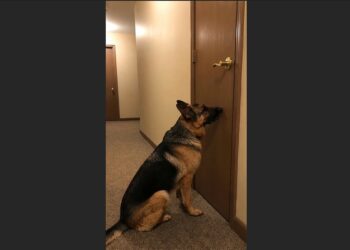
At two o’clock in the morning, our elderly German Shepherd began scratching at our bedroom door.
His name was Arlo. He was at least twelve years old, struggled with severe arthritis, and usually spent most of his nights sleeping.
But that night, he wouldn’t settle down.
He paced through the house, nudged the door, and scratched until I finally got out of bed.
I thought he needed to go outside.
Instead, he led me toward the back of the house, stopping occasionally to make sure I was following.
When I reached the back door and opened it, I understood why he had been so determined to wake us.
The smell of gas was unmistakable.
Something had gone wrong with our heating system, and gas had been accumulating inside the house while my wife and I slept.
We had no idea we were in danger.
Arlo had been with us for only two weeks.
According to the shelter, he was an old dog whose remaining time might be short. We had brought him home expecting to provide a peaceful place for his final days.
We never imagined he would be the one protecting us.
An Unexpected Call About a Dog Who Needed Somewhere to Go
Two weeks earlier, our lives had been very different.
Our son had recently left for college, and my wife and I were still adjusting to the quiet that followed.
After years of having him around, the house felt strangely empty.
There were no longer the familiar sounds of his daily routines. The rooms seemed larger without him moving through them, and evenings had become unusually quiet.
We were proud of him, of course. Going away to college was an important step in his life.
But knowing that didn’t make the adjustment effortless.
My wife and I had spent so many years organizing our lives around being parents that we were still learning what it meant to have the house largely to ourselves again.
Then, late one afternoon, the phone rang.
A woman from an animal shelter was calling about an elderly German Shepherd.
She spoke gently, but there was no mistaking the seriousness of what she was telling us.
“His name is Arlo. He’s an older German Shepherd… around twelve, maybe more. We’re just hoping someone can give him a calm place for whatever time he has left.”
She explained that Arlo had severe arthritis and old injuries. He was barely eating and spent much of his time lying down.
There was no reason to believe he was about to make a remarkable recovery.
The shelter was simply hoping someone would be willing to care for him in a quiet home.
I looked across the table at my wife.
Neither of us said anything immediately.
We understood what taking Arlo home might mean.
We might have only a short time with him. We could be facing difficult decisions and the sadness of losing a dog almost as soon as we had welcomed him.
But I kept thinking about what the shelter worker had said.
He needed a calm place.
That was something we could give him.
Our house was quiet now. We had room for a dog who didn’t need long walks or constant entertainment. We could offer a comfortable bed, companionship, and the attention an older animal deserved.
My wife met my eyes.
We didn’t need a long discussion.
“We’ll take him,” I told the shelter worker.
At the time, I thought we were making a small difference in the life of a dog who had been overlooked.
I had no idea how much he would change ours.
Meeting Arlo: A Dog With Almost No History
When we arrived at the shelter, Arlo was lying in his kennel.
He was a large German Shepherd, but age had taken much of the strength from his body.
His coat was uneven and thin in places. One ear tilted slightly, giving his face an expression that was both dignified and a little weary.
His eyes were cloudy, with the soft gray appearance sometimes seen in older dogs.
He didn’t look like a dog who had enjoyed an easy life.
Still, we couldn’t know exactly what he’d been through.
His shelter file offered very little information.
The entries were painfully brief:
Stray.
No owner.
Senior — hospice.
There was no detailed medical history, no account of where he had lived, and no explanation of how he had ended up alone.
We didn’t know whether he’d once belonged to a family or how long he had been wandering before someone brought him to safety.
We only knew that he was old, uncomfortable, and in need of a home.
When the kennel door opened, Arlo didn’t hurry toward us.
He didn’t bark or jump up to greet us.
He simply lifted his head and watched.
After a moment, his eyes moved from me to my wife and back again.
I crouched nearby, careful not to expect more from him than he could comfortably offer.
He seemed tired.
Not merely sleepy, but worn down in a way that made me wonder how long he had been struggling.
There was no sudden display of affection. No excited tail wagging or playful attempt to win us over.
But none of that mattered.
We hadn’t come looking for an energetic young dog.
We had come for Arlo.
And whether he had months, weeks, or only a few days left, we wanted those days to be comfortable.
Giving an Old Dog Permission to Rest
Bringing Arlo home was a quiet experience.
He moved slowly, placing his paws carefully as though every step required thought.
We knew his arthritis caused discomfort, so we had prepared a soft bed beside the living room couch.
It was close enough that he could be near us without having to move around the house unnecessarily.
We wanted him to have somewhere comfortable to rest and somewhere he could feel included.
During those first days, Arlo spent most of his time on that bed.
He slept for long stretches.
Occasionally, he lifted his head when we approached with food. At other times, he simply watched us from where he lay.
His appetite remained poor, just as the shelter had warned.
We tried not to overwhelm him with attention.
I had the impression that he needed time more than anything else.
There was no reason to rush him into behaving like a younger, healthier dog.
He didn’t have to perform tricks, follow us from room to room, or demonstrate affection to prove he appreciated being there.
If he wanted to sleep, he could sleep.
If he wanted to watch us quietly, that was fine too.
My wife and I began adjusting our routines around his comfort.
The bed beside the couch became his regular place, and we grew accustomed to seeing his gray face resting near us in the evenings.
There was something reassuring about having him there.
Our son’s absence hadn’t stopped mattering, but the house no longer felt quite as empty.
Arlo needed very little from us beyond care and patience.
And perhaps that simplicity was part of what made his presence so welcome.
We didn’t expect him to become a lively companion.
We were grateful that he could rest without having to worry about where he would sleep next.
A Small Change on the Tenth Day
Around the tenth day, I heard an unfamiliar sound coming from the hallway.
It was faint, almost too quiet to notice.
The soft tapping of paws against the floor.
I turned toward the sound.
Arlo was standing.
For a moment, I simply watched him.
He was unsteady, and his movements were slow, but he had gotten up from his bed and made his way into the hallway.
He took a careful step.
Then another.
I didn’t want to startle him, so I stayed where I was and let him move at his own pace.
It was such a small thing.
A dog walking down a hallway.
But after watching Arlo spend most of his time lying down, it felt significant.
Over the following days, he began getting up more often.
He didn’t suddenly become strong or energetic. His arthritis hadn’t disappeared, and he still needed plenty of rest.
But he seemed increasingly interested in being wherever we were.
If I moved from one room to another, I would sometimes hear those slow footsteps behind me.
When my wife went about her day, Arlo made an effort to stay nearby.
He followed us carefully, pausing whenever he needed to.
We never asked him to keep up.
It was enough that he wanted to come along.
I began thinking that perhaps the shelter had underestimated how much life remained in him.
Not because his medical problems had vanished, but because there were still things he wanted to do.
He wanted to be near us.
He wanted to know where we were going.
And he seemed to enjoy being part of the household.
For a dog we had brought home to say goodbye to, Arlo was quietly beginning to settle into a new life.
The Night Arlo Refused to Let Us Sleep
Two weeks after we adopted him, something unusual happened.
It was around 2:00 in the morning.
My wife and I were asleep when I became aware of movement outside our bedroom.
At first, I wasn’t fully awake.
Then I heard scratching.
Not a single uncertain scrape, but repeated scratching against the bedroom door.
I sat up, confused.
Arlo rarely moved much at night. He certainly didn’t make a habit of waking us.
Yet there he was, pacing outside our room and trying to get our attention.
I got out of bed and opened the door.
“What is it, buddy?” I asked.
Arlo didn’t come toward me.
Instead, he turned away and began moving down the hallway.
His steps were slow, but his behavior was unusually determined.
I followed him.
He made his way toward the living room and then continued toward the back door.
Several times, he stopped and looked back at me.
I couldn’t know exactly what he intended, but it certainly seemed as though he wanted me to follow.
I assumed he needed to go outside.
It was the simplest explanation, especially for an older dog who might have difficulty waiting until morning.
But when I reached the door, something felt different.
Arlo wasn’t behaving like a dog casually asking to go into the yard.
He had been persistent enough to wake us, and now he had led me directly to the back of the house.
I opened the door.
And immediately, I noticed the smell.
The Warning We Had Been Sleeping Through
It was gas.
Strong enough that I knew something was wrong.
Suddenly, Arlo’s unusual behavior took on an entirely different meaning.
I realized we might have a dangerous problem inside the house.
I woke my wife, and we got outside with Arlo before seeking emergency help from a safe location.
What had seemed like an ordinary request to go outdoors had turned into a frightening discovery.
We later learned that our heater had malfunctioned.
Gas had been leaking into the house while we were sleeping.
Neither my wife nor I had noticed it.
Had Arlo remained quietly on his bed, we might have continued sleeping without realizing anything was wrong.
The thought was difficult to shake.
A technician who examined the problem made it clear that the situation could have been far more serious.
“You’re lucky,” he told us. “Another hour… and this would’ve ended very differently.”
I remember looking down at Arlo after hearing those words.
He was standing near us, looking like the same elderly dog we had brought home from the shelter.
His movements were still careful.
His gray muzzle and cloudy eyes hadn’t changed.
He was still the dog with severe arthritis, the dog who had barely eaten and spent most of his first days resting.
Yet somehow, he had sensed that something was wrong and made enough noise to wake us.
I crouched beside him.
Arlo lifted his head and gave a small wag of his tail.
It was a simple response, nothing dramatic.
But I don’t think I’ll ever forget it.
The Dog We Thought We Were Saving Had Protected Us
In the days afterward, my wife and I talked often about that night.
We couldn’t know precisely what Arlo had detected or why he had responded the way he did.
Perhaps the unfamiliar smell disturbed him.
Perhaps he simply knew something about the house was different and wanted to get outside.
Whatever the reason, he had refused to settle until someone followed him.
That persistence had given us the warning we needed.
I kept thinking about our decision to adopt him.
When the shelter called, we had believed we were offering an old dog a final kindness.
We expected quiet days, extra care, and the possibility of saying goodbye much sooner than we wanted.
We never imagined he would alert us to danger in our own home.
But I also didn’t want that one extraordinary night to become the only reason Arlo mattered.
He was already worth bringing home before he did anything for us.
His age, arthritis, and uncertain future hadn’t made him less deserving of kindness.
And even if he had spent every remaining day sleeping peacefully beside our couch, adopting him would still have been worthwhile.
The night of the gas leak didn’t make Arlo valuable.
It simply showed us another side of a dog we were already learning to love.
Four Months Later, Arlo Is Still Here
That happened four months ago.
Arlo is still with us.
He hasn’t become a young dog again.
His arthritis continues to limit his movement, and he spends much of his day resting.
He walks slowly and takes his time getting from one room to another.
But he gets up.
He follows us when he feels able.
And most mornings, when we begin our day, he’s there.
Waiting.
One of my favorite changes has nothing to do with the night he warned us about the gas.
It’s a small, worn tennis ball we found underneath the couch.
Arlo has taken an interest in it.
Sometimes he carries it across the room and drops it near my feet.
He looks up at me, waiting to see what I’ll do.
It’s such an ordinary thing for a dog to enjoy, but I never expected to see it from him when he first arrived.
I remember that tired German Shepherd lying in his shelter kennel, barely willing to move.
Now, even on days when his steps are slow, he sometimes wants to play.
Not for long.
Not with the energy of a puppy.
Just enough to remind us that he still enjoys the simple pleasures of being a dog.
My wife smiles whenever she sees him with that tennis ball.
I do too.
We know Arlo is old, and we haven’t forgotten what the shelter told us about his health.
We still understand that our time together may be limited.
But we no longer spend every day wondering whether it will be his last.
Instead, we try to appreciate the time he has.
Some days, that means watching him sleep comfortably beside the couch.
Other days, it means hearing his careful footsteps behind us.
And occasionally, it means finding an old tennis ball waiting at my feet.
A Second Chance Neither of Us Expected
When our son left for college, my wife and I were trying to adjust to a quieter home.
When the shelter called about Arlo, we thought caring for an older dog might bring a little warmth back into our daily lives.
It did.
But it brought more than we anticipated.
Arlo reminded us that an animal’s age doesn’t determine the importance of the life it still has ahead.
He reminded us that a dog with painful joints and a difficult history can still enjoy affection, companionship, and small moments of happiness.
And one frightening night, he reminded us how fortunate we were to have him nearby.
I sometimes think about what might have happened if we had decided the responsibility was too great.
If we had told the shelter we couldn’t take him.
If we had assumed that a twelve-year-old German Shepherd with arthritis had nothing left to offer.
We would never have known him.
We would never have heard those quiet footsteps in our hallway.
And we wouldn’t have experienced the particular comfort of watching an elderly dog discover that he still had a place to belong.
The shelter had asked us to give Arlo a peaceful ending.
Four months later, he is still writing his own small chapter in our family.
I don’t know how much time we have left together.
But when he walks into the room carrying that old tennis ball, I try not to think too far ahead.
I bend down, reach for it, and spend a little time with him.
Because Arlo has already taught me something worth remembering.
A dog doesn’t have to be young, healthy, or strong to make a home feel complete.
Sometimes all he needs is a comfortable place to rest, someone willing to care for him, and the freedom to enjoy whatever good days remain.
And sometimes, the old dog you bring home hoping to give him a little more time becomes the reason you’re grateful for every day you have together.