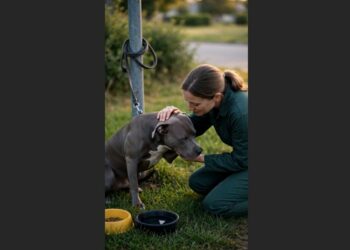
The photograph showed a giant tattooed biker sitting on the steps of an abandoned house in Flagstaff, Arizona.
He was holding a Pit Bull so thin that her ribs were visible beneath her fawn-and-white coat.
The dog’s head rested against his chest.
His forehead was pressed gently to hers.
And his arms were wrapped around her as though he was afraid to let go.
He sat there for thirty minutes.
Not speaking.
Not looking toward the street.
Just holding a dog he’d found chained inside a filthy, abandoned house.
A woman across the road took a photograph.
By the following morning, it had been shared more than eleven thousand times.
People wanted to know who the biker was.
Whether the dog had survived.
And why such a large, intimidating-looking man had been sitting on a stranger’s porch with tears running down his face.
Then the biker himself appeared in the comments.
His name was Mack.
He wasn’t someone who posted much online.
But beneath that photograph, he wrote something about his childhood that he’d kept private for most of his life.
The last two sentences were the ones people couldn’t stop sharing.
“I didn’t save that dog today. I saved the kid in the closet. The only difference is this time I was big enough to break the chain.”
When I interviewed Mack two days later, he told me the story behind those words.
And it began with a cleanout job nobody expected to involve a living animal.
The House Nobody Had Entered
Mack worked for a property cleanout company.
His crew handled abandoned properties, foreclosures, and houses that needed to be emptied before they could be repaired or sold.
He was accustomed to unpleasant conditions.
Spoiled food.
Damaged furniture.
Trash left behind by former occupants.
And the occasional animal that had found its way into an empty building.
On a Thursday morning, a property management company contacted his employer about a small bungalow in Flagstaff.
The house had been foreclosed on six months earlier.
The last tenants had apparently left in a hurry.
Neighbors had complained about a smell, and the management company needed someone to inspect the property and document its condition.
Mack’s usual coworker, Diego, was out with a shoulder injury.
So Mack went alone to complete the initial inspection.
He arrived at 9:14 a.m.
The front door had been boarded shut.
He used a key supplied by the management company to unlock the back gate and entered through the rear door.
The smell hit him immediately.
He’d worked in enough abandoned houses to recognize the odor of rotting waste.
But this was worse than usual.
He put on his respirator and switched on his flashlight.
The kitchen was nearly empty.
A refrigerator stood with its door hanging open.
Discarded takeout containers were scattered nearby.
The living room had damaged carpeting.
He continued down a short hallway.
At the end was a small utility room.
A water heater stood against one wall.
Mack pushed the door open.
And stopped.
There was a dog lying on the concrete floor.
The Pit Bull in the Utility Room
She was a fawn-and-white Pit Bull.
Mack couldn’t tell her age.
She was painfully thin, with her ribs and hips prominent beneath her coat.
The concrete floor was covered in waste.
A short chain connected a nylon harness on her body to a steel pipe extending from the wall.
Later, Mack measured the chain.
Twenty-four inches.
That was the limit of her world.
She could move only a couple of feet in any direction.
She had no room to walk around the room or stretch out comfortably.
The harness had rubbed against her skin so severely that parts appeared embedded in injured tissue.
When the door opened, the dog raised her head a few inches.
Mack shone his flashlight toward the floor so the beam wouldn’t hit her directly in the eyes.
She looked at him.
She didn’t bark.
She didn’t attempt to stand.
But she was conscious.
And her eyes followed him.
When Mack spoke to me later, he said that was the detail he couldn’t forget.
Not the smell.
Not the waste.
Not even how thin she was.
“Her eyes, Nora,” he told me. “That’s the part that keeps you up.”
He stood in the doorway trying to understand how an animal could have been left in such conditions.
The property had been vacant for months, but nobody knew precisely when the dog had been confined there or whether someone had been entering to provide occasional care.
All Mack could see was that she was severely neglected.
And she needed help immediately.
The Chain Was Only Two Feet Long
Mack returned to his pickup and retrieved his bolt cutters.
Then he went back into the utility room.
The dog was still lying in the same place.
He knelt beside her.
“Hey, girl. I’m not gonna hurt you.”
He showed her the tool without moving it toward her face.
“I’m just gonna cut this.”
He positioned the cutters near the metal pipe, away from her body.
Then squeezed.
The chain snapped.
He left the damaged harness in place because he was concerned that trying to remove it could worsen her injuries.
That was something a veterinarian needed to handle.
He tried encouraging the dog to stand.
She shifted her weight.
Her front legs moved.
But when she attempted to push herself upright, her hind legs couldn’t support her.
She gave a small whine.
Then settled back onto the concrete.
Mack stopped trying to lift her onto her feet.
He sat beside her.
For a moment, anger overwhelmed him.
He told me he wanted to find the person responsible for leaving her there.
He imagined confronting them.
Demanding an explanation.
Making them understand what they’d done.
Then he looked down at the dog.
And realized none of that anger would help her.
“I wanted to hurt somebody,” he admitted during our interview. “I’m not proud of that. But then I looked at her and thought, that’s not going to feed her. That’s not going to get her to a vet.”
So he focused on what he could do.
He carefully gathered the injured dog into his arms.
She weighed about thirty-one pounds.
For a dog of her frame, she should have weighed considerably more.
Her body felt frighteningly light.
Mack carried her through the hallway.
Past the empty living room.
Through the kitchen.
And out the back door.
Then he walked around the house to the front porch.
He lowered himself onto the wooden steps.
And held her against his chest.
Thirty Minutes on the Porch
Mack knew the dog needed medical attention.
He knew animal control needed to be involved.
But for a while, he couldn’t bring himself to move.
He sat there holding her.
Her body rested across his arms.
Her head leaned against his chest.
Every so often, he gently touched her back.
He wasn’t trying to make a dramatic statement.
He wasn’t thinking about photographs or social media.
And he certainly wasn’t expecting strangers to recognize him the following day.
He told me he was remembering something from his own childhood.
Something he’d spent years learning to live with.
Across the street, a woman named Denise noticed him.
She was sixty-two and lived in a small yellow stucco house directly opposite the abandoned bungalow.
She’d been worried about the property for months.
At one point, she’d heard a sound that made her suspect an animal might be trapped somewhere inside.
She’d contacted the county, but access to the foreclosed property had been complicated.
Now she watched a large man emerge carrying a limp dog.
He sat on the front steps.
Lowered his forehead toward the animal.
And remained there.
Denise watched from her window for several minutes.
Then stepped onto her porch with her phone.
She took one photograph.
Later, she told me she’d been reminded of her late husband by the way the man held the dog.
Something about his shoulders.
The gentle way he supported the animal.
And the fact that he seemed completely unaware anyone was watching.
She posted the photograph to a local community Facebook page that evening.
Her caption was brief.
She explained that a man had found a starving dog inside the abandoned house and carried her outside.
She didn’t know his name.
She didn’t know whether the dog would survive.
And she had no idea how far the photograph would travel.
Eleven Thousand Shares by Morning
By nine o’clock the next morning, the photograph had been shared more than eleven thousand times.
People across northern Arizona were asking about the dog.
Some offered to help with veterinary expenses.
Others wanted to know who the man was.
Many commented on the contrast between his intimidating appearance and the way he held the frail animal.
A few people said they’d never seen such a moving rescue photograph.
Then, at 11:47 a.m., someone commented beneath the post.
It was Mack.
His account was hardly active.
He’d joined Facebook years earlier and rarely posted anything.
But this time, he wrote nine sentences.
He explained that he was the man in the photograph.
He said he hadn’t been trying to look heroic.
He’d simply needed a moment with the dog.
Then he shared something deeply personal.
As a child, his father had locked him in a bedroom closet when he was drunk.
The closet was only about three feet wide.
Mack remembered being hungry.
He remembered being unable to bathe.
He remembered being frightened and unable to leave.
And when he’d found that Pit Bull confined to a tiny space inside the bungalow, those memories had returned.
He wrote:
“I know what it feels like to be chained inside two feet.”
Then came the words that people shared again and again.
“I didn’t save that dog today. I saved the kid in the closet. The only difference is this time I was big enough to break the chain.”
Mack closed the app afterward.
He didn’t spend the rest of the day reading comments.
He had work to do.
And he was still worried about the dog.
By midnight, the photograph and his response had been shared thousands more times.
The Man I Met on Saturday
I drove to Flagstaff on Saturday morning to interview Mack.
He’d agreed to meet me at the abandoned bungalow.
The management company had secured the property but granted permission for him to return briefly.
When I arrived, Mack was sitting on the same porch.
This time, the dog was beside him.
She’d received emergency veterinary care and had been given the name Mercy.
She was wearing a protective cone and a new, soft harness.
Her wounds had been treated.
She was still very thin and unable to move comfortably, but she was receiving care.
Mercy lay across Mack’s feet on the wooden porch boards.
Every so often, he reached down and scratched gently behind her ear.
He didn’t look like someone enjoying sudden internet fame.
He seemed uncomfortable with the attention.
I asked him why he’d agreed to speak publicly.
He looked toward Mercy.
Then said something I didn’t expect.
“Nora, I’m not here because of a dog.”
He paused.
“I’m here because of the people who read what I wrote.”
He explained that strangers had been messaging him.
Adults who’d experienced abuse as children.
People who’d spent years keeping those experiences private.
And teenagers who said they were currently living in frightening homes.
Some told him his comment was the first time they’d seen an adult describe something similar to what they’d endured.
Mack didn’t claim to have answers for everyone.
He wasn’t a therapist.
He couldn’t fix their lives through a Facebook comment.
But he wanted them to know that he’d grown older, received help, and built a life after a childhood that had once seemed impossible to escape.
“Somebody has to say it out loud,” he told me.
The Closet He Never Forgot
Mack told me he’d been in therapy since he was thirty-two.
He’d also stopped drinking shortly after beginning treatment and had remained sober.
Before the viral photograph, only a small number of people knew the full story of his childhood.
His therapist.
His recovery sponsor.
His former wife.
A priest he’d spoken with years earlier.
And a few others he trusted.
Most of his motorcycle club brothers had never heard the details.
He hadn’t planned to tell strangers on the internet either.
But when he sat on that porch holding Mercy, the memories came back unexpectedly.
He remembered being six years old.
He remembered the closet.
And he remembered how desperately he’d wanted someone to open the door.
“When I picked her up, I wasn’t thinking about any of that,” he said. “Not at first.”
He rested a hand against Mercy’s shoulder.
“Then I sat down with her, and suddenly I was back there.”
He went quiet.
After a while, he continued.
“If somebody had sat with me like that when I was six, I think things might have been different.”
I didn’t interrupt.
Mack looked down at the dog.
Then gave a small smile.
“I’m not saying everything turned out perfect. It didn’t.”
He paused again.
“But I’m okay, Nora. I’m pretty okay.”
That was what he’d wanted people to understand.
He’d experienced terrible things.
He’d needed help.
And healing had taken years.
But his childhood hadn’t been the end of his story.
He had become an adult capable of offering the protection he’d once needed himself.
“I got to be the guy with the bolt cutters this time,” he said.
“That’s the part that matters.”
Mercy’s Recovery
Mercy’s recovery was gradual.
Veterinarians treated the wounds caused by her damaged harness.
They addressed her severe malnutrition.
And they worked with her as she began regaining strength and mobility.
Her hind legs were weak after a prolonged period of restricted movement.
She couldn’t simply stand up and walk normally once the chain was removed.
She needed time.
Appropriate nutrition.
Medical care.
And rehabilitation.
Mack visited regularly.
He didn’t expect her to recover overnight.
He understood she might have lasting mobility problems.
But he was willing to provide the care she needed.
Three weeks after our first interview, Mack officially adopted Mercy.
She went home with him.
Over the following four months, she gained twenty-eight pounds.
Her body gradually filled out.
Her skin healed.
And she became stronger.
Veterinarians expected that she would probably retain some stiffness in her hind legs.
But with continued care, her overall outlook was encouraging.
Mack arranged his home around her needs.
He gave her a comfortable place to rest.
Kept her appointments.
And avoided forcing her into situations that made her uncomfortable.
Mercy slowly learned the household routine.
Meals arrived regularly.
She had room to move.
And when she wanted to lie down, nothing restrained her.
For a dog who had once been confined to a two-foot radius, those ordinary freedoms mattered.
“Nobody’s Locking This Door.”
The second time I visited Mack, we sat in his kitchen drinking coffee.
Mercy was resting nearby.
She looked very different from the skeletal dog in the photograph.
Her coat was healthier.
Her body was stronger.
And she seemed comfortable moving around the house at her own pace.
Mack told me about their nighttime routine.
Mercy slept at the foot of his bed.
Every evening, before he turned out the light, he knelt beside her.
He placed his large, scarred hands gently on either side of her head.
Then leaned forward and touched his forehead to hers.
He said one sentence.
Every night.
“Nobody’s locking this door.”
Then he stood up.
Turned off the light.
And went to sleep.
Mercy stretched out across the foot of the bed, sometimes resting against his feet.
I asked whether he really said the words every night.
He nodded.
“Every night.”
He knew Mercy couldn’t understand the sentence the way a person would.
But the ritual mattered to him.
It reminded him of the difference between the past and the present.
He’d once been a frightened child who couldn’t leave a closet.
Now he was an adult with his own home.
His own choices.
And a dog who could move freely from room to room.
He couldn’t rewrite his childhood.
But he could decide how Mercy would be treated.
And he could make sure she never faced that kind of confinement in his care.
The Comments Mack Couldn’t Forget
Months passed.
The original photograph continued circulating online.
Its share count eventually reached seventy-three thousand.
People kept discovering the story.
Some wrote about rescued dogs.
Others spoke about difficult childhoods.
And some simply thanked Mack for being willing to share something so personal.
He didn’t respond to every message.
There were too many.
But he read a number of them.
Four messages affected him especially deeply.
Three men and one woman told him they’d experienced similar childhood confinement.
Each described recognizing something of their own history in his words.
They told him they were doing okay now.
Their lives weren’t perfect.
But they’d survived.
And they wanted him to know.
Mack wrote their first names on a list and kept it on his refrigerator.
Not as trophies.
Not as proof that he’d saved anyone.
But as reminders that speaking about his experiences had helped other people feel less alone.
He still received messages from people seeking support.
When someone described current abuse or immediate danger, he understood that a Facebook conversation wasn’t enough.
They needed trusted adults, appropriate services, and practical help.
Mack wasn’t qualified to replace those things.
But he could encourage people to reach out.
And he could tell them something he’d learned through decades of therapy and recovery.
What happened to them wasn’t something they had to carry in silence forever.
The Comment He Pinned Six Months Later
Six months after the original photograph, Mack returned to the Facebook post.
He wrote another comment and pinned it beneath the image.
It was much shorter than the first.
Just one sentence.
“If you’re a kid reading this and you’re in a closet: somebody is coming. Hold on.”
It was a message of hope, not something Mack could guarantee for every child.
He understood that real help sometimes requires telling a trusted adult, contacting child protective services, or reaching emergency services when someone is in danger.
But he wanted frightened children to know that their circumstances did not have to remain unchanged forever.
He wanted them to keep seeking a way to safety.
And he wanted adults reading his story to recognize how much a single act of protection could mean.
The photograph had begun as an image of a biker holding an injured dog.
Now it had become a way for people to talk about experiences they’d rarely discussed.
Mack hadn’t expected any of that.
He’d simply gone to inspect an abandoned house.
Found a dog who couldn’t stand.
Cut her chain.
And carried her into daylight.
The Photograph on Denise’s Page
Denise never removed the photograph.
It remained on her community Facebook page.
A large man in a black shirt and leather vest.
His head lowered.
A thin Pit Bull resting in his arms.
An abandoned bungalow behind them.
There was nothing glamorous about the scene.
The porch boards were weathered.
The yard was neglected.
The dog’s body showed the effects of severe suffering.
And Mack looked like someone who had reached the end of an emotionally overwhelming morning.
But people kept sharing it.
Partly because of Mercy.
And partly because of Mack’s response.
He’d written openly about something many adults spend their lives trying not to discuss.
He’d explained that seeing a helpless animal trapped in a tiny space had brought back memories of his own childhood.
And he’d admitted that when he held Mercy, part of him felt as though he was finally able to offer protection to the little boy he’d once been.
The photograph didn’t prove he had overcome every effect of childhood abuse.
He never claimed that.
Years of therapy and recovery had been part of his life long before Mercy arrived.
But rescuing her became an important moment in that ongoing process.
It reminded him of who he’d become.
Someone who could recognize suffering.
Respond without violence.
And offer safety.
The Dog Who Could Finally Stretch Out
The last time I visited, Mercy was lying across the foot of Mack’s bed.
She was no longer the frighteningly thin animal he’d found in the utility room.
She’d gained weight.
Her wounds had healed.
And although her hind legs remained somewhat stiff, she could move around the house.
Mack had provided soft places for her to rest.
She didn’t have to sleep on concrete.
She didn’t have to remain in one position because a chain wouldn’t allow her to move.
And she no longer had to wait for someone to enter a dark utility room before she could receive help.
She could stand.
Walk.
Turn around.
Or stretch out across the bed.
Mack watched her sleep.
Then reached down and gently touched her shoulder.
I asked him whether he ever thought about the day he found her.
He smiled faintly.
“Every day.”
Then he told me something that stayed with me.
For years, he’d been ashamed of how frightened he was as a child.
He’d thought about the times he hadn’t fought back.
The times he cried.
And the helplessness of being locked away.
Therapy had helped him understand that a six-year-old child wasn’t responsible for stopping an abusive adult.
That fear wasn’t weakness.
And that surviving was not something to be ashamed of.
But seeing Mercy had brought those memories close again.
The difference was that now he had choices.
He could call for help.
He could cut the chain.
He could carry her outside.
And he could give her a safe home.
He couldn’t do those things when he was six.
Now he could.
The Man With the Bolt Cutters
When I first saw the viral photograph, I saw what everyone else saw.
A tattooed biker holding a starving dog.
A moving image.
The kind of photograph people stop scrolling to look at.
But after interviewing Mack, I understood why he hadn’t moved from those porch steps for thirty minutes.
He wasn’t posing.
He wasn’t waiting for someone to notice him.
He was trying to process what he’d discovered.
A helpless animal confined to a tiny, filthy space.
A body so weak she couldn’t stand.
And a situation that reminded him of something he’d experienced before he was old enough to protect himself.
He’d freed Mercy from the chain.
Then sat with her.
For half an hour, he simply held her.
Afterward, he arranged for the care she needed.
He visited during her recovery.
Eventually, he adopted her.
And months later, she was sleeping comfortably in his home.
That is the part of the story I wish more people would remember.
Not the number of shares.
Not the comments.
Not how surprising it looked to see a large biker holding a fragile animal.
But what happened after the photograph.
Mercy received medical treatment.
She gained strength.
She found a permanent home.
And Mack continued caring for her long after strangers had stopped paying attention.
The Last Thing Mack Told Me
Before I left his house, I asked Mack whether he regretted posting that first comment.
After all, he’d revealed something deeply private.
Thousands of strangers now knew about the childhood he’d spent years discussing only with people he trusted.
He thought about it for a while.
Then shook his head.
“No.”
He looked toward Mercy.
“I didn’t plan to tell anybody all that. It just came out.”
He paused.
“But if it helped somebody understand they’re not the only one, I’m okay with it.”
I asked whether rescuing Mercy had changed how he thought about himself.
He considered the question.
Then said:
“I spent a lot of years wishing somebody had opened that closet door.”
He reached down and scratched Mercy gently behind her ear.
“That day, I got to open a door for somebody else.”
I looked toward the dog.
She was resting quietly.
Her body stretched comfortably across the bed.
Mack smiled.
“And she gets to stay out.”
Before turning off the bedroom light that evening, he’d kneel beside her as usual.
Place his hands gently against her head.
Touch his forehead to hers.
And say the sentence that had become their nightly ritual.
“Nobody’s locking this door.”
Mercy would settle at his feet.
And Mack would go to sleep in a home where both of them were safe.
The photograph will probably continue circulating for years.
People will look at it and see a huge biker holding a fragile Pit Bull.
Some will comment on his tattoos.
Others will ask about the dog.
But when I see it now, I think about a six-year-old boy who once wished somebody would open a closet door.
And a fifty-something man who finally got to be the person holding the bolt cutters.
He couldn’t change what happened to that little boy.
But he could change what happened to Mercy.
And he did.
Editor’s Note: The characters in this story are fictional. Through these stories, we hope to share the intelligence, loyalty, compassion, and loving nature of dogs with people everywhere.