Biscuit was 10 years old when everything familiar disappeared from his daily life.
He had not been abandoned.
No one had decided he was too old, too inconvenient, or no longer wanted.
His longtime owner had reached a point where living independently was no longer safe and had moved into residential care. Keeping Biscuit there was not possible.
So arrangements were made.
A new home was found with someone who wanted to give the senior dog stability, patience, and a place to spend the rest of his life.
On paper, it was the best outcome anyone could reasonably hope for.
Biscuit did not know that.
He only knew that one day he was in the home he understood, and the next he was somewhere else.
Different walls.
Different smells.
Different footsteps.
Different nighttime sounds.
A comfortable bed had been prepared for him.
Biscuit ignored it.
Instead, he walked to the front door, lowered himself onto the floor, and waited.
His Old Life Had Ended Without His Understanding Why
Dogs experience change through what they can observe.
They know familiar people.
Familiar scents.
Meal times.
Walking routes.
The sound of a particular person’s keys.
The chair someone always sits in.
The room where everyone settles in the evening.
They do not understand legal arrangements, medical decisions, or why an elderly person may need to move into care.
Biscuit could not be told, in any meaningful human sense, that his previous owner was safe somewhere else.
He could not understand that his move had been arranged because people cared what happened to him.
All he had was absence.
The person he knew was missing.
The house was different.
And he had no way to know whether any of that was temporary.
His New Family Had Prepared Carefully
Before Biscuit arrived, a bed had been placed in a quiet corner of the living room.
There were water and food bowls.
A few soft toys.
A blanket.
The plan was to give him his own space and allow him to settle without pressure.
Nobody expected a 10-year-old dog to arrive and immediately behave as though he had always lived there.
Still, there was hope that once he explored the rooms and realized nothing frightening was happening, he might relax.
Biscuit did explore.
Slowly.
He sniffed the furniture.
Paused in the hallway.
Walked into the kitchen.
Then he returned to the entrance.
He Kept Going Back to the Front Door
At first, it seemed like ordinary curiosity.
Perhaps he had heard something outside.
Maybe he wanted a walk.
But after being taken out and brought back in, Biscuit returned to the same place.
He lowered himself beside the door.
His head stayed up.
His ears shifted whenever footsteps passed outside.
Every sound in the hallway made him pay attention.
Then the sound faded.
Biscuit stayed where he was.
The new bed waited only a few feet away.
He showed almost no interest in it.
Nobody Tried to Drag Him Away
It would have been easy to decide that Biscuit needed to learn immediately where he was supposed to sleep.
Instead, his new family watched him for a while.
He was not pacing frantically.
He was not scratching the door.
He was not barking.
He simply seemed unable to settle anywhere else.
So they left him there.
A pillow was brought over.
Biscuit sniffed it.
Then looked toward the door again.
A blanket came next.
Nobody wrapped him in it or tried to coax him onto it.
They simply placed it within reach.
If the doorway was where he felt safest that night, then the doorway could become his temporary sleeping place.
Senior Dogs Often Need Time to Adjust
Moving can unsettle dogs of any age.
For an older dog, however, years of established routine may make a sudden transition especially noticeable.
Biscuit had spent most of his life learning one set of patterns.
He knew when mornings began.
He knew where meals appeared.
He knew which sounds belonged in the house.
He knew the person whose presence had shaped his days.
Now nearly every cue had changed at once.
That did not mean he would never adapt.
It meant adaptation could not be demanded on a schedule.
The First Goal Was Not Affection
Nobody needed Biscuit to cuddle.
He did not have to play.
He did not have to show gratitude.
He did not even have to use the expensive dog bed waiting for him.
For the first night, the goal was much smaller.
Eat something.
Drink.
Go outside when needed.
Rest if possible.
Discover that nobody in the new house would force him into interaction.
That was enough.
Trust in a new environment is often built through repetition rather than dramatic breakthroughs.
Nothing bad happens.
Then nothing bad happens again.
Food arrives.
The water stays available.
The same people return.
Eventually, predictability begins replacing uncertainty.
Biscuit Watched Everything
Whenever someone walked through the living room, his eyes followed.
When the refrigerator opened, his nose lifted.
If a door closed elsewhere in the house, one ear turned toward it.
He seemed tired.
Still, he resisted sleep.
Dogs in unfamiliar environments sometimes remain alert because they have not yet learned which sounds can safely be ignored.
A heating system turning on may be ordinary to a person who lives there.
To a newly arrived dog, it is new information.
Biscuit had an entire house full of new information.
So his family kept the evening quiet.
They Sat Nearby Without Crowding Him
The television stayed low.
Lights were dimmed.
Nobody repeatedly called his name.
Occasionally, someone spoke to him softly.
“It’s all right, Biscuit.”
He could not understand the sentence as reassurance about his future.
But he could understand tone.
Calm voices.
Slow movement.
No hands reaching over his head.
No insistence that he move.
Little by little, his body seemed less tense.
His head lowered once.
Then lifted again when a car passed outside.
The night continued.
The Pillow Eventually Became Interesting
At some point, Biscuit shifted.
One front paw moved onto the pillow.
Then the other.
His nose touched the fabric.
He remained like that for several minutes.
Later, his chin rested along the edge.
Nobody commented.
Nobody rushed over to pet him and accidentally made the moment more complicated.
They let him choose.
His breathing slowed.
The muscles around his face softened.
For the first time since arriving, Biscuit seemed close to sleep.
He Was Still Beside the Door
That mattered.
The small success was not that Biscuit had abandoned the entrance and embraced his new bed.
He had not.
He was still exactly where he had chosen to wait.
The change was that the unfamiliar house had become safe enough for him to close his eyes.
The pillow helped.
The blanket helped.
So did the people who allowed him to stay where he was.
A dog does not have to stop looking for the old life before beginning to experience safety in the new one.
Both can exist at once.
Biscuit Finally Slept
His head settled fully onto the pillow.
His eyes closed.
At first, they opened again at every unfamiliar sound.
Then the pauses became longer.
Eventually, he remained asleep.
Nobody moved him.
The new bed stayed empty across the room.
That was fine.
The dog had found rest.
For his first night, that was the only victory anyone needed.
The Next Morning Did Not Solve Everything
Biscuit woke early.
For several seconds, he looked around as though reorienting himself.
Then he stood and returned his attention to the front door.
The behavior had not disappeared overnight.
No one expected it to.
He went outside for a slow walk.
He sniffed the yard carefully.
At breakfast, he ate a little more confidently than he had the evening before.
Afterward, he followed someone into the kitchen.
That was new.
Then he went back to the door.
Adjustment rarely moves in a straight line.
His New Family Let Him Set the Pace
The next few days were intentionally ordinary.
Meals happened at regular times.
Walks followed roughly the same route.
Biscuit’s water stayed in one place.
Nobody rearranged his belongings every day.
The household avoided overwhelming him with visitors.
If he wanted affection, hands were available.
If he moved away, he was allowed to do so.
The bed remained near the sofa.
The pillow stayed near the door.
Gradually, Biscuit began using both.
His First Signs of Comfort Were Easy to Miss
There was no single dramatic moment when he suddenly decided the new house was home.
Instead, small things changed.
He drank water without repeatedly stopping to look around.
He stretched out on his side rather than sleeping tightly curled.
He began accepting treats without hesitation.
One afternoon, he fell asleep while someone walked through the room and did not wake.
Another day, he followed his new caregiver away from the entrance before any leash appeared.
These were ordinary behaviors.
For Biscuit, they meant something had shifted.
The house was becoming predictable.
The Front Door Slowly Became Less Important
For the first few nights, Biscuit returned there often.
Then he began spending longer periods elsewhere.
Sometimes he rested near the sofa.
Sometimes he lay in the kitchen while dinner was being prepared.
Eventually, he tried the bed that had been waiting since the first day.
He stepped inside.
Circled once.
Then stepped out again.
Nobody made a fuss.
A few hours later, he returned.
This time, he stayed.
Progress did not need applause.
It needed room to happen.
His Previous Life Was Not Something to Erase
There can be a temptation, when an older dog enters a new home, to talk about giving him a completely new life.
But Biscuit already had a life.
He had years of memories and routines associated with another person.
His former owner had cared for him.
Their separation happened because circumstances changed, not because the relationship stopped mattering.
His new family did not need to replace that history.
They simply needed to become the next safe part of it.
That distinction mattered.
Biscuit did not have to forget in order to belong somewhere new.
Familiar Objects Helped
Some of Biscuit’s old belongings came with him.
A blanket carrying familiar scent.
His usual bowl.
A worn toy he had apparently owned for years.
Those objects did not magically make the transition easy.
Still, familiarity can reduce the amount of new information a dog has to process all at once.
The old blanket eventually went into the new bed.
That seemed to help.
Biscuit sniffed it, turned several times, and lowered himself down.
Soon afterward, he slept there for almost an entire afternoon.
Age Changed the Way His Needs Were Handled
At 10, Biscuit was no longer a young dog.
His walks did not need to be long.
He moved more carefully when standing after a nap.
His family watched for signs of stiffness and made sure slippery floors did not make moving around harder.
A senior veterinary examination helped establish a baseline for his health.
There were conversations about dental care, mobility, heart health, and the other issues that can become more important with age.
Giving an older dog a home meant accepting the practical parts too.
Patience alone was not enough.
He needed thoughtful care.
Biscuit Also Had Opinions
Once the first uncertainty began fading, his personality became easier to see.
He preferred certain treats and rejected others with surprising conviction.
He liked sleeping late.
He disliked cold rain.
If someone stopped rubbing his ears too soon, he leaned toward the hand as a reminder.
He had a habit of standing directly where people needed to walk.
The worried expression remained.
That, apparently, was simply his face.
As Biscuit became more comfortable, the household stopped seeing him primarily as “the senior dog adjusting to a move.”
He became Biscuit.
Eventually, He Began Greeting People at the Door
This was especially noticeable because of how much time he had once spent waiting beside it.
Now the door had a different meaning.
Someone leaving could also come back.
Footsteps in the hallway sometimes belonged to a person he recognized.
Keys turning in the lock no longer meant uncertainty.
They meant reunion.
His tail moved.
He approached.
Then, after checking who had arrived, he often returned to whatever nap had been interrupted.
The doorway had stopped being the place where he waited for a vanished routine.
It became part of a new one.
Nobody Could Tell Exactly When He Felt “At Home”
There was no date anyone could circle on a calendar.
Was it the first night he slept away from the door?
The first time he rolled onto his back?
The first meal he finished without looking around?
The first afternoon he chose the sofa?
Maybe it was none of those things individually.
Home may have arrived through accumulation.
One safe night.
Then another.
A familiar breakfast.
A walk.
A nap.
Someone leaving.
Someone returning.
Days becoming weeks.
Uncertainty becoming routine.
The First Night Remained the One Everyone Remembered
Mostly because it revealed what Biscuit needed.
Not excitement.
Not a room full of toys.
Not people repeatedly telling him how lucky he was.
He needed permission to be confused.
His world had changed without explanation.
Standing beside a new bed and expecting immediate relaxation would have been asking too much.
So his family changed the plan.
The dog did not need to fit the home that first night.
The home could adjust to the dog.
The pillow moved to him.
The blanket moved to him.
Eventually, sleep followed.
Senior Dogs Often Arrive Carrying History
Sometimes that history is painful.
Sometimes, as with Biscuit, it includes years with someone who loved them but could no longer provide care.
Either way, an older dog may enter a new household with established habits.
He may be used to sleeping in one kind of place.
Eating at a certain time.
Walking at a particular pace.
Hearing one voice more than any other.
Not all of those habits need to be changed.
Sometimes the kindest approach is to preserve whatever remains useful while slowly introducing what must be different.
Biscuit did not need to become a new dog.
He needed to learn a new home.
That Took Time
There were days when he seemed settled.
Then an unexpected sound sent him back toward the entrance.
Occasionally, he appeared restless in the evening.
The family did not interpret those moments as failure.
Stress can resurface.
Adjustment can move forward and backward.
What mattered was the overall direction.
Biscuit was eating.
Sleeping.
Following people around.
Seeking affection.
Exploring more of the house.
He was participating in his surroundings instead of simply waiting beside the door.
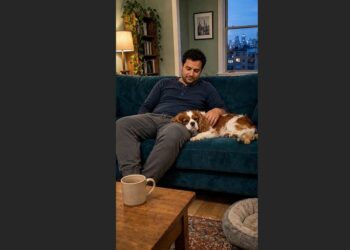
One Evening, He Chose the Sofa
No one called him over.
Biscuit walked into the living room, looked around, and made his way toward the couch.
With the careful determination of an older small dog, he climbed up.
Then he settled against the person sitting there.
His head landed across a leg.
His eyes closed.
The moment was not dramatic.
That was why it mattered.
He had stopped behaving like a visitor who might need to leave at any moment.
He was simply taking a nap.
The New Bed Finally Became His
Eventually, Biscuit used it every night.
The pillow from the doorway ended up there too.
So did his old blanket.
He turned in circles before lying down, arranged himself carefully, and then somehow managed to occupy nearly the entire thing.
That was Biscuit.
Small dog.
Remarkable talent for requiring maximum space.
The front door was still there.
He noticed when people came and went.
But he no longer spent entire evenings watching it.
There were other places he wanted to be.
His Former Owner Still Mattered
When circumstances allowed, updates were shared.
Pictures showed Biscuit sleeping comfortably.
Walking.
Eating.
Looking, as always, mildly worried about something.
His previous owner could know that the dog was safe.
That mattered to the new family too.
Taking Biscuit in had never required pretending his earlier bond did not exist.
Love does not always continue in the form people hoped it would.
Sometimes caring for an animal means recognizing that someone else must take over.
Biscuit’s move had happened because his owner could no longer provide daily care.
Not because Biscuit had stopped being loved.
His New Beginning Was Quiet
There was no dramatic rescue.
No moment when he suddenly understood everything.
No miraculous transformation.
There was simply a senior dog lying near a door in a house he did not recognize.
Then someone brought him a pillow.
Someone else placed a blanket beside him.
Nobody forced him to move.
Hours later, Biscuit finally lowered his head.
Then his eyes closed.
That was how it began.
Sometimes Safety Starts With Being Allowed to Wait
Biscuit did not need people to convince him that his old life no longer mattered.
He needed time to discover that the new one was dependable.
That meals would come.
That footsteps could become familiar.
That people could leave and return.
That the bed across the room would still be there tomorrow.
Eventually, the front door stopped holding all his attention.
The rest of the house began to matter too.
The sofa.
The kitchen.
The soft bed.
The person whose footsteps he learned next.
He Never Had to Forget in Order to Move Forward
That may be the most important part of Biscuit’s story.
A new beginning did not erase what came before it.
His previous owner remained part of the life that shaped him.
The routines they shared had mattered.
The sudden absence was real.
So was the confusion that followed.
But something else became real too.
A new person who stayed.
A new routine that repeated.
A new bed that slowly became familiar.
A home that gave him enough time to decide where he wanted to rest.
On his first night, Biscuit lay beside the door and listened for the life he knew.
Nobody pulled him away.
They simply placed a pillow beneath his head.
Eventually, his breathing slowed.
His eyes closed.
And for the first time in that unfamiliar house, the old dog slept.
Maybe that is what a new beginning sometimes looks like for a senior dog.
Not forgetting.
Not instantly understanding.
Just discovering, one quiet night at a time, that something good can still be waiting ahead.
Editor’s Note: The characters in this story are fictional. Through these stories, we hope to share the intelligence, loyalty, compassion, and loving nature of dogs with people everywhere.