He Does It Before Anyone Calls His Name
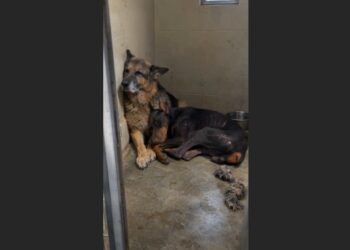
The shelter hallway is rarely quiet.
Kennel doors open and close.
Leashes click against metal.
Dogs bark when volunteers appear, when another dog passes, or simply because a familiar person has entered the building.
Amid all that noise, one older shelter dog has developed a much quieter way of asking people to notice him.
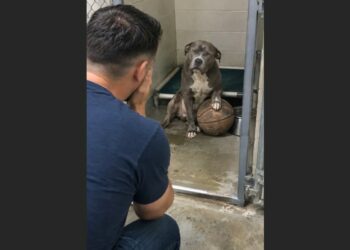
He sits near the front of his kennel.
He watches the hallway.
And when someone comes close, he raises one paw.
Not dramatically.
Not frantically.
He simply extends it toward the gate and waits.
Sometimes people notice.
Often they do not.
When they keep walking, the paw eventually lowers back onto the concrete.
Then he watches for the next person.
Someone Taught Him That Gesture Once
Nobody at the shelter knows exactly when.
His previous history is incomplete.
But the behavior is too familiar to look accidental.
“Paw.”
“Shake.”
“Give me five.”
Whatever word was once used, someone probably practiced the cue with him enough that it became part of his behavioral repertoire.
Maybe a treat followed.
Maybe praise.
Maybe a hand reached down and held his paw for a second.
There is no way to know.
What shelter staff can see is that he still offers the behavior readily.
He remembers the movement.
A person approaches.
He sits.
His paw rises.
Then he waits for a response that does not always come.
It Is Tempting to Say He Remembers Being a “Good Boy”
That is how people often describe the videos.
They imagine another life.
A kitchen floor.
A family member holding a treat.
The dog sitting proudly while someone says, “Good boy.”
Perhaps something like that happened.
But we cannot know what specific memories are attached to the behavior.
Dogs can retain trained behaviors for years, especially ones reinforced repeatedly.
They can also offer familiar behaviors spontaneously when they have learned those behaviors make people engage with them.
So the raised paw may not mean, I remember when somebody loved me.
It may mean something simpler.
This has worked before.
That possibility is heartbreaking enough.
Shelter Dogs Learn Quickly What Gets Attention
Some bark.
Some jump.
Some press their bodies against the gate.
Others sit very still because excitement makes them uncertain.
This dog offers a paw.
Staff began noticing that he did it with almost everyone.
A volunteer walking past with laundry.
A family touring the kennels.
A maintenance worker.
A visitor stopping briefly to read his information card.
The hand does not even need to reach toward him first.
If the person pauses long enough, the paw often comes up.
He appears to have learned that this particular gesture is one of the safest ways he knows to start an interaction.
Sometimes a Person Takes It
Those are the moments when the behavior changes.
A volunteer crouches.
The dog’s paw reaches through the opening.
A hand supports it gently.
His posture softens.
Sometimes his tail moves against the floor.
Sometimes he leans closer.
The volunteer may scratch his chest or speak quietly to him.
Then the interaction ends.
The person stands.
The dog watches them leave.
He does not understand volunteer schedules or adoption procedures.
He does not know why one person can stay for three minutes while another passes without stopping.
He simply experiences the pattern.
People come.
Sometimes hands meet his.
Sometimes they do not.
The Hardest Part Is When He Keeps the Paw Raised
A family walks into the aisle.
The dog notices.
He moves toward the gate.
Sits.
Raises one paw.
The adults are discussing another dog several kennels away.
A child glances in his direction but keeps moving.
The paw remains in the air for another second.
Then another.
Eventually it lowers.
There is no dramatic cry.
No barking fit.
No collapse.
The dog simply returns his foot to the floor.
That quietness is what affects the volunteers most.
Because nothing visibly terrible has happened.
Someone has only continued walking.
Yet in a shelter, being passed can happen dozens of times a day.
It Does Not Mean the Dog Feels Human-Style Rejection Every Time
That distinction matters.
We should be careful about turning ordinary canine behavior into a detailed internal monologue.
The dog cannot understand an adoption decision the way a person does.
He does not know that someone chose a puppy instead.
He cannot read a housing application.
He does not know that a visitor’s landlord prohibits large dogs or that a family came looking for a completely different temperament.
What he can perceive is attention.
Proximity.
Movement.
Hands.
Voices.
A person comes near.
He performs a familiar behavior.
The person either engages or leaves.
Over time, those patterns matter.
The Paw Tells Us Something About His Past Without Telling Us Everything
He has been taught.
That is clear.
Someone spent enough time with him for a social cue to become automatic.
That is a piece of history.
But it does not prove his previous home was perfect.
Nor does it prove it was terrible.
Dogs arrive at shelters for countless reasons.
Housing loss.
Owner illness.
Death.
Financial hardship.
Behavior mismatches.
Family changes.
Stray intake.
Sometimes cruelty.
Sometimes circumstances that have little to do with whether an animal was loved.
A trained “shake” tells us only that, at some point, a person and this dog repeated that exchange enough for him to remember it.
That small fact gives the behavior its weight.
He Is Not Performing Because He Owes Anyone Something
Shelter visitors sometimes respond as if a dog must earn their interest.
Sit.
Shake.
Smile.
Be quiet.
Be playful.
Be affectionate immediately.
But a shelter dog is not applying for a job.
He does not need to demonstrate perfect manners to deserve care.
The fact that this dog offers his paw is touching.
It should not become another test.
If he stopped doing it tomorrow, his value would not change.
If he became tired of reaching toward strangers, he would still deserve the same consideration.
The paw is simply one thing he knows.
One small bridge between him and the people walking past.
Volunteers Have Learned Not to Turn It Into a Performance
They do not line people up to make him repeat the behavior.
They do not keep asking for “paw” because the gesture looks good on camera.
If he offers it, they may respond.
If he does not, they leave him alone.
Choice matters.
Even familiar trained behaviors can become stressful if people demand them constantly.
Some days he seems more interested in lying on his bed.
Some days he watches without approaching.
That is allowed.
A dog’s most meaningful moments are not always the ones that make good social media clips.
Sometimes the best sign is that he feels safe enough not to perform.
A Kennel Can Make Small Behaviors Look Enormous
Outside a shelter, a dog offering his paw might seem ordinary.
In a living room, someone might barely notice.
The dog lifts a foot.
A person takes it.
Then everyone moves on with the evening.
Inside a kennel, the same gesture carries a different feeling.
The dog has limited ways to interact with strangers.
A gate separates him from the hallway.
Most people are there only briefly.
So a familiar behavior becomes one of the few tools available to him.
Sit.
Look.
Lift paw.
Wait.
That sequence is simple enough to repeat all day.
The Concrete Floor Is Where the Paw Always Comes Back Down
That is the image people remember.
Not the paw reaching up.
The moment after.
When no hand arrives.
The foot returns to the floor.
The dog keeps watching.
There is something painfully ordinary about it.
He does not know why the person passed.
Maybe they did not see him.
Maybe they were there to visit another animal.
Maybe they already have pets.
Maybe they cannot adopt.
None of those explanations are available to him.
There is only the hallway.
Movement.
Then stillness again.
Staff Try to Give Him More Than Passing Attention
His life cannot be reduced to waiting at a gate.
He needs walks.
Sniffing.
Rest.
Food puzzles.
Quiet human contact.
Time outside the kennel.
Opportunities to make choices.
A shelter can meet many of those needs while still being a difficult environment.
Even excellent shelters are full of unpredictable noise and interrupted routines.
That is why volunteers matter.
Not because every volunteer can adopt.
Because twenty minutes of walking, sitting quietly, or letting a dog sniff outside can make the day larger than the kennel.
For this dog, human time is valuable even when it does not end with a ride home.
Sometimes He Gives His Paw During Quiet Visits Too
A volunteer may sit beside him without asking for anything.
After a while, the dog moves closer.
He sits.
One paw rises.
The volunteer takes it.
No audience.
No camera.
No adoption interview.
Just contact.
The dog may stay like that for several seconds.
Then he withdraws his paw and lies down.
Those moments suggest the gesture is not only something he uses with prospective adopters.
It is part of the social language he knows.
That matters because it takes some of the tragedy out of the story.
The paw is not only about being passed over.
It is also one of the ways he connects.
He Still Has Other Things to Learn
A dog with a known cue is not automatically fully trained.
Shelter staff still assess how he walks on leash.
How he reacts around other dogs.
How he handles food.
Whether he is comfortable with children.
What happens when he is left alone.
How he responds to handling.
Whether he has medical needs.
A touching habit should never replace a complete adoption assessment.
The right home depends on compatibility.
Not pity.
Not a viral clip.
Not one heartbreaking gesture at a kennel gate.
The Right Person May Not Be the First Person Who Takes His Paw
That is another difficult truth.
A visitor can feel moved and still be the wrong adopter.
Someone may live in housing that does not allow dogs.
Someone may already have an animal who would not be compatible.
A person’s physical abilities, work schedule, finances, children, travel, and other responsibilities all matter.
Responsible shelter staff cannot hand a dog to the first person who cries at his story.
The goal is not simply to get him out of the building.
It is to find a placement that can last.
That sometimes means more waiting.
Until Then, People Can Still Stop
They can read the kennel card.
Ask questions.
Spend time with an adult dog instead of heading automatically toward puppies.
Volunteer.
Foster, if the shelter offers an appropriate program and the household is suitable.
Share accurate information.
Or simply allow an overlooked animal a few quiet minutes of human company.
Not every compassionate interaction must become an adoption.
For a social dog in a shelter, being noticed still has value.
Nobody Knows Whether He Understands Why His Paw Works
Perhaps he learned that the movement earns food.
Perhaps hands remind him of earlier training.
Perhaps it has become a default behavior when he is excited and uncertain.
All are plausible.
The human interpretation—that he is offering the only thing he has in hopes someone will choose him—is emotionally powerful.
It is also more specific than the evidence allows.
We do not need to claim that much.
A dog repeatedly offers a trained social behavior to people.
Many of them pass.
He keeps offering it anyway.
That is already enough to stop a person in the hallway.
He Does Not Need Anyone to Call Him Broken
Nothing about this dog suggests he has forgotten how to connect.
Quite the opposite.
He is still trying.
That does not mean endless optimism lives inside him in some human sense.
It means a behavior reinforced by contact remains available.
The gate opens for walks.
Volunteers return.
Hands sometimes meet his paw.
His world still contains interaction.
That should be protected.
A shelter stay should not become a story in which a dog must grow progressively sadder before people decide he is worth seeing.
He was worth seeing on the first day.
Maybe Someone Once Said “Good Boy”
Perhaps a person knelt in a kitchen and taught him to shake.
Maybe there was laughter.
Maybe a treat.
Maybe he learned the movement in five minutes.
Maybe it took weeks.
The details are gone.
The behavior remains.
Now his paw rises beside a shelter gate instead of a living-room chair.
Different floor.
Different people.
Same familiar movement.
That contrast is what stays with you.
At the End of the Day, He Eventually Stops Watching the Hallway
The shelter quiets.
Visitors leave.
Lights dim.
The dog walks back to his bed.
He turns around once or twice and settles.
Tomorrow, footsteps will return.
He will hear voices.
Someone will stop.
Someone else will not.
And at some point, most likely, that paw will rise again.
Not because anyone can prove he remembers being praised.
Not because he understands adoption.
Because somewhere in his history, reaching toward a human became associated with connection.
For now, that association survives.
The paw comes up.
It waits.
And when a person finally stops and takes it, the dog does not need to understand anything larger than the hand holding his.
Editor’s Note: The characters in this story are fictional. Through these stories, we hope to share the intelligence, loyalty, compassion, and loving nature of dogs with people everywhere.