I Had Almost Walked Past the Last Kennel
I had not gone to the shelter looking for anyone in particular.
My son Leo and I were simply walking through the adoption wing, taking our time, when we reached the final kennel at the end of the row.
That was where I saw him.
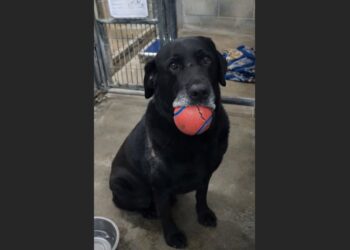
A gray pit bull lay on a blanket with an old basketball tucked between his front paws.
The ball was badly worn.
The orange surface had faded in places. Several seams were cracked. One section had gone slightly soft from age and repeated use.
The dog rested his chin against it.
At first, I noticed the ball because it seemed strange.
Then the dog lifted his head.
My chest tightened.
I knew that face.
His Name Was Buster
I had not seen him in three years.
Not since my best friend Julian died.
For several seconds, I could not move.
Buster had aged.
There was more gray around his muzzle now.
His body looked heavier through the shoulders and leaner around the waist than I remembered.
One ear carried the same little fold near the tip.
And those eyes were unmistakable.
Soft.
Observant.
Familiar.
I stepped closer to the kennel.
Buster stared at me.
Then he stood.
The basketball remained between us.
I whispered his name.
“Buster?”
His head lifted higher.
That was enough to send me back eight years.
Julian and I Had Grown Up With Basketballs Under Our Arms
We had been childhood friends.
Same neighborhood.
Same cracked asphalt court.
Same long summer evenings when neither of us wanted to go home until the streetlights came on.
Julian loved basketball in a way that shaped his entire life.
He was good too.
Not NBA good.
But good enough to eventually play semi-professionally for a local club.
I went to as many games as I could.
No matter how the night ended, he usually found me afterward.
Sometimes he tossed me the game ball as he left the court.
“Hold this for me, Alex.”
It became a joke between us.
A ritual.
Something carried from childhood into adulthood.
That was Julian.
He held onto little things.
Buster Entered His Life Eight Years Earlier
Julian adopted him when he was still young.
The dog was energetic then.
Strong.
Clumsy.
Entirely convinced that personal space was a suggestion.
Buster became part of our routines quickly.
He was around during practices.
Around on Sunday walks.
Under the table when Julian came to dinner.
He learned that basketballs mattered because basketballs were everywhere.
There was almost always one in Julian’s car.
Another near the back door.
Another bouncing across a driveway.
Buster became interested in them too.
He could not dribble, obviously.
But he learned to push a ball around with his nose and front paws.
Julian encouraged it.
Sometimes Buster would roll the ball toward us and wait for it to move again.
It became another ordinary part of their life together.
Then Julian Died Suddenly
There had been no long warning.
No slow decline that gave any of us time to prepare.
One evening after an ordinary training session, Julian suffered a sudden cardiac event and died.
Everything after that happened too quickly.
Phone calls.
Family.
Funeral arrangements.
People showing up with food nobody wanted to eat.
Conversations none of us could believe we were having.
I remember standing in a room full of people and feeling as if the air had changed.
Julian had been one of those people whose presence made ordinary days feel fuller.
Then he was gone.
And in the middle of everyone else’s grief was Buster.
I Should Have Asked What Happened to Him
That is still difficult to admit.
At the time, my own life was collapsing too.
I was going through a painful divorce.
I had moved into a small apartment.
I was working two jobs to stay ahead of rent and bills.
Leo was still young, and much of my energy went into keeping his world stable while mine felt anything but.
Julian’s family was grieving deeply.
Nobody felt capable of taking Buster permanently.
I heard that arrangements were being made.
Then I allowed myself to stop asking questions.
I told myself Buster was friendly.
Good with people.
Easy to love.
Surely someone would take him.
That belief was convenient.
So I accepted it.
Three Years Later, He Was Still in a Shelter
A staff member approached while I stood outside his kennel.
“You know him?”
I could barely answer.
I told her Buster had belonged to my best friend.
She went quiet.
Then she pulled up his records.
The story was complicated.
After Julian died, Buster had moved through temporary arrangements before eventually entering the shelter system.
There had been interest in him.
Nothing permanent.
His age increased.
So did the time he spent waiting.
By the time I found him, he had been overlooked often enough that staff no longer expected every visitor to stop.
The old basketball had stayed with him through much of it.
Staff Said He Was Protective of the Ball, but Not Aggressively
That distinction mattered.
Buster did not growl when people passed.
He did not snap if staff handled it appropriately.
He simply preferred to keep the ball close.
He slept beside it.
Carried it short distances.
Rested his chin on it.
There was no way to know exactly what the object represented to him.
Dogs can form strong preferences for familiar objects through scent, repetition, play history, and emotional association.
Buster could not understand the ball as a memorial to Julian in the human sense.
But it belonged to a life he had known.
Its smell, texture, and history were familiar.
After three years of change, familiarity probably mattered.
I Dropped to My Knees
Not dramatically.
My legs simply stopped feeling reliable.
I crouched outside the kennel.
Buster stayed where he was for several seconds.
Then he came forward.
I let him approach.
I did not throw my arms around him immediately.
Three years had passed.
Whatever I remembered about our relationship, Buster deserved the chance to decide whether I was still familiar to him.
He sniffed my hands.
My jeans.
Then my face.
His tail moved.
Slowly at first.
Then faster.
I said his name again.
Buster stepped closer.
He Pressed His Head Into My Shoulder
That was when I lost whatever control I had left.
I put one arm around him carefully.
Buster stayed.
Then leaned harder against me.
His body felt warm and solid.
He exhaled deeply.
I cried into the side of his neck.
Not because I believed Buster understood all the years that had passed.
Not because I thought he knew I regretted not finding him sooner.
I cried because this dog had once been part of a life I thought was gone.
And suddenly he was standing against me again.
Alive.
Older.
Still Buster.
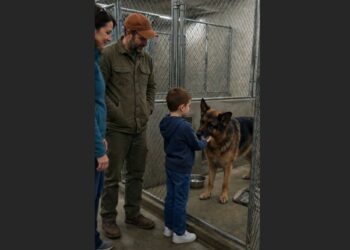
Leo Came Closer Slowly
My son had heard plenty of stories about Julian.
But he had never known him.
To Leo, Julian existed through photographs and the stories I told at home.
Buster made those stories physical.
Real.
Leo crouched nearby and waited.
Buster turned toward him.
Sniffed.
Leo placed one hand gently against his shoulder.
There was no instant mystical connection.
Just a boy meeting a dog who had once belonged to someone important to his father.
That was meaningful enough.
I Did Not Promise to Take Him Home Until We Talked About Reality
The impulse was immediate.
Of course I wanted him.
But adoption deserved more than grief.
My life was different from three years earlier.
The divorce was settled.
I had more stable work.
Leo and I no longer lived in the tiny apartment.
We had a modest house with a fenced yard.
Still, Buster was older now.
He needed veterinary evaluation.
We needed to understand his temperament after years of transition.
How was he with children?
Other dogs?
Visitors?
Could he manage our stairs?
Did he have medical needs?
The shelter answered what it could.
We spent more time together before signing anything.
This time, I was determined not to assume.
The Basketball Came With Him
There was never any question about that.
The shelter employee picked it up only after making sure Buster was comfortable with the handling.
Then she placed it beside his things.
A leash.
Medical records.
Medication instructions.
Food information.
And one battered basketball.
When the kennel door opened, Buster walked out slowly.
He did not race toward freedom.
He sniffed the hallway.
Looked back once.
Then stayed near us.
At the car, we used safe restraint for the ride home.
The basketball went in the back with him.
Leo sat nearby.
Leo Talked Almost the Entire Drive
Children sometimes fill emotional moments with practical details.
Leo told Buster about the house.
His room.
The backyard.
The tree near the fence.
Where the dog bed would go.
Which toys were already waiting.
Buster did not understand those plans.
But he heard Leo’s voice.
His ears shifted toward changes in tone.
Sometimes he looked at him.
Other times he rested his head near the basketball.
I watched them through the mirror.
The feeling I had was not that some missing piece of our family had magically returned.
It was quieter.
Something unfinished had been given another chance.
Buster Stopped at the Front Door
The house was new to him.
That mattered.
He had not been “coming home” in the literal sense.
He was entering another unfamiliar environment after several previous transitions.
I opened the door.
Buster sniffed the threshold.
Then walked inside.
Slowly.
We did not surround him.
Leo wanted to show him everything immediately.
I asked him to wait.
Let Buster choose the pace.
The dog investigated the living room.
Hallway.
Kitchen.
Then returned to the living room.
He circled twice on the rug and lay down.
I placed the basketball nearby.
Buster pulled it between his front paws.
Then rested his muzzle against it.
That Evening, Leo Asked About Julian
“Dad, what was he like?”
We sat on the floor.
Buster remained beside us.
So I talked.
I told Leo about the outdoor court where Julian and I spent summers.
About games played long after we should have gone home.
About his laugh.
About the semi-professional team.
About the way he noticed people.
About dinners.
Bad jokes.
Arguments that never lasted.
I also told him how Julian had played with Buster using basketballs.
How the dog learned to push them back toward people.
Not as a sacred signal.
Not as a formal trick.
Just something they did together.
Leo listened.
Then looked at the worn ball between Buster’s paws.
I Was Careful Not to Tell Leo the Ball Meant “Trust”
That kind of story is tempting.
Buster rolls the ball to you because he has chosen you.
It sounds beautiful.
But dog behavior is rarely that simple.
Buster may have learned that pushing the ball toward people made them continue the game.
He may associate the movement with attention.
Familiar routines can persist for years.
That does not make them less meaningful.
It simply keeps us from pretending to know exactly what is happening inside a dog’s mind.
So I told Leo the truth.
“Julian used to play that game with him.”
Leo seemed satisfied with that.
The First Weeks Were Quieter Than the Story People Wanted
Friends expected Buster to transform instantly.
He did not.
He slept a lot.
Watched us.
Followed me occasionally.
Then stopped and returned to his bed.
Sometimes he carried the basketball from one room to another.
He was cautious around sudden household noise.
He needed time to learn our routine.
Veterinary evaluation showed the kinds of things we expected in an older dog.
Some stiffness.
A need to watch his weight.
Routine senior care.
Nothing affection could cure.
We added rugs to slippery areas.
Kept his walks manageable.
Let him rest.
Leo Learned That Loving an Older Dog Can Be Quiet
He wanted to play constantly at first.
Buster did not.
So we adjusted.
Short games.
Slow walks.
Time in the yard.
If Buster walked away, the game ended.
If he was sleeping, Leo left him alone.
That may have been one of the most useful lessons the dog brought into our home.
Love is not constant access.
Sometimes it means letting an aging dog rest.
Sometimes it means moving a water bowl closer.
Sometimes it means understanding that a body that once ran beside basketball courts cannot do the same things forever.
The Ball Changed Meaning Again
At the shelter, it had looked heartbreaking to me.
A dog holding onto the last piece of his former life.
At home, it slowly became ordinary.
The ball rolled under the table.
Leo nudged it with his foot.
Buster pushed it back.
Sometimes.
Other times he ignored it.
One afternoon, he carried it into the yard.
Leo followed.
Buster pushed it through the grass with one paw.
Leo laughed.
For a few seconds, I heard another laugh in my memory.
Julian’s.
That was my association.
Not necessarily Buster’s.
I learned to keep that distinction clear.
Watching Them Play Hurt and Help at the Same Time
Grief can do both.
There were moments when seeing Buster with Leo made me miss Julian so sharply that I had to look away.
But there was comfort too.
Buster had known my friend.
Leo had not.
Now there was a living connection between them.
Not a mystical one.
A practical one.
A dog shaped by years with Julian was now learning life with Julian’s friend’s son.
Some of the old routines came along.
The basketball.
The patient way Buster waited for someone to move it.
The habit of settling near a person rather than on top of them.
Those were enough.
Buster Became More Playful, but He Did Not Become Young Again
That was important.
Some stories describe an adopted senior dog as if happiness reverses age.
It does not.
Buster’s muzzle stayed gray.
He still rose more slowly after naps.
Cold mornings made his joints stiffer.
We adjusted exercise accordingly.
What did change was engagement.
He approached us more.
Carried toys.
Waited by the door when Leo came home.
Began choosing the sunny spot near the back window.
Started sleeping more deeply.
Those were meaningful changes without turning him into the dog he had been eight years earlier.
One Afternoon, Leo Came Running Into the Kitchen
“Dad, come see.”
I followed him outside.
Buster stood in the grass with the basketball.
Leo moved a few feet away.
Buster pushed the ball.
It rolled toward Leo.
He stopped it with his shoe.
His whole face brightened.
“He sent it to me.”
“Yes.”
“Does that mean he trusts me?”
I looked at Buster.
The dog was waiting for movement.
I could have told Leo exactly what he wanted to hear.
Instead, I said something more accurate.
“It means he wants to keep doing this with you.”
Leo thought about it.
Then smiled.
“I like that better.”
He rolled the ball back.
Trust Was Visible in Other Ways Anyway
Buster slept near Leo.
Allowed him to brush his shoulders gently.
Followed him into the yard.
Rested on his side while the boy read nearby.
Did not lift his head every time Leo moved.
Those were better indicators than trying to turn one learned game into a symbolic language.
Trust often looks boring.
A dog sleeping while someone walks past.
A dog choosing not to monitor every movement.
A body loose enough to rest.
Buster began showing us those things.
I Had to Forgive Myself Too
That took longer.
Finding Buster brought back one question repeatedly.
Why hadn’t I looked for him?
I could list the reasons.
Divorce.
Money.
Housing.
Leo.
Two jobs.
Grief.
All of them were true.
None of them erased the regret.
Eventually, I stopped trying to decide whether I had been a good or bad person.
I had been overwhelmed.
I had made an assumption.
The assumption had been wrong.
What mattered now was what I did after learning that.
Buster did not need my guilt.
He needed veterinary appointments.
Food.
Walks.
A safe yard.
Consistency.
So I tried to give him those instead.
Julian’s Family Learned Where Buster Was
I contacted them.
That conversation was emotional.
They had believed he had eventually been placed too.
There had been too many handoffs during a terrible period.
People assumed other people knew what was happening.
No single relative had deliberately chosen seven years in a shelter for him.
Life had simply fractured.
When I sent photographs of Buster with Leo, several family members cried.
One visited later.
Buster appeared to recognize something familiar in the person’s voice or scent.
Maybe.
We did not overstate it.
He approached willingly.
That was enough.
The Old Basketball Is Almost Finished Now
The rubber is cracked.
One section barely holds shape.
We do not allow Buster to chew pieces from it.
If it becomes unsafe, it will be retired.
Objects can matter emotionally to people while still being subject to ordinary safety rules.
For now, Buster mostly rests beside it.
Sometimes Leo rolls it gently.
Sometimes Buster pushes it back.
The game is slower.
That suits them both.
At Night, Buster Sleeps Near Leo’s Room
Not as a guard.
Not because Julian somehow assigned him a new person to protect.
He simply prefers that part of the house.
Some nights he sleeps on a bed in the hallway.
Other nights near my chair.
Once in a while, Leo finds him at the foot of his bed after forgetting to close the bedroom door.
We let Buster choose.
His life has included enough decisions made for him.
I Do Not Tell Leo That Julian Is Watching From Somewhere
I cannot know that.
Grief once made me want certainty about things no one can prove.
These days, I find more comfort in what I can see.
Julian mattered.
His influence remains in people who remember him.
In stories Leo now knows.
In the dog who learned routines beside him.
In the old basketball that somehow survived long enough to arrive in our living room.
That is not the same as saying someone is literally watching from beyond the clouds.
It is enough.
Three Years of Shelter Life Did Not Disappear
Buster still has habits we did not know before.
He can become unsettled if left somewhere unfamiliar.
He prefers predictable meal times.
He sometimes gathers his favorite objects near his bed.
Those behaviors may come from personality, past routines, shelter living, or several things together.
We do not need to explain every one.
Our job is simpler.
Notice.
Adjust.
Give him structure.
Keep his senior body comfortable.
Let him be a dog rather than a symbol of someone we lost.
That Last Part Matters Most
For a while, I worried I was adopting Buster because he had belonged to Julian.
Maybe I was trying to recover something.
Then Buster’s personality reminded me that he was not a memorial.
He was irritating in ways Julian never was.
He could steal dish towels with impressive stealth.
He considered delivery drivers suspicious.
He disliked getting his feet wet.
He snored.
He once pushed the basketball into a flower bed and spent ten minutes barking at it because retrieving it would have required stepping into mud.
He was his own creature.
That helped.
I stopped seeing only Julian’s dog.
I started seeing Buster.
Leo Never Knew Julian, but He Knows His Stories Now
Some are funny.
Some are ordinary.
Some are painful.
He asks questions.
What music did Julian like?
Was he better at basketball than me?
Yes, by an embarrassing margin.
Did he yell at referees?
Occasionally.
Did he love Buster?
That answer is easy.
“Yes.”
I do not need to explain it dramatically.
Eight years together had already answered the question.
The House Sounds Different With Buster in It
Tags against a water bowl.
Toenails crossing the hallway.
Leo laughing in the backyard.
A basketball rolling slowly across grass.
At the shelter, that worn ball looked like evidence of everything Buster had lost.
Here, it became part of what he still had.
That difference means something to me.
Not because the past disappeared.
Because the object acquired new memories beside the old ones.
Tonight, Buster Is Asleep Near Leo
His muzzle is nearly white.
One front paw rests against the battered basketball.
Leo is already in bed.
The house is quiet.
I can hear Buster’s breathing from the hallway.
Three years ago, I assumed he had found a home somewhere else.
I was wrong.
I cannot change those years.
I can only make sure the years ahead look different.
So the basketball stays near his bed.
The rugs stay on the floor for his aging joints.
His medication gets given on time.
Leo knows to let him sleep.
And when Buster wakes tomorrow, there will be familiar people in the same familiar rooms.
That is what home has become for him now.
Not a replacement for Julian.
Not an erasure of the shelter.
Just another chapter.
One old dog.
One child.
One battered basketball.
And enough time, finally, for all three to belong in the same story.
Editor’s Note: The characters in this story are fictional. Through these stories, we hope to share the intelligence, loyalty, compassion, and loving nature of dogs with people everywhere.