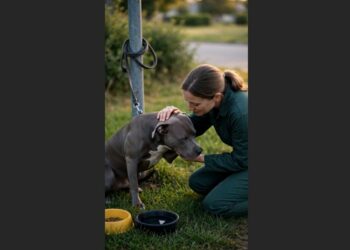
I came home three hours early on a rainy afternoon and found my rescue dog sleeping beside something I thought I’d lost.
My old brown wool jacket.
The same jacket I’d worn almost every day since bringing him home.
He had somehow dragged it across the room and curled up with his muzzle resting against the fabric.
I stood in the doorway, afraid that if I moved, I’d frighten him.
His name was Shadow.
He was a painfully thin little dog with patchy dark fur and tired eyes. I’d adopted him seven weeks earlier, hoping to give him the quiet, comfortable home the shelter said he needed.
But for 49 days, Shadow had barely allowed me near him.
He wouldn’t sleep in the soft bed I’d bought.
He ignored the toys.
And whenever I entered his room, he pressed himself against the wall, watching every movement I made.
I’d spent nearly two months wondering whether he would ever feel safe with me.
Now, while I was away at work, he’d chosen to sleep beside my jacket.
He was afraid of my hands, but something carrying my familiar scent had become part of the place where he felt comfortable enough to rest.
That afternoon, I finally began to understand that we might have been making progress all along.
I just hadn’t recognized it.
The Dog Who Stayed in the Corner
When I first met Shadow at the shelter, the staff warned me that he would need patience.
“He’ll need time. A lot of time.”
I remember nodding.
I thought I understood what that meant.
I knew he wouldn’t necessarily run toward me on his first day home. I wasn’t expecting an excited greeting or a dog who immediately wanted to cuddle on the couch.
I was prepared to let him settle in.
At least, that’s what I believed.
Before bringing him home, I’d prepared a quiet room.
There was a soft dog bed, warm blankets, fresh water, and a few toys.
I placed the bed where the afternoon sunlight reached the floor, thinking he might enjoy sleeping somewhere warm.
I wanted everything to feel comfortable.
But when Shadow arrived, he chose a different place.
The farthest corner of the room.
He lowered himself against the wall and stayed there.
That first evening, I sat several feet away and spoke quietly.
I wanted him to become familiar with my voice.
Shadow watched me without moving.
When I shifted closer, his body stiffened.
His breathing became shallow.
So I moved back.
I told myself he simply needed a few days.
A few days became a week.
Then two.
And Shadow still spent most of his time in that corner.
Everything I Tried
I read about helping nervous rescue dogs adjust to new homes.
I tried to keep our routine predictable.
I gave Shadow plenty of quiet time.
I offered treats without insisting he take them from my hand.
When he seemed uncomfortable, I backed away.
Some evenings, I sat on the floor for nearly an hour.
I didn’t ask him to do anything.
I just wanted him to get used to having me nearby.
Sometimes he watched.
Sometimes he lowered his head.
But he never approached.
The toys remained untouched.
His bed stayed empty.
And every time I entered the room, he seemed to prepare himself for something unpleasant.
It was difficult not to take it personally.
I knew that wasn’t fair.
Shadow hadn’t asked to leave the shelter. He hadn’t chosen me, and he didn’t understand why he’d been brought into another unfamiliar place.
But I wanted so badly for him to feel comfortable.
I wanted him to understand that I wasn’t going to hurt him.
That his food would arrive every day.
That he had somewhere warm to sleep.
That he didn’t have to be frightened every time I walked into the room.
The problem was that I couldn’t explain those things to him.
I could only show him.
And after several weeks, I began wondering whether anything I did was helping.
Forty-Nine Days
By the seventh week, I was discouraged.
Shadow was eating and receiving the care he needed, but he still kept his distance.
I sometimes wondered whether another person would have been better at helping him.
Someone with more experience.
Someone who knew exactly what to do with a dog who was this frightened.
The shelter had told me he needed time.
But how much time?
Another month?
Six months?
Would he ever feel comfortable living with me?
I didn’t know.
I kept following the routine we’d developed, but the lack of visible progress was difficult.
I never wanted to force him into contact.
Yet I also longed for some small sign that he was beginning to feel at home.
A wagging tail.
A few steps in my direction.
Anything.
Then came the rainy afternoon.
The Jacket on the Floor
I arrived home from work three hours earlier than usual.
Rain was pounding against the windows as I opened the front door.
I removed my wet shoes and walked toward Shadow’s room.
Normally, I’d find him in his corner.
Sometimes he’d lift his head as I entered.
Other times, he’d watch me without moving.
But that afternoon, the corner was empty.
For a second, I wondered where he’d gone.
Then I saw him.
He was curled up beside the dog bed.
The bed he’d refused to use for seven weeks.
And beneath his muzzle was my old brown wool jacket.
I recognized it immediately.
I’d worn it so often that it had become part of my daily routine.
Somehow, Shadow had found it and dragged it into his room.
Now he was sleeping against it.
I didn’t know what to think.
This was the dog who became tense whenever I approached.
Who watched my hands.
Who retreated when I moved too close.
Yet when nobody was home, he’d come out of his corner, found something that belonged to me, and chosen to rest beside it.
I stood there for a while.
Then slowly sat down on the floor.
I didn’t call him.
I didn’t reach toward the jacket.
I didn’t want to interrupt whatever had allowed him to become comfortable enough to sleep there.
I simply listened to the rain and watched him rest.
The First Step Toward Me
After a while, Shadow opened his eyes.
He lifted his head and noticed me sitting on the floor.
I expected him to get up and retreat to his corner.
That was what usually happened whenever he realized I was nearby.
But this time, he stayed where he was.
He looked at me.
I remained still.
Several moments passed.
Then Shadow slowly stood.
He seemed uncertain.
His movements were careful, and he watched me closely.
I kept my hands resting in my lap.
He took one step toward me.
Stopped.
Then took another.
My heart began beating faster, but I tried not to show my excitement.
I didn’t want to startle him.
For 49 days, I’d been waiting for Shadow to approach me voluntarily.
Now he was crossing the room.
One cautious step at a time.
When he finally reached me, he stopped directly in front of my knees.
I didn’t reach for him.
I let him decide what happened next.
Then he lowered his head.
And rested it in my lap.
For a moment, I couldn’t move.
I was afraid that even lifting my hand would send him back to the corner.
But he remained there.
So I slowly touched his back.
He stayed.
I gently stroked him.
And after a while, he let out a long, quiet sigh.
I started crying.
Not because everything had suddenly been fixed.
But because, after seven weeks of waiting, Shadow had chosen to come close.
He’d made that decision himself.
“My name is Clara,” I whispered.
“And I’ll always be here.”
I knew he couldn’t understand that promise the way a person would.
But I hoped that, with time, my actions would make the words less important.
He could learn what to expect from me.
And perhaps one day, being near me wouldn’t feel frightening at all.
What the Jacket Helped Me See
I thought about that afternoon for days afterward.
The jacket had been an ordinary part of my life.
Something I wore to work, hung up when I came home, and rarely thought about.
But Shadow had noticed it.
He’d been living in my house for seven weeks.
He knew when I came and went.
He’d become familiar with my movements, my voice, and the things I used every day.
Even though he hadn’t felt comfortable approaching me, he may have been gradually becoming accustomed to my presence.
My jacket probably carried a familiar scent.
And perhaps that familiarity made it easier for him to settle.
I couldn’t know exactly why he’d chosen it.
But finding him asleep beside it helped me look at his behavior differently.
I’d been measuring his progress by whether he came toward me.
Whether he accepted affection.
Whether he behaved like the dog I’d imagined bringing home.
I hadn’t paid enough attention to the quieter changes.
Maybe he was learning about me when I wasn’t asking him to do anything.
Maybe he’d been becoming comfortable with parts of his new environment long before he was ready for physical contact.
I realized I didn’t need to know exactly what Shadow was thinking to respect his pace.
I just needed to keep making his days safe and predictable.
Progress Wasn’t a Straight Line
The following morning, Shadow didn’t come running to greet me.
He was back in his quiet corner.
For a moment, I felt disappointed.
Then I remembered how long it had taken him to approach me the day before.
I wasn’t going to treat one good afternoon as a reason to expect him to change overnight.
So I continued giving him space.
Some days, he allowed me to sit closer.
Other days, he preferred to be alone.
Unfamiliar sounds still startled him.
Occasionally, he’d retreat when I entered the room too quickly.
I learned to pay more attention to those signals.
When he wanted distance, I gave it to him.
When he approached, I let him decide whether he wanted to be touched.
I didn’t stop caring for him.
I stopped expecting every interaction to produce visible progress.
And slowly, our routine changed.
Shadow began spending more time outside his corner.
He sometimes rested near the bed I’d bought him.
And the old brown jacket remained nearby.
I didn’t put it away.
He seemed comfortable having it there.
So I left it.
The Dog Waiting at the Door
Another month passed.
Shadow was still a cautious dog.
He didn’t suddenly become outgoing around strangers.
He still had moments when he needed quiet and distance.
But at home, he was becoming more relaxed.
He began sleeping in his soft bed.
Sometimes he’d curl up beside my old jacket before falling asleep.
Other times, he’d rest close enough that I could gently stroke his back.
The biggest change came during my daily return from work.
At first, Shadow had stayed hidden whenever I entered the house.
Now I sometimes found him waiting near the front door.
His tail would move gently when he saw me.
He didn’t leap into my arms.
He didn’t race around the house.
He simply stood nearby, watching me come in.
And when I spoke to him, he often stayed.
It was such a quiet greeting that someone else might barely have noticed it.
But I remembered the dog who had spent seven weeks pressed against a wall.
I remembered how frightened he’d been of my hands.
And I knew how much those small changes meant.
The Jacket I Won’t Put Away
My old brown wool jacket still lies beside Shadow’s bed.
It isn’t particularly special.
The fabric is worn, and I’ve owned it for years.
Before adopting Shadow, I probably would have replaced it without thinking twice.
Now I can’t imagine putting it away.
Not because I believe the jacket has some magical importance.
But because it reminds me of the afternoon I finally noticed a change I hadn’t known to look for.
I’d spent 49 days trying to convince Shadow that he was safe.
I’d bought him everything I thought a dog should have.
A comfortable bed.
Warm blankets.
Toys.
A quiet room.
But I couldn’t buy his trust.
And I couldn’t hurry it.
The first time he approached me, I hadn’t called him.
I hadn’t offered a treat.
I hadn’t reached out to pet him.
I’d simply come home early, found him resting beside my jacket, and sat down on the floor.
He was the one who decided to close the distance.
And when his head finally settled into my lap, I understood that our relationship was beginning to change.
Not because I’d found the perfect technique.
But because we’d had enough ordinary days together for him to become a little more comfortable.
The Dog I Almost Misunderstood
I still think about those first seven weeks.
There were evenings when I sat on the floor, feeling completely helpless.
I’d watch Shadow in his corner and wonder whether I’d failed him.
I wanted to make him happy.
I wanted him to enjoy his new home.
And I wanted to see some sign that he understood I cared.
But Shadow couldn’t give me that reassurance on my schedule.
He needed time to learn about the person who had brought him home.
To become familiar with the rooms.
To discover which sounds were ordinary.
And to decide when he felt comfortable enough to move closer.
I couldn’t know everything he’d experienced before we met.
I couldn’t erase whatever had made him so frightened.
But I could make sure he had the space and care he needed while he adjusted.
The change didn’t happen all at once.
It happened quietly.
And I nearly missed it because I was waiting for something bigger.
For 49 days, I thought my rescue dog was making no progress because he wouldn’t come near me.
Then I came home early and found him asleep beside my old jacket.
And when I sat down on the floor, he slowly walked toward me and rested his head in my lap.
That single afternoon didn’t erase his fears.
But it helped me recognize that learning to trust someone can take time, and that progress doesn’t always look the way we expect.
These days, Shadow sleeps comfortably in the bed I bought him.
My jacket rests nearby.
And when I come home from work, I often find a little dark-haired dog waiting by the door, his tail moving gently as I step inside.
I used to think helping a frightened rescue dog meant finding the right way to show him how much love I had to give.
Now I understand that sometimes the most important thing is being patient enough to let him decide when he’s ready to come closer.
And whenever I see Shadow sleeping beside that old brown jacket, I remember the rainy afternoon he finally did. ❤️🐾
Editor’s Note: This story is adapted from an account that has not been independently verified. Shadow’s attachment to the jacket may reflect familiarity or comfort, but his precise motivations cannot be known. Frightened rescue dogs may need time, consistent care, and individualized behavioral support as they adjust to a new home.
#RescueDogStories #BuildingTrust #SecondChances #RescueDogs