The Truck Driver Thought the Labrador Belonged to Someone Nearby
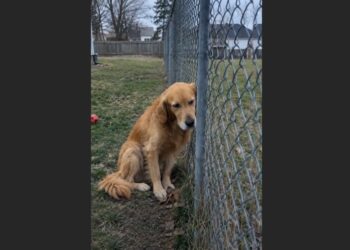
During the summer of 2021, a truck driver traveling through rural Missouri noticed a golden Labrador sitting on the gravel shoulder of a busy highway.
The dog was far enough from traffic not to be in immediate danger, but close enough that the driver remembered him.
He was sitting upright.
Watching the road.
There were farms scattered through the area, so the driver assumed the Labrador had wandered over from one of them.
He continued on his route.
Six days later, he drove the same highway again.
The dog was still there.
Almost at the same mile marker.
Other Drivers Had Seen Him Too
At a gas station farther down the route, the trucker mentioned the Labrador.
Another driver immediately knew which dog he meant.
Then another person joined the conversation.
They had all seen him.
Sometimes he was sitting.
Sometimes lying in the grass near the gravel.
But he stayed close to the same section of highway.
The story began circulating among drivers who used the route regularly.
Someone left food.
Another person stopped and placed a bowl near him.
The Labrador accepted enough to keep going, but he did not appear interested in following anyone away.
Days passed.
Then weeks.
Summer Was Hard on Him
The highway offered little protection.
Afternoon heat settled over the pavement.
Passing trucks threw dust and road spray toward the shoulder.
Storms came through.
The Labrador’s once-clean coat became dull with dirt.
Yet after each storm, drivers reported seeing him in roughly the same area.
The food left by strangers helped, but roadside life was taking a toll.
His body became thinner.
His movement slowed.
People started asking why nobody had simply picked him up.
Several had tried.
The dog would move away.
He did not chase or threaten them.
He simply avoided being taken.
On Day 41, a Local Woman Stopped
She lived near the surrounding farms and had been hearing about the dog for weeks.
That afternoon, she brought food, water, and a leash.
The Labrador allowed her closer than he had allowed most strangers.
She crouched sideways rather than reaching immediately.
He ate.
Drank.
Then watched her.
When she tried to guide him toward her vehicle, his behavior changed.
He pulled backward.
Whined.
Returned to the patch of ground where he had been lying.
She tried again carefully.
Same response.
That was when she noticed something beneath him.
There Was an Old Green Collar in the Gravel
The Labrador had been lying over it.
It was a faded nylon collar.
Green once, though sunlight and weather had washed much of the color away.
The buckle was broken.
There was no identification tag.
A shallow depression had formed beneath the dog’s chest where the collar rested.
The woman picked it up carefully.
The Labrador became immediately attentive.
She put it down again.
He moved toward it.
That reaction made her stop trying to load him herself.
Instead, she called for help.
A Volunteer Examined the Collar More Closely
Animal control was contacted, and a rescue volunteer arrived to assist.
The Labrador remained wary.
The two women gave him space while they examined the damaged collar.
There was no tag.
No phone number.
But along the inside of the nylon, barely visible beneath dirt and wear, someone had once written a name in permanent ink.
Only a few letters remained clear.
Bailey.
They looked at the dog.
Was Bailey his name?
A search through recent reports gave them an unexpected answer.
No.
The golden Labrador was Milo.
Bailey was another dog.
Sixty-Seven Days Earlier, a Family Had Crashed Nearby
The report involved a family traveling from Illinois through Missouri.
Their vehicle had left the road and overturned in a ditch less than a quarter mile from the place where Milo was now staying.
The people inside survived.
During the confusion after the crash, however, a door had been left open.
Two Labrador retrievers escaped.
One was golden.
The other was chocolate brown.
Both disappeared into the unfamiliar countryside.
Searches began almost immediately.
One dog was eventually accounted for.
The other remained missing.
The records connected the names.
The golden dog was Milo.
The chocolate Labrador was Bailey.
Milo and Bailey Were Littermates
According to the family, the two dogs were four years old.
They had grown up together from puppyhood.
They ate in the same kitchen.
Shared the same yard.
Rode in the same vehicle.
Slept in the same home.
Their family described them as closely bonded.
After the accident, however, the normal pattern of their lives disappeared in minutes.
There was traffic.
Emergency activity.
Unfamiliar people.
An unfamiliar landscape.
The family themselves were dealing with injuries and the aftermath of the crash.
Somewhere in that confusion, the dogs were separated.
Nobody Could Say How Milo Found Bailey’s Collar
That part remained a mystery.
Perhaps Bailey lost it while moving through the area after the crash.
Perhaps both dogs had initially remained together.
Perhaps Milo encountered the collar later by following scent through the roadside vegetation.
There was no witness.
The collar could not tell the story.
What rescuers could observe was that Milo treated the object as important.
He returned to it.
Lay over it.
And became reluctant when people attempted to move him away from it.
That did not prove Milo understood the collar as a memorial or consciously believed Bailey would return.
Dogs do not think about missing-person searches the way humans do.
But familiar scent and objects can be powerful cues.
For Milo, the collar clearly mattered.
The Rescue Attempt Changed Once They Understood That
The volunteers stopped trying to separate Milo from the object.
The collar came with him.
They spent time allowing him to become accustomed to their presence.
Food helped.
So did patience.
Milo was exhausted.
Eventually, his resistance weakened enough that the rescuers could safely support him.
By then, sixty-seven days had passed since the crash.
When they lifted him, his physical condition was worse than it had appeared from the road.
His paw pads were damaged.
His ribs were visible.
His eyes were irritated by dust and exposure.
He was dehydrated enough to need veterinary attention.
The Labrador who had spent more than two months surviving outdoors was finally leaving the highway.
But not alone.
Milo Reached for the Green Collar
As the volunteer prepared to move him, Milo turned toward it.
She handed it back.
He took the nylon gently in his mouth.
It was an ordinary object.
Broken buckle.
Faded fabric.
No tag.
Yet Milo carried it to the vehicle.
During the drive to the veterinary clinic, he kept it nearby.
Sometimes between his paws.
Sometimes in his mouth.
The rescuers did not keep taking it from him merely because they wanted to examine it again.
It was safe enough for him to have under supervision.
So they let him.
Veterinary Care Came Before the Reunion
Milo needed more than food and sleep.
His hydration had to be addressed carefully.
His feet needed treatment.
His eyes required examination.
His weight loss had to be evaluated.
After prolonged outdoor exposure, simply placing a large meal in front of a dog is not always the only consideration. Veterinary staff need to assess the animal’s overall condition and decide how nutrition, fluids, wound care, and rest should proceed.
Milo was tired enough that he spent much of his first hours at the clinic resting.
The green collar stayed close.
When he ate, he put it down.
When he settled again, he often returned to it.
The Family Was Contacted
They were back in Illinois.
For weeks after the accident, they had searched for information.
Local reports.
Calls.
Online posts.
Contacts with shelters.
There had been no reliable sighting that brought Milo home.
Bailey remained missing too.
Then came the call from Missouri.
Milo had been found alive.
The family began arranging the drive almost immediately.
The trip would take roughly seven hours.
They left the following day.
Milo Could Not Understand What Was About to Happen
He did not know someone had called Illinois.
He did not understand that a familiar person was driving hundreds of miles toward him.
He knew only the clinic.
New smells.
New people.
Handling.
Food.
Rest.
And the collar beside him.
Staff tried to keep his environment quiet.
After what he had experienced, there was no reason to overwhelm him with constant attention.
The goal was simple.
Stabilize him.
Keep him comfortable.
Let him sleep.
Then His Owner Walked Into the Clinic
She called his name.
“Milo.”
His head lifted.
There was a pause.
Then his body changed.
He stood slowly.
Not with the explosive excitement people sometimes imagine in reunion stories.
He was still weak.
His feet hurt.
His body had been depleted by weeks outdoors.
But he moved toward the familiar voice.
He sniffed.
Then continued forward.
The woman crouched.
Milo reached her.
And leaned.
The Green Collar Was Beside Her Shoes
At some point during the reunion, Milo placed the collar down.
It landed near her feet.
Then the dog pressed his body against her legs.
She put her hands along his shoulders and began crying.
Nobody needed to say Milo had deliberately returned Bailey’s collar to the family.
That interpretation would have gone beyond what anyone could know.
Milo had carried an object that smelled or felt familiar.
Now he was beside a familiar person again.
Those facts were powerful enough.
There Was Still One Dog Missing
Bailey had not been found.
The chocolate Labrador’s absence remained the painful part of the reunion.
The family now knew that at least one dog had survived.
They also had physical evidence that Bailey had been somewhere near the area after the crash.
But a broken collar did not reveal what happened next.
Searches continued.
Reports were reviewed.
People in the area were contacted.
No confirmed recovery followed.
The family had Milo back.
They did not have closure about Bailey.
Milo Went Home to Illinois
Only after the veterinary team considered him stable enough to travel.
The highway did not disappear from his body immediately.
His paw pads needed time.
His coat needed care.
He had lost muscle and weight.
He tired easily.
The family worked with their veterinarian during the following weeks.
Meals were managed appropriately.
Activity remained limited while his feet healed.
His hydration normalized.
His eyes improved.
Gradually, his body began looking like the dog the family remembered.
But recovery was not a five-week miracle in which every trace of sixty-seven days vanished.
Some effects took longer.
The Collar Came Home Too
Nobody threw it away.
It had no practical use.
The buckle was broken.
The nylon was worn.
Bailey could never wear it again even if he were found.
Still, Milo repeatedly showed interest in it.
So the family kept it where he could safely access it under supervision.
At first, he carried it frequently.
Later, he often left it near his bed.
At night, it sometimes rested between his front paws.
There was no need to decide whether Milo understood whose collar it had been.
Its familiarity was enough.
Dogs Can Form Strong Bonds Without Understanding Loss Like We Do
Milo and Bailey had spent four years together.
That history matters.
Dogs recognize familiar individuals through scent, sound, appearance, routine, and repeated social interaction.
When a long-term companion disappears abruptly, the remaining dog may search, vocalize, become more attentive to familiar cues, or show changes in routine.
That does not mean Milo sat beside the highway forming a human-style thought:
I will wait here until my brother returns.
We cannot know that.
But the crash site and the nearby road may have contained familiar scent information.
The collar certainly did.
And Milo repeatedly stayed near both.
The Highway Had Become the Center of His Search
Whether through scent, habit, orientation, or simple association, Milo remained in that area.
That persistence was dangerous.
Cars moved at highway speed.
Heat and storms exposed him to injury.
His paws deteriorated.
He lost weight.
His body became dehydrated.
His survival should not be romanticized as proof of loyalty.
He needed help much sooner.
The people leaving food likely helped keep him alive, but food alone could not make a highway shoulder safe.
What eventually changed his situation was a coordinated rescue that respected his fear and brought the collar with him.
Back Home, Milo Had to Relearn Ordinary Days
A house can feel different after more than two months outdoors.
The first nights, the family kept things quiet.
His bed remained in a predictable location.
Meals arrived consistently.
Walks were limited by his healing feet.
There was no Bailey beside him.
That absence affected the household whether or not Milo understood it in the same terms.
For years, the dogs had moved through daily routines together.
Now there was only one bowl being filled.
One dog going outside.
One set of paws in the hallway.
The family felt that difference sharply.
Milo Sometimes Watched the Door
Especially during the first months.
He would lift his head when someone entered.
Certain sounds made him attentive.
Sometimes he remained facing the doorway longer than usual.
His family wondered whether he expected Bailey.
Perhaps familiar arrival sounds had once predicted the other dog’s movement.
Perhaps Milo was simply more vigilant after his experience.
There was no way to know.
They allowed him to watch.
They did not repeatedly call him away.
Eventually, he usually settled again.
Often near the green collar.
Bailey Was Never Confirmed Found
That remained the ending nobody wanted.
There was no dramatic second reunion.
No late-night phone call from another state.
No microchip scan months later that solved the mystery.
The family continued to hope for information, but hope did not become evidence.
Milo’s return was extraordinary enough.
Bailey’s fate remained unknown.
Responsible storytelling required leaving that uncertainty intact.
Milo had survived.
His littermate had disappeared.
Both things could be true at the same time.
Over Time, Milo Became Physically Strong Again
His paw pads healed.
His weight improved.
His coat regained its shine.
He returned to longer walks when his veterinarian considered him ready.
He became interested in ordinary household things again.
Food preparation.
A familiar chair.
People coming home.
A favorite place near the window.
The family did not try to erase his roadside experience.
They simply rebuilt routine around him.
Morning.
Meal.
Walk.
Rest.
Evening.
Home becomes familiar partly because the same safe things keep happening.
The Green Collar Became Less Urgent but Never Entirely Irrelevant
At first, Milo seemed reluctant to be separated from it.
Later, he could leave it behind for longer periods.
Sometimes it remained beside the bed while he went into another room.
That was a useful change.
He did not need to remain physically attached to the object for it to stay part of his environment.
The family kept it.
Not because they wanted Milo permanently fixed on the past.
Because there was no reason to take away something that appeared familiar and comforting.
As long as the worn material remained safe, it could stay.
People Who Heard the Story Called It Proof of Brotherly Love
The phrase was understandable.
Milo and Bailey were littermates.
They shared four years of life.
Milo remained near the place where Bailey disappeared.
He kept Bailey’s collar close.
But animal relationships do not need human kinship language to become meaningful.
The dogs did not know they were “brothers” in the social sense people assign to that word.
They knew each other.
Shared routines.
Shared space.
Shared years.
That was enough to create attachment.
The Hardest Detail Was Never the Sixty-Seven Days
It was the collar.
A dog beside a road is heartbreaking.
A dog beside a road with the worn collar of his missing companion introduces a detail people cannot easily forget.
Yet even that detail should remain grounded in what was actually observable.
Milo carried it.
Slept near it.
Returned to it.
Resisted leaving without it.
What he believed about it cannot be known.
Sometimes restraint makes a story more powerful.
We do not need to tell Milo what he was thinking.
His behavior tells us enough.
Years Later, the Family Still Keeps the Collar
It is older now.
More faded.
The writing inside is almost impossible to see.
But the name remains part of the family’s memory.
Bailey.
Milo does not carry the collar constantly anymore.
His world has expanded again.
There are walks.
Meals.
Familiar people.
Places to sleep.
Normal days.
Yet the collar remains near one of his resting places.
Sometimes he settles beside it.
Sometimes several feet away.
And sometimes, when a vehicle door closes outside, Milo raises his head toward the entrance.
He listens.
Waits briefly.
Then lowers his head again.
There is no way to know whether he is waiting for Bailey.
Perhaps he is responding to an old familiar cue.
Perhaps he is simply a dog paying attention to a door.
What matters is that he no longer waits beside a highway.
After sixty-seven days of heat, rain, roaring engines, and gravel beneath damaged paws, Milo is home.
The old green collar came home with him.
Bailey did not.
And because no one ever learned where the chocolate Labrador went, that worn strip of nylon remains the one piece of the story that never reached an ending.
Editor’s Note: The characters in this story are fictional. Through these stories, we hope to share the intelligence, loyalty, compassion, and loving nature of dogs with people everywhere.