I Had Driven That Highway Too Many Times to Miss Her
I knew that stretch of Arizona highway so well that most days I barely noticed it.
The road ran between two small desert towns, past long stretches of cactus, hard-packed sand, utility poles, and abandoned structures slowly being worn down by wind and sun.
There was not much traffic outside the busiest hours.
That was why the dog stood out immediately.
The first time I saw her was on a scorching Tuesday afternoon in June.
I was driving home from a maintenance job at a solar farm when a flash of black and white caught my attention near mile marker 87.
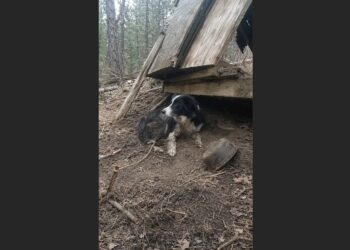
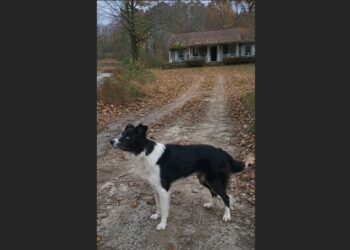
A Border Collie sat several yards off the shoulder.
She was medium-sized, thin, and alert.
Beside her was an old navy-blue duffel bag.
The bag was dirty, sun-faded, and scraped badly enough to look as though it had spent a long time outdoors.
The dog was not wandering.
She was not sniffing for food.
She stayed beside the bag and watched the road.
Every vehicle.
Every one.
At First, I Told Myself Someone Was Coming Back
That explanation was convenient.
Maybe a traveler had broken down and gone for help.
Maybe someone had stopped nearby.
Maybe the dog belonged to a person working out of sight.
People leave all kinds of things beside desert roads.
Furniture.
Old mattresses.
Broken appliances.
Boxes.
Sometimes, sadly, animals.
I did not want to believe I was looking at one of those cases.
So I kept driving.
The next morning, she was still there.
That evening, she was still there again.
The day after that, the same.
She stayed close to the blue bag and lifted her head whenever a vehicle approached.
If a truck slowed, her body became more alert.
If it passed, she settled again.
By the end of the first week, I had stopped believing someone would return soon.
I had also started wondering why I had not stopped myself.
The Heat Made Her Condition Harder to Ignore
June heat in the Arizona desert is not subtle.
By late morning, the road radiated warmth.
The asphalt shimmered.
Metal surfaces became painful to touch.
Shade mattered.
Water mattered even more.
Each day I passed the dog, she looked a little more worn down.
Dust settled into her coat.
Her ribs became easier to see.
She moved less.
At first, she had stood whenever a vehicle approached.
Later, she only lifted her head.
I did not see a reliable water source nearby.
I did not see anyone feeding her.
The bag remained in the same place.
So did she.
The combination began bothering me at work.
I would be checking equipment and suddenly picture that Border Collie sitting beside the road.
At night, I wondered whether she was still there.
And every morning, she was.
Watching Her Wait Brought Back Something I Knew Too Well
Seven years earlier, my wife had left our marriage.
There had been no warning I understood at the time.
One day we were living together.
Then she was gone.
For almost a year afterward, I had a habit I am not proud of.
I sat by the living room window in the evening and watched the driveway.
I knew she was not coming back.
At least, the rational part of me knew.
But some other part kept listening for a car.
Kept expecting headlights.
Kept believing that if I waited long enough, the missing piece of my life would simply return.
The dog beside mile marker 87 reminded me of that feeling.
I had no idea what she was waiting for.
It was possible I was projecting too much onto her.
Dogs watch roads for many reasons.
They respond to movement, sound, routine, and familiarity.
Still, I could not stop thinking about the way she tracked each passing vehicle.
Then the Monsoon Came
By the third week, the weather changed.
A violent monsoon storm swept through the area.
Rain hammered the desert.
Wind pushed sand across the road.
Water filled normally dry channels and carved through low ground.
By morning, debris had collected along the shoulder.
I expected the Border Collie to be gone.
Instead, she was still beside the duffel bag.
Soaked.
Dirty.
Curled against it.
The sight stayed with me all day.
I kept telling myself I had work.
That I was not an animal control officer.
That someone else must have noticed her.
That there were risks in approaching an unfamiliar dog beside a highway.
All of those things were true.
They were also becoming excuses.
By the fourth week, she looked visibly weaker.
Her hips showed.
Her eyes looked dull.
Her movements had slowed.
She no longer stood for most vehicles.
She just watched them pass.
The Dust Storm Was the Point When I Stopped Driving Past
It happened on a Friday evening.
A dust storm was moving across the desert.
The sky had turned a dark orange-brown.
Wind pushed sand against the truck hard enough to make the body panels rattle.
Visibility was getting worse.
When I reached mile marker 87, I saw the dog lying beside the bag.
She was motionless.
For one second, I thought I was too late.
I pulled onto the shoulder.
I took a bottle of water and approached slowly.
The closer I got, the worse she looked.
Her paws were cracked.
There were old scars on her legs.
Her body was much thinner than it had appeared from the road.
When I moved toward the bag, she forced herself upright.
A low growl came from her throat.
It was weak.
But clear.
I stopped.
That mattered.
A severely exhausted dog can still bite, especially when frightened or guarding something important.
I stayed several feet away and spoke quietly.
I did not reach for her.
It Took Time Before She Would Drink
For nearly fifteen minutes, I stayed where I was.
The wind blew sand around both of us.
I talked because silence felt wrong.
The words did not matter much.
My tone probably did.
Eventually, the growling stopped.
The dog lowered herself again.
Not necessarily because she trusted me.
She may simply have been too tired to maintain the warning posture.
I poured some water into a small container and placed it where she could reach without me moving closer.
At first, she ignored it.
Then she drank.
Too fast.
I slowed the process and offered more carefully.
Once she had finished, I looked at the duffel bag again.
Whatever connection she had to it was obvious.
Every time I shifted toward the bag, her attention sharpened.
When I finally lifted it, she stood again.
The bag was heavier than I expected.
The Border Collie followed immediately.
Limping.
Watching the bag.
She Climbed Into the Truck Beside It
At the truck, I opened the passenger side and set the bag down.
The dog climbed in after it.
She curled herself around the duffel and rested her head against the fabric.
I did not try to separate them.
At that point, the practical priorities were simple.
Get her out of the storm.
Get her somewhere safe.
Get water into her.
Arrange veterinary help.
The bag could wait.
During the drive home, she barely moved.
Every few minutes, I looked across at her.
She stayed pressed against the duffel.
I still had no idea what was inside.
Part of me expected tools.
Clothes.
Maybe camping equipment.
The weight suggested something substantial, but the bag made no sound when the truck turned.
Whatever was inside had been packed tightly.
That night, after the dog had water, a small amount of food, and a place to rest, I finally decided to look.
The Zipper Was Almost Rusted Shut
The Border Collie sat nearby while I pulled the bag toward me.
The zipper resisted.
Dust had collected in the seams.
The metal pull was stiff.
I worked it loose a little at a time.
When the opening finally widened, the first thing I saw was fabric.
Children’s clothing.
Small shirts.
A pair of sneakers.
A stuffed rabbit missing one ear.
Photographs.
A worn notebook.
An old dog collar.
The contents did not match anything I had imagined.
I picked up the photographs first.
The dog beside me appeared in nearly every one.
Younger.
Heavier.
Cleaner.
Her black-and-white coat looked glossy.
Beside her, again and again, was the same girl.
Curly brown hair.
A large smile.
Backyard photographs.
Camping trips.
Birthday pictures.
The dog had clearly belonged to that family.
The pictures showed years, not weeks.
The Notebook Explained the Loss, but Not Every Mystery
The first pages belonged to the girl’s mother.
According to the account recorded there, the family had been involved in a serious highway accident three years earlier.
The parents survived.
Their daughter did not.
The Border Collie had been in the vehicle.
Afterward, the family struggled.
Eventually, they prepared to move away.
Before the move was complete, the dog escaped.
They searched for months.
They never found her.
The notebook helped explain who the dog was and what had happened to the family.
It did not explain everything I was seeing.
In particular, it could not establish exactly how the duffel bag had ended up beside mile marker 87.
The story I later pieced together was that the dog had returned to the area connected with the family’s last traumatic journey and somehow remained with the child’s belongings.
But that part could not be treated as verified fact.
No one had watched her drag the bag there.
No one could prove how long the bag had been at that exact spot.
What was certain was narrower.
The bag contained the child’s belongings.
The Border Collie had a long history with that child.
And for nearly a month, I had watched the dog refuse to leave the bag beside the highway.
I Finally Learned Her Name
Her name was Willow.
It appeared more than once in the notebook.
The old collar in the bag matched the photographs.
Willow had been part of the girl’s childhood.
In some pictures, she was still young herself.
In later ones, both the dog and child had grown.
There were photographs of the two sitting in grass.
Sleeping near each other.
Standing beside a tent.
One image showed the girl with both arms around Willow’s neck while the dog looked toward the camera.
Looking through them felt intrusive.
These were not my memories.
They belonged to a family that had already lost a child and then lost the dog connected to so many of those memories.
Willow rested her head against my knee while I read.
For the first time since I had stopped at the highway, her body seemed less tense.
I did not interpret that as relief in a human sense.
She was exhausted, fed, hydrated, and indoors.
Those were enough reasons for her to settle.
The Family Could Hardly Believe I Had Found Her
The notebook contained enough information to help me contact the family.
The first conversation was confused.
Then silent.
Then emotional.
They asked me to describe the dog.
I described the folded ear.
The coat.
The markings.
The scars.
They asked about the bag.
When I told them what was inside, the conversation stopped again.
Willow had been missing for years.
They had eventually accepted that they might never know what happened to her.
Now a stranger from Arizona was calling to say she was alive.
She was not healthy.
That was important to explain.
She was underweight.
Her paws needed attention.
She had been exposed to severe heat and storms.
Before any reunion, she needed veterinary evaluation.
The family understood.
They arranged to come.
Three Days Later, a Car Pulled Into My Driveway
The family had driven about six hours.
I watched their vehicle stop.
Willow was inside with me.
The moment the former owners stepped out, her posture changed.
Her head lifted.
Her tail began to move.
Dogs can retain powerful associations with familiar scent, voice, movement, and gait even after long separations.
Recognition does not require them to understand how many years have passed.
Willow moved toward the door.
Then another dog stepped out of the vehicle.
An older Labrador.
The family told me he had grown up with Willow.
For a second, Willow stopped.
The Labrador did too.
Then both moved toward each other.
The reunion became noisy almost immediately.
Tails moving.
Bodies circling.
Sniffing.
Whining.
People crying.
The family knelt down.
Willow pressed close to them.
There was no need to claim she understood the full history of what had happened.
Familiar cues were enough.
The Labrador Seemed to Matter Just as Much
I had expected Willow to react to the people.
I had not expected the older dog.
That reunion may have been the most revealing part.
The Labrador approached without hesitation.
Willow’s body loosened.
They moved around each other in the way dogs do when scent tells them more than people can see.
No one needed to narrate the relationship for them.
They had shared a home before.
Now they were in the same place again.
The family cried.
I did too.
For weeks, I had watched Willow sit beside an object connected to her past.
Now the living parts of that past were standing in front of her.
That distinction mattered.
The duffel bag had held photographs, clothes, and scent.
The people and dog in front of her could respond.
They Asked Whether I Wanted to Keep Her
By then, the answer was not simple.
I had become attached to Willow.
I had stopped for her.
Brought her home.
Fed her.
Sat beside her.
Watched her sleep.
Taken her for care.
Part of me had already started imagining what it would be like if she stayed.
The family saw that.
They asked whether I wanted to keep her.
I appreciated the question.
But I also understood what I was looking at.
Willow had recognized them.
She had recognized the Labrador.
They had a shared history that existed long before mile marker 87 entered my life.
I did not believe I had earned a greater claim simply because I was the person who finally stopped.
So Willow left with them.
That was harder than I expected.
It was also right.
Recovery Took More Than Going Home
The reunion did not erase Willow’s physical condition.
She still needed food given appropriately.
Veterinary follow-up.
Treatment for her paws.
Time to rebuild body condition.
Rest.
Possibly orthopedic evaluation depending on the cause of her limp.
A familiar family can reduce stress.
It cannot reverse dehydration, malnutrition, or injury by itself.
The family understood that.
They did not treat Willow’s return as the end of the work.
They treated it as the beginning of another phase.
A month later, they sent me photographs.
Willow had gained weight.
Her coat looked healthier.
Her eyes appeared brighter.
In one picture, she was asleep on a couch beside the older Labrador.
Their bodies touched.
The image was quiet.
That made it better.
The Blue Duffel Bag Never Explained Everything
I still think about the unanswered parts.
How did the bag reach that stretch of highway?
How long had Willow actually stayed near it before I noticed?
Had she returned there because the location was associated with the accident?
Had someone else moved the bag?
Had she found it later?
The source story offers one explanation: Willow somehow brought the child’s belongings back to the place connected with the family’s loss and guarded them while waiting.
Emotionally, that explanation is powerful.
Factually, it cannot be confirmed from the details available.
That does not weaken what I actually saw.
For nearly a month, Willow remained beside that bag.
She watched the road.
Her physical condition deteriorated.
When I moved the bag, she followed.
When I brought it into the truck, she curled around it.
Inside were photographs linking her to the child whose belongings filled the bag.
Those facts were meaningful enough.
I Had Spent Years Thinking Waiting Was the Same as Loyalty
Willow changed that for me.
After my wife left, I had believed my waiting meant something.
That if I remained ready long enough, the past might reopen.
It did not.
Eventually, I stopped sitting by the window.
Life moved forward because it had to.
Watching Willow beside the highway brought that old feeling back.
The temptation was to make her story identical to mine.
It was not.
Dogs do not understand marriage, divorce, bereavement, or time in the same conceptual way people do.
Willow may have been responding to scent.
Place.
Routine.
Familiar objects.
The road itself.
I could not know.
What I did know was that she had stayed too long in a dangerous place.
Whatever held her there was costing her physically.
At some point, loyalty and survival had come into conflict.
That was the part that finally made me stop.
The Last Photograph Was the One I Kept Looking At
The family sent several updates.
Willow eating.
Willow in the yard.
Willow lying in sunlight.
The older Labrador nearby.
The photograph I returned to most showed both dogs asleep on the couch.
There was no highway.
No dust storm.
No blue duffel bag.
No dramatic reunion.
Just two older dogs resting.
That felt like the real ending.
Willow did not need to keep proving devotion.
She did not need to remain beside an object until her body failed.
She did not need to wait for a car.
She had food.
Water.
A familiar household.
A dog she already knew.
People who recognized her.
The past remained part of the family.
The child’s photographs were still real.
The loss was still real.
But Willow no longer had to sit beside a desert highway for that history to matter.
Sometimes Stopping Is the Most Important Thing
For weeks, I drove past Willow because I kept inventing reasons not to interfere.
Someone else would help.
Someone would return.
Maybe she belonged there.
Maybe I was misunderstanding the situation.
Maybe tomorrow would be different.
Tomorrow kept arriving.
Willow kept getting thinner.
In the end, the most important thing I did was not solving the mystery of the bag.
It was pulling over.
Everything after that required other people.
Veterinary care.
A family willing to drive six hours.
Time.
Food.
Rest.
Recovery.
I happened to be the person who stopped first.
Sometimes that is enough to change what happens next.
A month after Willow went home, I drove past mile marker 87 again.
The shoulder was empty.
No dog.
No duffel bag.
Just sand, cactus, heat, and the same road I had driven for years.
For the first time, I was glad there was nothing there to notice.
Editor’s Note: The characters in this story are fictional. Through these stories, we hope to share the intelligence, loyalty, compassion, and loving nature of dogs with people everywhere.