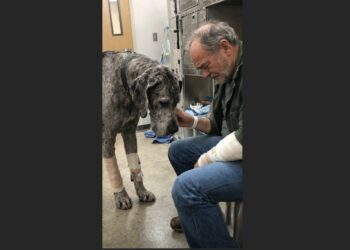
Finn Knew the Evening Routine
For almost nine years, the last ferry of the day meant one thing to Finn.
Arthur was coming home.
Every afternoon, the elderly Border Collie slipped through the gate of a small cottage near the harbor and followed the familiar road toward the waterfront.
He never went empty-mouthed.
A weathered red scarf hung gently between his teeth.
It belonged to Arthur.
The scarf had once been practical, something Arthur wore on cold mornings while teaching at the island school. Later, after retirement, it became part of a ritual neither man nor dog had planned.
Arthur would leave the scarf behind.
Finn would carry it to the harbor.
Then they would come home together.
Arthur Had Spent Most of His Life on the Island
He had been a schoolteacher for decades.
Generations of children knew the sound of his shoes in the hallway and the patient way he explained the same arithmetic problem for a third time without making anyone feel foolish.
Even after retirement, Arthur rarely stayed still.
Several times a week, he took the ferry to the mainland.
Sometimes there were appointments.
Sometimes errands.
Other days, Helen, his daughter, suspected he simply liked the trip.
The ferry gave shape to his week.
Finn gave shape to nearly everything else.
By late afternoon, the Border Collie seemed to recognize the sequence of events that usually preceded Arthur’s return.
Light changing over the bay.
Activity near the dock.
The sound of the ferry horn in the distance.
Then the familiar walk toward the harbor.
The Green Bench Was Their Meeting Place
Finn always stopped beside the same weathered bench overlooking the dock.
It had once been painted a bright green.
Years of wind and salt had softened the color.
From there, Finn could see the water and the ramp where passengers came ashore.
He sat with Arthur’s scarf in his mouth.
Then he waited.
When the ferry appeared through fog or evening mist, Finn’s posture changed.
His ears lifted.
His eyes followed the vessel.
As soon as passengers began stepping onto the pier, he searched.
Then Arthur appeared.
Finn’s tail swept against the wooden boards.
His front paws shifted impatiently.
Sometimes the scarf nearly fell from his mouth before Arthur reached him.
“You kept it safe for me again,” Arthur would say.
Then he took it from Finn and wrapped it around his neck.
They walked home side by side.
The Walk Home Was Rarely Direct
Some evenings, Arthur stopped at the fish market.
The owner knew Finn well enough to save him a small piece of smoked haddock.
Other nights, they took the longer path.
That route followed the shoreline and passed the lighthouse before turning back toward the cottage.
Arthur often talked as they walked.
He described people he had seen.
Things he had forgotten to buy.
Old students he had run into.
Sometimes he complained about the weather even when the weather was perfectly ordinary.
Finn listened.
There was no need to claim he understood the stories.
Dogs respond to voices, tone, movement, routine, and the presence of familiar people.
Arthur simply liked having someone beside him.
Finn was always there.
After Arthur’s Wife Died, The Walks Changed
The house became quieter.
One chair at the supper table stopped being used.
A pair of shoes disappeared from beside the bedroom door.
Some routines ended completely.
Others became more important.
Arthur still boarded the ferry.
Finn still carried the scarf.
And every evening Arthur returned to the same dog waiting beside the same green bench.
Helen noticed how much the ritual seemed to matter to her father.
Grief did not disappear because Arthur had a dog.
Finn could not replace the woman Arthur had spent much of his life with.
What the Border Collie provided was different.
Routine.
Company.
Movement.
A reason for Arthur to keep walking home instead of entering the cottage alone and closing the door behind him.
Finn Never Let the Harbor Be Empty
Even in unpleasant weather, the dog went.
Wind off the bay could be sharp.
Rain sometimes blew sideways.
Fog occasionally swallowed the ferry until it was almost at the dock.
Finn still waited.
Arthur often laughed when he saw him.
“You could have stayed home, you know.”
Finn responded by stepping closer.
Then Arthur put on the scarf.
That was the pattern.
People at the harbor came to recognize it.
The old teacher.
The Border Collie.
The red scarf.
Some routines become part of a place without anyone deciding they should.
Then, during one bitter winter, Arthur became ill.
And the routine broke.
Helen Took Arthur to the Mainland
The illness worsened quickly enough that Helen came to the cottage herself.
Arthur needed hospital care.
Before leaving, he moved slowly through the kitchen.
The red scarf was still around his neck.
He removed it and draped it over the back of a chair.
Finn watched.
Arthur touched the dog gently.
He told him he would be home soon.
Finn could not understand those words as a promise about illness or hospital care.
What he knew was that Arthur left.
And the scarf stayed behind.
That evening, the last ferry crossed the bay.
Finn went to the harbor.
Arthur was not on it.
The next evening, he was not there either.
Several days later, Helen returned to the island alone.
She Came Back Carrying Arthur’s Suitcase
Finn met her at the cottage.
He smelled the luggage.
He searched around her.
Then he looked toward the gate.
Helen had prepared herself for many difficult things after Arthur died.
Telling people.
Sorting papers.
Calling relatives.
Going through clothing.
What she had not prepared for was watching Finn notice the absence.
Arthur’s boots disappeared from beside the door.
His crossword remained unfinished on the kitchen table.
His coat still hung from its usual hook.
The cottage looked almost the same.
Yet the person around whom Finn’s routine had been organized was missing.
Helen stayed to settle her father’s affairs.
She also stayed because Finn needed someone.
The Next Afternoon, Finn Picked Up the Scarf
Helen watched him walk into the kitchen.
The red scarf was still hanging from the chair.
Finn took one end carefully between his teeth.
Then he moved toward the door.
Helen’s first impulse was to stop him.
Instead, she opened the gate.
Finn headed toward the harbor.
His pace was slower than it had once been.
Age had stiffened his legs.
Still, he followed the route without hesitation.
Helen walked behind him.
When Finn reached the green bench, he sat.
The ferry appeared.
Passengers came ashore.
Finn watched every one.
Arthur was not among them.
Then Finn carried the scarf home.
He Repeated It the Next Day
And the day after that.
The routine persisted.
Each afternoon, Finn collected the scarf.
Each afternoon, Helen followed him toward the waterfront.
At the harbor, the Border Collie studied the passengers.
Whenever an older man came down the ramp, Finn’s ears rose.
When footsteps approached behind him, he turned.
The reactions were difficult for Helen to watch.
It would be tempting to say Finn understood that Arthur was dead and was refusing to accept it.
No one could know that.
Dogs can react strongly when a familiar person disappears.
They can continue established routines.
They can search familiar places.
They may respond to footsteps, voices, clothing, and scents associated with someone who is no longer present.
Finn did all of those things.
Whatever he understood, the absence affected him.
Winter Began to Fade
Days became longer.
The worst of the cold passed.
Still, Finn walked toward the harbor.
Rain did not stop him.
Neither did fog.
Helen began timing her afternoons around the ritual.
She knew approximately when Finn would rise.
She knew when he would go to the chair.
She knew which path he would choose.
Some days she walked directly beside him.
Other times she stayed several yards behind.
She did not try to remove the scarf.
It seemed to be one of the few familiar objects remaining in a routine that had changed almost everywhere else.
Arthur’s scent would gradually fade from it.
Still, the scarf had become familiar through years of repetition.
Finn carried it as he always had.
The Harbor Workers Knew Why He Was There
People began noticing that Arthur no longer came off the ferry.
Some had already heard about his death.
Others learned by asking Helen.
Nobody disturbed Finn.
The fish market owner occasionally brought him a small piece of haddock.
Finn accepted it.
Then he returned to the bench.
There was no dramatic refusal to eat.
No constant howling.
He simply maintained the pattern.
That made the waiting harder to witness, not easier.
Finn was doing something ordinary.
Something he had done hundreds of times.
Only one part was missing.
Arthur.
Age Made the Walk More Difficult
By spring, Finn was visibly slower.
He had been an adult dog for most of the years Arthur owned him.
Now arthritis made itself known.
His rear legs were stiff when he first stood.
The road to the harbor took longer.
Helen considered shortening the walks.
Instead, she let Finn set the pace.
There was no reason to hurry him.
If he stopped to rest, they stopped.
If he wanted to sniff along the seawall, she waited.
Senior dogs do not need to maintain the schedule of their younger years simply because people find the old routine comforting.
Finn’s body had changed.
So the ritual changed with it.
The destination remained the same.
The green bench.
The dock.
The last ferry.
Then One Evening, Finn Did Something Different
The sun was lowering behind the lighthouse.
The ferry horn carried across the bay.
Finn was already on his way toward the harbor.
Helen followed.
He reached the waterfront later than usual.
When he came to the green bench, he did not immediately sit on the ground beside it.
Instead, he paused.
The scarf remained in his mouth.
Finn looked at the bench.
Then, slowly, he lifted himself enough to place the red scarf across the empty wooden seat.
The movement required effort.
His rear legs trembled.
Finally, the scarf lay across the weathered green boards.
Finn stepped back.
The wind lifted one end.
Helen stopped several yards away.
The Ferry Arrived
People began coming down the ramp.
Families greeted one another.
Suitcases rolled across the pier.
Workers called across the dock.
Ordinarily, Finn would have watched each face.
That evening, he did not search with the same urgency.
Instead, he climbed carefully onto the bench.
It took time.
His front paws went up first.
Then he shifted his weight and brought the rest of his body onto the seat.
The red scarf moved in the wind beside him.
Finn turned once.
Then he lowered himself.
His body curled around the familiar fabric.
One paw rested across it.
Helen began crying.
She did not approach immediately.
She simply watched him.
Nobody Could Know What Finn Had Decided
For Helen, the moment felt different from all the evenings before it.
Finn was not standing at the edge of the dock.
He was not turning toward every older man who stepped off the ferry.
He had placed Arthur’s scarf on the bench and settled beside it.
It would be easy to say that Finn finally understood Arthur was never coming home.
That would go beyond what anyone could know.
Dogs do not process death through the same concepts humans use.
But behavior can change.
Routines can shift.
Searching can decrease.
Familiar objects can remain comforting even after the person connected to them is gone.
That evening, Finn stayed on the bench.
The ferry unloaded.
Then the passengers disappeared into the village.
Finn remained beside the scarf.
Helen Sat Down With Him
After a while, she approached.
Finn lifted his head.
His tail moved once against the bench.
Helen sat at the far end.
She did not take the scarf.
For several minutes, neither moved.
The bay darkened.
Lights came on along the harbor.
Somewhere behind them, the fish market closed for the night.
Helen looked at the scarf and remembered seeing it around her father’s neck countless times.
She remembered Arthur coming home from school decades earlier.
Later, she remembered him as an older man walking beside Finn.
The scarf connected those versions of him in a way no valuable object ever could.
It was ordinary.
Worn.
Faded.
That was why it mattered.
Finn’s Routine Changed After That Evening
He did not stop going to the harbor entirely.
Some afternoons, he still walked toward the waterfront with Helen.
But the urgency seemed different.
He no longer carried the scarf every day.
Sometimes he slept through the time when the ferry arrived.
Other times he stopped near the green bench and rested before returning home.
Helen did not force the old ritual to continue for her own sake.
Finn was aging.
His walks became shorter.
The path near the lighthouse was eventually too much for his stiff legs.
So they stayed closer to the cottage.
Arthur’s red scarf remained indoors most days.
Helen draped it over the same kitchen chair.
Finn occasionally smelled it.
Then he moved on.
The Cottage Was Quiet, But Not Empty
Helen stayed longer than she had originally planned.
There were practical matters.
Papers.
Repairs.
Decisions about the house.
There was also Finn.
He needed arthritis care.
He needed shorter walks.
He needed someone to notice whether he had eaten and whether his legs were bothering him more than usual.
Caring for him did not erase Helen’s grief.
In some ways, it made Arthur’s absence more visible.
Every habit Finn retained reminded her of her father.
Still, those routines gave the days structure.
Morning food.
Slow walks.
Medication.
Rest.
The occasional trip toward the harbor.
Grief existed alongside all of it.
The Green Bench Stayed Where It Had Always Been
Tourists sat on it.
Fishermen rested there.
Children climbed on it while waiting for relatives.
Most had no idea that an old teacher and his Border Collie had used the same bench for years.
Finn did not need a memorial.
Neither did Arthur.
The place simply remained part of their history.
On mild afternoons, Helen sometimes brought Finn there.
He usually settled beside her.
Occasionally, his attention shifted toward the ferry.
He still noticed the horn.
He still watched movement near the dock.
Old habits do not disappear completely.
But Helen no longer saw the same searching she had witnessed in those first weeks.
For her, that was enough.
The Red Scarf Never Left the House Again
Helen could have packed it with Arthur’s clothing.
She did not.
The scarf returned to the kitchen chair.
Its color faded a little more over time.
One end still showed the places where Finn’s teeth had carried it gently for years.
Helen never washed those marks away.
She understood that eventually, Finn would be gone too.
He was already old.
His pace made that obvious.
So she stopped thinking of the scarf as proof of a sad ending.
Instead, it became evidence of an ordinary routine repeated often enough to become precious.
A dog.
A teacher.
A ferry.
A walk home.
Nothing more complicated than that.
Finn Had Never Let Arthur Return to an Empty Harbor
That was what Helen remembered most.
After Arthur’s wife died, evenings could have ended with him stepping alone from the ferry and walking toward a silent cottage.
Instead, Finn was there.
Red scarf in his mouth.
Tail moving.
Waiting beside a green bench.
Arthur never came back to an empty dock.
For years, Finn made sure of that.
Then one winter, Arthur left and did not return.
Finn continued the only routine he knew.
Afternoon after afternoon, he carried the scarf back to the place where their evenings had always begun.
Until one evening, something in the pattern changed.
He placed the scarf on the bench.
Curled beside it.
Rested one paw across the fabric.
And watched the ferry come and go without searching every face.
For Helen, it did not look like forgetting.
It looked more like the waiting had softened into something quieter.
Finn was still beside Arthur’s scarf.
The harbor was still there.
The last ferry still crossed the bay.
Only now, the old Border Collie no longer seemed to be asking the water to bring someone back.
He simply rested in the place where, for nearly nine years, goodbye had always meant, “I’ll see you this evening.”
Editor’s Note: The characters in this story are fictional. Through these stories, we hope to share the intelligence, loyalty, compassion, and loving nature of dogs with people everywhere.