I Was There to Give Something Away
The rescue coordinator said something that stayed with me long after that Saturday morning.
“She carries that blanket to anyone who sits with her.”
Then, after a pause, she added what the staff had come to believe it meant.
“We joke that she’s trying to show people she won’t take up much room.”
There was no way to know whether Mabel thought anything that complicated. Dogs do not make adoption pitches or calculate how much space a stranger might be willing to give them.
What we could see was simpler.
When someone stayed near her long enough, Mabel often dragged over the same faded plaid blanket and settled beside them. Pasted markdown
I had not gone to the event looking for a dog.
I had gone there to get rid of everything that reminded me of one.
Rosie Had Been Gone Four Months
My beagle, Rosie, died at fifteen.
Four months later, her things were still in my garage.
Two beds.
Stainless-steel bowls.
Unopened food.
A pink collar.
Several little sweaters she wore during Kansas winters.
I had packed everything into boxes after she died, but I could not make myself move them farther.
Every time I opened the garage, there they were.
For years, those belongings had meant Rosie was somewhere nearby.
Now they were objects without a dog attached to them.
Eventually, I found a senior-dog rescue called Second Mile holding an adoption event inside a converted train depot near Wichita.
Their website said they accepted gently used supplies.
That gave me a plan.
Load the car.
Drop off the boxes.
Thank the volunteers.
Leave.
Most importantly, do not meet anyone.
I was not ready for another dog.
At least, that was what I kept telling myself.
The Depot Was Full of Dogs People Wanted
Wind pushed against the old building when I arrived.
Inside, temporary pens lined the depot while volunteers talked with families moving from one dog to another.
The youngest and smallest dogs attracted most of the attention.
A little terrier wearing a yellow bow seemed to have a permanent crowd around her enclosure.
Two fluffy Pomeranian mixes already had people waiting to meet them.
Children pointed.
Adults crouched at gates.
Adoption forms appeared on clipboards.
Near the far end of the building, away from most of the activity, an elderly bloodhound mix lay alone.
That was Mabel.
She was twelve.
And nobody seemed to be waiting for her.
Mabel Was Easy to Walk Past
She had the long ears and enormous paws of a hound.
Her coat was brown and white.
Loose skin folded around her face.
Her belly sagged with age, and several small patches of fur were missing from her hind legs.
Her nails were thick.
Standing took effort.
Then there was her tail.
Whenever someone looked toward her, it made one careful movement against the floor.
Thump.
Then Mabel waited.
If the person continued walking, the tail became still again.
She did not bark to bring them back.
She did not jump against the gate.
She simply lowered her head.
I might have walked past too.
Instead, one of Rosie’s sweaters slipped from the top of the donation box in my arms.
It landed beside Mabel’s pen.
That was how we met.
She Smelled Rosie’s Sweater Before She Smelled Me
Mabel slowly pushed herself upright.
The movement was stiff enough that I could see why her information card mentioned arthritis.
She crossed the enclosure and lowered her nose toward the fallen sweater.
For several seconds, she smelled it carefully.
Then she looked at me.
I remember thinking, absurdly, that maybe Rosie was still in the fabric somewhere.
Of course, Mabel could have been responding to any familiar animal scent left behind.
I knew that.
Still, grief is not always interested in technical explanations.
I crouched beside the gate.
My fingers rested lightly against the wire.
Mabel stepped closer and pressed the side of her face against them.
No licking.
No pawing.
No excited movement.
She simply leaned.
“Sweet girl,” I whispered.
Her tail struck the floor once.
I Sat Down Inside the Pen
A volunteer approached and opened the enclosure so I could retrieve the sweater.
Instead of leaving, I stepped inside.
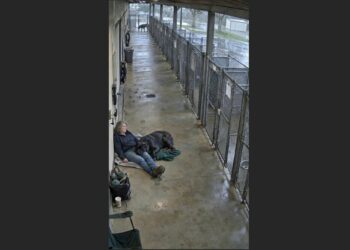
Mabel watched me lower myself to the floor.
For a moment, she remained beside me.
Then she turned and walked toward the far end of the pen.
I assumed she was finished with the interaction.
Instead, she lowered her head and gripped one corner of a plaid blanket between her teeth.
It was much too small for her.
The green-and-brown pattern had faded until the colors almost blended together. Several edges were unraveling.
Mabel began dragging it toward me.
She stopped twice.
Adjusted her grip.
Pulled again.
When she finally reached my shoes, she dropped the blanket over them.
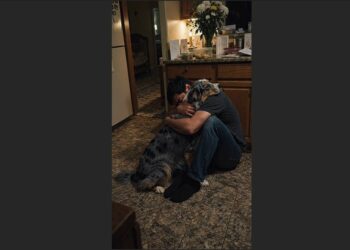
Then she turned once and lowered herself beside my legs.
Only part of her body fit on the fabric.
She seemed unconcerned.
“She Does That With People Who Stay”
I looked toward the volunteer.
“What is she doing?”
The woman smiled.
“She does that whenever someone spends a little time with her.”
“Brings them her blanket?”
“She brings it over and lies beside them.”
The staff had developed their own interpretation.
They imagined Mabel saying something like, This is all I need. I can fit.
It was a heartbreaking thought.
It was also only a thought.
Nobody could know why Mabel carried that particular blanket.
It could have smelled familiar.
The behavior may have become associated with receiving attention.
Perhaps moving it gave her something predictable to do around visitors.
Whatever the reason, she had repeated the routine enough that staff recognized it immediately.
Seventy pounds of old hound settled against my legs.
The blanket covered barely half of her.
The Blanket Had Come From Her Old Home
The volunteer sat nearby and told me what they knew.
Mabel had spent most of her life with the same woman at a farmhouse outside Hutchinson.
Then the woman died unexpectedly.
Distant relatives came to clear the property.
According to the rescue, they removed furniture, dishes, photographs, and other belongings.
Mabel remained.
A neighbor discovered her several days later near the back door.
Beside her was the small plaid rug or blanket she had apparently used in the house.
The rescue took both.
That blanket was the only object from her former home that stayed with her.
Mabel had now been available for adoption for about ten months.
At first, she reportedly approached almost everyone.
Over time, staff noticed that she became more selective about getting up.
For a twelve-year-old dog with painful joints, that made practical sense too.
Standing for every stranger cost her something.
She Had Watched Many Dogs Leave
Young dogs came to adoption events and disappeared into cars.
Puppies sometimes left within hours.
Small dogs attracted immediate attention.
Mabel stayed.
A few people had seriously considered her.
Then they learned about the arthritis.
She needed joint medication.
She could not comfortably manage many stairs.
Future veterinary care was difficult to predict.
At twelve, nobody could promise how much time she had left.
“People worry about losing her too soon,” the volunteer told me.
I understood that better than she knew.
Four months earlier, I had been holding Rosie when she died.
I had walked out of the veterinary clinic without her.
For weeks, I still caught myself listening for her toenails against the floor.
Loving another senior dog seemed almost like volunteering to repeat the worst day I had already lived through.
So I looked at Mabel and understood exactly why people hesitated.
Then another family approached.
Mabel Tried Again
The family had a teenage daughter.
She knelt beside the enclosure.
Mabel noticed.
Slowly, she pushed herself up.
She collected the plaid blanket.
Then she carried it toward the girl.
Her tail moved.
Once.
Twice.
A little faster.
The girl smiled and rubbed one of Mabel’s long ears through the gate.
For several seconds, Mabel looked more alert than she had since I arrived.
Then the father read her information card.
“Twelve years old,” he said.
He looked toward the next row.
“Let’s find one that can keep up with us.”
There was nothing unreasonable about that.
A household wanting long hikes or years of high activity would not necessarily be a good fit for Mabel.
The family moved toward a younger spaniel.
Mabel remained where she was.
The blanket hung from her mouth.
Eventually, she dropped it.
Then she dragged it back toward the corner.
Mabel Did Not Know Why They Left
It would be easy to say she understood rejection.
I do not believe we can know that.
She could see people approach and depart.
She could form expectations around repeated interactions.
She could certainly distinguish between a person remaining nearby and one walking away.
But she did not understand her age printed on an information card.
She did not know families were calculating future veterinary costs or wondering how many years they might have.
She simply returned to the back of her pen.
Then she rested her head between her paws.
My attention shifted toward the donation boxes near the entrance.
Rosie’s belongings were stacked inside them.
I had driven there determined not to begin again.
Now I was sitting beside a dog whose age represented exactly what frightened me most.
I Had Been Protecting Myself From Another Goodbye
After Rosie died, I told people I needed time.
That was true.
Grief does not require an immediate replacement.
A new dog would not have been Rosie anyway.
Still, somewhere during those four months, needing time had quietly become a permanent rule in my head.
No more dogs.
If I never adopted again, I would never have to sit in another veterinary room and say goodbye.
The logic worked if the only goal was preventing future grief.
It worked less well if I thought about what Mabel needed that day.
She was alive now.
She needed medication now.
A soft place to sleep now.
Someone willing to adjust life around an old dog’s limitations now.
My future pain and Mabel’s present life were two different things.
For the first time, I saw how much weight I had been giving only one of them.
This Time, I Moved the Blanket
I returned to the back of the enclosure.
Mabel glanced up but stayed down.
I picked up the plaid blanket.
Then I spread it beside me.
“Would you mind sharing?”
Her ears lifted.
For a few seconds, she watched.
Then Mabel stood.
She crossed the short distance and lowered herself beside me.
I took Rosie’s old sweater from the box.
It was far too small to fit a bloodhound mix properly, so I simply laid it loosely across Mabel’s shoulders for a moment.
She turned her head and smelled it again.
Her tail tapped the floor.
I looked at the volunteer.
“What would I have to do if I wanted to take her home?”
The woman’s expression changed instantly.
“Are you serious?”
I looked down.
Mabel had already closed her eyes against my leg.
“Yes,” I said.
“I think I am.”
Adoption Still Required Practical Questions
Emotion got me to the paperwork table.
Responsibility had to take over from there.
The rescue reviewed Mabel’s veterinary information.
Her arthritis needed ongoing medication.
She would require regular monitoring as she aged.
Stairs should be limited.
Slippery flooring could be difficult, so rugs or runners might be necessary.
Her exercise needed to match her endurance rather than someone else’s idea of how far a dog should walk.
Senior dogs can also develop medical problems quickly.
I understood that the adoption might become expensive.
I understood that the time could be short.
The rescue asked about my home.
My schedule.
My ability to handle a seventy-pound dog if her mobility declined further.
Those questions mattered.
A moving story does not make an unsuitable home suitable.
Fortunately, my situation worked.
The paperwork took almost an hour.
Mabel slept through most of it.
She Went Back for the Blanket
When everything was complete, a volunteer clipped a blue leash to Mabel’s collar.
We started toward the exit.
Then Mabel stopped.
She turned toward the empty pen.
For a moment, I wondered whether she was frightened to leave.
Instead, she walked back inside.
She lowered her head.
Picked up the plaid blanket.
Then carried it toward us.
A volunteer near the front desk began crying.
Someone else knelt beside Mabel and kissed the top of her head.
The rescue coordinator watched her approach the door.
“She’s been waiting a long time to carry that blanket out of here.”
Again, none of us could know what leaving meant to Mabel.
But we understood what it meant to us.
The old blanket was leaving the adoption event with the dog.
This time, both were going home.
Mabel Needed Help Getting Into the Car
Outside, she stopped beside my vehicle.
The seat was too high.
At twelve, with arthritis already affecting her hindquarters, there was no reason to make her jump.
I lifted her carefully.
Rosie’s old bed was on the back seat because I had intended to donate it.
Now I arranged it beneath Mabel.
She placed the plaid blanket on top.
Then she settled.
Her head rested against one of the boxes containing Rosie’s things.
I sat behind the steering wheel for a while before starting the car.
I had arrived planning to empty it.
Instead, there was more inside than when I came.
An old hound.
A faded blanket.
A bed I thought I no longer needed.
And memories I suddenly realized did not have to be thrown away simply because Rosie was gone.
Mabel Was Not Rosie
That distinction mattered from the first night.
Mabel did not replace the dog I lost.
She had different habits.
Different needs.
A different personality.
Rosie had wanted to follow me everywhere.
Mabel preferred knowing where I was and then choosing whether getting up was worth the effort.
Rosie loved long sniffing walks even late in life.
Mabel preferred shorter outings followed by serious naps.
Rosie hated peanut butter.
Mabel discovered almost immediately that arthritis medication became much more acceptable when followed by a spoonful of it.
Within the first weeks, I bought an orthopedic bed large enough for a much bigger dog.
Mabel used it occasionally.
Mostly, she returned to the faded plaid blanket.
No matter how carefully I arranged better bedding, she found her way back to that familiar piece of fabric.
So I stopped trying to replace it.
Two Years Changed Our Routine
Mabel is fourteen now.
She moves more slowly.
Some mornings require extra time before her legs loosen up.
I built a ramp over the three steps leading to the porch.
Rugs cover sections of slippery flooring.
Her veterinary appointments happen more often than Rosie’s did when she was young.
We talk about comfort.
Mobility.
Appetite.
Quality of life.
Loving an old dog means paying attention to those things.
It does not mean pretending age can be defeated through affection.
Mabel’s body is fourteen years old.
She deserves to be treated accordingly.
Most afternoons, she sleeps in a patch of sunlight near the living room window.
The expensive orthopedic bed is nearby.
The faded blanket is usually under her.
Barely half of her fits.
She does not seem bothered.
She Still Carries the Blanket to Visitors
Friends sometimes come over.
Mabel no longer gets up for everyone immediately.
Her joints make those decisions practical.
But when she likes the company, she sometimes does something that takes me straight back to the depot.
She grips a corner of the blanket.
Then she drags it toward the person.
Slowly.
Carefully.
The first time it happened at home, I felt my chest tighten.
For one second, I saw the adoption pen again.
Mabel trying to make herself fit beside another stranger.
Then I noticed what happened when my friend eventually left.
Mabel did not stare at the front door.
She did not carry the blanket after them.
She simply settled back down in the living room.
That was when the behavior began to mean something different to me.
Not because I suddenly knew what Mabel was thinking.
Because the context had changed.
She was no longer waiting to be chosen.
The Blanket Was No Longer Her Entire Home
At the rescue, the plaid blanket had been the one familiar object carried from her previous life.
At my house, it became one familiar object among many.
Her food bowl.
The sunny window.
The ramp.
My voice in the morning.
The sound of the refrigerator.
The place where her medication is kept.
The corner where I leave my shoes.
The route from the living room to the backyard.
The blanket still mattered.
It simply did not have to carry the entire weight of familiarity anymore.
I think that may be why seeing her drag it toward visitors feels different now.
Whatever motivates the behavior, Mabel returns afterward to a place she knows.
There is no enclosure waiting.
No adoption event.
No row of people choosing other dogs.
There is just home.
Loving Her Did Not Make Me Stop Missing Rosie
That surprised me.
I had feared that bringing another dog home would somehow betray the one I lost.
Instead, Rosie’s memory remained exactly where it had always been.
Sometimes Mabel sleeps on Rosie’s old bed.
Sometimes I find one of the beagle’s sweaters in a drawer and still feel the familiar ache.
Mabel does not remove it.
She gives me something else alongside it.
Routine.
Company.
A reason to keep dog medication beside the coffee maker again.
A reason to check the weather before deciding how long an old dog’s walk should be.
A living animal requiring attention in the present.
Grief and affection turned out not to occupy one limited space.
There was room for both.
I could miss Rosie and love Mabel.
Neither relationship had to diminish the other.
I Was Right About One Thing
Adopting Mabel meant agreeing to another goodbye.
There is no way around that.
At fourteen, our time is more obviously limited than it was when Rosie was young.
I watch Mabel closely.
If she struggles, we adjust.
If pain medication needs changing, we call the veterinarian.
If she wants to sleep, she sleeps.
The point of adopting her was never to squeeze as many years as possible out of an elderly body.
It was to make the years she had comfortable and secure.
I know the ending will hurt.
That knowledge has not disappeared.
What changed was my belief that avoiding pain was more important than everything that happened before it.
Mabel taught me otherwise simply by continuing to be here.
The Old Blanket Barely Covers Her
Tonight, Mabel will probably sleep near the window.
She may use the orthopedic bed.
More likely, she will turn around twice and lower herself onto that ridiculous little plaid blanket.
Half her chest will hang over one side.
Her hind legs will extend beyond the other.
When friends visit, she may drag it across the room.
Nobody in this house asks her to make herself smaller.
She does not need to prove she can fit.
We make room.
That difference matters to me more than any sentimental interpretation of what the blanket once meant.
Two years ago, I entered a converted train depot carrying boxes filled with the life of a dog I had lost.
I thought donating those things might help me move on.
Instead, an old hound smelled Rosie’s sweater, leaned her face against my hand, and dragged a worn blanket across the floor.
I went there expecting to leave something behind.
I drove home with Mabel in the back seat and most of Rosie’s things still in the car.
The grief came home too.
So did something I had not expected.
The willingness to love another dog even though I knew how the story would eventually end.
Mabel never needed to promise that she would take up less space.
She needed someone willing to give her enough.
And after four months of trying to protect myself from another goodbye, I finally understood that the years remaining were not a reason to walk away.
They were the reason not to waste the day we already had.
Editor’s Note: The characters in this story are fictional. Through these stories, we hope to share the intelligence, loyalty, compassion, and loving nature of dogs with people everywhere.