The Flower Stall Stayed Empty
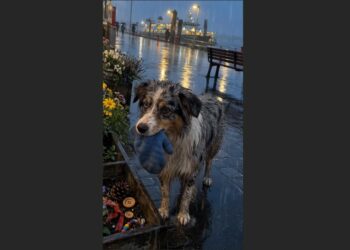
For nine days, a small Border Collie waited beside an empty flower stall at a farmers market in Eugene, Oregon.
Rain darkened the pavement each morning.
Vendors came and went around her carrying bread, produce, crates of apples, buckets of flowers, and folding tables. Several left food and water near the dog. Someone found a tarp. Another person brought blankets.
Poppy accepted the help.
What she would not do was leave.
Around her neck was a faded purple bandana.
Beneath her front paws, she kept a canvas gardening glove.
Whenever a woman with silver hair came through the market gates, Poppy stood.
She watched the face.
She smelled the air.
Then, when the woman turned out to be a stranger, Poppy went back to the glove.
Nobody could explain to her where Margaret had gone.
That was the problem.
I Knew Margaret Before I Knew Poppy
My name is Daniel Reyes.
At the time, I delivered groceries through a volunteer program serving older adults who lived alone.
That was how I met Margaret Ellis.
She was seventy-two and lived in a small cottage on the outskirts of Eugene.
After her husband died, Margaret poured much of her time into gardening.
Her backyard was crowded with roses, herbs, tomatoes, squash, lavender, and whatever else she could persuade to grow.
She rarely complained about being alone.
Still, I noticed how quiet the house could feel when I dropped off groceries.
Then, three years before the farmers market incident, Margaret adopted a Border Collie from a rural rescue.
Her name was Poppy.
The rescue knew very little about her history.
She had been found wandering near an abandoned farmhouse.
She was underweight.
Sudden movements frightened her.
She resisted going indoors.
Margaret did not try to force any of that away.
Margaret Let Poppy Decide the Distance
The first weeks were slow.
Margaret opened the back door every morning.
Then she carried her tea to the porch and sat down.
Poppy stayed in the yard.
Some mornings, she remained twenty feet away.
Other days, she edged closer.
Margaret rarely called her repeatedly.
She did not corner her.
She did not reach toward her every time the dog approached.
Instead, she made herself predictable.
Same porch.
Same quiet voice.
Same cup of tea.
Same open door.
That kind of repetition can matter to a frightened dog.
Trust is often less dramatic than people imagine.
It can begin with a dog realizing that nothing bad happens when a person sits nearby.
Nearly a month passed before Poppy rested her head against Margaret’s knee.
After that, the distance between them changed.
They were rarely apart.
Saturdays Belonged to the Market
Every Saturday, Margaret sold flowers and dried herbs at the farmers market.
She arrived early.
Usually before most customers.
Sometimes before several other vendors.
By opening time, sunflowers, roses, and whatever else was in season stood arranged in buckets across the front of her stall.
Poppy stayed behind the table.
Margaret had an old quilt she spread out for her.
Most mornings, Poppy watched the market without trying to involve herself in it.
People noticed her anyway.
Some asked to pet her.
Others simply admired the alert little dog lying behind the flowers in her purple bandana.
Margaret joked that Poppy was the real business strategy.
“People come for her,” she once told me. “Then they buy flowers so they don’t feel guilty.”
It sounded like Margaret.
She could make a joke without needing everyone around her to laugh.
For years, that Saturday routine remained dependable.
Then one morning, Margaret’s stall was empty.
I Noticed Because Margaret Was Never Late
The empty table bothered me immediately.
Margaret was one of those people who considered arriving on time almost a moral obligation.
By the time I normally passed through the market, she usually had everything arranged.
That morning, there were no flowers.
No dried herbs.
No Margaret.
No Poppy.
I assumed something minor had happened.
Maybe she was sick.
Maybe her truck would not start.
Later that afternoon, one of the vendors called me.
Poppy was there.
Margaret was not.
I drove back.
By then, the market was quieter.
I found Poppy curled beneath Margaret’s wooden table.
Several bouquets had fallen across the ground.
Her leash was still tied around one table leg.
A gardening glove lay between her paws.
I said her name.
She looked at me.
Poppy knew me from grocery deliveries.
Still, she did not get up.
Then the honey vendor told me what had happened.
Margaret Had Collapsed While Arranging Flowers
That morning, Margaret had been setting up as usual.
She had carried buckets to the stall and begun arranging them.
Then she lost her balance.
According to people nearby, she reached toward the table as though trying to steady herself.
She never managed it.
Margaret collapsed.
Within seconds, vendors and early customers surrounded the stall.
Someone called emergency services.
Another person moved the flower buckets out of the way.
Poppy became increasingly distressed as strangers crowded near Margaret.
Then the stretcher arrived.
That was when she panicked.
She pulled backward hard enough to slip free of her collar.
Before anyone could catch her, she disappeared beneath a nearby produce truck.
Paramedics concentrated on Margaret.
They had to.
People later remembered her trying repeatedly to say something.
The words were difficult to understand.
They believed she was asking about Poppy.
Then the ambulance doors closed.
The vehicle left.
By the time Poppy crawled back out, Margaret was gone.
The Glove Was Still on the Pavement
Poppy returned to the flower stall.
There, on the wet ground near where Margaret had fallen, was one gardening glove.
Poppy picked it up.
Then she stayed.
That was how the waiting began.
At first, people assumed the situation would resolve quickly.
Surely someone would learn which hospital Margaret had been taken to.
Surely a family member would come.
Surely Poppy could go home for the night.
None of that happened.
Margaret had left her purse and phone at home that morning.
Her emergency contact information was outdated.
People at the market were not family, so the hospital could not simply provide medical details to anyone who called asking.
Someone remembered Margaret mentioning a niece in California.
Nobody knew enough to find her.
Even I had never met her.
Meanwhile, Poppy remained beside the stall.
We Tried Taking Her Back to the Cottage
It seemed like the obvious solution.
Poppy knew Margaret’s house.
She had a yard there.
Food.
Water.
A familiar bed.
Several of us tried.
Poppy refused.
The moment someone applied gentle pressure to the leash and attempted to lead her away from the market, she flattened herself against the ground.
Her body began shaking.
We stopped.
There was no reason to turn confusion into a struggle.
A frightened dog can make associations quickly, especially after a stressful event.
Forcing Poppy into a vehicle or dragging her away from the last place she had seen Margaret might have made things worse.
So the market vendors changed plans.
If Poppy would not leave, they would make the area as safe as possible.
A temporary shelter appeared beside Margaret’s stall.
Folding tables created a roofline.
Waterproof sheets blocked some of the rain.
Blankets covered the ground.
Food started arriving.
Poppy stayed.
The Market Built a Routine Around Her
The baker brought plain scrambled eggs in the morning.
A teenager from the apple stand sat nearby during his lunch break.
He did not bother Poppy.
Mostly, he ate his own lunch several feet away and talked to her occasionally.
At night, the market caretaker left a security light on above the flower stall.
Fresh water appeared.
So did chicken and small amounts of dog food.
Poppy ate enough.
She drank.
She allowed familiar people to come near.
What she did not do was wander far.
Whenever the market gates opened, she watched.
When an ambulance passed somewhere beyond the market, her head snapped up.
Sometimes she stood.
People naturally interpreted that as Poppy waiting for Margaret to return.
Perhaps she was.
Still, nobody could know what she expected.
What we could see was simpler.
Poppy repeatedly returned to the last place where Margaret’s routine had broken.
The stall had become her fixed point.
On the Fifth Day, the Rain Became Worse
A heavier storm moved through Eugene.
Part of the market began flooding.
Water gathered across lower sections of pavement and pushed beneath tables.
We moved Poppy’s blankets to higher ground.
Someone shifted the shelter structure too.
Poppy followed for a while.
Then she returned to Margaret’s stall.
She carried the gardening glove with her.
The pavement was wet.
Rain caught in her fur.
She lowered herself near the exact area where Margaret had fallen.
The glove went between her paws.
That image changed something for me.
Until then, I had thought Poppy was attached to the stall because it was familiar.
Now the glove seemed more important.
It smelled like Margaret.
For a dog whose world is dominated by scent, that mattered.
Poppy did not have a hospital name.
She did not have an address.
She had one object carrying the smell of the person who had disappeared.
By the Seventh Day, We Were Worried
Poppy’s coat had become damp and tangled despite the coverings.
Her appetite was also decreasing.
She still ate, but less enthusiastically.
Her attention seemed fixed on everyone moving through the market.
We began taking turns staying after closing.
Nobody wanted her alone for long.
At the same time, I kept searching for Margaret.
I called senior centers.
Clinics.
Outreach programs.
I checked with people who might know her through gardening or community work.
Several times, I drove to her cottage.
The house sat quiet.
I looked for anything that might point toward a relative.
A holiday card.
A name.
A note.
Nothing useful appeared.
Then Margaret’s next-door neighbor remembered something.
Margaret belonged to a gardening club.
That changed everything.
The Gardening Club Had Rebecca’s Number
The club met at a community center across town.
I called.
The coordinator knew Margaret.
More importantly, she had an emergency contact.
Rebecca.
Margaret’s niece.
When I finally spoke with her, I learned she had been searching too.
Margaret was alive.
Those three words immediately changed the problem.
She had suffered a serious stroke.
After emergency treatment, she had been transferred to a rehabilitation hospital nearly forty miles away.
Rebecca said Margaret’s speech was improving.
Walking remained difficult.
She needed extensive therapy.
Then Rebecca told me the part that mattered most to everyone at the market.
Margaret kept asking about Poppy.
Not once.
Almost every day.
“Has anyone found Poppy?”
Rebecca had no answer.
Until then.
I Returned Before Sunrise
The following morning, I reached the market early.
Poppy was asleep beneath the flower table.
Margaret’s gardening glove rested under her chin.
For several moments, I just watched her.
Then I sat on the pavement a few feet away.
I did not reach toward her.
“Poppy.”
Her eyes opened.
“Margaret is waiting for you.”
Of course, Poppy could not understand the full meaning of that sentence.
But she knew the name.
I said it again.
“Margaret.”
Poppy lifted her head.
Her ears moved toward me.
She stared for several seconds.
Then she stood.
What happened next surprised me more than anything during those nine days.
Poppy picked up the glove.
She walked over.
Then she placed it in my lap.
It Was the First Time She Chose to Leave
I stood carefully.
Poppy stayed beside me.
No one pulled the leash.
No one had to coax her across the pavement.
She followed.
When I opened the van, she hesitated only briefly.
Then she climbed inside.
Nine days earlier, we could not persuade her to leave the stall.
Now she sat behind me with the glove nearby.
We still could not drive straight to Margaret.
The rehabilitation hospital had rules.
Poppy needed current vaccination records.
She also needed a health examination before entering.
Fortunately, an animal clinic nearby offered to help.
The veterinarian checked her that afternoon.
A vendor from the market brushed the dried mud from her coat.
The baker washed the purple bandana and returned it clean.
Two days later, the hospital approved the visit.
Poppy was ready.
The Hospital Smelled Nothing Like Home
Poppy stayed quiet during the drive.
The gardening glove rode beside her.
When we entered the rehabilitation hospital, her behavior changed.
Her head came up.
Her nose worked constantly.
Hospitals contain an overwhelming mixture of scents.
Disinfectants.
Food.
People.
Laundry.
Medical equipment.
Other visitors.
Poppy moved through that unfamiliar environment slowly at first.
Then she began pulling gently forward.
We passed several doors.
No one showed her a room number.
Still, scent and sound can give dogs information people barely notice.
Eventually, Poppy stopped outside one closed door.
I was about to check the number when a voice came from inside.
Weak.
But familiar.
“Is that my girl?”
Poppy scratched once.
A nurse opened the door.
Margaret Was Sitting Beside the Window
She was in a wheelchair.
A blanket covered her legs.
One side of her face still showed effects of the stroke.
Poppy saw her.
Then she moved.
The Border Collie crossed the room quickly and pressed her chest against Margaret’s knees.
A soft, high sound came from her.
I had never heard her make it before.
Margaret leaned forward as far as she safely could.
Both hands settled along Poppy’s face.
“You waited for me,” she whispered.
Poppy tried to climb closer.
She could not fit properly into Margaret’s lap, but that did not stop her from trying.
Eventually, she settled with her front half against Margaret.
The faded purple bandana was still around her neck.
Margaret buried her face in Poppy’s fur.
Poppy closed her eyes.
For several minutes, nobody interrupted them.
The Reunion Did Not Solve Everything
It solved the most urgent problem.
Margaret and Poppy had found each other.
But Margaret could not simply leave the hospital that afternoon.
A serious stroke does not disappear because a beloved dog arrives.
She still needed rehabilitation.
Her mobility had changed.
Returning home required planning.
The cottage presented several problems.
The front steps were steep.
The bathroom was not accessible enough for her new needs.
She required help with everyday tasks while continuing therapy.
Poppy could visit.
She could not live full time in the rehabilitation hospital.
So once again, separation became necessary.
This time, however, it was different.
Margaret knew where Poppy was.
Poppy could return for visits.
And there were people around both of them who knew exactly what needed to happen next.
The Market Community Stepped In Again
Rebecca arranged to stay in Oregon temporarily.
Volunteers went to Margaret’s cottage.
A small ramp was built outside.
Handrails were installed.
Furniture was moved so a wheelchair could pass more easily.
The gardening club organized a fundraiser.
Money helped cover household costs and temporary foster care for Poppy while Margaret remained in rehabilitation.
The hospital allowed Poppy to visit several times each week.
Those visits became part of Margaret’s schedule.
Poppy learned the building.
Staff learned her.
She entered more calmly after the first visit because the environment was no longer entirely unfamiliar.
Margaret’s therapy continued.
Progress was not instant.
Some days were exhausting.
Walking remained difficult.
But there was now a concrete goal attached to returning home.
A porch.
A garden.
And a Border Collie waiting to settle at Margaret’s feet again.
Two Months Later, Margaret Came Home
The garden had changed while she was away.
Weeds filled sections that Margaret would once have kept meticulously controlled.
Some plants had gone to seed.
Others had grown wild.
The roses remained.
On the day Margaret returned, volunteers waited at the cottage.
Someone guided the wheelchair toward the new ramp.
Poppy walked beside it.
She did not pull.
She stayed close.
At the top, Margaret paused.
The back garden was visible from the porch.
For a moment, she simply looked.
Poppy stood beside the wheelchair.
Then they went inside.
It was not the same household they had left.
Margaret’s body had changed.
Her routines had to change too.
Poppy adjusted with her.
Walks became shorter.
Time on the porch became longer.
The garden became something Margaret tended differently rather than something she abandoned.
I Visited Them a Few Weeks Later
Autumn light filled the porch.
Margaret sat with a cup of tea.
Poppy lay near her feet.
The purple bandana looked almost colorless after years of wear and repeated washing.
She still wore it.
Near the door, I noticed a small wooden frame.
Inside was the gardening glove.
The same one Poppy had kept at the market.
The canvas was stained and worn.
I asked Margaret why she had saved it.
She looked at the frame.
Then at Poppy.
“Because she did.”
That was all.
Poppy heard her name and lifted her head.
Slowly, she moved closer and rested her chin against Margaret’s knee.
Margaret placed one hand over her head.
Neither seemed in any hurry to move.
Poppy Did Not Need to Wait Anymore
For nine rainy days, Poppy had remained beside an empty flower stall.
She ate what people brought.
She slept beneath waterproof sheets.
She tolerated strangers trying to help.
But she kept returning to the same place.
The place where Margaret had disappeared.
The glove stayed with her.
It was tempting to describe that behavior using grand words.
Devotion.
Faith.
Loyalty.
Perhaps all of those fit in some human sense.
But the observable reality was enough.
Poppy knew Margaret’s scent.
She knew her voice.
She knew the Saturday market routine.
Then one morning, the person around whom those routines were built vanished.
Poppy stayed close to the last familiar thing she had.
When she finally heard Margaret’s name from someone she knew, she chose to leave.
Months later, the market stall was no longer where she needed to wait.
Home had changed.
Margaret had changed.
Poppy had changed too.
The garden was less orderly.
The walks were shorter.
A ramp now crossed the steps.
But the porch was still there.
So was the tea.
And when Margaret sat outside, Poppy still settled nearby.
The glove that once lay between her paws now rested in a frame beside the door.
The dog no longer needed it to hold onto Margaret’s scent.
Margaret was right there.
And for the first time since the ambulance pulled away from the farmers market, Poppy did not have to watch the entrance and wonder whether she was coming back.
They were home together.
Editor’s Note: The characters in this story are fictional. Through these stories, we hope to share the intelligence, loyalty, compassion, and loving nature of dogs with people everywhere.