Rosie’s new life lasted less than one night.
The seven-year-old beagle had spent nine months at a small rescue center in rural Ohio before someone finally chose her.
She left in the afternoon.
Before sunrise the next morning, headlights appeared again in the rescue’s gravel parking lot.
Rosie was sitting in the passenger seat.
The man who had adopted her stepped out holding her leash.
“She howled most of the night,” he said. “Every time I closed the bedroom door, she scratched at it. I need a dog that can be alone.”
Then he handed Rosie back.
A few minutes later, his truck disappeared down the road.
Rosie stood in the parking lot and watched it go.
She did not bark.
She did not pull after him.
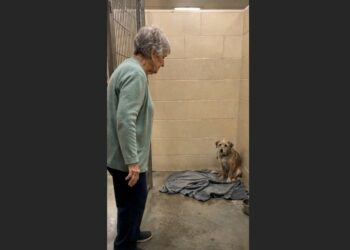
She simply turned toward the rescue entrance, walked to the locked door, and lay down on the cold concrete.
Rosie Had Already Been Left Once
Nobody at the rescue knew every detail of Rosie’s first seven years.
They knew enough.
Her former owner had moved away.
Rosie had not gone with him.
She had been found chained beside the empty house he left behind.
By the time she reached the rescue, she was physically safe, but certain situations made her uneasy.
Doors closing between her and a person were especially difficult.
If someone she had been following disappeared into another room, Rosie might whine.
If a volunteer stepped outside and shut the door, she sometimes waited close to it.
At night, she rested better when she could hear someone nearby.
The rescue workers did not claim to know exactly what Rosie remembered or how she understood the earlier abandonment.
Dogs do not interpret moving away, property, or permanent separation the way people do.
But they learn patterns.
A familiar person disappears.
A door closes.
The person does not return.
For Rosie, being separated from people appeared to carry more weight than it did for many other dogs.
At First, Every Car Made Her Stand
During her first weeks at the rescue, Rosie reacted whenever tires crunched across the gravel parking lot.
Her head came up.
Then she stood.
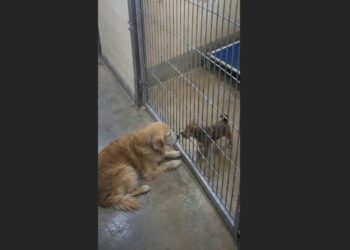
Sometimes she rose onto her back legs and pressed her front paws against the kennel gate.
Her nose pointed toward the parking area.
She studied each person who entered.
A delivery driver.
A volunteer.
A family looking for a puppy.
A veterinarian.
Visitors who had never seen Rosie before.
She watched every one.
Maybe she was simply interested in new arrivals.
Maybe she had learned that cars brought people.
The staff could not know whether she expected one particular person to return.
Still, the behavior repeated often enough that everyone noticed it.
Then, slowly, Rosie stopped getting up for every car.
Younger Dogs Kept Leaving
The rescue was small.
That meant the staff knew the animals well.
It also meant Rosie could see much of what happened around her.
A young dog arrived.
A family visited.
Paperwork was completed.
The dog left.
Then another.
And another.
Rosie attracted attention too.
She was affectionate once she felt comfortable.
She had long beagle ears, expressive brown eyes, and a graying muzzle that made her look older than seven.
But many adopters wanted younger dogs.
Others worried about her discomfort when left alone.
Some people listened to the rescue director explain that Rosie would need a patient transition and decided another dog would fit their lives better.
No one was necessarily wrong for recognizing a mismatch.
But the result was the same.
Rosie stayed.
Eventually, She Moved Beneath the Bench
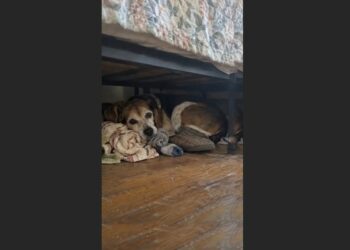
There was an old wooden bench near one side of the kennel area.
Rosie began spending her afternoons beneath it.
Her chin rested on her paws.
She still responded when familiar volunteers entered.
She still enjoyed walks.
She still accepted affection.
But the excited reaction to every arriving car faded.
The staff noticed.
Nine months is a long time in a rescue environment.
Even a well-run shelter cannot offer the quiet, consistency, and individual attention of a stable home.
Rosie adapted to the place.
Perhaps too well.
The rescue became predictable.
People came.
People left.
Her kennel remained.
Eric Arrived Looking for an Older Dog
Nine months after Rosie came in, a man named Eric visited.
He explained that he worked long hours and did not want a puppy.
A young dog, he said, would require more training and attention than he could reasonably provide.
An older dog seemed more practical.
The rescue director introduced him to Rosie.
She approached without much hesitation.
Eric stroked her ears.
Rosie leaned against his leg.
He smiled.
On the surface, the match looked promising.
Rosie was calm.
She was house-trained.
She did not need the constant activity of a young puppy.
Then the rescue director explained the difficult part.
“She May Cry When You Leave the Room”
The warning was specific.
Rosie became distressed by separation.
She might follow Eric through the house.
She might cry if he shut a door between them.
The first nights could be especially difficult.
A new home would contain unfamiliar smells, sounds, rooms, and routines.
The rescue director encouraged him to keep the transition quiet and gradual.
Rosie would need time to learn that people could leave a room and come back.
Eric nodded.
“I can handle that.”
The director asked again whether his work schedule allowed enough time during the adjustment period.
Eric said yes.
He seemed confident.
Rosie climbed into his truck that afternoon.
She Looked Back Before Leaving
One of the volunteers walked Rosie outside.
At the truck, Rosie paused.
She turned toward the rescue.
Her tail moved slowly.
Someone called goodbye.
Then she climbed into the vehicle.
The staff watched Eric pull away.
There was relief in the building.
After nine months, Rosie had finally been chosen.
Nobody knew what she understood about the drive.
She could not know that adoption paperwork had been signed or that people believed she had found a permanent home.
She only knew she was leaving a familiar place with a person she had just met.
The staff hoped the rest would come with time.
Rosie did not get much.
Her First Night Was Hard
Eric later described Rosie following him closely through the house.
When he went into the kitchen, she followed.
When he sat down, she stayed nearby.
At bedtime, he wanted her outside the bedroom.
He closed the door.
Rosie began crying.
Then came scratching.
He opened the door.
Later, he tried again.
The behavior returned.
For Rosie, the new environment had existed for only a few hours.
Nothing about it was predictable yet.
She did not know where Eric slept.
She did not know the household routine.
She did not know whether a closed door would open again.
Those things can only be learned through repetition.
Eric heard something else.
A dog he could not leave alone.
Before Breakfast, He Made His Decision
The next morning came early.
Eric put Rosie in the truck.
He drove back to the rescue before the normal opening time.
When he arrived, the building was still locked.
Rosie waited in the passenger seat until he took her out.
Then she stood in the same parking lot she had left the afternoon before.
Eric was frustrated.
He had imagined an older dog fitting quietly into his routine.
Rosie had shown him, within one night, that age did not necessarily mean effortless.
Senior and middle-aged dogs can bring established habits, fears, health needs, and histories into a new home.
Rosie needed more support than he wanted to provide.
So he returned her.
Rosie Watched the Truck Leave
The moment looked worse because Rosie did not resist.
Eric handed over the leash once a staff member arrived to assist.
Then he drove away.
Rosie watched the truck.
Her ears stayed low.
When it disappeared, she turned toward the rescue entrance.
The door was locked.
She lay down beside it.
No barking.
No frantic scratching.
She curled her body tightly against the cold concrete.
Later, when the rescue director arrived, Rosie was still there.
The director put down her bag.
Then she sat beside the dog.
“You Were Only Afraid”
The director ran one hand along Rosie’s long ear.
“You weren’t trying to cause trouble,” she said quietly. “You were only afraid the door meant someone was leaving you again.”
Rosie could not understand the sentence.
The words were for the human as much as for the dog.
The important part was what happened next.
Rosie was brought inside.
She was not punished for howling.
Nobody treated the failed adoption as evidence that she could never live in a home.
Instead, the staff changed their plan.
If Rosie needed to learn that people could remain nearby without disappearing permanently, they would start there.
They Moved Her Closer to People
Rosie was relocated to the reception area for part of each day.
It was not silent.
Phones rang.
People spoke.
A printer started and stopped.
Staff walked between rooms.
The environment let Rosie hear normal human activity even when she was not directly interacting with anyone.
At night, volunteers began staying nearby until she settled.
They did not keep their hands on her constantly.
The goal was not to create a dog who could never rest without physical contact.
Instead, they worked gradually.
Quiet routine.
Predictable movement.
Short separations.
Return.
Repeat.
Rosie needed experiences that ended differently from the pattern she seemed to fear.
Progress Came in Minutes
At first, a closed door still brought her to attention immediately.
If a familiar volunteer left the room, Rosie sometimes stood.
When the person returned shortly afterward, nothing dramatic happened.
They simply continued.
Again.
Leave.
Return.
A little longer.
Then shorter if Rosie became too distressed.
The process was slow.
There was no reason to flood her with long periods of isolation in the hope that she would “get used to it.”
Fear does not reliably disappear because an animal is forced to endure more of it.
The staff wanted Rosie below the point where panic took over.
Some days went better than others.
But eventually, she began resting even when someone briefly stepped out.
She Started Watching Visitors Again
The change was subtle.
One morning, tires moved across the gravel.
Rosie’s head lifted.
The rescue director noticed.
A few days later, another visitor arrived.
Rosie stood.
She did not rush the door.
She simply watched.
The behavior had once been routine.
Then it had disappeared.
Now it was coming back.
Staff did not interpret it as proof that Rosie had forgotten the failed adoption.
They simply saw a dog becoming more interested in what happened around her.
That was encouraging.
Then, on a rainy Saturday afternoon, Walter walked inside.
Walter Had Not Come Looking for Silence
Walter was a retired school custodian.
His wife had died recently.
Since then, he had been living alone in the farmhouse they had shared.
He described the house in practical terms.
Too many rooms for one person.
A kitchen table built for more than one plate.
A television he sometimes left on because the sound helped.
The rescue director asked what kind of dog he wanted.
Walter considered the question.
“I’m not looking for a quiet dog,” he said.
Then he gave a small smile.
“I’ve had enough quiet.”
The director thought of Rosie.
Walter Heard the Whole Story
Before introducing them, she told him everything.
Rosie had been abandoned at an empty house.
She had spent nine months at the rescue.
She struggled when separated from people.
An adoption had already failed because she cried and scratched behind a closed bedroom door.
The director did not soften that part.
Walter needed to understand that Rosie might follow him everywhere.
She might need gradual training before she could tolerate being alone comfortably.
Her behavior could improve.
It might never disappear completely.
Walter listened.
Then he asked to meet her.
Rosie Stayed Several Feet Away
Walter sat in the reception room.
Rosie entered.
She noticed him immediately.
Then she stopped.
Walter did not call.
He did not slap his knees or reach toward her.
The rescue director remained nearby.
Rosie watched.
Walter waited.
Several minutes passed.
He seemed comfortable with silence in a way he had not been comfortable with it at home.
Eventually, Rosie moved.
One step.
Then another.
Her nose worked as she approached.
Walter kept his hands relaxed.
She Put Her Head on His Knee
Rosie reached him.
She sniffed his pants.
Then she stood beside his chair.
Walter still did not grab her.
A few seconds later, Rosie lowered her head.
Her chin came to rest on his knee.
Then she released a long breath.
It shook slightly on the way out.
Walter smiled.
Only then did he move one hand beneath her chin.
“I think we could keep each other company,” he said.
The rescue director did not immediately hand him an adoption form.
They talked first.
A Farmhouse Could Still Be Lonely
Walter’s home offered space.
That alone did not make it the right home.
The rescue asked about fencing.
Veterinary care.
How long Walter normally spent away from home.
Whether he understood Rosie’s separation needs.
Whether there was family support if he became ill.
Walter answered.
Retirement meant he spent much of his time at home.
He still ran errands.
He visited friends.
Rosie would need to learn gradually that short absences did not mean permanent disappearance.
Walter understood.
More importantly, he did not expect Rosie to arrive and behave as though she had lived there for years.
He expected an adjustment.
That difference mattered.
Rosie Did Not Leave the Same Day
Walter returned.
Then he returned again.
He walked Rosie.
He spent time with her inside.
Staff watched how she responded.
She began recognizing his arrival.
Her tail moved when he entered.
On another visit, she walked directly to him and leaned against his leg.
The adoption moved forward.
This time, everyone planned the transition carefully.
The rescue wanted Rosie to have more than a second chance.
They wanted the second chance to have a realistic chance of working.
The First Night at Walter’s House Wasn’t Perfect
Rosie explored the farmhouse cautiously.
The rooms were bigger than the rescue’s reception area.
Old floorboards creaked.
A refrigerator hummed.
Wind touched the windows.
Walter showed her where the water was.
A soft bed sat beside his own.
Rosie smelled it.
Then ignored it.
She followed Walter instead.
Into the kitchen.
Back into the hallway.
Into the bedroom.
When Walter went to the bathroom and closed the door, Rosie began vocalizing almost immediately.
A beagle can produce a remarkable amount of sound when motivated.
Rosie was motivated.
Walter opened the door.
She was sitting directly outside.
He Did Not Treat It as a Failure
Walter looked down.
Rosie looked up.
“All right,” he said.
He did not assume opening the door had solved her fear.
Nor did he decide after one night that she was impossible.
Instead, he remembered what the rescue had told him.
Rosie needed time.
They would work on short separations later, in controlled ways.
There was no reason to turn bedtime or bathroom doors into a battle during the first days.
That night, Rosie slept near Walter.
Not perfectly.
She woke twice.
Each time, she checked where he was.
Then she settled again.
Morning came.
She was still there.
So was he.
The Rescue Received a Voicemail a Week Later
Walter called with an update.
The message began with laughter.
In the background, Rosie was baying loudly.
“She follows me into every room,” Walter said.
Then Rosie made another long beagle sound.
“Last night, I closed the bathroom door, and she sang until I opened it.”
The rescue staff laughed when they played the recording.
Walter’s tone changed toward the end.
“I’ll never shut her out again,” he said. “She needs to know I’m still here.”
The staff understood the feeling behind the statement.
They also encouraged him to continue the gradual separation exercises they had discussed.
Rosie needed closeness.
She would also benefit from learning, gently, that Walter could step away and come back.
Both could be true.
Walter Began Building Predictability
He developed routines.
Morning coffee happened at roughly the same time.
Rosie went outside afterward.
Meals were predictable.
Walks were unhurried.
When Walter needed to leave, he started with short absences appropriate to Rosie’s comfort.
No dramatic goodbye.
No long speech.
He returned calmly.
Over time, Rosie learned the sequence.
Coat.
Keys.
Door.
Brief absence.
Then familiar footsteps came back.
Some days she managed better than others.
The work did not require perfection.
It required repetition.
Rosie Became His Shadow
Inside the farmhouse, Rosie rarely saw a reason to be far away.
Walter repaired a loose cabinet hinge.
Rosie lay behind him.
He folded laundry.
Rosie followed.
He carried firewood.
She waited near the door.
At breakfast, she slept under the kitchen table while Walter drank coffee above her.
In the evenings, she settled close to his chair.
Walter had told the rescue that the silence of the farmhouse had become unbearable.
Rosie solved that particular problem almost immediately.
Her tags jingled.
Her paws moved across old floorboards.
She snored.
She bayed when she believed a closed door represented an unacceptable administrative decision.
The farmhouse was not quiet anymore.
Walter Never Asked Her to Replace His Wife
That distinction mattered.
Rosie did not cure Walter’s grief.
His wife’s chair was still empty.
Her belongings were still around the house.
There were mornings when Walter reached automatically for a second coffee mug.
Rosie could not change that.
What she changed was the structure surrounding those moments.
He had someone to feed.
Someone waiting to go outside.
A warm body sleeping near the bed.
Company while he sat on the porch.
Those things did not replace his marriage.
They made the farmhouse inhabited again.
Walter had lost one kind of companionship.
Rosie brought another.
Rosie Also Began Sleeping More Deeply
At the rescue, staff had noticed how easily Rosie became alert to movement.
At Walter’s house, that gradually changed.
She still followed him often.
But her sleep became heavier.
Sometimes Walter walked from the kitchen to the living room without her immediately getting up.
The first time it happened, he returned to check on her.
Rosie was stretched beneath the table.
One ear lay inside out.
She had not bothered to follow.
Walter smiled.
That was progress too.
A dog who feels secure does not always need to monitor every movement.
The Photographs Began Arriving
The first picture showed Rosie across Walter’s bed.
Not beside it.
Across it.
All four legs extended as though she owned the mattress.
The rescue director laughed.
Another photograph came a few weeks later.
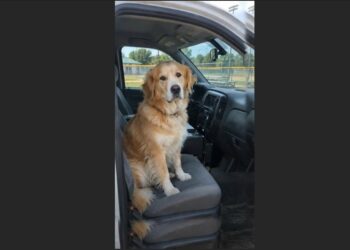
Rosie sat in the passenger seat of Walter’s old tractor.
Her ears lifted in the breeze.
Then came one from the kitchen.
Walter’s coffee mug sat on the table.
Below it, Rosie slept with her body partly across his slippers.
In every picture, she was near him.
That became the theme.
Rosie beside Walter.
Walter beside Rosie.
Neither seemed bothered by the arrangement.
She Was Still a Dog Who Needed Reassurance
Months in a stable home did not erase every old behavior.
A door could still concern Rosie.
Unexpected schedule changes sometimes made her more restless.
If Walter was gone longer than usual, she might become unusually vocal when he returned.
They continued working on it.
The goal was not to erase all attachment.
Nor was it to make Rosie completely indifferent when Walter left.
Dogs are social animals.
Many notice their person’s absence.
The goal was to keep the reaction manageable and help Rosie experience separation without panic.
Some fears become smaller through repeated safe experiences.
That was happening.
Slowly.
Nobody Needed to Call Rosie “Damaged”
The rescue had heard people use words like difficult.
Needy.
Too attached.
Those descriptions missed something important.
Rosie’s behavior had context.
She had experienced abrupt loss.
Then long shelter confinement.
Then a new home that lasted one night.
Her fear did not make her defective.
It meant any adopter needed realistic expectations and patience.
Walter had both.
He also had something Eric had not really had.
A lifestyle that fit the dog in front of him.
Eric needed a dog comfortable with substantial independence.
Rosie was not that dog.
Walter wanted companionship almost constantly.
Rosie excelled at that.
Compatibility Mattered More Than Good Intentions
Eric had not necessarily set out to hurt Rosie.
He had simply underestimated what her needs would mean in daily life.
He heard “older dog” and imagined easy.
He heard “she may cry” and assumed it would be minor.
Then the behavior interrupted his first night.
He decided quickly that he could not live with it.
Returning Rosie after one night was painful.
Yet a long-term home that resented her needs might have been worse.
The deeper mistake had happened before adoption.
Expectation and reality had not matched.
With Walter, they did.
Rosie Learned the Sound of Walter Coming Back
The farmhouse had a hallway with old wooden boards.
Walter’s footsteps were distinctive.
Rosie learned them quickly.
If he walked toward the bedroom, she often followed.
If he returned from outside, her ears lifted before he reached the room.
When he came home from errands, she met him near the door.
For months at the rescue, cars had made Rosie search unfamiliar faces.
Now a different pattern became more important.
Walter left.
Walter returned.
His footsteps crossed the hallway again.
The sequence repeated.
Enough times, perhaps, for the return to become as familiar as the leaving.
She Stopped Watching the Driveway the Same Way
During her early months at Walter’s home, Rosie sometimes sat where she could see the long gravel drive.
A vehicle passing on the road could catch her attention.
Over time, the behavior softened.
She still noticed cars.
She was a dog, after all.
But she no longer spent afternoons positioned as though every arriving vehicle required inspection.
There were more interesting things to do.
Follow Walter into the kitchen.
Nap.
Investigate the yard.
Ride in the tractor.
Search for crumbs beneath the table.
Her life had become larger than waiting.
Walter Had Wanted Noise
He got it.
Beagles are not famous for silence.
Rosie bayed at squirrels.
She occasionally informed Walter that meals were late when they were approximately three minutes late.
When someone pulled into the driveway, she announced it.
And if Walter closed the bathroom door at the wrong moment, she still sometimes offered an opinion from the hallway.
Walter usually laughed.
After losing his wife, the farmhouse had become so quiet that he sometimes turned on the radio simply to hear another voice.
Now he had Rosie.
Not a substitute.
Not a solution to grief.
Just a living creature moving through the same rooms.
For Walter, that was enough.
The Bed Beside His Went Mostly Unused
Walter had bought Rosie a comfortable dog bed.
She used it occasionally.
Mostly during the day.
At night, she preferred his bed.
At first she slept near the bottom.
Then, gradually, she moved farther up.
Walter allowed it.
One of the photographs he sent to the rescue showed Rosie asleep with her head across the pillow beside his.
Her gray muzzle stood out against the blanket.
The caption was simple.
She snores.
The rescue director printed that one too.
Rosie Had Finally Found the Right Kind of Home
Not a perfect one.
Walter still had appointments.
He still needed to leave sometimes.
Rosie still needed to practice being alone.
There were veterinary bills.
Her face continued turning gray.
Eventually, age would bring more physical needs.
But the home fit.
Walter wanted a dog who stayed close.
Rosie wanted to stay close.
Walter did not interpret following as an inconvenience.
Rosie did not need constant entertainment.
A farmhouse, a retired man, several slow walks, and the freedom to sleep nearby suited her.
Sometimes successful adoption is less about changing a dog than finding a life that makes sense for the dog who already exists.
Her First Adoption Lasted Less Than a Night
The rescue staff never forgot seeing Rosie outside the locked door.
Curled on concrete.
Truck disappearing.
No protest.
That image remained difficult.
But it was no longer the final image they carried of her.
Now they had others.
Rosie in the tractor.
Rosie beneath the table.
Rosie stretched across Walter’s bed.
And Rosie standing beside him on the farmhouse porch, close enough that one of her shoulders touched his leg.
Those photographs did not erase what happened.
They showed what came after.
Rosie Did Not Need a Person Who Promised Never to Leave
No one can promise that.
People work.
Shop.
Go to appointments.
Life changes.
And eventually, every relationship ends.
What Rosie needed was something more realistic.
A person whose pattern she could trust.
Leave.
Return.
Open the door.
Come back down the hallway.
Feed breakfast tomorrow.
Take the same walk again.
Sit at the same table.
Sleep in the same room.
Dogs understand consistency far better than promises.
Walter gave her that.
The Footsteps Became the Important Part
Months after the adoption, Rosie still liked being close enough to touch Walter.
She slept beneath his table.
Rode beside him in the tractor.
Followed him from room to room.
Sometimes she remained asleep when he stepped away.
Sometimes she still followed.
Both were fine.
The rescue director kept one photograph near her desk.
Rosie was curled on Walter’s bed with her nose tucked beneath one paw.
Nothing about the picture was dramatic.
That was why she liked it.
For much of Rosie’s life, separation had been connected with uncertainty.
An empty house.
A rescue kennel.
A new home that lasted one night.
At Walter’s farmhouse, the pattern changed.
A door could close.
Footsteps could move away.
Then, after a while, those footsteps came back.
Rosie no longer had to spend her days watching the driveway for someone who had disappeared.
Now, when she heard Walter moving down the hallway, she knew something much simpler.
He was still there.
Editor’s Note: The characters in this story are fictional. Through these stories, we hope to share the intelligence, loyalty, compassion, and loving nature of dogs with people everywhere.