For almost a year, Margaret had been telling her daughter the same thing.
She was not ready for another dog.
At 80, she lived alone in a house that had once felt much fuller. Her husband was gone, and so was the dog they had shared for nearly 15 years.
That dog had been part of the household through an entire chapter of Margaret’s life.
Morning walks.
Meals.
Quiet evenings.
Trips to the veterinarian.
A familiar shape sleeping nearby at night.
When he died, Margaret discovered that losing a dog after so many years created its own kind of silence.
She was not eager to fill it.
Her daughter understood.
She never pushed.
Then, one Saturday morning, Margaret surprised both of them.
“I suppose we could look,” she said.
Her daughter tried not to sound too excited.
Margaret noticed anyway.
“We are only looking.”
She Set the Rules Before They Left Home
Margaret repeated the terms during the drive.
No paperwork.
No decisions.
No dog coming home.
Her daughter agreed to all three.
That was important.
Margaret did not want to feel cornered into making a decision simply because they had entered a shelter.
She had spent the previous year learning how to live differently.
Her days were quieter now.
Meals were simpler.
Evenings followed a routine she could manage.
Bringing another dog into the house would change all of that.
There would be feeding schedules again.
Walks.
Veterinary appointments.
Hair on the furniture.
Someone depending on her.
And, eventually, another goodbye.
That last part was difficult to ignore.
Opening your life to a dog always means accepting that the relationship is likely to end before you are ready.
Margaret had already experienced that once.
She was not sure she wanted to do it again.
The Shelter Was Louder Than Her House
When they entered the kennel area, the contrast was immediate.
Dogs barked from both sides of the hallway.
Metal gates rattled.
Some animals hurried forward as soon as Margaret approached.
A young dog pressed his nose through the bars.
Another bounced up and down, tail moving so hard that his entire body followed it.
Margaret smiled at several of them.
She asked questions.
Age.
Size.
Temperament.
She listened politely when the shelter worker described each dog.
But she kept walking.
There was no moment of instant certainty.
That suited Margaret.
She had not come looking for one.
Charlie Was Near the End of the Row
They had been walking for almost half an hour when Margaret slowed near one of the final kennels.
A small scruffy terrier sat on a gray blanket against the back wall.
His name card said CHARLIE.
Unlike the dogs Margaret had just passed, Charlie made no attempt to come forward.
He did not bark.
He did not growl.
He simply watched.
His body stayed close to the wall.
When another visitor paused briefly in front of the kennel, Charlie lowered his head slightly.
The visitor moved on.
Charlie remained where he was.
Margaret did not.
She stood there.
“He’s Still Pretty Nervous”
The shelter worker explained that Charlie had been there for several weeks.
He had gradually become more comfortable around the staff members who cared for him every day.
Strangers were different.
New people made him uneasy.
Most visitors wanted a dog who would approach quickly.
Charlie usually gave them nothing to work with.
No tail wag.
No excited greeting.
No nose against the bars.
So they moved on.
That did not make him unfriendly.
It meant he was cautious.
The shelter worker did not know exactly why.
There was no need to invent a dramatic history simply because Charlie was afraid.
The staff could only respond to the behavior he showed them.
And what he showed them was simple.
He wanted distance.
Margaret Stayed Longer Than Most Visitors
Her daughter expected them to keep walking.
Instead, Margaret remained at the kennel.
Charlie watched her.
Margaret watched him.
A full minute passed.
Then another.
Finally, Margaret turned toward the shelter worker.
“Can I go in?”
The worker hesitated briefly, then agreed.
Charlie was nervous but had not shown aggression.
Still, the interaction needed to remain low-pressure.
The kennel gate opened.
Margaret stepped inside.
Charlie immediately moved tighter against the back wall.
Margaret stopped.
She had crossed only a few feet.
That was enough.
“You Don’t Have to Be Scared”
Margaret spoke quietly.
“Oh, you don’t have to be scared.”
Charlie did not move toward her.
A slight tremble ran through his body.
Margaret saw it.
She also saw what would happen if she continued walking.
The dog had already told her, through posture alone, that the distance mattered.
So she stayed where she was.
There was no reaching.
No calling his name repeatedly.
No trying to convince him through enthusiasm.
Just space.
That was harder than it looked.
People naturally want to comfort frightened animals by moving closer.
Sometimes the kinder choice is the opposite.
Getting Down Wasn’t Easy
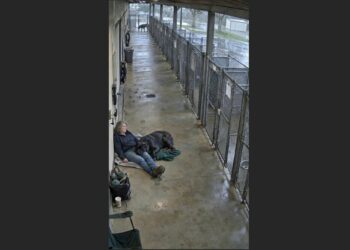
Margaret decided to lower herself closer to Charlie’s level.
At 80, that required planning.
She reached behind her and gripped the metal kennel frame for support.
Then she bent one knee slowly.
Her daughter immediately took a step forward.
Margaret waved her off.
“I’ve got it.”
Carefully, she lowered herself until she was resting on one knee.
The position was not particularly comfortable.
She stayed anyway.
Then she looked toward Charlie.
“Come to me.”
Nothing happened.
Margaret Did Not Ask Again
Charlie remained on the gray blanket.
His ears shifted.
His eyes stayed on Margaret.
She did not repeat the invitation.
That mattered.
A frightened dog does not need a command given ten different ways.
He needs information.
Is this person moving toward me?
Will she grab me?
What happens if I stay where I am?
Margaret gave Charlie an answer through stillness.
Nothing happened.
No hand came closer.
No one forced him up.
No one touched him.
Minutes passed.
Her daughter watched from the hallway.
The shelter worker waited near the gate.
Margaret remained awkwardly on one knee.
Charlie kept looking at her.
Then Charlie Stood
The first change was small.
Charlie shifted his weight.
Then he stood.
Margaret did not smile broadly or clap.
She stayed still.
Charlie took one step.
It was so short that Margaret’s daughter later said she could not tell whether he was actually approaching or simply repositioning himself.
Then he stopped.
His head remained low.
He watched Margaret.
She waited.
Another step followed.
Then another pause.
Crossing a Few Feet Took Time
The kennel was not large.
For a confident dog, the distance between Charlie’s blanket and Margaret would have taken seconds.
Charlie needed much longer.
He advanced one careful step at a time.
Each time he stopped, Margaret allowed him to reconsider.
She did not shorten the distance herself.
That was what made the moment meaningful.
Charlie was controlling the interaction.
He could move forward.
He could stop.
He could retreat.
Margaret made no attempt to remove those choices.
Little by little, the space between them disappeared.
Margaret Stayed on One Knee
By then, the position had become uncomfortable.
Her daughter could see it.
Margaret shifted slightly to relieve pressure but did not stand.
She understood something simple.
Charlie had already done the harder part.
He had left the only place in the kennel where he seemed to feel safe.
If Margaret rose suddenly now, her movement might cause him to retreat.
So she stayed.
There was no hurry.
Not anymore.
Charlie Reached Her Hand
Eventually, Charlie stood close enough to investigate.
Margaret kept one hand low.
He leaned forward and sniffed near her fingers.
She did not immediately stroke his head.
A common mistake with cautious dogs is assuming that approaching a hand automatically means permission to touch.
Margaret did not make that assumption.
She simply allowed him to smell her.
Charlie stayed.
For several seconds, nothing happened.
Then he moved closer.
Charlie Made the Contact
His head came forward.
Then, gently, he pressed himself against Margaret’s chest.
The movement surprised her.
Her face changed immediately.
Charlie shifted again until part of his body rested against her shoulder.
Only then did Margaret lift one arm.
She placed it loosely around him.
Her other hand began moving slowly along his back.
“Oh, sweetheart.”
Her voice caught slightly.
Charlie remained there.
Her Daughter Watched From Outside
Later, Margaret’s daughter would say that the hug was not the part she remembered most.
It was her mother’s knee.
Margaret had stayed in that awkward position longer than she reasonably needed to.
She was 80.
Getting up would not be simple.
Yet she never tried to hurry Charlie through those last few inches.
That was what stayed with her daughter.
The dog had already crossed the kennel.
Margaret seemed to understand that her job was not to make him finish faster.
It was to let him finish.
So she waited.
One Good Moment Wasn’t an Adoption Decision
Eventually, Charlie moved away.
Margaret stood with help from the kennel gate.
Her daughter expected the decision to be obvious now.
It wasn’t.
Margaret was emotional.
She liked Charlie.
That did not mean she was ready to take him home immediately.
The shelter worker encouraged her to think about the practical side.
Charlie was small, which made handling easier.
Still, he would need time to adjust.
A new home could make his fear temporarily worse.
He might hide.
He might refuse food at first.
Visitors might need to ignore him.
Margaret would have to avoid forcing affection simply because he had approached her once.
She listened.
Then she went home without him.
Exactly as she had promised.
The House Felt Different That Evening
Nothing had changed physically.
Margaret returned to the same quiet rooms.
The same chair stood beside the window.
The same kitchen table had one place setting.
But Charlie followed her home in another way.
She kept thinking about him.
Not the hug.
The walk across the kennel.
One step.
Pause.
Another step.
The way he had watched her before making each decision.
Margaret recognized the feeling more than she expected.
Not fear of people.
Her own hesitation was different.
But she understood what it was like to stand at the edge of something new and not know whether moving forward was worth the risk.
Losing One Dog Had Changed Her
For almost 15 years, Margaret’s previous dog had been part of the marriage she shared with her husband.
The dog’s death had carried memories of both relationships.
It was not simply the loss of an animal.
It was another connection to that earlier life disappearing.
Afterward, Margaret became protective of the quiet she had built around herself.
Routine felt safe.
Another dog would disrupt it.
Another dog might also become important.
That was the problem.
Margaret did not fear feeding a dog or taking him outside.
She feared loving one.
Because she knew what came with it.
Her Daughter Did Not Call That Night
That restraint mattered too.
Margaret’s daughter wanted Charlie to come home.
But she understood that pressure would likely make her mother retreat from the idea.
So she said nothing.
The next morning, Margaret called her.
“What do you think he needs?”
Her daughter knew who she meant.
They talked about food.
A bed.
Veterinary care.
A quiet place in the house.
They discussed how much exercise a small terrier might need and whether Margaret felt comfortable managing a leash.
Practical questions replaced emotion.
By the end of the conversation, Charlie seemed less like a dramatic decision and more like a dog whose needs could be considered one by one.
Margaret Went Back
The following day, she returned to the shelter.
Charlie did not run toward her.
Margaret did not expect him to.
He watched from farther back.
Then, after a while, he moved closer.
This time, Margaret sat on a chair outside the kennel rather than kneeling inside.
She talked quietly.
Charlie came toward the gate.
The change was small.
But it was enough.
Margaret filled out an application.
The Shelter Asked Questions Too
Responsible adoption works both ways.
Margaret wanted Charlie.
The shelter still needed to decide whether the home suited him.
At 80, Margaret’s age was not automatically a reason to deny an adoption.
What mattered was whether she could meet Charlie’s needs.
Could she manage his exercise?
Was the home safe?
Did she have a plan if she became ill?
Could she afford routine veterinary care?
Would someone help if Charlie needed transportation?
Margaret answered honestly.
Her daughter lived nearby.
She was willing to help.
The home was quiet.
There were no small children or frequent visitors.
For a cautious little dog, that might actually be an advantage.
The adoption moved forward.
Preparing the House Felt Strange
Margaret had removed her old dog’s things long ago.
Now she found herself buying them again.
A bed.
Food bowls.
A leash.
A few toys.
She placed the bed in a low-traffic corner of the living room where Charlie could observe without feeling trapped.
Nothing went directly beside the front door.
He would need options.
She also thought about visitors.
For the first week, there would be none.
Her daughter could come if necessary, but even she agreed to keep things quiet.
Charlie had spent weeks learning the shelter.
Now he would have to learn another world.
Margaret wanted to make that world simple.
Two Days Later, Charlie Went Home
When adoption day arrived, Margaret returned to the shelter.
Charlie looked at her from inside the kennel.
This time, the gate opening meant something different.
But Charlie could not know that.
He did not understand adoption paperwork.
He did not know that a bed had been placed beside Margaret’s couch.
He did not know that bowls were waiting in her kitchen.
He only knew the familiar woman had returned.
Margaret entered slowly.
She did not expect him to repeat their first meeting exactly.
Charlie came toward her in his own time.
Then they left together.
The First Day Was Quiet
At Margaret’s house, Charlie explored cautiously.
He smelled the doorway.
Then the rug.
Then the edge of the sofa.
Margaret stayed nearby but did not follow him from room to room.
He needed space to investigate without feeling watched constantly.
The new bed went untouched.
The toys were ignored.
Charlie drank a little water.
Later, he found a corner and settled there.
Margaret let him.
She had learned enough at the shelter to understand that coming home was not the same as feeling at home.
That would take longer.
Charlie Did Not Become Brave Overnight
During the first week, progress came slowly.
A delivery at the door sent Charlie toward another room.
When Margaret accidentally dropped a spoon, he startled.
The first time her daughter visited, Charlie watched from several feet away.
Nobody pursued him.
Meals arrived predictably.
Walks remained short.
Margaret kept her voice calm.
When Charlie approached, she responded.
When he wanted distance, she gave it.
That rhythm began to matter.
A New Routine Formed
Eventually, Charlie started following Margaret into the kitchen.
Not always.
Just sometimes.
Then he began resting nearer the chair where she read in the afternoons.
The bed she had bought slowly became useful.
One evening, Margaret looked down and realized Charlie had curled into it without anyone directing him there.
She smiled.
Then she returned to her book.
The house remained quiet.
But the quiet had changed.
There were small sounds now.
Paws moving over the floor.
A collar shifting.
A water bowl being used.
The soft exhale of a dog settling nearby.
Margaret had forgotten how noticeable those sounds could be.
Charlie Gave Her Something to Do in the Morning
Before Charlie, Margaret’s mornings had become flexible.
There was little reason to hurry.
Now someone wanted breakfast.
Someone needed to go outside.
The leash had a place near the door.
Walks were short and suited to Margaret’s pace.
Charlie did not care.
He spent much of the time investigating smells.
That worked for both of them.
Neither needed speed.
They simply went out.
Then came home.
The routine was modest.
It was also dependable.
Margaret Still Missed Her Old Dog
One relationship did not erase another.
There were days when Charlie did something that reminded Margaret of the dog she had shared with her husband.
That could be painful.
She did not pretend otherwise.
Sometimes she told Charlie stories he could not understand.
“You would have liked him,” she said once.
Charlie looked at her.
Margaret laughed softly.
She knew he had no idea what she meant.
Still, saying it felt good.
Charlie did not replace anyone.
He occupied a new place.
Trust Looked Different at Home
At the shelter, trust had looked like crossing a few feet.
At home, it appeared in other ways.
Charlie slept more openly.
He stopped watching Margaret’s hands every time she moved.
He began approaching without waiting for her to call.
Eventually, he rested against her leg while she sat on the couch.
Each change came from repetition.
Margaret stood up and did not frighten him.
She left the room and returned.
Meals appeared.
Doors opened.
Nothing bad followed.
Day by day, the house became predictable.
Margaret Had Needed the Same Thing
In a quieter way, she had been learning too.
The first night, she worried that adopting Charlie had been impulsive.
The second week, she worried less.
By the end of the month, she could hardly imagine the empty corner where his bed now sat.
That did not mean the decision had been easy.
It meant uncertainty had changed through experience.
Margaret had not needed complete confidence before adopting Charlie.
She had needed enough confidence to take the next step.
Then another.
That was something she had watched Charlie do first.
The Distance Between Them Kept Shrinking
Months later, Charlie still had cautious moments.
Some visitors made him retreat.
Unexpected noises could send him toward his bed.
Margaret did not describe him as cured.
He did not need to become a different dog for the adoption to succeed.
He had simply become more comfortable in the life they had built.
And Margaret had changed too.
She still lived alone.
She still missed her husband.
She still remembered the dog who had shared almost 15 years with them.
Those facts remained.
So did Charlie.
The Day They Met Still Made Sense to Her
Sometimes Margaret’s daughter brought up that first afternoon.
The gray blanket.
The back wall.
Margaret lowering herself onto one knee.
Charlie moving one tiny step at a time.
Her daughter still remembered how long Margaret had stayed in that uncomfortable position.
Margaret usually shrugged.
“What else was I supposed to do?”
To her, the answer had become obvious.
Charlie was trying.
So she waited.
Dogs Notice What People Do Repeatedly
Can dogs tell when someone is willing to wait for them?
No one can know exactly what Charlie understood about Margaret’s intentions.
He could not know that she had lost another dog.
He did not know she was afraid of becoming attached again.
He could not understand that the woman kneeling across the kennel was deciding whether she was ready to change her life.
But dogs are very good at experiencing patterns.
A person stays still.
A hand does not grab.
A voice remains soft.
Distance is respected.
The interaction ends before it becomes overwhelming.
Then the person returns and behaves the same way again.
Charlie did not need to understand patience as an idea.
He could experience it.
They Met Somewhere in the Middle
Margaret had entered the shelter insisting she would not bring a dog home.
Charlie had spent weeks making sure strangers did not come close.
Neither was ready to rush.
Perhaps that was why the meeting worked.
Margaret stayed on one side of the kennel.
Charlie stayed on the other.
For a while, nothing happened.
Then Charlie stood.
One step.
Pause.
Another.
Margaret did not move.
Eventually, he reached her.
He sniffed her hand.
Then, when he was ready, he pressed his head against her chest.
Two days later, Charlie went home with her.
Not because Margaret had suddenly forgotten what it felt like to lose a dog.
And not because Charlie suddenly stopped being cautious.
They simply gave each other enough time to make one decision.
Then another.
The same way Charlie had crossed that kennel.
One careful step at a time.
Editor’s Note: The characters in this story are fictional. Through these stories, we hope to share the intelligence, loyalty, compassion, and loving nature of dogs with people everywhere.