The Storm Made Everything Harder
By the time Dr. Lena Carter reached the rescue sanctuary, snow had already buried much of the mountain road.
Her truck moved slowly through the final stretch, tires pressing into deep tracks left by volunteers earlier that morning. Wind pushed loose snow across the road almost as quickly as it was cleared.
When Lena finally stopped beside the old wooden barn, she stepped out carrying a medical bag and hurried toward the entrance.
Inside, a volunteer was kneeling beside an elderly Golden Retriever.
His name was Winston.
He was thirteen years old.
His once-golden coat had faded around the face, his eyes had grown cloudy with age, and the strength that had carried him through years of work as a therapy dog was disappearing quickly.
The volunteer looked up as Lena entered.
“He still won’t stand.”
Winston barely lifted his head.
Winston Had Spent Years Comforting Children
Before coming to the sanctuary, Winston had worked at a children’s hospital.
His job had never been complicated in the way people sometimes imagine therapy work.
He did not understand diagnoses.
He did not know why some children were frightened or why others stayed for weeks.
He simply knew the routines he had been trained for.
Walk calmly through hallways.
Settle beside beds.
Accept gentle hands.
Remain steady around unfamiliar sounds, medical equipment, wheelchairs, and people moving differently from those he encountered at home.
For years, Winston had been the quiet dog beside children who needed something familiar and warm nearby.
Eventually, age caught up with him.
His working days ended.
The sanctuary took him in so he could spend retirement somewhere quieter.
For a while, he adapted easily.
He followed volunteers around the property.
He enjoyed slow walks.
He slept in warm patches of sunlight.
Then, during one bitter winter week, his condition changed.
At First, He Simply Stopped Finishing His Meals
Nobody panicked immediately.
Older dogs sometimes have off days.
Winston still drank water.
He still raised his head when familiar people entered.
But his appetite continued declining.
Then he became reluctant to walk.
Two days later, when the storm arrived, he no longer had enough strength to leave his stall.
That was when the sanctuary called Lena.
She knelt beside him beneath the barn’s dim yellow lights.
His breathing was shallow.
His pulse felt weak.
His gums were paler than she wanted to see.
Those signs could point to several serious problems in an elderly dog, including anemia, internal bleeding, infection, heart disease, or other systemic illness.
Lena began working methodically.
Temperature.
Heart rate.
Hydration.
Mucous membrane color.
Abdominal examination.
She prepared fluids and supportive medication while asking volunteers about changes in appetite, urination, stool, mobility, and behavior.
Nothing about Winston’s condition suggested they had time to waste.
The Emergency Clinic Was Almost Two Hours Away
Under normal circumstances, Lena would have preferred advanced diagnostics immediately.
That night, weather changed the equation.
The nearest emergency facility was nearly two hours down the mountain in good conditions.
These were not good conditions.
Snow was still falling.
Visibility was poor.
Sections of the road were already becoming difficult for ordinary vehicles.
Transporting a weak thirteen-year-old dog over an icy mountain route could create its own danger.
Lena explained the situation to the sanctuary manager.
They would stabilize Winston as much as possible.
They would monitor him constantly.
If conditions improved enough for transport, they would move him.
But she also said the sentence nobody wanted to hear.
“He may not make it through the night.”
Across the barn, scratching began.
A small dog was pushing at the gate of the neighboring stall.
Her name was Poppy.
Poppy Had Once Been the Frightened One
Poppy was a five-year-old Beagle mix.
When she first arrived at the sanctuary, she had been afraid of almost everything.
She came from an abandoned farmhouse, though nobody knew enough about her previous life to explain each fear.
Loud sounds made her retreat.
New places overwhelmed her.
Unfamiliar people had difficulty approaching.
At mealtimes, she sometimes waited until everyone stepped away before eating.
Winston became one of the dogs she tolerated almost immediately.
He did not crowd her.
He did not try to play when she wanted distance.
He simply rested nearby.
When Poppy hesitated around food, Winston sometimes stayed within sight while she ate.
If she became frightened by noise, he often settled beside her.
Nobody claimed he consciously understood her history.
His temperament was simply calm and predictable.
For Poppy, that appeared to help.
Over time, she began sleeping close to him.
Now the gate between their stalls was closed, and she could see Winston on the floor.
Poppy Would Not Stop Watching Him
She paced.
Then stopped at the gate.
Her ears remained low.
Every few seconds, she pushed her nose toward the narrow opening.
Lena continued adjusting Winston’s fluid line.
The sanctuary manager glanced toward Poppy.
“She’s been doing that since he went down.”
Normally, staff avoided unnecessary interactions around a sick dog.
Rest mattered.
So did infection control and safety.
But Poppy was calm enough, and Winston showed no sign that her presence would distress him.
One volunteer opened the gate.
Poppy moved forward quickly.
Then, several feet from Winston, she slowed.
That change caught everyone’s attention.
She approached him carefully.
No jumping.
No pawing.
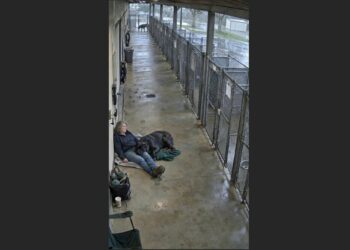
She lowered herself onto the straw beside his back.
Then she curled close enough for her body to touch his.
She Put Her Chin Across His Neck
Winston did not respond immediately.
Poppy began licking the fur near one of his ears.
She paused.
Waited.
Then tried again.
A soft sound came from her.
It was not quite a bark.
Not quite a whine.
More like a low, brief call.
Winston’s eyelids moved.
Lena looked up.
Poppy made the sound again.
This time, one of Winston’s front paws shifted beneath the blanket.
The movement was small enough that someone could have missed it.
Nobody in the barn did.
Poppy stood.
She moved around until she was near Winston’s face.
Then she touched her nose gently to his.
Several seconds passed.
Winston opened his eyes.
His gaze settled on her.
Then he lifted his head barely an inch from the straw.
Nobody Mistook That for a Cure
The volunteers reacted emotionally.
Lena did not confuse emotion with medicine.
A sick dog becoming more alert in response to a familiar companion did not mean the underlying illness had improved.
Winston was still weak.
His gums were still pale.
His breathing still concerned her.
Whatever was happening inside his body would require diagnosis and treatment.
Still, responsiveness mattered.
It showed he was conscious enough to engage with the environment.
Poppy’s presence might have provided familiar sensory cues.
Her scent.
Her movement.
Physical warmth.
The sound of her vocalizing.
Any of those could have contributed to Winston lifting his head.
The explanation did not need to be mysterious.
Poppy’s tail began moving when Winston looked at her.
She licked his nose.
Winston answered with one weak lick of his own.
Then his head lowered again.
For the people watching, it was a tiny moment.
It changed the atmosphere inside the barn anyway.
Lena Called the Emergency Clinic
She contacted a colleague and described Winston’s condition.
They reviewed the signs together.
Pale gums.
Weakness.
Reduced appetite.
Shallow breathing.
Sudden decline.
His age complicated the picture, but one possibility was severe anemia.
They discussed treatment options that could be safely started while the roads remained difficult.
Lena adjusted the supportive plan.
Meanwhile, sanctuary staff arranged for a snowplow operator to clear enough of the route for additional supplies to reach them.
The goal was not to “keep Winston fighting.”
That phrase sounds comforting, but a dog does not make medical decisions through willpower alone.
His body needed fluids.
Monitoring.
Diagnostics.
Appropriate medication.
Possibly transfusion support if anemia proved severe enough.
What Poppy could provide was different.
She stayed beside him.
Midnight Came and Winston Lifted His Head Again
The storm continued outside.
Snow struck the side of the barn in waves.
Inside, the sanctuary remained quiet except for equipment, low voices, and the occasional movement of animals in neighboring stalls.
Poppy barely left Winston.
When she needed water, a volunteer brought it close.
Then she returned to his side.
Shortly after midnight, Winston lifted his head again.
This time, he held it up a little longer.
Lena checked him.
His condition remained serious.
Still, there were no signs of immediate collapse.
Near sunrise, someone offered a shallow bowl of water.
Winston drank a small amount.
Later that morning, he accepted several pieces of warm chicken from the sanctuary manager.
No one celebrated yet.
Eating a little did not mean the danger had passed.
But after a night when survival had been uncertain, those small behaviors were welcome.
Testing Finally Gave Them an Answer
Once conditions improved enough for additional diagnostics, the veterinary team identified a serious tick-borne infection.
It had caused severe anemia.
That explained much of what they were seeing.
The weakness.
The pale gums.
The reduced stamina.
The rapid decline.
In severe anemia, the blood cannot carry oxygen as effectively as the body needs.
An elderly dog may tolerate that poorly, especially if other age-related conditions are present.
The diagnosis was dangerous.
It was also treatable.
For the first time, the sanctuary knew exactly what they were dealing with.
Winston began targeted therapy while continuing supportive care.
Lena warned everyone that recovery could be slow.
He was thirteen.
His reserves were limited.
And returning a blood count toward normal did not instantly restore lost strength.
They would need patience.
Poppy Stayed Close During the Hardest Days
The next several days were tightly controlled.
Winston rested.
Staff monitored his appetite, hydration, breathing, gum color, temperature, and energy.
Medication arrived on schedule.
Poppy remained part of the routine when it was safe for her to be there.
If Winston slept, she often slept beside him.
If staff needed space for treatment, she was gently moved away.
Then she returned afterward.
Her presence was not considered part of the medical therapy.
It was companionship.
That distinction mattered.
Medicine addressed the infection.
Nutrition helped rebuild strength.
Rest allowed his body to recover.
Poppy simply made the stall familiar.
For a dog accustomed to resting beside her, Winston did not have to face every difficult hour alone.
His First Attempt to Stand Lasted Only Seconds
Several days into treatment, Winston tried.
He shifted his front legs underneath himself.
Then his back legs followed.
For a moment, he stood.
His body swayed.
A volunteer placed a hand near his chest without pulling him forward.
Poppy stood too.
Winston took one step.
Then another.
His hindquarters weakened.
He stopped.
Poppy stopped.
Nobody pushed him farther.
The goal was not distance.
It was safe movement.
After a few seconds, Winston was helped back onto the bedding.
The following day, they tried again.
Progress came in tiny increments.
Three steps.
Then six.
Then enough to leave the stall briefly.
Poppy frequently remained nearby, moving at the same slow pace.
It looked touching.
It was also practical.
She was not dragging him or crowding him.
She simply walked beside him.
Recovery Was Measured in Ordinary Things
Winston’s appetite improved before his endurance did.
He began finishing more of his meals.
Then he started showing interest when volunteers entered carrying food.
His eyes followed activity around the barn again.
He spent less time lying completely flat.
The veterinary team repeated bloodwork.
Numbers moved in the right direction.
Still, nobody pretended he had become young again.
Even before the infection, Winston had been a thirteen-year-old Golden Retriever.
His joints were old.
His eyesight was cloudy.
His stamina had declined naturally.
Recovering from illness would return him to his own senior baseline, not to the dog he had been at five.
That was enough.
Several weeks passed before Winston could cross the barnyard without help.
By then, snow was beginning to disappear.
Dark earth appeared along the edges of paths.
Small patches of grass broke through near the fence.
Spring was coming.
Then Winston Found an Old Rope Toy
One afternoon, a volunteer looked toward the gate and stopped.
Winston was standing there.
Something hung from his mouth.
An old rope toy.
Months earlier, he and Poppy had occasionally played with it.
Now he held one end loosely.
Poppy stared at him.
Then she walked over.
For a second, nobody knew what she would do.
She lowered her head.
Took the other end.
Then pulled.
Very gently.
Winston held on.
There was no real tug-of-war.
His body was not ready for that.
Poppy leaned backward only enough to create tension.
Winston remained standing.
His tail moved.
People nearby started laughing.
A few cried.
This time, Lena would later agree, the moment was worth celebrating.
Not because the rope toy had cured anything.
Because Winston had enough energy to want an old routine back.
His Life Became Slower
Winston never returned to his younger pace.
He did not need to.
Slow walks around the barn became enough.
Long naps in sunlight replaced longer activities.
His health required continued monitoring.
Medication remained part of daily life for a time, and follow-up blood tests mattered.
The sanctuary also watched his appetite and energy closely.
Older dogs can compensate for illness quietly until they suddenly cannot.
Everyone became more attentive to subtle changes after that winter.
Poppy kept following him.
Not constantly.
She had her own routines too.
Still, when Winston settled somewhere comfortable, Poppy often chose a nearby place.
Sometimes touching.
Sometimes not.
Their relationship did not need continuous contact to be real.
The pattern simply returned.
Where Winston rested, Poppy was often close.
Lena Came Back in the Spring
Months after the storm, Dr. Carter returned to the sanctuary.
The road looked completely different.
Snow was gone.
Trees were beginning to leaf out.
The barn doors stood open.
She expected to find Winston resting inside.
Instead, someone pointed toward the yard.
Beneath an oak tree, the old Golden Retriever was asleep.
Poppy lay next to him.
Her body pressed lightly against his side.
Her chin rested across his back.
The position immediately reminded Lena of the storm.
That night, Poppy had curled against Winston while he was too weak to raise his head.
Now he was sleeping comfortably in spring sunlight.
Lena watched for a moment before approaching.
Neither dog needed to be disturbed.
Poppy Had Not Saved Winston With Love
That was the part Lena always clarified when people retold the story.
Poppy did not cure severe anemia.
She did not eliminate a tick-borne infection.
She did not replace diagnostics, medication, fluids, monitoring, or veterinary judgment.
Winston survived because a serious illness was recognized, treated, and supported appropriately.
The story did not become less meaningful because medicine mattered.
If anything, it became more honest.
Poppy contributed something medicine does not provide.
Familiarity.
Physical closeness.
A known scent.
A companion who had already been part of Winston’s daily world.
On one of the worst nights of his illness, Winston responded to that presence.
He opened his eyes.
He lifted his head.
He touched his nose to hers.
Those actions were small.
They mattered because they were his.
Years Earlier, Winston Had Been the Calm One
That reversal was what the sanctuary staff remembered most.
When Poppy arrived frightened and overwhelmed, Winston had never demanded anything from her.
He rested nearby.
He shared space.
He gave her time.
If she was uncertain about eating, he stayed close.
If she shook after a loud noise, he did not crowd her.
He simply remained predictable.
Later, when Winston became the vulnerable one, Poppy did something remarkably similar.
She did not jump on him.
She did not force play.
She lowered herself beside him.
She waited.
Whether she was consciously returning the comfort he had once provided is impossible to know.
Dogs do not need a human idea of reciprocity to form strong social bonds.
What mattered was what she did.
She stayed.
Winston Returned to the Things He Still Enjoyed
His world became smaller after the illness.
That was appropriate.
No one expected a thirteen-year-old dog recovering from severe anemia to resume an active schedule.
He enjoyed slow walks.
Short time outdoors.
Meals.
Sun.
Poppy.
Sometimes an old rope toy.
Those were enough.
Age did not make his life less valuable because the radius of it had narrowed.
The sanctuary adjusted around him.
Soft bedding.
Easy access to water.
Non-slip surfaces where needed.
Regular medical monitoring.
Frequent rest.
He no longer spent his days comforting children in hospital rooms.
He did not need another job.
Retirement meant he could finally be the one receiving care.
Under the Oak Tree, Poppy Still Slept Beside Him
Lena eventually walked closer.
Poppy lifted her head.
Winston did not.
He remained asleep.
His breathing was steady.
The Beagle mix watched Lena for a moment, then lowered her chin onto Winston’s back again.
There was no need to turn the scene into a lesson about miracles.
It was simpler than that.
A winter storm had trapped everyone on the mountain during a medical crisis.
An old dog became dangerously ill.
A veterinarian found a way to stabilize him until proper treatment could be organized.
A small dog who had once depended on his calm presence remained beside him while it happened.
Months later, they were still together.
Medicine had treated Winston’s body.
Time had returned some of his strength.
And on the coldest night, when he barely responded to anyone around him, one familiar companion had curled against his back and given him something his medical chart could never record.
Not a cure.
Not a promise.
Just another reason to open his eyes and notice that he was not alone.
Editor’s Note: The characters in this story are fictional. Through these stories, we hope to share the intelligence, loyalty, compassion, and loving nature of dogs with people everywhere.