He Saw the Scar Before He Saw Sadie
The comment came on an ordinary afternoon at a farmers market.
Sadie was standing beside me while I looked through a table of produce. At her age, she no longer moved with the power she once had. Her hips had become stiff, and after twenty minutes of walking, she was usually ready to find some shade.
Still, she was hard to miss.
Sadie is a Rottweiler.
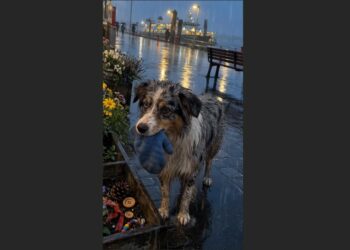
She has a broad head, a heavy chest, and the kind of physical presence that makes some people step aside before they know anything about her.
Then there is the scar.
It runs across one side of her face, interrupting the dark fur in a pale, uneven line.
A father walking nearby noticed her.
He pulled his young son slightly closer.
“Stay back,” he told him. “Those dogs can turn on you.”
He probably thought he was protecting his child.
What he did not know was how Sadie got that scar.
I Could Have Walked Away
For a second, I considered doing exactly that.
There was no reason to argue with a stranger in the middle of a farmers market.
People have opinions about dogs.
Sometimes those opinions come from personal experience. Sometimes they come from stories they have heard, photographs they have seen, or assumptions built around a breed’s appearance.
Sadie did not care.
She stood quietly beside me.
At eleven years old, she has little interest in proving herself to anyone.
But the boy was looking at her.
Not with the certainty his father had.
With curiosity.
So I did not pull Sadie away.
Instead, I gave her a familiar cue.
“Sit.”
Her back end lowered carefully.
The arthritis makes that movement slower now.
Then I held out my hand.
Sadie lifted one paw and placed it in my palm.
She had performed that simple behavior thousands of times.
The father went quiet.
His son kept watching.
Sadie Had Spent Six Years Working Beside My Husband
Before retirement, Sadie belonged to an urban search-and-rescue team.
My husband was her handler.
Their work was nothing like the dramatic images people often associate with powerful dogs.
Most of it involved training.
Repeated searches.
Obedience.
Agility over unstable surfaces.
Learning to work around noise, smoke, machinery, crowds, emergency personnel, unfamiliar buildings, and difficult terrain.
Search-and-rescue dogs are not useful because they are fearless superheroes.
They are useful because they are trained.
They learn to use scent, follow patterns, work independently when necessary, and communicate with their handlers when they locate something important.
That takes enormous repetition.
It also requires a dog capable of concentrating in environments that can overwhelm an ordinary pet.
Sadie did that work for six years.
Her job was not to frighten people.
Her job was to find them.
The Tornado Call Changed How Everyone Saw Her
One of the incidents my husband remembers most happened after a tornado struck an elementary school.
By the time Sadie and the team arrived, sections of the building had collapsed.
Walls were down.
Roof material had folded into classrooms.
Insulation, wood, metal, desks, wiring, and broken glass were mixed together in piles that looked impossible to search from the outside.
The first priority was safety.
Rescue workers had to evaluate unstable sections before sending people or dogs into them.
Sadie was fitted with her working equipment.
My husband gave the search cue.
Then she went in.
Dogs can reach spaces people cannot.
Their noses can also detect human scent moving through openings that may be invisible beneath debris.
Sadie worked slowly through one damaged section.
Then she stopped.
She Kept Returning to the Same Spot
At first, rescuers could not see anything unusual there.
The debris looked much like everything around it.
Sadie investigated the area again.
Then she gave the trained response indicating human scent.
My husband redirected her once to confirm.
Sadie returned to the same location.
That was enough.
Firefighters began digging.
The work had to be careful.
Collapsed structures can shift unexpectedly, and a rescue effort can become dangerous if debris is removed in the wrong order.
Sadie was moved back while crews worked.
Minutes passed.
Then more.
Eventually, rescuers heard something.
A voice.
Two children were trapped beneath the debris.
Both were alive.
Sadie had not understood that they were children or that a school had been destroyed.
She had done what training taught her to do.
Locate human scent.
Signal.
Stay focused.
That was enough to lead rescuers to them.
She Did Not “Know” She Had Saved Anyone
People sometimes asked whether Sadie understood what she had accomplished.
We never claimed that she did.
Dogs do not need a human concept of rescue work to perform it exceptionally well.
Sadie knew the search routine.
She knew my husband’s cues.
She knew that locating human scent and giving her trained indication was the task.
The rest belonged to the firefighters, paramedics, engineers, and medical teams.
Still, her role mattered.
Two children were located beneath an area that could not be visually cleared from the surface.
That is what trained search dogs can contribute.
Not magic.
Not supernatural intuition.
A highly developed sense of smell combined with conditioning, repetition, and a handler who understands the dog’s behavior.
After the search, Sadie drank water, rested, and waited for another assignment.
Dogs are wonderfully practical that way.
They do extraordinary work and then go looking for their bowl.
Years Later, the Scar Appeared
The injury that changed Sadie’s face happened during another deployment.
An apartment building had partially collapsed following a gas explosion.
The scene was chaotic.
Windows were gone.
Interior walls had shifted.
Concrete and broken furniture filled spaces that had once been hallways.
Some residents had escaped.
Others were still unaccounted for.
Sadie and my husband were assigned to search one section after structural teams determined where they could safely work.
She moved through debris under his direction.
At one point, broken glass cut the side of her face.
My husband saw the injury.
So did another team member.
The responsible choice would have been to remove her if the wound affected her ability to work safely.
For the moment, however, Sadie remained responsive, mobile, and focused.
They assessed her quickly.
Then she continued the search.
She Alerted Near a Collapsed Staircase
Sadie slowed near what remained of a stairwell.
Much of it had fallen inward.
She began investigating one particular area.
Then came the trained indication.
My husband called rescuers over.
Again, Sadie was moved away while people took over.
The digging was difficult.
Sections of timber and plaster had settled together, and crews could not simply pull material free without considering what might move above it.
Eventually, they reached a trapped resident.
An elderly woman had been buried beneath part of the staircase.
She was alive.
Paramedics took over.
Only after the search was complete did Sadie’s facial wound receive the attention it needed.
The cut healed.
The scar did not disappear.
That is the line the father saw at the farmers market.
Not damage from a dog fight.
Not evidence that Sadie had attacked something.
A piece of glass had cut her while she was searching the remains of a building for someone who could not get out alone.
She Came Home Looking Tougher Than She Felt
The scar changed how strangers reacted to her.
Before the injury, some people already hesitated around Sadie because of her size.
Afterward, they stared longer.
A broad-headed Rottweiler with a visible facial scar fit a picture people already carried in their minds.
They rarely saw what happened at home.
Sadie slept upside down.
She hated getting her nails trimmed.
She became suspicious of bananas after one rolled off the kitchen counter and startled her.
She preferred sleeping in patches of sunlight large enough for only half her body.
After difficult deployments, she often came home exhausted and slept for hours.
Her working life required physical strength.
Her home life mostly required a soft bed.
That contrast never seemed unusual to us.
Working dogs do not spend every hour acting like working dogs.
When the vest came off, Sadie was simply Sadie.
Retirement Came Gradually
Six years of search work leave wear on a dog’s body.
Training alone involves climbing, jumping, balancing, turning, crouching, and navigating irregular surfaces.
Eventually, my husband noticed small changes.
Sadie took longer to get up after resting.
Her pace slowed toward the end of exercises.
She recovered more slowly after demanding searches.
Veterinary evaluations confirmed what age was already making obvious.
Her hips needed more care.
Nobody wanted to wait until pain forced the decision.
So Sadie retired.
There was no dramatic final rescue.
No last ceremony in the middle of a disaster site.
Her working schedule simply became lighter until one day it stopped.
At first, I think the change was harder on my husband than on her.
Sadie adapted quickly.
She discovered retirement offered several advantages.
Mostly naps.
Her Life Now Is Much Smaller
These days, Sadie does not climb through collapsed buildings.
She walks around the neighborhood.
Slowly.
She spends time in the backyard.
On cold mornings, she takes several extra seconds before her hips loosen enough for an easy stride.
We have rugs on slick floors.
Her bed provides more support than the thin mats she slept on when she was younger.
Her veterinary care focuses increasingly on comfort and mobility.
Long games of fetch are over.
Short walks are enough.
If she wants to stop and smell the same shrub for a full minute, we wait.
She earned the slower pace, although Sadie herself would have no understanding of retirement as a reward.
Her needs simply changed.
So our routines changed with them.
One Working Habit Never Completely Left
There is one thing Sadie still does.
If she hears a child crying, her head often comes up.
Not every time.
And we do not pretend she believes every crying child needs rescuing.
But years of working around people in distress may have made certain sounds particularly noticeable to her.
She looks.
She listens.
Sometimes she stands.
Then, once she sees that nothing is required of her, she settles again.
My husband notices every time.
He never gives her a search command.
That part of her life is finished.
The dog who once crawled through unstable debris no longer needs to prove that she can.
Now she can hear a sound, look up, and go back to sleep in the sun.
There is something comforting about that.
The Boy at the Market Was Still Watching
Sadie’s paw remained in my hand.
The little boy took a step closer.
His father held him back slightly.
I understood why.
A child should not approach an unfamiliar dog without permission, regardless of breed.
Even a well-trained retired working dog deserves space.
So I did not tell the boy to pet her.
I simply said, “Her name is Sadie.”
The boy looked at the scar.
“What happened to her face?”
His father looked uncomfortable.
I answered the question.
“She got cut while she was helping search a collapsed building.”
The boy looked back at Sadie.
“For people?”
“Yes.”
I told him she had worked with a search-and-rescue team.
I did not give him every detail.
He was young.
He only needed the simple version.
“She used to help find people who were trapped.”
His Father Did Not Argue
I expected some defensive response.
None came.
Instead, he looked down at Sadie again.
Maybe he noticed the gray beginning around her muzzle.
Maybe he saw the way her hind legs shifted because sitting too long had become uncomfortable.
He asked how old she was.
“Eleven.”
I released Sadie from the sit.
She stood slowly.
The boy remained a respectful distance away.
That mattered to me more than turning the interaction into some staged lesson about how every dog wants to be touched.
They do not.
Sadie is gentle, but she is still entitled to choose whether she wants contact.
She smelled the air in the boy’s direction.
Then she looked at me.
I gave her another quiet cue.
She settled beside my leg.
The father finally said, “I didn’t know.”
Of course he did not.
How could he?
All he had seen was a large dog with a scar.
Breed Alone Does Not Tell You an Individual Dog’s Story
I understand caution around unfamiliar animals.
I encourage it.
Parents should teach children not to rush toward strange dogs, climb on them, hug them, or put their faces close to theirs.
That advice applies whether the dog weighs fifteen pounds or a hundred.
Where I disagreed with the father was the certainty.
“Those dogs can turn on you.”
Sadie was being reduced to a category before anyone knew anything about her behavior, training, health, history, or current temperament.
Breed can influence physical traits and some behavioral tendencies.
It cannot tell a stranger everything about one individual dog.
Sadie’s life had been shaped by genetics, professional training, repeated work, handling, environment, aging, and years spent beside the same person.
Her scar told even less.
A scar is evidence that tissue was injured.
It does not explain the event.
People supplied the frightening story themselves.
The Scar Means Something Different to Us
When I look at Sadie’s face, I remember my husband coming home after the apartment collapse.
I remember the exhaustion.
I remember hearing about the woman found beneath the staircase.
I remember the careful veterinary follow-up afterward.
My husband remembers even more.
He remembers Sadie working through noise and dust.
He remembers reading her body language.
He remembers the moment she committed to one search area and gave the indication he had learned to trust.
The scar is not beautiful because suffering is beautiful.
It is simply part of what happened.
We would rather Sadie had never been injured.
But because the mark remains, it carries a history.
Years later, that history walked beside me through a farmers market while a stranger interpreted the same line in an entirely different way.
That is how appearances work.
They reveal something.
Rarely everything.
Sadie Never Needed the Father to Change His Mind
After a few minutes, the family moved on.
The boy looked back once.
Sadie did not.
She had discovered a smell near one of the market stalls that seemed far more interesting than our conversation.
We continued walking.
Slowly.
Her gait became stiffer as the afternoon went on, so I shortened the trip.
Back at the car, she waited while I opened the rear door.
Years ago, she could jump in easily.
Now we use a ramp.
Sadie climbed it at her own pace.
Then she turned around twice and settled onto the padded surface behind the front seats.
Before I closed the door, I rubbed the side of her neck.
The scar remained visible above my hand.
For a moment, I thought about the father’s warning.
Then I thought about the children beneath the school.
The woman beneath the staircase.
The years of training nobody at the farmers market had seen.
She Spent Her Best Years Going Toward the Wreckage
That is the part I wish people understood about Sadie.
Not that she is harmless because she once worked in rescue.
Any dog deserves thoughtful handling, and age, pain, fear, or illness can alter behavior.
Sadie is still an animal, not a saint.
What matters is that the picture the father created from her appearance had almost nothing to do with the dog standing in front of him.
He saw size.
He saw a powerful breed.
He saw a scar.
I saw six years of training.
I saw my husband putting on her working gear before a deployment.
I saw a dog who learned to move through places humans considered dangerous because that was the task she had been conditioned to perform.
She searched because she was trained to search.
She found people because her nose could detect what human rescuers often could not.
She returned to my husband because he was her handler.
And after retirement, she came home and became an old dog who likes warm pavement, short walks, and afternoon naps.
Now the Hero Mostly Sleeps in the Sun
Sadie spends many afternoons near our living room window.
Sunlight moves across the floor, and she follows it as the hours pass.
Sometimes only her front paws fit in the warm patch.
She seems satisfied with that.
My husband still occasionally runs his fingers along the scar when he sits beside her.
He knows exactly where it came from.
Sadie probably experiences it differently.
It is simply part of her face.
Her hips matter more to her these days.
So does dinner.
The farmers market encounter did not become some dramatic confrontation.
The father did not apologize publicly.
The boy did not throw his arms around Sadie.
I would not have wanted that anyway.
What happened was smaller.
A man looked at a dog and made an assumption.
Then he learned one piece of her history.
That was enough to make him look again.
Sadie sat beside me through all of it.
Scarred face.
Gray muzzle.
One paw waiting in my hand.
Years earlier, she had spent her working life moving toward damaged buildings while people were trying to get out.
Now she does not need anyone to call her brave.
She just needs enough room to stretch out in the afternoon sun.
Editor’s Note: The characters in this story are fictional. Through these stories, we hope to share the intelligence, loyalty, compassion, and loving nature of dogs with people everywhere.