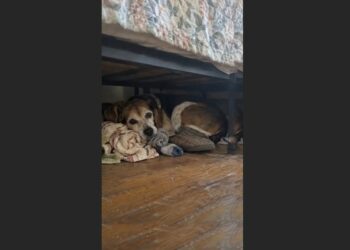
Mabel Had Stopped Coming to the Front of Her Kennel
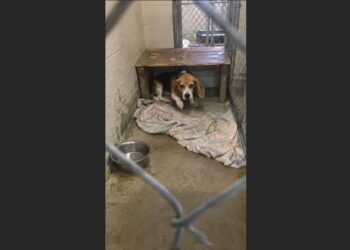
By the fifth week, Mabel no longer got up when visitors walked past.
The nearly twelve-year-old shepherd mix had arrived at a county shelter outside Dayton, Ohio, in the middle of winter. A landlord had discovered her alone inside an empty apartment after the tenant moved away.
No one came back for her.
Mabel was not in immediate medical crisis, but age had left its marks. The fur around her shoulders had thinned. One eye had become cloudy, and arthritis caused her hind legs to tremble if she stood too long.
A small growth near her ribs also needed further examination.
During her first days at the shelter, none of that stopped her from greeting people.
Whenever someone paused near her kennel, Mabel walked forward.
She pressed her nose toward the gate.
Then she waited.
Usually, someone reached through to touch her.
Almost everyone smiled.
Few stayed.
People Liked Mabel Until They Learned Her Age
Shelter visitors often came with an idea already formed in their minds.
Some wanted a puppy.
Others wanted a young dog who could hike, run, or grow up with children.
A twelve-year-old shepherd mix with arthritis and an unresolved medical issue required a different kind of commitment.
Mabel might need pain medication.
She would probably need more frequent veterinary care than a younger dog.
Slippery floors could become difficult as her mobility declined, and long walks were already beyond what she comfortably managed.
None of those realities made her less deserving of a home.
They did make adoption more complicated.
Again and again, people stopped at Mabel’s kennel.
They admired her gentle expression.
Then they read the card.
Nearly twelve.
Arthritis.
Medical follow-up needed.
Their attention shifted toward another dog.
There was rarely anything cruel in the decision.
Still, Mabel remained.
Slowly, Her Behavior Changed
Shelter staff noticed the difference before most visitors did.
At first, Mabel came to the front whenever footsteps stopped outside.
By the third week, she sometimes stayed on her bed.
Later, she stopped approaching almost entirely.
Instead, she began curling herself against the rear wall with her face toward the concrete.
Dogs cannot understand adoption boards, applications, or why strangers choose one kennel and walk past another.
Still, repeated changes in environment and routine can affect behavior.
Mabel had already lost a familiar home and person.
Now she was living among barking dogs, unfamiliar smells, metal doors, cleaning equipment, and people arriving and disappearing throughout the day.
Whatever she understood about the situation, she was becoming increasingly withdrawn.
Staff moved her bed toward the front of the kennel, hoping she might rest closer to activity.
The following morning, the bed was back in the corner.
Mabel had dragged it there herself.
One Volunteer Started Spending Lunch With Her
A volunteer began sitting beside Mabel during lunch breaks.
She did not try to make the old dog play.
Instead, she sat near the kennel and talked quietly.
Sometimes she brought treats.
If Mabel moved close enough and appeared comfortable, the volunteer rubbed behind her ears.
On good days, Mabel leaned slightly into the touch.
On others, she remained curled up.
Nobody forced her to respond.
At her age, she slept more than a younger dog would have anyway. Arthritis also made standing unnecessarily uncomfortable.
The staff tried to keep her bedding soft.
They monitored her appetite.
Medication helped with some of her joint discomfort.
Still, there was one problem no amount of kindness inside the kennel could solve.
The shelter was filling rapidly.
Then a winter storm hit.
Two Days Filled Nearly Every Kennel
Freezing weather brought a surge of emergency calls.
Animal control officers picked up stray and abandoned dogs found outside in dangerous conditions.
Within two days, nearly every available kennel was occupied.
More animals were expected.
Shelter employees began calling rescue groups.
Senior-dog organizations were high on the list.
Mabel seemed like exactly the kind of animal a specialized foster network might take.
Calls went across Ohio.
Some organizations never responded.
Others did.
They wanted to help.
They simply had no open foster homes.
That distinction did little to solve the shelter’s problem.
Mabel was old, medically uncertain, and showing poorly to adopters.
Meanwhile, space kept disappearing.
Her name was eventually placed on the shelter’s final list.
No staff member felt good about it.
But wanting more time did not create another kennel.
On Monday Evening, Her Photograph Came Down
Mabel’s picture had been displayed on the public adoption board.
For five weeks, it had shown the face of an elderly shepherd mix still needing somewhere to go.
On Monday evening, an employee removed it.
Her kennel card remained.
A small red mark was added to one corner.
The change was easy enough that most visitors would never have noticed it.
Staff did.
The next morning, one technician brought Mabel a soft breakfast.
She sat near her longer than usual.
Mabel ate roughly half.
Shortly before nine, staff moved her away from the public kennel area and into a quieter holding room near the clinic.
She followed slowly.
Her back legs shook slightly.
No one pulled her.
When they reached the room, Mabel stepped onto the blanket provided for her, circled twice, and lowered herself carefully.
Then she rested her chin between her paws.
Outside that room, the shelter day continued.
At 9:16 a.m., the front door opened.
A woman walked in holding an old photograph.
Claire Had Not Seen Mabel in More Than a Decade
Her name was Claire.
The photograph in her hand was faded around the edges.
It had been taken nearly eleven years earlier.
In it, a much younger shepherd mix stood beside a red pickup truck.
Her coat was fuller.
Her eyes were clear.
Her legs looked strong.
Across her chest was a distinctive white patch.
Claire placed the photograph on the counter.
“Does anyone recognize this dog?”
The employee looked at it.
At first, the answer appeared to be no.
The young animal in the picture looked very different from the elderly dogs currently listed by the shelter.
Mabel’s online profile had already been removed.
Her photograph was no longer on the adoption board.
For a moment, Claire seemed to have reached another dead end.
Then another staff member overheard the conversation.
She came closer.
Something about the white chest marking caught her attention.
Then she noticed writing on the back of the photograph.
One word stood out.
Mabel.
The employee stopped.
“Please wait here.”
The Photograph Had Been Sitting in a Box for Years
While she waited, Claire explained how she knew the dog.
Years earlier, she had lived in an apartment across from an older man named Frank.
Mabel belonged to him.
Frank worked nights and occasionally needed help with the dog. Claire began walking Mabel in the afternoons.
Soon, it became a routine.
According to Claire, Mabel often waited outside her door near walk time.
Sometimes she already had her leash.
Claire became more than a neighbor who helped occasionally.
She became part of the dog’s familiar schedule.
Then life changed.
Claire accepted a job in another state.
She moved away.
Phone numbers changed.
Years passed.
Eventually, she lost contact with Frank.
The photograph of Mabel remained packed away with other belongings.
Claire did not see it again until many years later.
By then, almost everything about their lives had changed.
Claire Came Back to Ohio for Her Mother
Several weeks before she entered the shelter, Claire returned to Ohio.
Her mother needed help, and Claire came back to stay nearby.
While unpacking old boxes, she found the photograph.
There was Mabel again.
Young.
Standing beside Frank’s red truck.
Claire began wondering what had happened to her.
Eleven years is a long time in a dog’s life.
Mabel had already been an adult in the photograph.
Claire knew there was a real possibility the dog was no longer alive.
Still, she searched for Frank.
What she found was difficult.
He had died the previous year.
That ended one question and created another.
What had happened to Mabel afterward?
Claire began making calls.
Most Shelters Had No Record of Her
Claire contacted one organization after another.
She described Mabel.
She gave Frank’s name when it seemed useful.
She explained the white patch on the dog’s chest.
Most places found nothing.
Some staff members checked current animals.
Others searched recent records.
No obvious match appeared.
Claire kept the old photograph nearby during the calls.
Eventually, her search brought her to the county shelter outside Dayton.
Had she arrived a day earlier, she might have seen Mabel’s photograph on the adoption board.
Had she searched the online listings earlier, she might have recognized her there.
Now both were gone.
Only an employee noticing the handwritten name on the back connected the old photograph to the dog in the holding room.
Less than a minute after the staff member disappeared through the secure doors, the shelter manager came into the lobby.
“How Certain Are You?”
The manager held the photograph carefully.
“How sure are you that this is Mabel?”
Claire turned it over.
Frank had written a short message on the back years earlier.
“Mabel and her favorite neighbor.”
Claire did not hesitate.
“I would know her anywhere.”
The manager explained that the dog they had was no longer young.
She described the arthritis.
The cloudy eye.
The growth near the ribs that still needed testing.
She made sure Claire understood that taking Mabel home would mean adopting a senior dog with uncertain medical needs.
Claire listened.
Then she asked the only question she cared about at that moment.
“Where is she?”
A few minutes later, they walked toward the clinic area.
Mabel Did Not Stand When They Entered
The holding room was quiet.
Mabel remained on the blanket.
She heard the door open but did not get up.
Claire stopped several feet away.
The dog in front of her barely resembled the strong young shepherd in the photograph.
Time had changed Mabel.
Her muzzle was gray.
Her body was thinner.
One eye had clouded.
Her hindquarters looked weak even while she was lying down.
Claire did not rush across the room.
She lowered herself instead.
For several seconds, she simply looked at the dog she had not seen in more than a decade.
Then she used a name that did not appear on the kennel card.
A private nickname from years earlier.
“Maybe-Mae.”
Mabel’s ears lifted.
Claire Said the Nickname Again
“Maybe-Mae.”
This time, Mabel raised her head.
She looked directly toward Claire.
Nobody in the room spoke.
It would be easy to say Mabel instantly remembered everything.
No one could know that with certainty.
Dogs can retain long-term associations with people, voices, scents, places, and routines. A familiar nickname may also carry auditory patterns associated with past experiences.
Whatever Mabel recognized first, her behavior changed.
She tried to stand.
Her hind legs slipped.
Claire started to move but stopped herself from rushing in.
Mabel adjusted her feet and tried again.
This time, she got upright.
Then the old shepherd began walking across the room.
Slowly.
Her legs remained unsteady.
But she kept coming.
Mabel Reached Claire and Began Smelling Her Coat
Claire stayed on her knees.
Mabel stopped directly in front of her.
Her nose pressed against Claire’s jacket.
She inhaled repeatedly.
Scent is enormously important to dogs, and familiar human odor can remain meaningful even after long separation.
Still, eleven years is an extraordinary length of time.
Nobody in the room tried to declare exactly what Mabel remembered.
They did not need to.
The old dog’s behavior was enough.
Her tail moved.
At first, slowly.
Then with more energy.
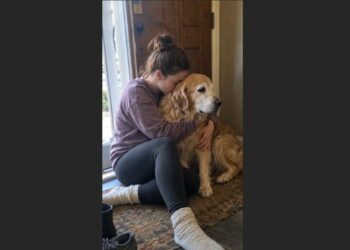
Claire lowered her arms around her.
Mabel leaned forward.
Then more of her weight settled against Claire’s chest.
For a dog whose rear legs already struggled to support her, it was almost as though Claire became something she could rest against.
The shelter manager later said she had not seen Mabel that animated since her arrival.
The Photograph Fell to the Floor
Claire barely noticed.
She had dropped it when Mabel reached her.
The younger dog beside the red truck now lay face-up on the floor several feet away.
Beside it stood the same dog eleven years later.
Older.
Slower.
Gray around the face.
Yet still carrying the same white patch across her chest.
Claire ran one hand gently over Mabel’s shoulders.
The dog remained close.
Nobody needed to turn the reunion into proof that Mabel had consciously spent five weeks waiting for Claire.
She had no way to know Claire had returned to Ohio.
Claire herself had not known Mabel was alive until she began searching.
Their paths had simply crossed again at a moment when the old dog’s future had become uncertain.
Sometimes coincidence is meaningful enough without calling it fate.
Claire Did Not Take Her Home on Emotion Alone
The reunion was powerful.
The adoption decision still required practical discussion.
Mabel was nearly twelve.
Her arthritis would need ongoing management.
The cloudy eye required monitoring.
The growth near her ribs had not yet been fully evaluated.
There could be future veterinary expenses.
Long walks were no longer appropriate.
At home, slippery floors might need rugs or runners for traction.
Mabel would need a soft bed and enough rest.
Claire asked questions.
She reviewed the veterinary notes.
Then she made her decision.
She was taking Mabel home.
The shelter completed the paperwork that morning.
Staff packed Mabel’s medication.
Her blanket came too.
So did the folder containing her records.
Before leaving, Claire picked the old photograph up from the floor.
This time, Mabel walked out with her.
The First Days Were Kept Quiet
Claire did not bring Mabel home and immediately fill the apartment with visitors.
A senior dog moving from a shelter into another unfamiliar environment needs time to adjust, even when someone familiar is present.
Mabel explored slowly.
Claire placed rugs where the flooring was slick.
Her bed went somewhere warm and easy to reach.
Food and water stayed in predictable locations.
Walks were short.
Some outings were little more than a trip outside followed by a few minutes of sniffing.
That was enough.
Mabel’s body no longer needed mileage.
It needed comfort.
The growth near her ribs was also examined as planned.
Fortunately, it proved benign.
That did not make Mabel young again.
She still needed arthritis medication.
Her cloudy vision remained.
Her rear legs still tired.
Claire adjusted to the dog she had now rather than expecting the young Mabel from the photograph to return.
One Old Routine Came Back
Then Claire noticed something familiar.
In the afternoon, Mabel began settling near the apartment door.
At first, Claire thought nothing of it.
Dogs often learn household schedules quickly.
Then one day she found Mabel resting there with her leash between her paws.
Claire stopped.
More than a decade earlier, when she lived across from Frank, Mabel had waited for afternoon walks in much the same way.
There was no need to say she had been consciously preserving that memory for eleven years.
Dogs learn routines.
Certain contexts can revive familiar behaviors.
Whatever the explanation, Claire recognized the scene immediately.
Only now the young shepherd from the old photograph was an elderly dog who could not walk nearly as far.
Claire picked up the leash.
Mabel stood carefully.
They went outside.
Not for long.
Long enough.
Mabel Had Not Been Waiting for a Miracle
For five weeks at the shelter, staff watched an elderly dog become quieter.
They did what they could.
They gave her food, medication, bedding, and attention.
One volunteer sat beside her.
Rescues were contacted.
Adopters were given opportunities to meet her.
Still, age worked against Mabel.
By Monday evening, her photograph had left the adoption board.
By Tuesday morning, she had been moved away from public view.
Then, at 9:16, a woman arrived carrying a photograph taken when Mabel’s face was still young.
The timing was extraordinary.
Yet the parts that followed were practical.
Claire signed forms.
She accepted responsibility for senior care.
She scheduled medical follow-up.
She changed her home to make it easier for arthritic legs.
Love did not remove Mabel’s age.
It gave her somewhere comfortable to be old.
The Photograph Now Means Something Different
Claire still has the picture.
In it, Mabel stands beside Frank’s red pickup with the posture of a much younger dog.
Her eyes are clear.
Her body is strong.
Time has changed nearly everything visible in that image.
Frank is gone.
The truck belongs to another period of life.
Claire has moved away and come back.
Mabel has aged into a dog who needs help on difficult days.
Still, the white patch across her chest remains.
So does the afternoon routine.
Some days, Mabel sleeps instead.
That is allowed too.
She no longer has to perform enthusiasm for strangers passing a kennel.
She does not need to stand at a gate hoping someone will stop.
Her walks can be short.
Her bed can stay exactly where she wants it.
And when the afternoon comes and she feels like going out, she waits near Claire’s door.
Sometimes the leash is between her paws.
Just as it was years ago.
Claire picks it up.
The door opens.
And Mabel follows the neighbor she once knew into another ordinary afternoon.
Editor’s Note: The characters in this story are fictional. Through these stories, we hope to share the intelligence, loyalty, compassion, and loving nature of dogs with people everywhere.