Animal Control Officer Claire Bennett expected a quiet Wednesday afternoon.
Most of her shift in the small town outside Boise, Idaho, had been exactly that.
She had checked on a dog left alone in a yard.
She helped remove a raccoon from a garage after it found its way inside and refused to leave.
Then came a complaint about a loose chicken that had wandered farther from home than its owner realized.
None of the calls was especially urgent.
By midafternoon, Claire was beginning to think she might finish her shift without anything more complicated than paperwork.
Then dispatch called.
A stray dog had been reported near the town’s baseball fields.
Claire picked up a leash and drove over.
What she found beneath the bleachers did not look much like a dog who had been living on his own for very long.
He Was Sitting Beneath the Bleachers
A youth baseball game had recently ended.
Parents were folding chairs.
Children carried gloves and water bottles toward the parking lot.
Someone was loading a cooler into the back of an SUV.
Beneath one section of aluminum bleachers sat a fluffy golden retriever mix.
Claire stopped several yards away and watched him.
The dog looked clean.
His coat was in good condition.
He was neither especially thin nor visibly injured.
Most importantly, he did not appear panicked.
He simply sat facing the parking lot.
Every so often, his eyes followed a car.
Claire had picked up enough stray dogs to recognize the difference between an animal accustomed to surviving outside and one who looked as though he had misplaced his family.
This dog looked misplaced.
Claire Approached Slowly
She carried a slip leash but kept it low at her side.
There was no reason to rush.
The retriever saw her.
He stood.
Then he stretched his front legs as though waking from a nap.
Claire stopped and let him make the next decision.
The dog started walking toward her.
His tail moved slowly from side to side.
“Hi, sweetheart,” Claire said.
He came close enough to sniff her clothing.
No collar tag hung from his neck.
There was no obvious identification.
Claire expected to slip the leash over his head and walk him toward the truck.
Instead, the dog noticed the open passenger door.
The next part happened before Claire could stop him.
He jumped inside.
“Oh, That’s Where You’re Going?”
Claire stared into the truck.
The retriever turned in a circle on the passenger seat and settled against it.
Then he looked through the windshield.
Claire laughed.
“Oh, that’s where you’re going?”
A few parents who had stayed nearby started laughing too.
One man called across the parking lot that Claire appeared to have found herself a new partner.
Claire reached into the truck for a treat.
The dog happily accepted it.
Then she tried encouraging him back onto the ground so she could secure him properly.
He stepped down.
A few seconds later, he climbed right back into the passenger seat.
This time he leaned away slightly when Claire approached the open door.
He was not growling or showing his teeth.
He simply seemed very clear about where he preferred to be.
Claire decided not to argue.
Some Dogs Make Intake Difficult
Stray-dog pickups can involve long waits.
Frightened animals sometimes retreat beneath cars, into drainage pipes or behind fences.
Others run as soon as an officer comes within leash range.
A dog that has been loose for hours may be overstimulated by traffic, unfamiliar people and repeated attempts to catch him.
Claire had spent plenty of afternoons sitting on pavement with treats, trying not to make eye contact with a nervous dog.
This retriever presented the opposite problem.
He had apparently decided Claire’s truck was transportation.
As far as he was concerned, the matter was settled.
Claire secured him safely before pulling away.
The dog sat upright on the passenger side.
As they drove, he watched traffic pass through the window.
Every few minutes, Claire glanced over.
He seemed entirely comfortable.
That made her even more convinced that someone was probably looking for him.
The Staff Named Him Captain
The animal services center was quieter than the baseball field.
As soon as the retriever walked inside, he began greeting people.
A staff member scratched behind his ears.
He leaned his full weight against her leg.
Another employee knelt.
The dog rolled partly onto his side, making his preferences obvious.
“Belly rubs already?” she said.
His tail struck the floor.
Within minutes, everyone in the building liked him.
Because he had claimed the front seat of Claire’s truck with such confidence, someone started calling him Captain.
The nickname stuck for the afternoon.
But Claire knew something the others knew too.
Dogs this relaxed around people usually have experience living with them.
Captain probably had another name.
More importantly, he probably had a home.
The First Step Was a Microchip Scan
Staff passed a scanner over the dog carefully.
Nothing.
They tried again.
No registered microchip appeared.
That was disappointing, but not unusual.
Some pets are never chipped.
Others have chips that migrate slightly under the skin and require a thorough scan.
And sometimes a chip exists but the owner’s contact information is out of date.
In Captain’s case, repeated scanning did not produce an identification number.
His collar offered no help either.
No tag.
No phone number.
Claire checked the day’s lost-pet reports.
Nothing matched.
Staff searched local postings they normally monitored.
Still nothing.
For the first time, Claire began wondering whether Captain might need a kennel for the night.
Somewhere Eight Miles Away, a Family Was Searching
Claire did not know it yet, but the dog’s day had started in a backyard about eight miles away.
His real name was Murphy.
That morning, 11-year-old Lily had gone outside before school.
Murphy followed, as he often did.
When Lily returned to the house, she forgot to latch the backyard gate completely.
Nobody noticed right away.
By the time the family realized Murphy was gone, the gate was open.
And so was the yard.
They checked the nearby streets first.
Lily called his name.
Her mother drove through the neighborhood.
Friends helped look.
They checked familiar walking routes and places Murphy liked to sniff.
Nothing.
Lily Thought It Was Her Fault
At eleven, Lily understood enough to know she had left the gate unlatched.
That knowledge stayed with her all day.
Adults told her accidents happen.
That did not make her feel much better.
Murphy had never disappeared before.
He slept beside Lily’s bed every night.
He followed her around the house.
If she sat on the floor, Murphy usually found a way to place part of his body against her.
Now she had no idea where he was.
Every passing hour gave her more time to imagine possibilities.
A road.
A stranger.
A dog who could not find his way back.
The family expanded the search.
They posted Murphy’s photograph online.
They called friends.
Eventually, they began contacting local animal services and shelters.
The Phone Rang Late That Afternoon
Claire was completing paperwork when someone answered the shelter phone.
A family was looking for a missing golden retriever mix.
Claire immediately began asking questions.
Male or female?
Male.
Approximate size?
The answer matched.
Coat?
Also consistent.
Then Claire thought about something she had noticed while looking at Captain’s face.
“Does he have a golden patch above his left eye?”
There was silence on the other end.
Then Lily’s mother started crying.
“Yes.”
Claire looked toward the dog.
Captain was lying calmly nearby.
Only he wasn’t Captain anymore.
“That sounds like him,” Claire said.
Murphy Had Traveled Farther Than Anyone Expected
Eight miles was enough distance that the family had not immediately thought to search near the baseball fields.
Nobody could know Murphy’s exact route.
Perhaps he followed interesting smells.
Maybe he walked with people for part of the way.
Perhaps the activity at the fields attracted him.
Whatever path he took, he eventually ended up beneath the bleachers.
Then Claire arrived.
The family was told where to come.
They left immediately.
At the shelter, Murphy had no idea that anything had changed.
He greeted another staff member.
He accepted water.
Then he waited.
Less than an hour later, a familiar voice reached him from the lobby.
Murphy Heard Lily Before He Saw Her
Murphy’s head came up.
His body changed instantly.
He stood.
Then Lily called his name.
“Murphy!”
The dog surged forward.
Staff opened the interior door when it was safe to do so.
Murphy raced toward the lobby.
Lily dropped to her knees.
He reached her with enough enthusiasm that she nearly lost her balance.
His tail moved so hard that his entire back end followed it.
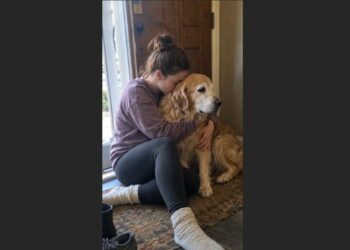
Lily wrapped both arms around his neck.
Then she buried her face in his fur.
Murphy pressed against her.
For the first time that day, Lily stopped imagining where he might be.
He was there.
Claire Let the Reunion Belong to Them
Animal control officers see many kinds of reunions.
Some are loud.
Some involve tears.
Some owners become so relieved that they start apologizing to everyone in the room.
Claire stayed slightly back.
Murphy had been safe all afternoon.
That was the important part.
Lily’s mother thanked the staff repeatedly.
Then Lily looked toward Claire.
“I thought I wasn’t going to see him again.”
Claire understood why the day had felt so enormous to her.
For an adult, several hours searching for a missing pet can feel frightening.
For an 11-year-old who believed she caused the escape, it could feel endless.
“He had a pretty good afternoon,” Claire told her.
She explained how Murphy had climbed directly into the passenger seat.
Lily laughed through her tears.
“That sounds like him.”
He Had Never Been Away From Home Before
Lily explained that Murphy normally slept beside her bed.
Every night.
Sometimes he started on the floor and later moved closer.
Other nights, she woke with his head resting partly against the side of the mattress.
He had never disappeared before.
The family had never needed to search for him.
The experience had changed a few household rules already.
The backyard gate would be checked carefully from now on.
The family also planned to talk with their veterinarian about microchipping him.
A tag could be replaced easily.
A registered chip would provide another layer of identification if Murphy ever slipped away again.
Nobody needed to lecture Lily.
She had already spent the entire day understanding the consequences of one forgotten latch.
Then Claire Learned Murphy Had Another Side
While they talked, Lily’s mother mentioned something that caught Claire’s attention.
The family had been looking into therapy-dog training for Murphy.
He had always been unusually gentle around people.
Children could sit beside him without making him restless.
He enjoyed calm attention from older adults.
Most of all, he loved visiting Lily’s grandfather.
Her grandfather lived in a nearby senior care home.
Whenever Murphy was allowed to visit, he moved slowly between residents and seemed happy to settle beside anyone willing to pet him.
The family wondered whether, with appropriate training and evaluation, he might eventually participate in organized therapy visits.
Claire looked at the dog who had spent his afternoon collecting belly rubs from every available employee.
She could see why they were considering it.
Being Friendly Was Only the Beginning
A dog who enjoys people is not automatically ready for therapy work.
Murphy would need more than a sweet temperament.
Therapy dogs must be able to remain calm around unfamiliar people, mobility equipment, sudden noises and unpredictable movement.
They need reliable manners.
They cannot jump on residents.
They have to tolerate handling appropriately.
Depending on the organization, the dog and handler may need specific training, health documentation and an evaluation before participating in visits.
Claire knew all of that.
So did Murphy’s family.
They were not assuming that because he liked Lily’s grandfather, he was ready to walk into a care facility and work.
They were planning to train.
That made Claire smile.
The dog who had appointed himself passenger in an animal control truck might soon have a more structured job.
Murphy Went Home That Evening
Before the family left, paperwork was completed.
Murphy’s leash was clipped on.
Lily kept one hand near his neck.
The dog showed no sign that he understood the significance of the day.
He did not know he had been considered a stray.
He did not know Claire had checked microchips or searched lost-pet reports.
He did not know Lily had spent hours frightened that he was gone forever.
He only knew that his people had appeared.
When the family walked toward the exit, Murphy followed them without hesitation.
Claire watched him go.
The passenger seat of her truck would be empty on the drive home.
That was exactly how she wanted it.
A Few Weeks Later, Claire Received a Photograph
Most stray-dog stories ended when the owner drove away.
Claire rarely heard anything afterward.
Murphy was different.
Several weeks later, an image arrived from his family.
Murphy was attending his first therapy-dog training class.
In the photograph, he sat beside Lily.
His attention was focused.
There was no passenger seat.
No baseball field.
No bleachers.
Just a dog learning.
Claire saved the picture.
The shelter staff who remembered “Captain” asked how he was doing.
“So far, so good,” Claire told them.
Training had begun.
That was all anyone needed to say at that stage.
Progress Took Months
The next update did not arrive immediately.
Murphy had work to do.
Friendly dogs still need practice.
The skills required for calm visits had to become reliable rather than occasional.
Murphy learned to settle around distractions.
He practiced greeting people without overwhelming them.
He became more accustomed to equipment and unfamiliar environments.
His family worked with him consistently.
Lily took the process seriously too.
She had learned something from the day Murphy disappeared.
Caring for a dog was not only about loving him.
It was also about responsibility.
Gates.
Leashes.
Identification.
Training.
Routine.
The details mattered because Murphy depended on people to manage the parts of the world he could not manage himself.
Another Update Arrived Months Later
This time, the news was different.
Murphy had completed the program his family had chosen.
He was beginning regular therapy visits at the senior care home.
Lily’s grandfather was still one of his favorite people there.
But now Murphy was also spending calm, structured time with other residents.
Some wanted to pet him.
Others simply enjoyed having him sit nearby.
That kind of work did not require Murphy to understand illness, loneliness or aging.
He did not need to know why a particular resident smiled when he entered the room.
His role was much simpler.
Be calm.
Be comfortable.
Allow appropriate interaction.
Stay close to his handler.
For many residents, that was enough.
Claire Thought About the Baseball Field
When the update arrived, Claire remembered the first moment she saw Murphy.
A fluffy dog beneath the bleachers.
Clean.
Well fed.
Watching the parking lot.
At the time, she had no way to know anything about him.
Not his name.
Not Lily.
Not the backyard gate.
Not the grandfather in the care home.
Not the therapy classes that would come later.
He was simply a loose dog with no identification.
That was part of what animal control work was like.
An officer often met an animal in the middle of the story.
The beginning was elsewhere.
The ending might be too.
Claire Printed One Photograph
The picture she chose for her desk was not from Murphy’s therapy visits.
It was from the day they met.
Someone had taken it while Murphy sat in Claire’s truck.
He was upright in the passenger seat, looking through the windshield as if the vehicle belonged to him.
His expression was calm.
Confident.
Completely unconcerned with the fact that he had just been classified as a stray.
Claire pinned the photograph above her desk.
People noticed it.
“Who’s that?”
Claire always gave roughly the same answer.
“That was Captain.”
Then she corrected herself.
“Actually, his name is Murphy.”
The Story Usually Made People Laugh
Claire told them how he climbed into the truck before she had finished trying to catch him.
How he refused to remain outside after discovering the front seat.
How shelter staff immediately decided he was some kind of supervisor.
Then she told them about the phone call.
The golden patch above his eye.
Lily’s voice from the lobby.
Murphy springing to his feet.
By the time Claire reached the part about the therapy-dog training, most people had stopped laughing and started smiling.
It was an easy story to remember.
Still, Claire never forgot how differently it could have ended.
Identification Could Have Made the Reunion Faster
Murphy had been fortunate.
He remained uninjured.
Someone reported him.
Claire found him before he wandered farther away.
His family called the right place.
And one distinctive patch of fur confirmed what everyone hoped.
A microchip or updated identification tag could have shortened the process considerably.
For Claire, that became part of the story too.
Even friendly, well-loved dogs can slip through an open gate.
Dogs do not need to be neglected to become lost.
One small mistake can be enough.
What happens afterward often depends on preparation.
Murphy’s family understood that better now.
Lily Stopped Blaming Herself
For a while after Murphy came home, Lily still talked about the gate.
Her mother kept reminding her that she had made a mistake, not a deliberate choice.
The distinction mattered.
Responsibility did not require an 11-year-old to punish herself indefinitely.
Instead, Lily turned the experience into new habits.
She checked the latch.
Then checked it again.
She became more involved in Murphy’s training.
When therapy-dog classes began, she paid attention to what the instructor asked.
The day Murphy disappeared remained part of their family story.
But it stopped being only the day Lily forgot the gate.
It also became the day Murphy climbed into Claire Bennett’s truck as if he had scheduled the ride himself.
Murphy Never Knew How Many People Had Worried
Dogs experience separation differently from people.
There was no way to know what Murphy thought during the hours he was away.
Perhaps he attempted to find home.
Perhaps the baseball fields simply became an interesting place to stop.
What was observable was simpler.
He was comfortable with Claire.
He readily accepted attention at the shelter.
And when he heard Lily’s voice, he responded immediately.
The family did not need a more elaborate explanation.
Murphy recognized someone deeply familiar.
Then he rushed toward her.
That was enough.
Claire Still Had Routine Wednesdays
There were plenty of ordinary shifts after that.
Loose dogs.
Wildlife in garages.
Noise complaints.
Animals where they were not supposed to be.
Most did not become stories Claire told for years.
Murphy did.
Not because the rescue itself was difficult.
It may have been one of the easiest stray pickups of Claire’s career.
She barely had time to use the leash before the dog selected his own seat.
What stayed with her was everything hidden behind that simple moment.
A family eight miles away searching desperately.
An 11-year-old girl blaming herself.
A dog who already had a life nobody at the baseball field knew about.
And, months later, a new routine in a senior care home.
Sometimes the Stray Already Has Somewhere to Belong
The photograph above Claire’s desk remained there.
Murphy in the passenger seat.
Golden fur against the dark upholstery.
Head up.
Eyes forward.
Looking for all the world like an animal control officer reporting for his first shift.
Every so often, someone new asked about him.
Claire would tell the story again.
She would describe the baseball field and the open truck door.
She would imitate her own surprised reaction when Murphy climbed inside.
Then she would talk about Lily.
The phone call.
The reunion.
And the later photographs from training.
There was no dramatic rescue.
No badly injured dog.
No long recovery.
Just a gate left open, a dog who wandered farther than anyone expected, and an animal control officer who happened to find him sitting beneath the bleachers.
Murphy had climbed into Claire’s truck before she could even reach for her leash.
But the place he belonged was never the passenger seat.
It was beside the little girl who had spent the entire day waiting for him to come home.
Editor’s Note: The characters in this story are fictional. Through these stories, we hope to share the intelligence, loyalty, compassion, and loving nature of dogs with people everywhere.