The shelter staff expected Mabel to leave quickly.
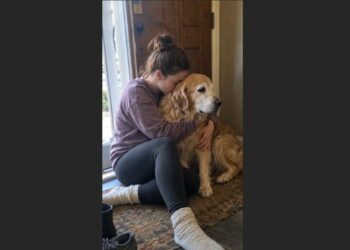
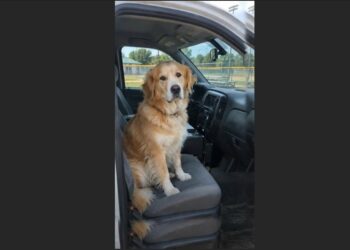
She was a senior golden retriever with a soft face, gray around her muzzle, and the kind of gentle manners that made people stop in the hallway even when they had come to meet another dog.
If someone knelt beside her, Mabel leaned carefully against them.
If a volunteer scratched behind her ears, she closed her eyes.
She walked well on leash.
She did not bark for attention.
For an older dog in a busy shelter, she seemed unusually easy to be around.
Everyone assumed someone would fall in love with her within days.
Then they noticed something strange.
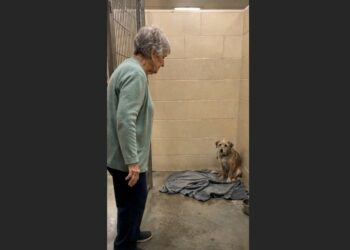
Whenever Mabel was led toward the front of the building, she stopped at the same kennel.
Inside was a tiny terrier puppy named Pip.
And no matter how gently the leash was encouraged forward, Mabel always wanted to go back.
Mabel Had Arrived Alone
Nobody at the shelter knew much about Mabel’s earlier life.
She arrived as an older dog with a worn collar, a whitening face, and the slower movement expected from a golden retriever well past puppyhood.
The veterinary team checked her over.
She was not seriously ill.
Her joints were a little stiff.
Her teeth showed age.
She moved more carefully than a younger dog, but she still enjoyed short walks and attention.
Most of all, she seemed comfortable around people.
That helped.
Senior dogs can be overlooked for many reasons.
Some adopters worry about medical bills.
Others want a dog they expect to have for many years.
Families with young children may prefer a younger, more energetic dog.
Mabel, however, had the kind of calm presence that made staff hopeful.
She did not need to prove herself.
She simply stood beside people and let them discover her.
Pip Arrived a Few Days Later
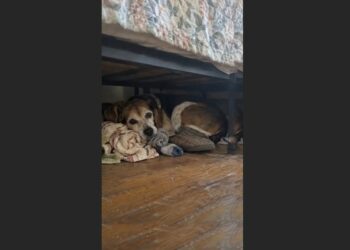
The terrier puppy came in frightened.
He was small enough that the shelter bed nearly swallowed him.
His coat was thin in places, and his body looked underweight.
Unlike Mabel, Pip wanted nothing to do with strangers.
He stayed at the back of his kennel.
When people passed, he watched.
If someone reached toward him too quickly, he moved farther away.
He did not growl.
He did not snap.
He simply made himself small.
The staff began working with him gently.
Meals arrived on schedule.
Volunteers sat outside the kennel instead of entering immediately.
Treats were placed within reach.
Nobody forced him forward.
The goal was not to make him friendly as quickly as possible.
It was to help him feel safe enough to become curious.
Mabel Noticed Him Before Anyone Noticed Her Interest
At first, it seemed accidental.
One afternoon, a volunteer returned from walking Mabel and paused near Pip’s kennel.
Mabel slowed.
Then stopped.
She turned her head toward the small dog behind the bars.
Pip remained in the back.
The volunteer waited.
Mabel stood quietly.
Nothing happened.
Then Pip took a few steps forward.
Mabel lowered her nose toward the gate.
The puppy froze.
Mabel did not push closer.
She simply stayed.
After a minute, Pip moved again.
By the time the volunteer finally led Mabel back to her own kennel, Pip was standing several feet closer to the front than usual.
Nobody thought much of it.
Then Mabel did the same thing the next day.
She Began Lying Outside His Door
The pattern became hard to miss.
If Mabel passed Pip’s kennel, she slowed.
If the hallway was quiet, she sometimes lay down outside his door.
She did not paw at the bars.
She did not whine.
She simply rested there.
At first, Pip stayed back.
Then he began approaching.
Sometimes he came close enough to smell through the gate.
Mabel would press her nose gently toward the bars.
The puppy might remain there for a few seconds before retreating.
On other days, he stayed near the front longer.
Staff started seeing Pip settle more quickly when Mabel was nearby.
Once, after pacing around his kennel, he curled into his bed while Mabel lay outside.
She stayed until he fell asleep.
Nobody Claimed Mabel Had “Adopted” Him
It would have been easy to turn the behavior into a human story.
The old dog had chosen the puppy.
She had become his mother.
She knew he needed her.
The staff avoided saying any of that with certainty.
Dogs can form attachments to other dogs.
They can seek proximity.
They can respond to familiar body language and scent.
A calm dog can also make another dog feel less threatened in a new environment.
But nobody could know exactly what Mabel understood about Pip.
What they could observe was simpler.
She repeatedly chose to stay near him.
Pip repeatedly became calmer when she did.
That was enough.
Walks Started Ending at Pip’s Kennel
Volunteers experimented with taking Mabel out at different times.
Morning.
Midday.
Late afternoon.
The result barely changed.
On the way back, she looked toward Pip.
If they passed another route, she sometimes tried to turn.
The staff began joking that Mabel had developed her own schedule.
Walk.
Water.
Then Pip.
The humor faded when they realized how consistent she was.
Mabel could be led away.
She was not difficult.
She did not pull hard or become distressed.
But if given the choice, she returned to the small terrier.
And Pip seemed to be waiting for her.
Pip Started Coming Forward Faster
The puppy’s progress remained gradual.
Mabel did not transform him overnight.
He was still cautious with strangers.
He still backed away from sudden movement.
He still needed time.
But the staff noticed small changes.
Pip began spending less time pressed into the far corner.
He ate more comfortably when the hallway was active.
He approached the gate more often.
When Mabel appeared, he sometimes hurried forward before she even lay down.
That became one of the few moments when Pip moved without hesitation.
His body stayed low.
His tail did not always wag.
Still, he came.
The shelter staff began allowing the two dogs carefully supervised time in the same space.
Their First Meeting Without Bars Was Quiet
Nobody wanted to rush it.
Mabel was older.
Pip was nervous.
So their first direct meeting took place in a controlled room with staff nearby.
Mabel entered first.
She sniffed.
Then settled.
Pip came in on a loose leash.
He stopped when he saw her.
Mabel looked toward him but did not approach immediately.
That seemed to help.
Pip moved closer on his own.
He sniffed near her shoulder.
Mabel remained still.
A few seconds later, Pip stepped behind her.
Then he returned to her side.
No dramatic play followed.
No sudden burst of affection.
They simply shared the room.
For Pip, that was progress.
Mabel Seemed Easier to Read Than People
Staff could not ask Pip what frightened him.
They did not know what he had experienced before arriving.
Human movement may simply have felt unpredictable.
Mabel was different.
She moved slowly.
Her posture was relaxed.
She did not loom over him.
She did not reach.
She did not call his name repeatedly.
For a frightened puppy, another calm dog can sometimes be easier to understand than an unfamiliar person.
Pip could watch her.
Smell her.
Follow her movement.
Over time, that seemed to give him confidence.
Again, no one needed to claim Mabel was deliberately teaching him.
The effect could be observed without inventing an intention.
Mabel Was Still Waiting for a Home
Meanwhile, adopters continued coming through the shelter.
Several people asked about Mabel.
Her age concerned some.
Others liked her immediately.
One couple spent twenty minutes with her before deciding they wanted a younger dog.
A woman who lived alone considered her but worried about managing an older dog’s future medical care.
Mabel returned to her kennel each time.
She still leaned into staff members.
She still enjoyed walks.
And she still looked for Pip.
The longer she stayed, the more everyone began wondering whether the attachment would complicate her adoption.
Then a Family Came to Meet Her
They had seen Mabel’s photograph online.
The family consisted of two parents and their young daughter.
They had specifically asked about an older dog.
That caught the staff’s attention immediately.
Many visitors began by asking for puppies.
This family wanted calm.
When Mabel entered the meeting room, she approached slowly.
The little girl sat on the floor.
Nobody told her to call the dog.
She simply waited.
Mabel walked over.
Then she rested her head across the girl’s lap.
The child looked toward her parents.
No one needed to say much.
Mabel Fit What They Were Looking For
The family asked practical questions.
How much exercise did she need?
Was she comfortable with children?
How stiff were her joints?
Had she shown any problems around food?
What veterinary care should they expect as she aged?
The shelter worker answered honestly.
Mabel would need regular medical monitoring.
She might become less mobile over time.
Stairs could become difficult.
Non-slip rugs could help.
Shorter walks might suit her better than long outings.
The family listened.
They did not seem discouraged.
By the end of the visit, they wanted to apply.
That afternoon, the paperwork began.
The Staff Were Happy for Her
Everyone at the shelter knew what adoption meant for an older dog.
A quieter home.
A softer place to sleep.
Individual attention.
Less noise.
More routine.
Mabel had waited long enough.
Her belongings were gathered.
Her medical records were reviewed.
The family listened to instructions about gradually introducing her to the house and giving her time to settle.
The little girl kept asking whether Mabel could sleep in her room.
Her parents said they would see what Mabel preferred.
Then came the moment everyone had expected.
Mabel was led toward the exit.
She Stopped
They had gone only partway down the hallway when Mabel slowed.
Then she stopped completely.
Her handler gave the leash a little slack.
Mabel turned.
Instead of heading toward the front doors, she angled back toward the kennel row.
The family followed.
The shelter worker assumed she might simply be confused by the routine.
Then Mabel reached Pip’s kennel.
She stopped beside it.
Inside, the puppy came forward immediately.
Pip Made a Small Sound
The little terrier hurried to the gate.
He looked at Mabel.
Then he made a soft, brief sound.
Mabel lowered herself to the floor outside the kennel.
The family stood a few feet away.
Nobody spoke for several seconds.
Pip remained near the bars.
Mabel stayed beside him.
It was the same scene the shelter workers had watched repeatedly.
Only now Mabel was supposed to be leaving.
The little girl looked at Pip.
Then at Mabel.
Then at the shelter worker.
“Does she like him?”
The worker chose the answer carefully.
“She spends a lot of time with him.”
The Family Learned the Rest of the Story
The shelter worker explained.
Pip had arrived frightened.
Mabel had begun waiting near his kennel.
Over time, the puppy had started coming forward more often.
They had been introduced safely.
The dogs appeared comfortable together.
No one said Mabel would refuse to live without him.
That would have been too much to claim.
She might have adapted perfectly well in the new home.
Pip might also have continued improving with staff and found a different family.
But the connection between them was obvious enough to discuss.
The little girl listened.
Then she asked the question everyone had quietly been avoiding.
“Can Pip come too?”
Her Parents Did Not Say Yes Immediately
That mattered.
Taking home two dogs instead of one was not a small change.
One was a senior golden retriever who would likely need increasing care.
The other was a fearful young terrier who would require patience, training, and careful socialization.
Double adoption meant double food.
Double veterinary care.
More time.
More management.
The parents asked for a few minutes.
They talked privately.
The shelter staff gave them space.
The little girl sat near Mabel.
Pip remained behind his gate.
Eventually, the parents came back with questions.
Could the dogs live together safely?
How had their supervised interactions gone?
What would Pip need?
Could they manage introductions to the house gradually?
The conversation became practical.
That was a good sign.
The Shelter Did Not Send Them Home Immediately
The family spent more time with both dogs.
Pip was brought into a quiet meeting area.
At first, he stayed near Mabel.
The little girl did not reach for him.
She sat on the floor as she had with Mabel.
Pip watched.
Mabel settled beside her.
After a while, Pip moved closer.
He did not climb into the child’s lap.
Nobody expected him to.
But he stayed in the room.
That was enough to continue the conversation.
The shelter reviewed the family’s home setup and experience.
A second adoption application was started.
Two Dogs Changed the Plan
The family had arrived prepared for one older dog.
Now they had to reconsider everything.
Sleeping arrangements.
Feeding areas.
Training.
Transportation.
The senior dog and the puppy would have different needs.
Mabel required comfort and joint support.
Pip needed confidence-building and boundaries.
They could not simply rely on Mabel to raise him.
He would need human guidance.
The family understood.
If they adopted both, Mabel could be a familiar presence for Pip.
But she would not be responsible for his rehabilitation.
That job belonged to the people.
The Little Girl Waited Too
While her parents completed the additional discussion, the child sat quietly with Mabel.
Every so often, she looked toward Pip.
She did not repeatedly call him.
A shelter worker had explained that he was nervous around people.
So she waited.
At one point, Pip approached the edge of the meeting area.
He sniffed in her direction.
Then stepped back.
The girl smiled but did not move.
Later, she would say that Mabel had shown her what to do.
Whether that was literally true did not matter.
She had watched the older dog give Pip space.
Now she did the same.
That Evening, Both Dogs Left
By the time the final paperwork was completed, the shelter was quieter.
Mabel walked toward the exit again.
This time, Pip was coming too.
He wore a small harness.
A staff member held his leash loosely while the family prepared the car.
Pip stayed close to Mabel.
When she moved, he followed.
When she paused, he paused.
The little girl walked beside them.
At the front doors, Mabel did not turn back toward the kennel hallway.
The doors opened.
They stepped outside.
The Car Ride Was Uneventful
That was probably the best possible start.
Mabel settled.
Pip remained alert.
The girl sat nearby without crowding him.
The parents had prepared separate secure areas so neither dog would be forced into constant contact.
At home, they let Mabel enter first.
She smelled the rooms.
Her pace was slow.
Pip followed several feet behind.
Every new sound made him pause.
A refrigerator motor.
The heating system.
A door closing upstairs.
Mabel continued moving calmly.
Pip watched her.
The House Had Two Beds
The family had planned ahead once the second adoption was approved.
Mabel had a supportive bed suitable for an older dog.
Pip had his own smaller bed nearby.
The arrangement seemed sensible.
Two dogs.
Two sleeping spaces.
That first evening, Mabel lay down.
Pip stood beside his own bed.
He sniffed it.
Then looked at Mabel.
A few minutes later, he walked over and curled against the edge of hers.
The family laughed quietly.
Nobody moved him.
Pip Followed Mabel Everywhere at First
During the first days, Pip treated Mabel almost like a map.
If she walked into the kitchen, he followed.
If she went outside, he followed.
If she settled in the living room, he usually stayed nearby.
That did not mean he was instantly comfortable.
New people still made him hesitate.
Sudden movement still worried him.
But Mabel’s routine gave him something predictable.
Breakfast.
Back door.
Yard.
Rest.
Water.
Another nap.
Nothing dramatic happened.
That was exactly what Pip needed.
Mabel Needed Rest Too
The family quickly learned to protect the senior dog’s space.
Pip was young.
Mabel was not.
Sometimes he wanted to follow when she clearly wanted to sleep.
The parents gently redirected him toward a toy or his own bed.
They did not expect Mabel to tolerate endless puppy behavior because the two dogs were attached.
That helped.
Mabel could stay close to Pip without being responsible for entertaining him.
Her age and comfort still mattered.
The family added rugs to slippery areas.
They kept walks appropriate to her pace.
Pip had separate opportunities for training and activity.
The household began developing two routines that overlapped without becoming identical.
Pip Began Exploring Without Her
After a few weeks, something changed.
Pip entered a room before Mabel did.
It happened so casually that the family almost missed it.
He walked from the living room into the hallway alone.
Stopped.
Then kept going.
The next day, he investigated part of the yard while Mabel stayed on the patio.
Later, he approached the little girl without first checking where Mabel was.
Each step was small.
Together, they showed that Pip was becoming more secure in the new environment.
Mabel remained important.
But she no longer had to be beside him every second.
The Little Girl Became Part of His Routine
Trust with people developed more slowly.
The girl helped by not rushing it.
She sat near Pip.
She tossed treats rather than insisting he take them from her hand.
When he moved away, she let him.
Gradually, he began approaching on his own.
One afternoon, he climbed onto the couch beside her.
Not on her.
Beside her.
She stayed completely still.
After a few minutes, Pip rested one paw against her leg.
The girl looked toward her mother but did not speak.
She understood by then that some moments lasted longer if nobody made a fuss.
Mabel Settled Into Senior Life
Mabel seemed comfortable in the home.
Her days became predictable.
Short morning walk.
Breakfast.
Long nap.
Time in the yard.
Attention from the little girl.
Another nap.
Her gray face became a familiar presence in every room.
She still leaned gently against people when they stopped to pet her.
She still moved slowly.
Some mornings, stiffness made her take extra time getting up.
The family adjusted rather than expecting her to keep up with Pip.
That was part of adopting an older dog.
Love did not remove age.
It simply made accommodation worthwhile.
Pip Had His Own Bed
The family never removed Pip’s bed.
It stayed in its place.
He used it too.
Sometimes.
He carried toys onto it.
He stretched across it after play.
On warm afternoons, he slept there alone.
But at night, he often made another choice.
Mabel would settle into her larger bed.
Pip would circle nearby.
Then he would squeeze himself beside her.
As he grew, the arrangement became increasingly impractical.
That did not stop him.
The family considered buying an even bigger bed.
Mabel Never Needed to “Save” Pip
People who heard the story often described Mabel as rescuing the puppy.
The family preferred something more grounded.
Pip had been helped by many things.
Shelter staff who did not force him.
Consistent meals.
A safe home.
Training.
A patient family.
Time.
Mabel was one part of that environment.
An important part.
Her calm presence may have made unfamiliar situations easier to tolerate.
Pip clearly sought her company.
But he was also building confidence through repeated safe experiences with people.
That distinction mattered.
Mabel did not cure him.
She accompanied him.
Nobody Knew Why Mabel Chose His Kennel
Perhaps Pip reminded her of another dog.
Perhaps she simply liked puppies.
Perhaps his quiet body language made her comfortable.
Maybe a bond formed because they were housed near each other at the right moment.
There was no way to know.
Dogs do not explain the reasons behind their relationships.
The family stopped trying to provide one.
What mattered was observable.
Mabel looked for Pip.
Pip looked for Mabel.
When separated, they noticed.
When together, they settled.
That was enough.
The Family Had Gone to Adopt One Dog
Months later, the parents sometimes laughed about the original plan.
They had wanted a calm senior dog.
They got one.
They also got a terrier puppy who needed careful training and believed the senior dog’s bed was shared property.
Life became busier than expected.
There were more vet appointments.
More food.
More muddy paws.
More training sessions.
Also more noise.
Pip eventually discovered barking.
Mabel rarely joined him.
Usually, she only lifted her head as if deciding whether the situation deserved her involvement.
Most of the time, it did not.
The Girl Still Remembered the Shelter Hallway
The moment she remembered most was not signing the second adoption form.
It was Mabel turning away from the exit.
The old golden retriever had been only a few yards from leaving.
Then she turned down the kennel hallway.
Nobody had ordered her to.
Nobody had called Pip.
Mabel simply went back to the place she had been choosing for weeks.
There, the puppy hurried to the gate.
And Mabel lay down.
The little girl had watched them.
Then she had asked a question.
Could he come too?
That one question changed the shape of their household.
The Beds Became the Simplest Picture of Their Relationship
Pip grew.
Mabel aged.
Eventually, there was nothing tiny about him.
He had longer legs.
More confidence.
A louder bark.
His own toys.
His own routines.
And his own bed.
Still, many nights, the family found him squeezed beside Mabel.
Sometimes his head rested across her back.
Other times, only one paw touched her.
If Mabel shifted, Pip adjusted.
They no longer needed to be together constantly.
Pip had learned the house.
He trusted the family.
He explored independently.
But when it was time to settle, he often returned to the same dog he had once watched through shelter bars.
Mabel Had Never Been Refusing a Home
That was how the shelter staff eventually came to understand it.
At first, her behavior had looked almost like reluctance.
She would move toward the front.
Then stop.
Turn back.
Return to Pip.
But Mabel had not been rejecting people.
She had not been refusing adoption.
She had formed a relationship inside the shelter, and that relationship became part of her routine.
When the right family noticed it, they did not treat it as an inconvenience.
They asked whether there was room for one more.
There was.
Pip Learned to Walk Ahead
As months passed, Pip no longer followed Mabel through every doorway.
Sometimes he ran into the yard before her.
Sometimes he approached visitors first.
He became more willing to explore.
The terrified puppy from the back of the kennel was still part of his history.
It was not the only part anymore.
Mabel continued moving more slowly.
Their roles changed.
Pip sometimes reached the back door and looked behind him while Mabel made her careful way across the room.
He waited.
Then they went outside together.
The family noticed that too.
The Old Dog and the Puppy Both Got What They Needed
Mabel received a home prepared to care for an aging dog.
Soft bedding.
Short walks.
Patience on stiff mornings.
A little girl who adored her without expecting puppy energy.
Pip received structure.
Training.
Space to be cautious.
And a familiar dog who had been there during one of the most uncertain periods of his young life.
Neither adoption was simple.
Neither dog was a perfect solution for the other.
But the family made room for both.
That turned out to be enough.
Pip Still Chooses Her Bed
He has his own bed now.
A good one.
Soft.
The right size.
Placed exactly where the family thought he would want it.
He uses it during the day.
At night, though, Pip often walks across the room toward Mabel.
The senior golden retriever lifts her head.
Pip circles once.
Then he lowers himself beside her.
Sometimes there barely seems to be enough room.
They make it work.
The family does not try to separate them unless Mabel needs space.
Most nights, she simply goes back to sleep.
Months earlier, people passing through the shelter had seen a frightened puppy hidden in the back of a kennel.
Mabel had kept going back to him.
Eventually, one family noticed.
And instead of asking the old dog to leave that relationship behind, they opened the car door for both of them.
Editor’s Note: The characters in this story are fictional. Through these stories, we hope to share the intelligence, loyalty, compassion, and loving nature of dogs with people everywhere.