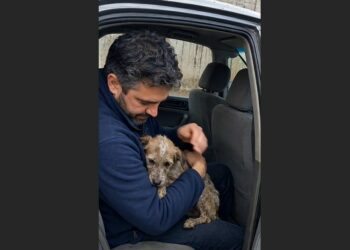
About three feet away, a five-year-old Basset Hound named Oscar was curled against the wall.
For almost a week, Oscar had been too frightened to approach Thomas.
He had been abandoned three times. The last time, someone had left him tied to a trash can in a parking lot.
We didn’t know everything that had happened before he came to us.
But we knew that men frightened him.
Whenever Thomas entered the room, Oscar usually pressed himself farther into the corner, sometimes tucking his face beneath his long, floppy ears.
So my husband had begun doing something unusual.
Every evening, he sat on the floor and read aloud.
He didn’t call Oscar over.
He didn’t reach toward him.
He simply opened a book and let the little dog become familiar with his voice.
That sixth evening, I was sitting quietly on the couch when I noticed Oscar lift his head.
He slowly unfolded his short legs and stood.
Then he began moving toward Thomas.
One cautious step.
Then another.
My husband continued reading, even as Oscar came close enough to touch him.
The little Basset Hound stopped beside his knees.
He looked up.
And then, so gently that I almost couldn’t believe it, he lowered his heavy head into my husband’s lap.
Thomas stopped reading in the middle of a sentence.
Oscar closed his eyes.
And I saw tears gathering in my husband’s eyes.
After six days of giving the dog space, Thomas had finally been the person Oscar chose to approach.
The Dog Nobody Had Managed to Keep
My husband, Thomas, and I have welcomed several rescued animals into our home over the years.
We’ve met dogs with different temperaments, backgrounds, and needs.
Some adjusted quickly.
Others required more time before they became comfortable with new people or unfamiliar surroundings.
We understood that a successful adoption doesn’t always begin with an affectionate greeting.
But Oscar was different from most of the dogs we’d cared for.
He was a five-year-old Basset Hound with long ears, short legs, and an unusually cautious manner around people.
His shelter history was difficult to read.
He had been abandoned three times.
The most recent incident involved someone leaving him tied to a trash can in a parking lot.
I found myself thinking about that detail long after we’d learned it.
A parking lot is not a safe place to leave a dog unattended, particularly one who may already be frightened.
We didn’t know how long Oscar had remained there before someone found him.
We didn’t know the circumstances of his earlier abandonments.
And we couldn’t determine what specific experiences had caused his fear of men.
But the shelter had made it clear that he needed a patient home.
Thomas and I believed we could offer that.
We just hadn’t realized how much patience the first few days would require.
The Corner He Chose on His First Day
The moment Oscar entered our house, he hurried toward the farthest corner of the living room.
He didn’t begin exploring.
He didn’t investigate the furniture or show much interest in the unfamiliar environment.
Instead, he curled himself into a tight ball against the wall.
Then he lowered his head and tucked his face beneath his long ears.
I watched him from a distance.
It was difficult to see a dog so visibly uncomfortable in a home where we wanted him to feel welcome.
But I reminded myself that Oscar had no way of knowing what kind of people we were.
He didn’t understand that we’d adopted him because we wanted to care for him.
He couldn’t know whether his surroundings would remain the same tomorrow.
All he could respond to was what he was experiencing in that moment.
I approached carefully.
Oscar watched me, but he didn’t immediately retreat farther.
Then Thomas entered.
The difference was unmistakable.
Oscar pressed himself against the wall and tucked his face down again.
My husband stopped where he was.
We looked at each other.
We knew helping Oscar settle would require a different approach from the one we’d used with some of our previous rescue dogs.
The Fear We Couldn’t Explain
Oscar’s fear of men was one of the first things we noticed.
He could tolerate my presence more readily, although he remained cautious around me too.
But when Thomas came into the living room, Oscar often became noticeably more tense.
His body drew inward.
He avoided approaching.
And if Thomas moved closer, Oscar tried to make himself smaller against the wall.
We didn’t want to guess at the exact cause.
It was tempting to imagine a specific story about what had happened before the shelter found him.
But we had no evidence for those details.
Dogs can develop fears through different experiences, and without knowing an animal’s history, it’s not always possible to identify the reason for a particular reaction.
What mattered was how Oscar behaved now.
He was uncomfortable around my husband.
And we needed to respond in a way that didn’t make his fear worse.
Thomas understood that.
He didn’t treat Oscar’s behavior as rejection.
He knew the little dog hadn’t had an opportunity to learn whether he could trust him.
So instead of repeatedly trying to approach, he decided to become a quiet, predictable presence.
His idea was simple.
He would sit nearby and read.
The First Evening With the Book
On the first evening, Thomas brought a book into the living room.
Oscar was curled in his usual corner.
My husband sat down on the floor about ten feet away.
He positioned himself so he wasn’t looking directly at the dog.
Then he opened the book and began reading aloud.
His voice was calm and steady.
He didn’t speak Oscar’s name repeatedly or attempt to persuade him to move.
He simply read the words on the page.
At first, Oscar remained curled against the wall.
There was no visible response.
I watched from nearby, wondering whether the sound of Thomas’s voice would make the dog more nervous.
But Oscar didn’t retreat any farther.
After a while, I noticed one of his long ears move.
Then it lifted slightly.
He appeared to be paying attention to the sound.
Thomas continued reading.
He didn’t turn around to see whether Oscar was watching.
And when he eventually finished, he closed the book and left the dog where he’d chosen to rest.
Nothing dramatic had happened.
Oscar hadn’t crossed the room.
He hadn’t asked for affection.
But he’d spent time listening to Thomas without being required to interact.
For the first evening, that was enough.
The Second and Third Evenings
The following evening, Thomas returned to the floor with his book.
Oscar was still using the corner as his preferred resting place.
My husband sat at a comfortable distance and began reading again.
Sometimes he read for half an hour.
Sometimes he stayed longer.
There was no fixed amount of time he expected Oscar to endure.
He paid attention to whether the dog seemed comfortable with his presence.
On the third evening, the routine continued.
Thomas didn’t bring a toy to attract Oscar’s attention.
He didn’t offer treats to lure him out.
He didn’t reach toward the dog whenever an ear moved or a pair of eyes appeared beneath the floppy fur.
He simply read.
I began appreciating how much effort that kind of patience required.
Most people naturally want to comfort a frightened animal.
They want to pet him, reassure him, and see him respond.
But Oscar wasn’t ready for those interactions.
Thomas understood that a dog who was afraid of approaching hands might not find an unfamiliar touch comforting at all.
So he allowed Oscar to observe.
The reading wasn’t magic.
It was a way for my husband to spend time nearby without constantly asking the dog to make another decision.
The Changes That Were Easy to Miss
By the fourth evening, I had started paying closer attention to Oscar’s small responses.
They weren’t always easy to interpret.
Sometimes his ears moved toward Thomas’s voice.
Sometimes he watched my husband from the corner.
Other times, he seemed more interested in resting.
I didn’t want to treat every movement as proof of progress.
A dog lifting his head or changing position can mean many things.
But I noticed that Oscar was becoming more familiar with Thomas’s evening routine.
He seemed to know that my husband would come in, sit down, and begin speaking in the same calm manner.
And nothing unpleasant followed.
Thomas didn’t suddenly move closer or insist on physical contact.
He kept the experience predictable.
I was beginning to understand why that mattered.
Oscar had entered our home with very little confidence around unfamiliar people.
He needed opportunities to observe us without feeling pressured.
Each quiet evening gave him another chance to become accustomed to the man sitting nearby.
For Thomas, there was no immediate reward.
He simply kept showing up.
The Fifth Evening
By the fifth evening, something had changed.
When Thomas entered the living room, Oscar no longer seemed quite as tense.
He still remained in the corner.
He still didn’t approach.
But instead of immediately hiding his face beneath his ears, he watched.
I noticed it before Thomas sat down.
The Basset Hound had raised his head enough to follow my husband’s movements.
Thomas lowered himself onto the floor and opened his book as usual.
Oscar continued watching for a while.
Then he settled again.
It was a small difference, but one that encouraged us both.
Thomas didn’t try to use that moment to move the relationship forward more quickly.
He didn’t call Oscar closer.
He simply continued reading.
Later, when we talked about how the evening had gone, I could tell he was pleased.
He cared deeply about helping Oscar become comfortable.
And he was willing to accept whatever progress the dog could manage.
We had no way of knowing that the following evening would bring the moment we’d been hoping for.
The Sixth Night
On the sixth evening, Thomas sat down with his novel about three feet from Oscar.
That was closer than he’d been during their earliest sessions, and he had allowed the distance to decrease gradually.
Oscar was in his familiar corner.
I sat quietly on the couch, watching them.
Thomas began reading aloud.
The scene felt ordinary by then.
My husband on the floor with a book.
Oscar near the wall.
The sound of Thomas’s voice moving steadily through the room.
A few minutes passed.
Then I noticed Oscar lift his head.
He looked toward Thomas.
For a moment, he remained where he was.
Then he began unfolding his short legs.
I sat still.
Oscar stood up.
He lowered his body slightly and began moving toward my husband.
His nails made faint clicking sounds against the hardwood floor.
Thomas continued reading.
I knew he must have noticed the movement.
But he didn’t turn toward Oscar.
He allowed the little dog to decide whether he wanted to come closer.
The Walk Across the Living Room
Oscar moved slowly.
There were only a few feet between him and Thomas, but for a dog who had been so frightened of my husband’s presence, the distance was meaningful.
He took a cautious step.
Then another.
He paused occasionally.
I watched his body language, afraid that any sudden movement from either of us might cause him to retreat.
Thomas continued reading.
His voice remained steady.
Oscar moved closer.
Eventually, he stopped just inches from my husband’s knees.
He looked upward toward Thomas’s face.
For a moment, neither moved.
I could hear Thomas reading, although I was barely following the words anymore.
I was watching Oscar.
The same dog who had hidden his face beneath his ears whenever Thomas entered the room was now standing directly beside him.
There was no treat waiting.
No one had called him.
He wasn’t being pulled forward on a leash.
He had crossed the room voluntarily.
Then Oscar took one final step.
And lowered his head.
The Head in Thomas’s Lap
Oscar gently placed his heavy head in Thomas’s lap.
My husband stopped reading in the middle of a sentence.
He looked down.
The Basset Hound remained where he was, his head resting against Thomas.
Then Oscar released a long, trembling sigh.
His eyes closed.
I felt tears gathering in my own eyes.
For six days, Thomas had sat on the floor without asking Oscar to come closer.
Now the dog had made the decision himself.
My husband didn’t immediately begin petting him.
He left his hands where they were and allowed Oscar to rest.
I could see Thomas struggling with his emotions.
There were tears in his eyes.
I wanted to go over and put my arms around both of them.
But I stayed on the couch.
Neither of us wanted to interrupt.
We understood how important it was to allow Oscar to remain comfortable with the contact he’d chosen.
So we stayed quiet.
And for a while, the only thing that mattered was that the frightened little dog was resting with his head in my husband’s lap.
The First Time He Chose to Be Close
I have thought about that evening many times since.
From the outside, the scene might not have appeared extraordinary.
A dog resting his head on someone’s lap is something many families experience every day.
But for Oscar, it was a significant change.
When we brought him home, he’d been so frightened of Thomas that he pressed his body against the wall.
He’d spent his first evenings curled in the corner, avoiding contact.
Now he was willingly resting against the same person he’d previously tried to avoid.
I didn’t believe that meant every fear had disappeared.
It was only the sixth day.
Oscar still had a great deal to learn about his new surroundings and the people caring for him.
But he’d had six evenings of calm, predictable interaction.
And on the sixth, he’d chosen to approach.
Thomas hadn’t needed to reach out and pull him into an embrace.
He’d simply made himself available.
That moment changed the way both of us thought about Oscar’s adjustment.
It gave us hope without making us forget how much patience he might still need.
The Morning After
The following morning, Oscar hadn’t suddenly become a fearless dog.
Unexpected noises still startled him.
If someone unfamiliar came to the house, he needed space.
Sometimes he preferred returning to a quieter part of the room rather than joining us.
We respected that.
I didn’t want the moment in Thomas’s lap to become a standard Oscar was now expected to meet every day.
He had been comfortable approaching once.
That didn’t mean he would always be ready.
But something had shifted in their relationship.
Oscar began approaching Thomas more often.
Sometimes he followed him into the kitchen.
Other times, he settled nearby while Thomas worked or read.
He wasn’t constantly seeking attention.
He still had moments when he preferred to observe from a distance.
But he was becoming more willing to share space with my husband.
Thomas continued behaving calmly around him.
He didn’t assume that trust, once offered, could never be shaken.
He understood that Oscar would need many more ordinary experiences before his new home felt completely familiar.
A Ball Rolling Across the Floor
Over the following weeks, we began seeing more of Oscar’s personality.
One afternoon, Thomas was sitting in the living room with a ball.
He gently rolled it across the floor.
Oscar watched it pass.
For a moment, he did nothing.
Then he reached out one of his short front paws and tapped the ball.
It rolled away.
Oscar gave a short, excited bark.
Thomas laughed.
I found myself smiling.
The interaction was so simple.
A ball rolling across the floor.
A Basset Hound reaching out to touch it.
And a man enjoying the response.
But I remembered the dog who’d spent his first days curled tightly against the wall.
Now he was interested in playing.
Thomas rolled the ball again, giving Oscar an opportunity to engage if he wanted.
We didn’t need him to perform any special trick or retrieve the toy perfectly.
It was enough to see him participate.
For the first time, the living room felt less like a place Oscar was trying to avoid and more like a room where he could enjoy spending time with us.
The Little Habits We Began to Notice
As Oscar grew more comfortable, our days together became increasingly ordinary.
He enjoyed his walks.
He began asking for affection.
And he developed a habit of following Thomas from room to room.
Sometimes he’d follow him into the kitchen.
Sometimes he’d remain nearby while my husband worked.
And if Thomas settled down with a book, Oscar often seemed interested in joining him.
I noticed how different their interactions had become.
At first, Thomas had to sit a considerable distance away simply to avoid making Oscar uncomfortable.
Now Oscar sometimes approached without hesitation.
He would rest his head against my husband’s knee and remain there while Thomas read.
There was no need for a special routine to persuade him.
He simply wanted to be close.
It made me happy to see how naturally their companionship had developed.
Their relationship hadn’t been built through dramatic displays of affection.
It had developed through small, predictable experiences repeated over time.
And Oscar had gradually learned that spending time with Thomas could be comfortable.
The Bed at the Foot of Ours
Today, Oscar sleeps peacefully at the foot of our bed.
His coat is healthy and glossy, and his daily life looks very different from the frightened first days he spent in our living room.
He enjoys going for walks.
He seeks affection when he wants it.
And he frequently follows Thomas through the house.
He still has moments of anxiety.
Unexpected sounds can unsettle him, and unfamiliar visitors sometimes make him cautious.
We don’t interpret those reactions as failures.
Oscar’s experiences before coming to us were difficult, and we don’t expect every old fear to disappear simply because his current life is safer.
What matters is that he’s comfortable with our daily routine.
He knows where he likes to rest.
He recognizes our familiar movements and voices.
And he has become affectionate with the people who care for him.
At night, when we turn off the lights, I can hear him settle into a comfortable position.
Sometimes I remember the little dog who once hid his face beneath his ears.
Now he sleeps close to us.
Why Thomas Still Reads Aloud
Thomas still reads to Oscar occasionally.
He doesn’t sit on the floor ten feet away anymore.
He doesn’t need to.
Sometimes he sits on the couch with a book, and Oscar comes over to rest his head against his knee.
Thomas begins reading aloud.
Oscar settles nearby.
It’s a familiar part of their relationship now.
I don’t think Oscar understands the stories in those books.
But he recognizes Thomas’s voice and the ordinary routine they have developed together.
The same voice that once seemed unfamiliar has become part of his daily life.
I sometimes watch them and remember those first six evenings.
Thomas sitting patiently on the floor.
Oscar staying in the corner.
The little movement of an ear.
The slight change in posture when my husband entered the room on the fifth day.
Then the sixth evening, when Oscar finally got up and crossed the floor.
It still amazes me how much meaning that small walk holds for us.
Thomas wanted to help the frightened dog feel comfortable.
And Oscar, in his own time, began allowing himself to approach.
What Oscar Taught Us About Patience
Before adopting Oscar, I thought I understood the importance of being patient with rescue animals.
Thomas and I had welcomed others into our home, and we’d learned that dogs don’t all adjust at the same pace.
But Oscar taught us something more specific.
Sometimes patience means resisting the urge to help in the way that feels most natural to us.
When Oscar was frightened, we wanted to pet him.
When he hid, we wanted to coax him out.
When he avoided Thomas, we wanted to show him immediately that my husband was gentle.
But Oscar wasn’t ready for those things.
He needed the freedom to decide when an interaction felt manageable.
Thomas’s reading routine provided that opportunity.
For several evenings, my husband offered nothing more than the sound of his voice and a calm presence.
He didn’t expect Oscar to approach because he’d spent thirty minutes on the floor.
He didn’t treat the following evening as a disappointment when the dog remained in his corner.
He simply came back with his book.
Over time, Oscar began showing signs of greater comfort.
And when he finally approached, he did it on his own.
That was what made the moment so meaningful.
The Same Living Room, a Different Dog
Sometimes I look across our living room and remember exactly where Oscar used to hide.
The corner is still there.
The walls haven’t changed.
Thomas still spends time reading in the same room.
But Oscar no longer spends his days curled against that wall, trying to avoid the people around him.
He moves through the house comfortably.
He asks for attention.
He enjoys playing and resting near us.
I think about the three times he’d been abandoned before coming into our lives.
I can’t know everything he experienced or why those placements ended.
But I know that when he arrived, he was frightened enough to hide his face beneath his ears whenever Thomas approached.
That was the dog we welcomed.
And we didn’t need him to become confident overnight to deserve our care.
We wanted him to have a home where his fears would be taken seriously.
A place where he could take his time.
And someone willing to remain nearby even when he wasn’t ready to be touched.
The living room hasn’t changed much.
But the way Oscar experiences it certainly seems to have.
The Sixth Evening I Will Always Remember
Of all the memories we’ve made with Oscar, I think the sixth evening will always remain my favorite.
I can still picture Thomas sitting on the hardwood floor with his novel.
I remember Oscar curled against the wall, watching him.
Then the quiet clicking of little nails against the floor.
The slow movement of those short Basset Hound legs.
The pause beside Thomas’s knees.
And the moment Oscar finally placed his head in my husband’s lap.
Thomas stopped reading.
Oscar sighed and closed his eyes.
And both of us struggled to hold back tears.
We hadn’t expected such a small gesture to affect us so deeply.
But we knew what it meant in the context of Oscar’s first days with us.
He was no longer keeping the same distance from Thomas.
He was comfortable enough, for that moment, to rest against him.
I didn’t want to move.
Neither did my husband.
We simply let Oscar stay.
There was no need to turn the moment into anything more.
A frightened dog had chosen to come closer.
And the person he’d approached was happy to sit quietly with him.
He Doesn’t Need Six Days Anymore
These days, when Thomas sits down with a book, Oscar often comes over almost immediately.
Sometimes he rests beside the couch.
Other times, he places his head against my husband’s knee.
Thomas occasionally reads aloud, just as he did during those first six evenings.
Oscar settles comfortably.
And if he wants to move away, he does.
There are no demands attached to their time together.
I love watching them because I remember how their relationship began.
Thomas didn’t win Oscar’s trust by insisting on affection.
He didn’t make the frightened dog approach before he was ready.
He offered a calm presence, repeated it patiently, and allowed Oscar to decide what happened next.
I know we’ll continue discovering things that make Oscar uncomfortable.
There may always be unfamiliar sounds or situations that cause him to hesitate.
We’ll respond as best we can.
He doesn’t need to become fearless to have a happy life with us.
He needs a home where he’s understood.
And he has one.
Tonight, Oscar is sleeping at the foot of our bed.
His ears are resting against the blanket, and his body is relaxed.
A little while ago, Thomas was reading on the couch, and Oscar walked over to rest his head against him.
It took only a few seconds.
No six-day introduction.
No long wait.
Just a familiar dog approaching someone he knows.
I thought about the first night Thomas sat on the floor, ten feet away, and began reading aloud.
Oscar hadn’t moved from the corner.
But he had lifted one ear.
That was how their friendship began.
And sometimes, when I see Oscar sleeping comfortably beside us now, I remember that the most important thing Thomas did during those first six evenings was remarkably simple.
He stayed.
He gave Oscar room.
And when that frightened little Basset Hound was finally ready to cross the living room, my husband was still there, with a book open in his hands and a place for Oscar to rest his head.
Editor’s Note: The characters in this story are fictional. Through these stories, we hope to share the intelligence, loyalty, compassion, and loving nature of dogs with people everywhere.