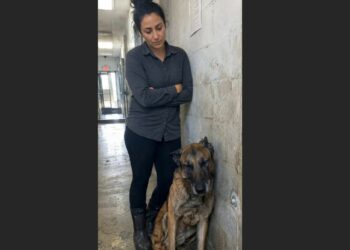
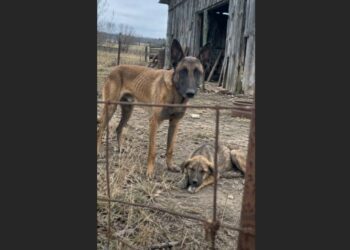
For five days, a four-year-old German Shepherd named Duke had barely eaten or drunk anything.
He spent most of his time lying beside the rear wheel of an old police patrol car, the same vehicle where he’d spent countless hours alongside Officer David Foster.
David had died unexpectedly the previous Thursday.
Since then, Duke had withdrawn from the people trying to care for him. He resisted their attempts to approach and kept returning to the car, settling against the tire as though it were the one familiar place he could still rely on.
When I arrived, he was lying on the asphalt with his ears pinned back and his eyes fixed toward the vehicle.
I had worked with police dogs for much of my career, but I’d rarely seen one so difficult to reach.
My name is William Vance. I’m 62 years old, a retired police officer who spent fourteen of his thirty years in law enforcement working with K9 units.
I knew I couldn’t explain David’s death to Duke.
I couldn’t make his handler return.
But I could offer him something he seemed badly in need of.
Time, patience, and the chance to approach another person without being forced.
So I stopped about ten feet away, lowered myself onto the pavement, and sat down.
I stayed there for four hours.
And for most of that time, Duke hardly looked at me.
The Phone Call I Couldn’t Ignore
I’d been retired for seven years when Thomas Miller called me.
Thomas was the son of a former colleague. I recognized the concern in his voice before he’d finished explaining what had happened.
“Mr. Vance,” he said, his voice shaking. “He won’t eat. He won’t leave the car. We’ve tried everything.”
He was talking about Duke, a young German Shepherd who had spent three years working alongside Officer David Foster.
I knew how demanding police K9 work could be. I also understood how closely a working dog could become attached to the person who trained, handled, and cared for him.
But what Thomas described was more than a dog becoming unsettled after a change in routine.
Duke had barely eaten or drunk anything for days.
That could become a serious medical emergency, regardless of the emotional distress that might be contributing to his behavior.
I knew he needed proper attention to his physical condition as well as a careful approach to rebuilding his confidence.
I told Thomas I would come.
I couldn’t promise that Duke would accept me.
But after fourteen years working as a K9 officer, I knew better than to assume that an animal’s reluctance could be overcome simply by giving louder commands.
Sometimes the most useful thing a handler can do is stop asking and start observing.
Three Years Beside Officer David Foster
Duke was only four years old.
For three of those years, he’d worked alongside David Foster.
They had trained together, spent long hours on duty, and responded to situations that required both concentration and trust.
A police K9 partnership develops through far more than obedience commands.
The dog learns familiar cues, recognizes the handler’s movements, and becomes accustomed to the daily routines surrounding the work.
The handler learns just as much.
You begin noticing small changes in posture, attention, and behavior. You learn when the dog is uncertain, when he is concentrating, and when he needs a moment to settle.
After enough time together, many of those interactions become almost automatic.
David had been Duke’s primary working companion for most of the dog’s young life.
The patrol car was part of that relationship.
It was where they traveled together, waited between assignments, and returned after long periods of activity.
For Duke, that vehicle held familiar smells and associations developed through countless working days.
Then David died.
The death was unexpected.
Whatever circumstances surrounded it, the result for Duke was a sudden and profound change in his everyday life.
The person who had guided his work and provided much of his familiar routine was no longer there.
And the car remained.
The German Shepherd Beside the Rear Tire
When I arrived, Thomas showed me where Duke was lying.
The patrol car was parked nearby, and the German Shepherd had settled against one of its rear wheels.
His ears were held back.
He looked tired, and his body language suggested he was uncomfortable with people approaching.
I stopped at a distance and observed him.
Duke didn’t rush toward us or respond with the usual interest I’d expect from a healthy young working dog.
He remained close to the vehicle.
Thomas explained that they’d been trying to encourage him to eat and move away from the car, but their efforts had accomplished very little.
I could understand their concern.
A German Shepherd of Duke’s age should ordinarily be active, alert, and interested in his surroundings.
Instead, he appeared exhausted and withdrawn.
I looked at the car, then at the dog lying beside it.
I couldn’t know what Duke understood about David’s absence.
Dogs recognize familiar people, routines, voices, and scents. When someone important disappears, their behavior can change considerably.
But it would have been wrong to claim Duke understood death in the same way a person does.
What I could see was that he remained attached to a place strongly associated with his missing handler.
I turned to Thomas.
“He’s lost the person he trusted most,” I told him. “We need to give him time.”
Ten Feet Away on the Asphalt
I approached Duke slowly.
When I was about ten feet away, I stopped.
He was aware of me, but he showed no interest in closing the distance.
I didn’t reach toward him.
I didn’t call his name or try to persuade him to stand.
Instead, I lowered myself onto the asphalt.
At sixty-two, sitting on pavement wasn’t particularly comfortable, but I wanted to avoid standing over a dog who already seemed uneasy.
From that position, I could remain nearby without making myself another source of pressure.
I let Duke decide whether to watch me.
He remained beside the tire.
Every so often, I looked toward him without holding his gaze.
I knew the people caring for him were worried. I was worried too, particularly about how little he’d been eating and drinking.
His condition required attention that patience alone couldn’t replace.
But forcing physical contact with a frightened or distressed dog could make the situation worse.
I wanted Duke to experience something different.
A person could come near him without immediately asking him to move, respond, or surrender the space where he felt most comfortable.
So I sat quietly.
And waited.
Four Hours Without a Command
Time passed slowly on the asphalt.
Duke remained beside the police car.
At first, he showed almost no interest in me.
He occasionally shifted his position, but he didn’t approach.
I didn’t interpret his lack of movement as stubbornness.
From everything I could see, he was struggling with an abrupt change to a life that had once been highly predictable.
I remembered the working dogs I’d known during my career.
Some had adjusted easily to new handlers or surroundings. Others needed more time, especially when their familiar routines were disrupted.
Duke’s situation was particularly difficult because he’d lost the person who had been central to so much of his life.
I couldn’t replace three years of trust in an afternoon.
Nor did I want to try.
After nearly four hours, Duke finally turned his head toward me.
He looked in my direction for a moment.
Then he settled again.
It was a small response, and I didn’t exaggerate its importance.
He hadn’t accepted my touch or decided to leave the car.
But he had acknowledged my presence without showing the same resistance that had concerned Thomas.
I considered that a useful beginning.
I left with the intention of returning.
The Second Morning Beside David’s Car
The following morning, I came back.
Duke was still spending time beside the patrol car.
I approached carefully and sat a little closer than I had the day before, keeping enough distance that he didn’t appear threatened.
This time, I spoke quietly.
I talked about David.
I remembered his familiar smile, his habits, and the way he seemed to understand what the dogs he worked with needed from him.
I wasn’t expecting Duke to understand the stories.
He might recognize David’s name or other familiar sounds, but he couldn’t follow a conversation about a person’s life in the way Thomas or I could.
Speaking helped me maintain a calm presence.
It also gave me an opportunity to remember David as someone more than the person whose absence had brought us there.
As I talked, Duke lifted one ear.
A little later, he let out a long sigh.
Then I noticed a slight movement at the tip of his tail.
It wasn’t the enthusiastic wag of a dog greeting an old friend.
But he seemed a little less guarded than he had during my first visit.
I stayed with him without asking for anything.
We were still strangers.
And I wanted to give that relationship room to develop naturally.
The Blanket From the K9 Unit
On the fourth day of my visits, I brought an old blanket from the K9 unit.
I wasn’t certain how Duke would respond to it.
Dogs can recognize familiar odors, and items associated with known environments sometimes provide useful cues.
But I knew better than to assume that one object would suddenly resolve his distress.
I brought the blanket as something familiar to offer, not as a way to force an emotional breakthrough.
By then, I had become accustomed to the routine of visiting Duke.
I would approach carefully, settle near the car, and spend time without making demands.
Some visits seemed to bring small signs of progress.
Others offered very little that I could confidently interpret.
I had to resist the temptation to measure each day as a success or failure.
Duke was a young dog, but he had experienced a major disruption.
It would take more than a few quiet visits for him to become comfortable with another person.
There were moments when I wondered whether he would ever willingly approach me.
Then I reminded myself why I had come.
I wasn’t there to prove I could train him.
I was there because he needed help finding a way back into ordinary life.
The Sixth Day He Came Toward Me
On the sixth day, Duke finally approached.
I had settled into my usual place near the patrol car.
He watched me for a while.
Then he stood.
I remained where I was, allowing him to decide how close he wanted to come.
He moved toward me slowly.
When he reached my side, he lowered his head and gently touched my hand with his nose.
I didn’t grab him or immediately try to pet him.
I let him investigate.
After a moment, he lowered himself onto the pavement beside me.
For the first time since I’d met him, Duke was choosing to rest near me rather than keeping the same distance.
I stayed still for a while.
There was something deeply moving about the simplicity of it.
The dog who had resisted nearly every attempt at contact was now comfortable enough to lie beside a person he’d known for less than a week.
I didn’t believe that meant his distress was over.
He was still adjusting, and his physical condition remained important.
But I was grateful that he’d taken a step toward trusting someone new.
I sat beside him without asking for anything else.
For that afternoon, his willingness to remain close was enough.
The Tenth Day and the Worn Rubber Ball
On the tenth day, Duke did something I hadn’t expected.
He stood up and climbed into David’s patrol car.
I watched him carefully.
The vehicle had been the center of his attention since David’s death, and I wondered what had prompted him to move inside.
A moment later, Duke came out carrying something in his mouth.
It was a worn rubber ball.
I recognized it as the kind of familiar toy or training object a working dog might carry.
For Duke, this particular ball belonged to the life he’d shared with David.
He walked toward me with it.
Then he stopped.
For a moment, I simply looked at him.
It was difficult not to think about the countless hours he must have spent in that car with his handler.
The ball had been part of those years.
Now he had brought it out and carried it toward me.
I couldn’t know precisely what he intended. Dogs retrieve and carry familiar objects for many reasons, including habit, comfort, and an interest in interacting with people.
But the behavior was meaningful because it was voluntary.
Duke had left his resting place, retrieved something familiar, and approached me.
I looked at him and spoke softly.
“Okay, buddy. Let’s go.”
The Ride to My Farmhouse
Duke followed me to my pickup.
He climbed inside.
Then he carefully placed the old rubber ball on my knee.
I looked down at it.
For a moment, I couldn’t speak.
I remembered arriving ten days earlier and seeing Duke lying beside the rear wheel of David’s patrol car, unwilling to let anyone near him.
Now he was sitting inside my truck.
The change hadn’t come from a forceful command or a single dramatic gesture.
It had come through days of patient contact and allowing him to make small decisions without pressure.
I was aware that a dog with Duke’s background needed responsible care and an appropriate transition away from his former working environment.
There were practical matters surrounding his future, and his physical well-being still had to remain a priority.
But that day, he came with me to the place I called home.
My farmhouse had been quiet for years.
I lived alone.
My wife had passed away five years earlier, and I’d gradually become accustomed to the absence of another person in the house.
I hadn’t planned to change that routine.
But as I drove home with Duke and his rubber ball, I began wondering what life might be like with a dog beside me again.
A House That Had Been Quiet for Years
After my wife died, I found myself living in a house that felt much larger than it once had.
I still had the farm, my familiar routines, and the work of maintaining the property.
There were things to do every day.
I wasn’t without purpose.
But the quiet could be difficult, particularly in the evenings.
After thirty years in law enforcement, I was accustomed to responsibility and structure. Retirement had already required an adjustment.
Losing my wife had brought another change, one I hadn’t been prepared for.
Over time, I learned how to manage the house alone.
I became used to making meals for one person, spending evenings quietly, and going about my days without much conversation.
I told myself I was comfortable with the arrangement.
In many ways, I was.
But I hadn’t realized how accustomed I’d become to keeping my life small and predictable.
When Duke came home, he brought a new presence into that quiet.
He wasn’t a substitute for my wife, just as I wasn’t a substitute for David.
We were simply two living creatures adjusting to circumstances neither of us had chosen.
And perhaps that gave us a useful starting point.
His First Nights Near the Door
Duke’s first days at the farmhouse were quiet.
He explored cautiously and remained alert to unfamiliar sounds.
He had spent three years following a working routine with David.
Now he was in a different home, with a different person, and no police assignments waiting for him.
I didn’t expect him to settle immediately.
At night, he preferred sleeping near the front door.
I let him choose that place.
There was no reason to force him into another room when he appeared more comfortable staying where he could observe the entrance.
Sometimes he carried his rubber ball from one part of the house to another.
I noticed how often he kept it nearby.
I didn’t take it away.
It was a familiar object in an unfamiliar environment, and I was content to let him have it.
I kept our daily routine predictable.
Meals, rest, gentle interaction, and opportunities for movement happened consistently.
I watched his body language and avoided overwhelming him with attention.
If he wanted space, I gave it to him.
If he approached, I welcomed him calmly.
I knew from my years working with dogs that trust isn’t built simply by spending a certain number of hours together.
It’s built through experiences that teach an animal what to expect.
And I wanted Duke to learn that my home was a place where he could feel secure.
The First Night He Slept Beside My Bed
Gradually, Duke began choosing different places to rest.
He no longer spent every night near the front door.
Sometimes he settled closer to where I was sitting.
Other times, he followed me through the house before finding somewhere comfortable to lie down.
Then one evening, he came into my bedroom and settled at the foot of the bed.
I noticed him there as I prepared to sleep.
He looked comfortable.
I didn’t call him closer or disturb him.
I simply let him stay.
It was a small change, but I appreciated it.
For weeks, the old patrol car had been the place Duke returned to when everything around him seemed unfamiliar.
Now he was beginning to establish new routines.
The farmhouse was becoming a place he recognized.
My movements and voice were becoming familiar.
And he appeared increasingly willing to spend time near me without remaining constantly alert.
I didn’t assume he’d forgotten David.
There was no reason to believe that.
But I could see that Duke was adapting to another home and another person.
That was what I had hoped for when I first sat down beside him on the pavement.
The Morning He Explored the Garden
One sunny morning, I opened the back door.
Duke was nearby.
He followed me onto the porch, then stepped into the yard.
The morning was quiet, and there was plenty of space for him to explore at his own pace.
He lowered his nose toward the grass.
Then he began investigating the garden.
I watched from the porch.
It was an ordinary sight, a dog enjoying familiar canine activities.
But I remembered how Duke had looked when I first met him.
He’d been lying beside a car, his body tense, reluctant to approach anyone.
Now he was moving through the yard, interested in the smells and surroundings.
I let him explore without directing his every movement.
For years, he had worked alongside a handler, following structured routines and responding to commands.
There was value in allowing him time to enjoy activities that didn’t require a task to be completed.
He didn’t have to search for anyone.
He didn’t have to follow a police assignment.
He could simply investigate the grass, walk through the garden, and return to the porch whenever he wanted.
A few minutes later, he came back.
And he wasn’t empty-mouthed.
The Rubber Ball at My Feet
Duke returned carrying his old rubber ball.
He walked toward me and stopped.
Then he lowered his head and dropped the ball near my feet.
I looked at him.
For a moment, I thought about the day he’d carried that same object out of David’s patrol car.
Back then, the gesture had marked the beginning of our journey home.
Now he was bringing it to me in the familiar surroundings of the farm.
I picked it up.
Duke watched attentively.
I tossed it a short distance across the yard.
He ran after it.
Then he brought it back.
I smiled.
We repeated the game, keeping the activity comfortable and enjoyable.
There were no training objectives.
No working requirements.
I wasn’t assessing his obedience or asking him to perform for anyone.
We were simply playing.
Eventually, we were both ready to rest.
I returned to the porch and sat down.
Duke settled nearby with the rubber ball between his front paws.
He looked relaxed in the sunshine.
I sat watching him for a while, remembering the dog who had once seemed unwilling to leave the patrol car.
Now he’d come to me because he wanted to play.
That was a moment I knew I’d remember.
A Dog Who Was Allowed to Enjoy Being a Dog
After that morning, Duke’s life continued changing in small ways.
He became more comfortable around the farmhouse.
He followed me during ordinary activities and often rested near my chair.
We took walks together.
He explored the property.
And his worn rubber ball remained one of his favorite possessions.
Sometimes he carried it around the house.
Other times, it lay nearby while he slept.
I never tried to replace it with something new simply because it had become worn.
It was part of his familiar routine, and he enjoyed having it.
Duke was still a German Shepherd who had spent most of his young life in police work.
His training and previous experiences would always be part of his background.
But he was discovering that life could involve more than assignments and instructions.
He could rest when he was tired.
He could explore without being directed.
He could bring me a toy and invite me to play.
I liked seeing those choices.
The first time I met Duke, almost every interaction had to be approached with caution.
Now he was seeking my company voluntarily.
That was the difference I valued most.
Remembering David Without Trying to Replace Him
I sometimes thought about David when I watched Duke sleeping.
The young officer had spent three years building a working relationship with this dog.
They had trained together and relied on one another through situations that required discipline and trust.
That history mattered.
I didn’t want to pretend that Duke’s life had begun the day I brought him to the farmhouse.
David had been part of his earliest working experiences, and many of Duke’s familiar routines had developed through their partnership.
The rubber ball was a reminder of that life.
So was the way Duke responded to certain commands and watched people closely when they moved.
I respected those things.
I also understood that dogs are capable of forming attachments to more than one person during their lives.
A new relationship doesn’t need to erase a previous one.
I had learned something similar after losing my wife.
For years, I’d struggled with the quiet that followed her death.
There were memories I wanted to keep close and routines I found difficult to change.
Living with Duke didn’t take away those memories.
But it added something to my present life.
A reason to go outside.
A companion on my walks.
The familiar sound of paws moving through the farmhouse.
And a German Shepherd who sometimes appeared beside my chair carrying a worn rubber ball.
The Farmhouse Doesn’t Feel So Empty Now
Today, Duke and I spend our days together at the farm.
Our routine is simple.
We walk, spend time outdoors, and return home when we’re ready.
He often rests near my chair while I read or enjoy a quiet afternoon.
At night, he usually sleeps at the foot of my bed.
And every morning, he still brings me the rubber ball that once belonged to his life with David.
I never expected to become responsible for another dog at this stage of my life.
After seven years of retirement, I’d assumed most of my meaningful experiences with K9s were behind me.
I had trained dozens of dogs during my career.
I’d worked with handlers, taught obedience, and seen what carefully developed trust could accomplish.
But Duke reminded me that working with dogs isn’t always about training or professional responsibility.
Sometimes it’s about allowing an animal to become comfortable in your presence.
Recognizing when he needs space.
Appreciating a small sign of trust.
And understanding that companionship can develop slowly, without either person or dog being required to change overnight.
Duke has become part of my daily life in ways I hadn’t anticipated.
I look forward to our walks.
I notice when he isn’t resting in his usual place.
And I enjoy the quiet company of having him nearby.
The farmhouse is still peaceful.
But it no longer feels quite so empty.
I Still Remember Those Four Hours on the Pavement
Every so often, I think about the first afternoon I met Duke.
I remember arriving and seeing him lying against the rear wheel of David’s patrol car.
His ears were pinned back.
He looked exhausted.
And he had little interest in anyone who approached.
Thomas had been worried sick.
I understood why.
The dog had barely eaten or drunk anything for days, and nothing they’d tried seemed to make him comfortable.
I remember lowering myself onto the asphalt about ten feet away.
I didn’t know whether Duke would ever choose to approach me.
I certainly didn’t know that ten days later he’d climb into my pickup with a rubber ball in his mouth.
At the time, I simply wanted to avoid making an already difficult situation worse.
So I stayed.
Four hours passed before he turned his head toward me.
It wasn’t a dramatic breakthrough.
But it was a beginning.
The following days brought more small changes.
A lifted ear.
A quiet sigh.
A slight movement of the tail.
Then, eventually, a nose touching my hand.
And a German Shepherd lying down beside me.
Those moments taught me something I had understood professionally for years but had never experienced quite this way in retirement.
You can’t demand trust from an animal who isn’t ready to give it.
You can only create conditions in which trust has the opportunity to develop.
The Same Ball, a Different Morning
Sometimes I sit on the porch and watch Duke lying in the sunshine.
His rubber ball is usually somewhere nearby.
I think about the years he spent beside David and how abruptly that partnership ended.
Then I think about the days when Duke wouldn’t leave the old patrol car.
I wish he’d never had to experience such a difficult change.
But I’m grateful he was given time to adjust, and that he eventually found a place where he could be comfortable again.
David will always be part of Duke’s story.
I wouldn’t want that history forgotten.
And my wife will always be part of mine.
Neither loss has disappeared.
But Duke and I have learned to enjoy the life we share now.
I used to think retirement meant the most meaningful years of my life were behind me.
After thirty years of police work and the loss of my wife, I had grown accustomed to expecting very little change.
Then Thomas called about a German Shepherd who wouldn’t leave his handler’s police car.
I went to help a dog who was struggling after losing the person he knew best.
I never expected that dog would become such an important part of my own life.
Now, at sixty-two, I find myself looking forward to ordinary mornings.
The sound of Duke moving through the farmhouse.
His familiar shape appearing in the doorway.
And the old rubber ball he carries toward me when he’s ready to play.
Some mornings, I remember how he once spent his days lying beside a patrol car, unwilling to move away.
Now he comes to find me.
He places that same worn ball at my feet.
I pick it up.
And together, we go outside.
Editor’s Note: The characters in this story are fictional. Through these stories, we hope to share the intelligence, loyalty, compassion, and loving nature of dogs with people everywhere.