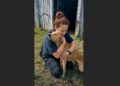
I Watched Them Leave Him Through My Kitchen Window
The morning Toby was abandoned, the cold had settled so deeply over our neighborhood that frost still covered the grass long after sunrise.
I was standing at my kitchen window when I noticed my neighbors loading their car.
Suitcases went into the trunk.
Cardboard boxes followed.
They carried out the last of their belongings, closed the front door, and made several trips between the house and the vehicle.
I had lived across from them for fifteen years.
Their Old English Sheepdog, Toby, had been part of the neighborhood for nearly as long.
He was a large, shaggy dog with a thick gray-and-white coat and the familiar, slightly clumsy movements of his breed.
I had watched him grow from a playful puppy into an older dog who preferred quiet afternoons to running around the yard.
Whenever he saw me outside, his tail usually began moving before I even called his name.
That morning, I expected him to climb into the car with his family.
Instead, someone led him toward the fence.
They tied his leash to a wooden post.
Then they got into the vehicle.
The engine started.
And the car drove away.
Toby remained beside the fence, looking toward the road.
At First, I Thought Someone Would Come Back
I stood at the window longer than I care to admit.
My first thought was that the arrangement was temporary.
Perhaps the family had another vehicle coming.
Perhaps they were transporting the furniture first.
Perhaps a relative would collect Toby later.
I wanted to believe there was a reasonable explanation.
But the driveway stayed empty.
The house remained dark.
And Toby continued standing near the fence, watching the direction in which the car had disappeared.
After a while, he lowered himself onto the frozen ground.
I put on my coat and went outside.
“Toby?”
He lifted his head.
His tail moved once.
Then he looked back toward the street.
I checked that he had access to water and made sure the leash was not tangled around the post.
There was no one home to answer the door.
As the day continued without anyone returning, I became increasingly concerned.
I Had Known Toby Since He Was a Puppy
When his family first brought him home, Toby was a rolling mass of gray-and-white fur with enormous paws and very little understanding of his own size.
He used to rush toward the fence whenever I worked in my garden.
Sometimes he barked once and then waited for me to acknowledge him.
As he grew older, those enthusiastic greetings became quieter.
He would stand near the fence.
Wag his tail.
Occasionally press his broad head toward my hand if I was close enough to greet him safely.
He had always seemed comfortable around me.
That familiarity mattered when I approached him on the morning his family left.
But it did not make the situation less dangerous.
He was an aging, large-breed dog tethered outdoors in bitter weather.
A thick coat is not a guarantee against hypothermia, especially when an animal is unable to move freely, becomes wet, or remains exposed for prolonged periods.
Toby needed help.
I Did Not Simply Leave Him There Without Care
As soon as it became apparent that nobody was returning, I contacted local animal services to report what I had witnessed.
I explained that the property appeared vacant and that the dog had been left tethered.
While the situation was being addressed, I continued checking on Toby.
I brought water and food.
I arranged temporary protection from the wind and made sure he could reach it without becoming trapped by the leash.
I watched for signs of worsening weakness or cold exposure.
He ate very little.
Sometimes he sniffed the food and turned away.
He remained unusually quiet.
There were ownership and reporting procedures to resolve, but none of those should have meant allowing an animal to remain in immediate danger.
During those days, I kept asking when Toby could be moved safely.
The answer could not come quickly enough for me.
By the Second Morning, He Was Still Watching the Road
I went outside before breakfast.
Toby was lying near the fence.
His muzzle rested between his front paws.
When I approached, he raised his head but did not stand immediately.
I crouched a short distance away.
“Good morning, Toby.”
His ears shifted toward my voice.
I placed food within reach and stepped back.
Eventually, he ate a small amount.
That was encouraging, but not enough to erase my concern.
His appetite was reduced.
His movements were slow.
And he had spent a cold night outside, even with the temporary protection I had arranged.
It would have been easy to describe him as heartbroken.
Perhaps the sudden disappearance of his familiar people and routine had distressed him.
But appetite loss and weakness can also indicate pain, dehydration, illness, or cold-related injury.
Those possibilities required veterinary attention, not merely comforting words.
On the Third Day, His Condition Frightened Me
Toby had always been a substantial dog.
Nearly seventy pounds, with a broad chest hidden beneath thick fur.
Now, when he shifted position, I could see how much effort the movement required.
His coat had become dirty and tangled near his legs.
He spent longer periods lying on his side.
He showed little interest in exploring the small area his leash allowed him to reach.
I reported the worsening condition and pressed for urgent intervention.
I was afraid the next cold night would be too much for him.
That evening, I sat nearby for a while.
Toby occasionally turned his head toward me.
When a car passed, his ears lifted.
Then he settled again.
I could not know whether he expected his former family to return.
Dogs recognize familiar vehicles, sounds, people, and routines. A dog may continue responding to cues associated with someone who has disappeared.
What I saw was an old dog whose familiar world had changed abruptly.
And whose physical condition was becoming dangerously concerning.
On the Fourth Morning, I Couldn’t Wait Any Longer
The necessary arrangements had finally reached the point where Toby could be removed from the property.
I went directly to the fence.
He was lying on his side.
“Toby,” I said quietly.
He barely lifted his head.
His body felt cold beneath the outer layer of his thick coat, and he seemed too weak to rise.
I carefully untied the leash.
When I encouraged him to stand, he made an effort but could not get his feet securely beneath him.
That frightened me more than anything I had seen during the previous days.
I had imagined walking him across the street.
Instead, I had to support nearly seventy pounds of exhausted dog.
Using a blanket to help lift and stabilize him, I managed to bring him the short distance into my home without dragging him by his collar or forcing him to walk.
I laid him on the living-room rug.
Then I contacted Dr. Martin.
Toby needed a veterinarian immediately.
Dr. Martin Was Concerned About More Than Sadness
When Dr. Martin examined Toby, he did not begin by asking whether the dog was grieving.
He began with his physical condition.
His temperature.
Heart rate.
Breathing.
Hydration.
Circulation.
Muscle strength.
The condition of his skin beneath the thick, matted coat.
He examined Toby’s legs and joints, looking for pain or injury that might explain why he struggled to stand.
Toby was exhausted.
He had been exposed to cold conditions and had eaten very little.
Those were serious concerns in an older dog.
Dr. Martin explained that sudden behavioral withdrawal can accompany stress, but it should never be used to explain away potentially dangerous medical symptoms.
Toby required treatment, warmth, careful nutrition, and close monitoring.
He also needed time to recover from the disruption of losing his familiar home.
I Had Not Planned to Adopt Another Living Creature
My name is Hélène.
I was fifty-eight years old and had lived alone for nine years.
My husband, Henri, left after our marriage fell apart.
There was no dramatic farewell.
No single argument that explained everything.
He simply moved out, and over time, the life we had shared became something I managed alone.
At first, the silence felt temporary.
I assumed I would eventually grow accustomed to it.
And I did, in practical ways.
I learned to prepare meals for one.
To make decisions without consulting anyone.
To spend weekends in a house where nobody else had plans.
I worked, kept my home in order, and maintained friendships.
But there were evenings when the quiet seemed to spread into every room.
I had never thought seriously about adopting a dog.
Not until Toby was lying on my living-room rug.
Toby’s Silence Felt Familiar, but Our Experiences Were Different
Watching him that first evening, I recognized the loneliness of an abruptly changed household.
Yet I knew I had to be careful with the comparison.
Toby did not understand abandonment the way I understood divorce.
He did not think about broken promises, blame, or the future.
He had lost familiar people and routines.
I had lost a marriage.
Those were different experiences.
Still, we had something practical in common.
Our homes had changed in ways we had not chosen.
And neither of us could restore the past simply by wishing for it.
I sat several feet from Toby while he rested.
He watched me briefly.
Then closed his eyes.
I did not reach toward him.
He had experienced more than enough disruption.
For the moment, he needed rest.
The First Days Inside Were Not Easy
Once Dr. Martin had addressed his immediate medical needs, Toby remained quiet.
He slept for long periods.
His appetite was inconsistent.
When he stood, he did so carefully.
I kept his bed in a calm part of the living room, away from drafts and heavy foot traffic.
His food and water remained easy to reach.
I followed the veterinarian’s instructions closely.
There were no visitors crowding around him.
No excited introductions.
No expectation that he would express gratitude because I had brought him indoors.
Sometimes I sat nearby while he slept.
Other times I left him alone.
Toby had spent years in another household.
My living room smelled different.
The furniture was unfamiliar.
The sounds outside were not the ones he had learned to expect.
Adjustment would take time.
On the Second Night, I Began Reading Aloud
It was something I had not done in years.
I used to read in the evenings when Henri still lived with me.
Sometimes we sat in the same room with separate books, occasionally interrupting each other to share something amusing.
After he left, I stopped reading aloud.
There was no particular reason to continue.
That evening, I picked up a novel and sat in the chair near Toby’s bed.
I began reading softly.
Not because I believed the story would comfort him.
Dogs cannot follow a novel’s plot.
But they can become familiar with voices, tones, and routines.
Perhaps hearing me speak calmly would make my presence more predictable.
After several minutes, one of Toby’s ears moved.
He did not open his eyes.
He did not approach.
He simply adjusted an ear toward the sound.
I continued reading.
I Started Looking Forward to Those Quiet Evenings
The next night, I read again.
And the night after that.
Sometimes Toby slept through the entire session.
Sometimes he raised his head when I entered.
Occasionally he watched me turn a page.
I liked having him there.
Not because he provided conversation.
He certainly did not.
But the room no longer felt quite so empty.
There was another living creature resting nearby.
Someone whose comfort mattered.
Someone who needed dinner, medication, clean bedding, and gentle care.
Those responsibilities changed the rhythm of my evenings.
Instead of coming home and wondering how to fill the hours, I had a routine.
Check on Toby.
Prepare his food.
Make sure he was comfortable.
Then sit down with my book.
On the Fourth Day at Home, He Came Toward Me
It happened during our usual evening reading.
I had reached the middle of a chapter when I heard a faint movement across the rug.
I lowered the book.
Toby had stood up.
He paused for several seconds, gathering his balance.
Then he took a few steps toward my chair.
I remained still.
His head was lowered.
His movements were cautious.
When he reached me, he stopped.
Then he rested his broad muzzle against my knee.
I felt the warmth of his breath through my trousers.
For a moment, I could not speak.
I moved one hand slowly toward the side of his neck.
Touched him gently.
Then stopped to see what he would do.
Toby remained there.
I stroked his head again.
And began crying.
It Was One Small Choice, Not a Complete Recovery
At the time, I wanted to believe everything had changed.
Toby had approached me.
He had accepted affection.
Perhaps he had finally understood that he was safe.
But the following days reminded me that recovery does not happen all at once.
He still startled at unfamiliar sounds.
Some mornings, he preferred to remain on his bed.
His appetite was not yet normal.
He continued needing veterinary follow-up.
One affectionate interaction could not resolve the physical and behavioral consequences of what he had experienced.
Still, his approach mattered.
For the first time since entering my home, Toby had voluntarily crossed the room to seek contact.
I did not want to turn that into an obligation.
The next evening, if he preferred to stay on his bed, I would let him.
The Following Morning, He Accepted the Chicken
Until then, feeding had required patience.
Dr. Martin had helped me manage Toby’s reduced appetite and monitor his recovery.
I offered the food recommended for him in appropriate portions.
That morning, I added a small amount of plain cooked chicken.
Toby sniffed.
Then ate a piece.
A second followed.
He did not suddenly empty the bowl.
But he ate with more interest than I had seen since bringing him inside.
I stood near the kitchen counter, trying not to make too much of the moment.
Over the following days, his appetite improved gradually.
So did his energy.
The food mattered.
The medical treatment mattered.
Rest mattered.
And repeated, predictable days seemed to help him settle.
Affection alone could not have restored his strength.
Toby Began Exploring the House
At first, he had remained almost entirely in the living room.
Then one morning, I heard him behind me in the hallway.
He was walking slowly toward the kitchen.
I turned.
He stopped.
For a moment, we looked at each other.
“Good morning, Toby.”
His tail moved.
Just once or twice.
Then he followed me inside.
Over the next week, he began investigating other rooms.
The hallway.
The space near the back door.
The corner beside my desk.
Sometimes he followed me.
Other times he returned to his bed.
I resisted the temptation to interpret every movement as a declaration of affection.
He was learning the house.
That was valuable in itself.
His Thick Coat Required Attention
Old English Sheepdogs have coats that need regular grooming.
Toby’s had become tangled and dirty during his time outdoors.
Some areas required careful professional attention because mats can pull painfully against the skin and conceal irritation.
Once his health had stabilized enough for grooming, we began addressing the condition of his coat.
It took patience.
Toby needed breaks.
We avoided prolonged sessions that would exhaust him.
When the worst tangles were gone, he seemed more comfortable moving and lying down.
I began learning how to maintain his coat properly.
Brushing became part of our routine.
Not always his favorite part.
Occasionally he sighed and turned his head away as though he had more important things to do.
I couldn’t blame him.
At fifty-eight, I also preferred to spend less time having my hair fussed over.
The First Time He Watched a Squirrel, I Laughed
It happened several weeks after he came home.
I was washing dishes when I heard a small movement near the living-room window.
Toby was standing there.
His head was raised.
His ears were alert.
Outside, a squirrel moved along the fence.
Toby followed it with his eyes.
The squirrel stopped.
Toby leaned forward slightly.
Then it disappeared into the branches.
He remained at the window for another moment before turning away.
Nothing extraordinary happened.
He did not bark or race through the house.
But he had become interested in something beyond the place where he slept.
For a dog who had spent his first days barely moving, that was encouraging.
I found myself smiling as I returned to the dishes.
A Ball Appeared in the Living Room Again
I had bought Toby a few toys before bringing him home.
Most had remained untouched.
One afternoon, I rolled a soft ball gently across the rug.
Toby watched it.
The ball stopped several feet away.
He looked at me.
Then toward the ball.
I left it alone.
A few minutes later, he walked over and sniffed it.
He nudged it with his nose.
The ball rolled a little farther.
Toby followed.
I laughed.
He turned toward me, then nudged it again.
It was not a wild game of fetch.
He was an older, large dog still regaining strength.
But he was showing interest.
We kept play short and gentle, allowing him to stop whenever he wanted.
Over time, the ball became another familiar object in the house.
Our Morning Walks Changed Both Our Days
Before Toby arrived, I often stayed indoors until I had somewhere specific to go.
I worked.
Ran errands.
Came home.
The mornings were quiet and predictable.
Now Toby needed to go outside.
Once he had recovered sufficiently, we began taking regular walks at a comfortable pace.
We did not go far at first.
His condition had been poor, and I wanted to rebuild activity gradually under veterinary guidance.
Sometimes we walked only a short distance.
Toby stopped frequently to sniff.
A tree.
A patch of grass.
The edge of someone’s garden.
He seemed especially interested in places other dogs had passed.
I learned not to hurry him.
A walk did not need to cover a great distance to provide stimulation.
For Toby, investigating familiar neighborhood scents appeared to be part of the pleasure.
For me, simply getting outside each morning made a difference.
One Evening, We Passed His Former Home
It had been several weeks since Toby moved in.
We were walking along our usual route when we approached the property where he had once lived.
The house stood quiet.
The yard was empty.
The wooden fence remained.
So did the post where he had been tied.
Toby slowed.
Then stopped.
He looked toward the yard.
I waited beside him.
I wondered whether he recognized the place.
That was certainly possible.
Dogs can remember familiar environments through scent, landmarks, repeated routes, and other sensory cues.
But I could not know what he associated with that house.
He might have been responding to a smell or sound I did not notice.
After a short pause, he turned away.
Then continued walking.
I followed.
I Did Not Tell Myself He Had Chosen to Forget Them
It would have made a beautiful sentence.
Toby looked at the house where he had been abandoned, then turned toward the person who loved him now.
But dogs do not necessarily interpret those choices the way humans do.
He did not need to make a conscious decision to leave his past behind.
He simply resumed walking.
That was enough for me.
There was no reason to force him closer to the house or wait for a more dramatic reaction.
His past was part of his history.
His present was a quiet walk through the neighborhood.
I wanted him to enjoy the present without demanding that he symbolically overcome the past.
We continued toward home.
Toby stopped to sniff another tree.
Then another.
By the time we reached my driveway, his attention seemed fully occupied by the ordinary smells of the evening.
The House Began Feeling Different
I had spent nine years arranging my life around solitude.
I knew which rooms would remain quiet.
Which evenings would feel longest.
How much food to buy.
How little laundry one person could produce.
Toby changed all of that.
There were towels near the back door.
A large dog bed beside the couch.
A grooming brush in a drawer.
Food stored in the kitchen.
Leashes hanging by the entrance.
Sometimes muddy paw prints appeared on the floor.
I cleaned them without much complaint.
There was something reassuring about evidence that another living creature had been moving through the house.
My home was no longer perfectly orderly.
It was occupied.
Toby Did Not Cure My Loneliness
I never expected him to.
The loneliness I experienced after Henri left had become part of my life over many years.
It involved disappointment, changing relationships, lost plans, and the practical adjustments of living alone.
Toby could not understand any of that.
He could not tell me why my marriage had ended.
He could not replace a human relationship.
But he could offer companionship.
A routine.
A reason to get outside.
A living presence while I read in the evening.
Those things did not erase the past.
They made the present more enjoyable.
Some nights I still felt lonely.
But I no longer sat in a completely empty room.
Toby was usually somewhere nearby, sleeping with his head resting against the rug.
Then I Began Thinking About Another Animal
Several months after Toby came home, I started considering adopting a kitten.
I had always liked cats, but I had never lived with one.
Now that Toby was more comfortable, I wondered whether another animal might fit into our household.
I did not assume he would welcome one.
A dog being gentle with people does not guarantee compatibility with cats.
So I approached the idea carefully.
I discussed it with the appropriate adoption staff.
Considered Toby’s behavior.
Prepared separate spaces.
And made sure any introduction would happen gradually.
Eventually, a small kitten named Léon came home.
He was tiny compared with Toby.
That made supervision especially important.
Léon Did Not Immediately Become Toby’s Best Friend
The first interactions were brief and controlled.
Léon had a safe room where Toby could not enter.
They became familiar with each other’s scents before meeting directly.
A barrier allowed them to observe without being forced into contact.
Toby seemed curious.
Léon was cautious.
I watched for signs of stress in both animals.
No chasing.
No forced nose-to-nose greeting.
No placing the kitten on Toby’s back for a cute photograph.
When they finally shared space under close supervision, Toby mostly watched while Léon investigated the room.
The kitten approached.
Sniffed.
Then walked away.
Toby lay down.
That was a perfectly acceptable beginning.
Their Friendship Developed Through Ordinary Days
Over time, Léon grew more confident.
He explored the living room.
Learned where his own resting places were.
Occasionally approached Toby while the dog slept.
Toby usually responded by lifting his head, sniffing briefly, then settling again.
As their comfort increased, I sometimes found them resting near each other.
At first, several feet apart.
Later, closer.
Eventually, Léon began choosing a place against Toby’s side when both were relaxed and supervised.
The size difference remained important.
Toby was a large dog.
Léon was a small kitten.
I continued providing separate spaces and never assumed a friendly relationship eliminated every safety concern.
But their companionship became one of the quiet pleasures of my home.
Watching Them Together Made Me Smile
One afternoon, I was sitting with my book when Léon walked across the rug.
Toby was asleep.
The kitten approached his side and curled into a small circle near his shoulder.
Toby opened one eye.
Sniffed gently.
Then lowered his head again.
Neither seemed interested in moving.
I watched them for a moment.
Then returned to reading.
Years earlier, I had spent evenings in the same room listening to the clock.
Now there was an old sheepdog breathing softly on the rug and a kitten curled beside him.
The room had not changed very much.
Same furniture.
Same windows.
Same bookshelves.
But it no longer felt like a place where I was simply passing the hours.
Toby Sometimes Still Watches Cars
Occasionally, he stands near the front window when a vehicle slows outside.
His ears lift.
His head turns.
Then the vehicle passes.
He usually returns to whatever he was doing.
I cannot say whether that behavior has any connection to the day his former family drove away.
Dogs notice traffic for many reasons.
Sounds.
Movement.
Familiar arrival patterns.
Curiosity.
What matters to me is the broader change in Toby’s behavior.
He no longer spends most of his day lying near an entrance.
He eats comfortably.
Rests deeply.
Shows interest in walks and toys.
And chooses to spend time near me.
A passing car is now only one small event in a much larger day.
I Still Remember How Heavy He Felt
That fourth morning has never left me.
The cold.
The fence.
The muddy gray-and-white coat.
Toby lying on his side, unable to rise.
The difficulty of moving his large body safely into my house.
I remember being frightened that I had waited too long, even though I had been trying to get help and keep him protected.
The memory still makes my chest tighten.
It also reminds me that kindness must be practical.
An animal exposed to severe cold needs protection.
A dog who stops eating needs evaluation.
An animal too weak to stand needs urgent veterinary attention.
Compassion means taking those needs seriously, not treating suffering as proof of loyalty.
Toby survived because his physical condition was addressed and he received ongoing care.
The quiet evenings with my books came afterward.
We Both Had to Learn New Routines
Toby had spent years in another household.
I had spent nine years living alone.
Neither of us was used to the arrangement we suddenly found ourselves sharing.
He had to learn where to sleep.
Where his meals appeared.
Which door led to the yard.
How I moved through the house.
I had to learn how to care for a large, aging dog.
His grooming needs.
His appetite.
His body language.
When he wanted affection.
When he preferred rest.
We made mistakes.
Adjusted.
And learned.
It was not a dramatic transformation completed in four days.
It was the slow accumulation of ordinary experiences.
I Stopped Calling Him My Rescue
At first, when friends asked about Toby, I sometimes referred to him that way.
“My rescue dog.”
It was convenient.
It explained how he came into my life.
Eventually, I found myself saying something simpler.
“My dog.”
Toby.
The sheepdog who slept beside the couch.
Who watched squirrels through the window.
Who sometimes left a tennis ball in the hallway.
Who needed regular grooming and preferred slow morning walks.
The dog whose large body required me to step carefully around the kitchen.
He was no longer defined primarily by the fence where he had been abandoned.
He had a whole life beyond that morning.
I wanted to remember that.
Léon Eventually Learned Toby’s Morning Routine Too
The kitten grew quickly.
He learned that Toby usually stirred before breakfast.
Sometimes Léon appeared in the hallway as soon as he heard the sheepdog stand.
He watched while Toby stretched.
Then followed at a safe distance toward the kitchen.
I laughed the first few times.
The two animals had different needs.
Different food.
Different temperaments.
But their routines had begun overlapping.
Toby did not understand that he was part of a little family.
Léon did not understand the history of the house.
They simply knew familiar sounds, smells, places, and patterns.
And those patterns increasingly included one another.
Our Morning Walks Became My Favorite Part of the Day
I used to wake up and immediately think about everything I needed to do.
Now, before checking my phone or opening the mail, I usually look toward Toby’s bed.
If he is awake, his tail may move when he hears me.
Sometimes he takes an extra minute to stand.
I wait.
Then we go outside.
The air may be cool.
The sidewalk damp.
The neighborhood still quiet.
Toby walks beside me at his own pace.
Sometimes he stops to sniff the grass near a fence.
Sometimes he pauses beneath a tree.
I no longer see those interruptions as delays.
They are part of the walk.
And after years of living according to a routine that seemed to contain very little pleasure, I have come to value those mornings enormously.
I Still Think About the Family Who Left Him
I cannot pretend I understand their decision.
I watched them tie an elderly dog to a fence and leave.
Whatever difficulties they faced, that choice exposed Toby to danger.
There were safer ways to seek help.
Animal shelters.
Rescue organizations.
Veterinary professionals.
People who might have assisted with placement.
I also know that the entire history of a family cannot be reconstructed from one morning.
I do not know what happened inside their home before they moved.
What matters is that Toby was left in circumstances he could not safely manage alone.
His vulnerability required intervention.
And once he was safe, he deserved more than a lifetime of being described as an abandoned dog.
He Has Become Part of the House
There are mornings when Toby sleeps so deeply that he barely notices me moving around the kitchen.
Other days, he follows me before I have finished making coffee.
Léon has his own favorite places.
Sometimes the kitten curls on the windowsill while Toby sleeps beneath it.
Sometimes both animals rest near the couch.
The house still has quiet hours.
Many of them.
But the silence feels different now.
It is no longer the absence of every sound I once expected to hear.
It contains breathing.
Paws moving.
A collar shifting.
Occasionally the little noise Léon makes when he jumps onto a chair.
Those sounds have become familiar enough that I notice when they are missing.
Toby Still Needs the Care of an Older Dog
His age has not disappeared.
Some mornings, he moves more slowly.
His coat still requires regular maintenance.
Veterinary visits remain important.
His exercise has to match his condition.
I do not expect him to run like the puppy I remember from fifteen years ago.
He has already lived through those years.
Now he needs a different kind of care.
Comfortable bedding.
Appropriate activity.
Attention to pain or stiffness.
A safe place to rest.
Food.
Water.
Predictable company.
There is nothing extraordinary about those needs.
They are simply the responsibilities that come with giving an aging animal a home.
I am glad to meet them.
The Cold Corner of My Life Was Never Toby’s Responsibility
Sometimes I think back to the lonely years after Henri left.
I had grown accustomed to making every decision alone.
Some parts of that independence were valuable.
Others left me isolated.
Toby did not arrive to fix my personal life.
He had needs of his own, and those needs came first.
But caring for him brought movement back into my days.
I spent more time outside.
I spoke aloud more often.
I laughed at small things.
I began planning around something other than my own obligations.
Eventually, Léon joined us.
The house changed gradually.
Not through one miraculous moment.
Through repeated, ordinary care.
One Afternoon, I Found Toby Watching the Road
He stood near the living-room window.
A car had just driven past.
For a moment, I remembered the morning his former family disappeared.
Toby beneath the fence.
His head raised.
The empty road.
Then the cold hours that followed.
I walked toward him.
He heard my footsteps and turned.
His tail moved.
I crouched beside him and stroked the side of his shaggy head.
“I thought I was saving you, Toby,” I whispered. “But you’ve helped me more than you know.”
He could not understand the sentence.
That was fine.
It was something I needed to say.
A moment later, he walked away from the window and returned to the rug.
Léon was already there.
Today, Nobody Is Waiting Beside That Fence
The old post remains in the neighboring yard.
I sometimes notice it while walking past.
I remember the four days when Toby stayed near it, growing weaker as the hours passed.
But when I return home, the memory is replaced by something much more ordinary.
Toby’s bed beside the living-room wall.
His leash near the door.
The grooming brush in the drawer.
Léon’s small toys occasionally scattered across the rug.
A tennis ball Toby still nudges when he feels like playing.
And an aging sheepdog who has learned where everything belongs.
He is not young.
He is not endlessly energetic.
He does not need to be.
He has a safe place to sleep and a routine that suits him.
Every Morning, Toby Meets Me at the Door
Sometimes he is already standing when I reach for my coat.
Other mornings, I hear him getting up behind me.
There is the familiar rustle of his bedding.
A pause.
Then the slow sound of paws crossing the floor.
Léon often watches from the hallway.
I attach Toby’s leash and open the door.
He steps outside carefully.
Stops to sniff the morning air.
Then looks toward the sidewalk.
We begin walking.
No hurry.
No destination more important than the walk itself.
Four days after his family left him, Toby had been lying beneath a fence in the cold, too exhausted to stand when I reached him.
Now, most mornings, he is the one who encourages me to leave the house.
And every evening, when we return, he settles onto his bed while Léon finds a place nearby.
I sit in my chair with a book.
Sometimes I read aloud, just as I did during those first difficult nights.
Toby usually closes his eyes.
Léon curls against his side.
The house grows quiet.
But it is the comfortable quiet of a home where everyone has somewhere safe to rest.
And tomorrow morning, when I pick up the leash, Toby will most likely rise slowly, stretch his aging legs, and come toward the door.
This time, nobody is driving away and leaving him behind.
We are simply going for our walk.
Together.
Editor’s Note: The characters in this story are fictional. Through these stories, we hope to share the intelligence, loyalty, compassion, and loving nature of dogs with people everywhere.