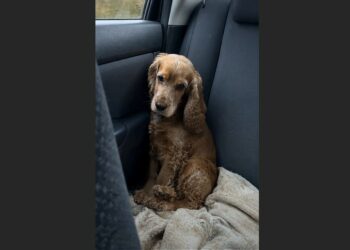
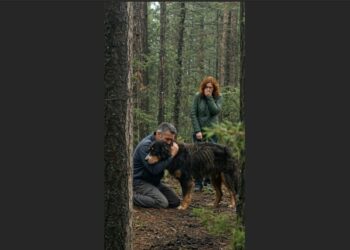
Our newly adopted black Labrador, Leo, was sitting quietly in the back seat. He wasn’t exploring his surroundings or showing much interest in where we were going. Instead, he kept turning toward the rear window, looking back along the road we had just traveled.
At first, I thought he was simply nervous about leaving the shelter.
Then I remembered Toby.
Toby was Leo’s brother, another beautiful black Labrador who had been blind since birth. The two dogs had spent their entire lives together, sleeping side by side and moving through the shelter with an easy familiarity.
We had adopted Leo.
Toby was still in his kennel.
I looked at my husband, Thomas, and felt a growing uneasiness about the decision we’d made.
Thirty minutes later, we would be standing inside the shelter again, asking to bring home the dog we had left behind.
The Dog We Had Been Looking For
Thomas and I had been talking about adopting a dog for quite some time.
We had a spacious house, a beautiful green backyard, and enough room to welcome a four-legged companion into our family. We pictured the ordinary pleasures of sharing our home with a dog: long walks, afternoons in the garden, and quiet evenings together.
We weren’t looking for anything extraordinary.
We wanted a friendly dog who would enjoy being part of our daily lives, someone we could care for and grow attached to over the years.
When we finally decided to visit the animal shelter, we were excited about the possibility of meeting that companion.
We knew that adopting a dog meant taking responsibility for much more than feeding and walking him. There would be adjustments, new routines, and time needed for everyone to become comfortable.
But we felt ready.
What we hadn’t seriously considered was bringing home two dogs.
In our minds, we were going to the shelter to find one companion.
Then we walked toward a kennel where two black Labradors were lying together, their bodies touching, and our carefully imagined plans began to change.
Two Brothers Sharing the Same Kennel
The dogs immediately caught my attention.
Both had beautiful, glossy black coats and gentle expressions. They were resting close together, so comfortably that it was difficult to look at one without noticing the other.
As Thomas and I approached, one of the Labradors lifted his head.
He seemed interested in the people standing outside the kennel.
“That’s Leo,” the volunteer explained.
Then she indicated the second dog, who remained close beside him.
“And this is Toby. He’s been blind since birth.”
I looked at Toby more carefully.
His eyes had a distant, unfocused appearance, and he didn’t follow our movements visually the way Leo did.
But he was far from unaware of what was happening around him.
When Leo changed position, Toby seemed to notice immediately. Leo gently touched his brother with his muzzle, and Toby shifted closer before settling against him again.
It was a small, natural interaction.
There was no dramatic display of affection. The two dogs simply seemed accustomed to one another’s presence.
“They’ve been together their entire lives,” the volunteer told us. “Leo has always been a familiar, reassuring presence for Toby.”
I watched them for a long moment.
I didn’t yet understand how important that observation would become.
The Brother Who Had Never Seen the World
I had never lived with a dog who was blind from birth.
Before meeting Toby, much of what I knew about blind dogs came from general assumptions about the difficulties they might face.
Watching him beside Leo gave me a different perspective.
Toby couldn’t see his brother, but he responded to his movement and touch. He appeared familiar with their shared space and comfortable resting close to another dog he knew well.
The volunteer’s explanation helped me appreciate how much of Toby’s daily life depended on sounds, scents, touch, and familiar routines.
Leo was part of that familiarity.
They had spent their entire lives together.
I imagined how much easier it might be for Toby to navigate a world he couldn’t see when so many things around him were predictable, including the presence of his brother.
At the same time, I didn’t want to assume that Toby was incapable of living independently.
Blind dogs can learn their surroundings, recognize familiar people, and participate in ordinary family life. They simply experience and navigate the environment differently.
But the closeness between these two brothers was unmistakable.
Whenever Leo shifted, Toby seemed attentive to the change.
And when they rested, they chose to remain close enough to touch.
Why We Chose Leo
As we spent time with the brothers, Leo began showing more interest in us.
He was friendly and attentive, approaching comfortably and accepting our affection.
Thomas and I both felt an immediate connection with him.
He seemed like the companion we had pictured when we first discussed adopting a dog. He was gentle, responsive, and comfortable around people.
We kept returning our attention to him.
Toby remained nearby, occasionally shifting in response to his brother’s movements.
We knew the dogs were close, and we understood that Toby had different needs because of his blindness.
Still, we had come to adopt one dog.
After spending time with them and discussing our decision, we chose Leo.
We completed the adoption paperwork and prepared to take him home.
I remember looking back toward the kennel as we were leaving.
Toby was still there.
Leo also kept glancing toward his brother as we moved away.
At the time, I noticed it without fully considering what it might mean.
I told myself that Toby would remain in the care of the shelter until another family adopted him.
He was a gentle dog who deserved a loving home, and I hoped someone would recognize that.
But the question of what it would mean for the brothers to live apart stayed with me longer than I expected.
The Quiet Labrador in Our Back Seat
Once we were in the car, I expected Leo to become curious about his new surroundings.
It was a significant change for him. He was leaving the place he had been living and traveling with two people he had only recently met.
I knew he might be nervous.
Still, I found myself watching him carefully.
He sat quietly in the back seat.
He didn’t wag his tail or show much interest in the passing scenery.
Instead, every few minutes, he turned his head toward the rear window.
He seemed more interested in what we were leaving behind than in where we were going.
I thought about the kennel.
I pictured the two black Labradors lying together, their coats almost touching, Toby responding whenever Leo moved.
Now Leo was in our car.
Toby was back at the shelter.
I couldn’t know exactly what Leo was thinking as he watched the road behind us. A dog leaving a familiar environment may look back for many reasons, especially during an unfamiliar car ride.
But I did know that we had separated two brothers who had never lived apart.
And the more I considered it, the less comfortable I felt about our decision.
The Question I Couldn’t Ignore
I tried to imagine Toby’s experience after we left.
He had never seen the world.
He knew the shelter through its sounds, smells, physical layout, and daily routines.
For his entire life, one of the most familiar parts of his surroundings had been Leo.
The two dogs had rested together, responded to each other’s movements, and spent their days in close contact.
Now that familiar companion was gone.
I didn’t know how Toby was reacting back at the shelter. Perhaps he was resting quietly. Perhaps he was listening for Leo or noticing his absence.
We had no way of knowing.
But I kept thinking about the volunteer’s words.
“They’ve been together their entire lives.”
I looked at Leo again.
He was still facing toward the back of the car.
I thought about how easily we had accepted adopting one brother while leaving the other behind.
No one had forced us to make that choice.
We had enough room at home, and we had already come prepared to take on the responsibilities of caring for a dog.
The more I considered our situation, the more I wondered whether we had overlooked something important.
Finally, I turned to Thomas.
“Thomas,” I said quietly.
He glanced at me.
“We left Toby behind.”
A Conversation That Changed Our Plans
For a moment, neither of us spoke.
I think Thomas already understood what I was trying to say.
We had chosen Leo because we liked him and felt he would be a wonderful addition to our home.
But choosing him hadn’t required us to ignore the relationship he shared with Toby.
Thomas sighed.
“I know. I’ve been thinking about him, too.”
I looked back at Leo.
He was still watching the road behind us.
“We can’t do this,” I whispered.
Thomas nodded.
There wasn’t much more to discuss.
We had room for two dogs. We were willing to learn how to support Toby’s needs, and we understood that caring for a blind dog would require thoughtful adjustments.
Most importantly, we no longer felt comfortable separating two animals who had spent their entire lives together when we had the ability to keep them both.
At the next safe place to turn around, Thomas changed direction.
We headed straight back toward the shelter.
Leo remained in the back seat as we retraced the road we had just traveled.
This time, our destination was very different.
We weren’t taking one Labrador away from his brother.
We were going back to ask whether we could bring them home together.
“We’d Like to Adopt Toby, Too.”
Thirty minutes later, we walked through the shelter entrance again.
The volunteer who had helped us earlier looked surprised.
“Is everything okay with Leo?” she asked.
I nodded.
“Yes. But we made a mistake.”
She waited for me to explain.
“We’d like to adopt Toby, too.”
Her expression softened.
Thomas and I explained what we had been thinking about during the drive.
We hadn’t fully considered the brothers’ lifelong relationship when we made our original decision.
We had focused on finding a dog who suited our home, without giving enough thought to what separating the two Labradors might mean.
We also explained that we had the space to care for both of them and were prepared to make the adjustments needed for a dog who couldn’t see.
The volunteer discussed Toby’s needs with us.
It was important that we understood the practical responsibilities, not simply the emotional appeal of keeping the dogs together.
Toby would need time to learn a new environment.
We would have to be consistent about the arrangement of furniture and careful about how we introduced him to unfamiliar spaces.
He would also need the same affection, exercise, attention, and opportunities to explore as any other dog, with appropriate support for his blindness.
We listened carefully.
Our decision wasn’t based on feeling sorry for Toby.
We wanted to give him a home where he could be comfortable, capable, and loved, with the brother he had always known.
After completing the additional adoption paperwork, we were finally ready to leave.
This time, we were bringing home two dogs.
Two Familiar Faces Meet Again
When we brought Toby to the car, Leo was nearby.
The moment Toby heard his brother, his ears lifted.
He moved toward Leo, sniffing him before pressing his body against him.
Leo turned and gently touched Toby’s face with his muzzle.
It was the same kind of quiet interaction we had watched in their kennel earlier.
There was no need for us to encourage them to approach each other.
They came together naturally.
Within moments, they were resting side by side again.
Toby settled with his head against Leo’s back.
I watched the two black Labradors resting together and felt the tension I’d been carrying begin to ease.
I couldn’t know whether Leo had been looking back because he was searching for Toby, or whether Toby had been distressed during their brief separation.
But seeing them together again confirmed something important about our decision.
They were comfortable in each other’s company.
Their bond was part of their daily lives, and we had the opportunity to preserve it while giving both dogs a home.
Thomas and I exchanged a look.
We had started the morning planning to adopt one dog.
Now there were two Labradors in our car, resting against each other as we headed home.
And for the first time since leaving the shelter, I felt entirely comfortable with where we were going.
Two Dogs, One Unfamiliar House
When we arrived home, we introduced Leo and Toby to their new surroundings slowly.
Our house was spacious, with a green backyard, but we knew that having plenty of room didn’t automatically make a new environment easy for a blind dog to navigate.
Leo began exploring with curiosity.
He moved through the house, investigating the rooms and becoming familiar with the place that would now be his home.
Toby approached things differently.
He moved more cautiously, using his sense of smell, hearing, and touch to gather information about the space around him.
We gave him time.
We didn’t expect him to understand the layout immediately or follow Leo everywhere without hesitation.
For Toby, learning the house involved discovering the location of furniture, recognizing doorways, and becoming familiar with places where he could rest comfortably.
We tried to make that process as predictable as possible.
Furniture stayed in consistent positions, and we avoided unnecessary changes that might make it harder for him to remember familiar routes.
We also paid attention to how he moved, allowing him to investigate new areas at his own pace.
Leo often remained nearby.
Sometimes the brothers explored together.
Other times, Leo moved ahead while Toby continued examining a particular part of the room.
Watching them, I began to understand that helping Toby didn’t mean doing everything for him.
It meant creating an environment where he could learn and move with growing confidence.
Learning the House Without Seeing It
As the days passed, Toby gradually became more familiar with our home.
At first, he was cautious about moving through unfamiliar rooms.
He took his time, relying on the information he gathered from sounds, scents, and the position of objects around him.
We tried to remain patient.
There was no reason to rush him.
The house wasn’t going anywhere, and we wanted him to become comfortable through repeated, predictable experiences rather than pressure.
Little by little, he began learning how different spaces connected.
He became familiar with the path from the living room to the backyard.
He started recognizing the sounds of our footsteps.
And as he grew more comfortable, he began exploring without needing Leo beside him every second.
That was one of the most rewarding changes to witness.
Before adopting him, I had wondered how much help a blind dog might need to manage daily life.
Living with Toby showed me how capable he could be when his surroundings were safe and familiar.
His blindness shaped the way he experienced the house, but it didn’t prevent him from taking an interest in it.
He learned.
He remembered.
And with time, he moved through familiar spaces with increasing confidence.
I was proud of him, although I knew he didn’t need my pride to accomplish those things.
He needed patience, consistency, and the opportunity to discover what he could do.
Leo Was Nearby, but Toby Found His Own Way
One of the things I appreciated most about watching the brothers settle into our home was seeing how their relationship worked in everyday life.
Leo often stayed near Toby.
Sometimes, when they were moving together, he gently nudged his brother.
Other times, he simply waited while Toby investigated a new area.
Those interactions reminded me of what we had seen at the shelter.
The brothers were accustomed to each other’s movements and seemed comfortable sharing space.
But Toby wasn’t helpless without Leo.
As he learned our home, he became increasingly willing to explore independently.
He could recognize familiar routes and respond to sounds around him.
He didn’t require his brother to remain beside him every moment.
I think that distinction mattered.
Their relationship was clearly important, but Toby also deserved the chance to develop confidence in his own abilities.
We didn’t want him to become dependent on being guided through every ordinary activity when he was capable of learning the environment himself.
The more familiar our household became, the more naturally the dogs settled into their routines.
Leo could explore.
Toby could explore.
And when they wanted to be together, they sought each other out.
Their companionship remained constant without preventing either dog from enjoying his own experiences.
Our Backyard Became Part of Their World
Before we adopted the brothers, Thomas and I had imagined having a dog who would enjoy spending time in our backyard.
Now we had two.
Leo seemed happy to investigate the outdoor space, and Toby gradually became familiar with it as well.
We introduced the yard carefully, allowing him to learn the surroundings at a comfortable pace.
Over time, he became more confident moving between the house and the garden.
Watching him explore reminded me that a dog doesn’t need sight to enjoy being outdoors.
Toby could investigate scents, recognize familiar sounds, and move through a space he had learned.
We continued to pay attention to his safety and comfort, especially as he encountered new areas.
But we also wanted him to have opportunities to behave like any other Labrador.
He could move around, play, rest, and enjoy being part of the household.
Leo was often nearby, and the two brothers spent time together outside.
What had begun as a plan to share our backyard with one dog had become something richer than we expected.
There were two sets of paws moving across the grass.
Two black coats to brush.
Two companions who had brought their own personalities and familiar relationship into our home.
It was more responsibility than we had originally planned.
It was also a responsibility we were grateful to have accepted.
The Evening Routine We Never Want to Change
As Leo and Toby settled into our home, the evenings became one of my favorite parts of the day.
After spending time exploring the house and yard, the brothers would eventually settle near us.
Leo was comfortable finding a place to rest.
Toby would move toward him, recognizing his familiar presence.
Even though Toby had become more confident navigating the house independently, the brothers continued choosing to sleep together.
It was a habit they had carried from the shelter into their new home.
I loved watching them settle beside one another.
There was something reassuring about seeing how little that part of their relationship had changed.
At the shelter, they had been two black Labradors resting in the same kennel, their bodies touching.
At home, they were still two brothers who preferred being close.
Only the surroundings were different.
They no longer needed to share a shelter kennel.
They had room to move, a backyard to explore, and people who cared for them.
Yet when it was time to rest, they continued returning to each other.
That choice was meaningful because it was so ordinary.
No one had to arrange them side by side.
They simply settled together.
What Toby Taught Us About Blind Dogs
Before Toby came home, I knew that blind dogs could adapt to their surroundings.
But knowing something in theory is very different from sharing your home with an animal who demonstrates it every day.
Toby taught Thomas and me to pay closer attention to the environment we were providing.
We learned the importance of familiar routines and consistency.
We saw how much information he could gather without relying on sight.
We also learned to give him time rather than immediately stepping in whenever he approached something unfamiliar.
Blindness was one part of who Toby was.
It wasn’t his entire identity.
He was affectionate, curious, and capable of learning new routines.
He enjoyed spending time with his brother and gradually developed confidence exploring our home.
His needs were different from Leo’s in some respects, but both dogs deserved the same fundamental things: affection, security, exercise, rest, and opportunities to enjoy their surroundings.
Leo also taught us something important.
The quiet interactions we had noticed at the shelter continued in our home.
He often stayed close to Toby and sometimes nudged him gently when they moved together.
Their bond didn’t require constant intervention from us.
It was already part of how they lived.
We simply had to make room for it.
I Still Think About That First Drive Home
Sometimes, when our house is quiet, I think about the first time we left the shelter with Leo.
I remember looking into the back seat and seeing him repeatedly turning toward the rear window.
I remember the road behind us and the uncomfortable feeling I couldn’t quite explain at first.
We had made what seemed like a reasonable decision.
We wanted to adopt a dog.
We met a friendly Labrador.
We completed the paperwork and brought him home.
There was nothing wrong with wanting one dog, and I understood that not every family could take responsibility for two animals.
But in our particular circumstances, we had a choice.
We had the space, the willingness, and the ability to care for both brothers.
What troubled me was that we had seen how close they were, yet hadn’t fully considered what separating them would mean.
I remember turning toward Thomas and saying, “We left Toby behind.”
And I remember his answer.
“I know. I’ve been thinking about him, too.”
Neither of us needed a long conversation after that.
We understood what we wanted to do.
At the next safe place, we turned around.
That simple decision changed the lives of two dogs, and it changed our daily lives as well.
Two Black Labradors Sleeping Side by Side
Today, our home is filled with the familiar sounds of two Labradors.
We hear them moving through the hallway, spending time in the backyard, and settling near us in the evenings.
Leo is still the friendly dog who first approached us at the shelter.
Toby is still the gentle brother who recognizes the world through sounds, scents, touch, and the familiar arrangement of his surroundings.
He has learned his way around our home.
He knows the route to the backyard and recognizes our footsteps.
And although he no longer needs Leo beside him every moment, he still chooses to rest close to his brother.
Some evenings, I watch them settle on the living room rug.
Leo lies down first, resting his head comfortably.
Toby moves beside him, finds a familiar place against his side, and settles.
Before long, both dogs are asleep.
It looks so much like the scene that first caught my attention at the shelter.
Two black Labradors.
Two brothers.
Their bodies touching as they rest together.
But now, when I look at them, I don’t see a kennel or wonder whether they will be separated.
I see our living room.
I see two dogs who have become part of our family.
And I remember that quiet drive home when Leo kept turning toward the road behind us.
We had planned to adopt one dog.
We brought Leo to the car, drove halfway home, and realized we had left his blind brother behind.
So we went back.
Now, when bedtime comes, Toby still settles against Leo’s side, just as he did when we first met them.
And every time I see them sleeping together, I’m grateful that Thomas and I turned the car around.
Editor’s Note: The characters in this story are fictional. Through these stories, we hope to share the intelligence, loyalty, compassion, and loving nature of dogs with people everywhere.