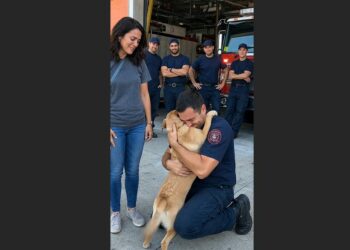
Otis pressed his entire body against David’s leg while they stood at the veterinary clinic’s reception desk.
The Boxer had been doing well at home for nearly two years. He loved car rides, followed David from room to room, and had developed the habit of squeezing himself onto the couch whenever someone sat down.
But the veterinary clinic was different.
The moment they’d arrived in the parking lot, Otis had grown quiet. By the time they reached reception, he was standing so close to David that there was hardly any space between them.
Then one of his big Boxer paws came up and wrapped against David’s leg.
David looked down.
Otis was staring straight up at him.
“Hey, Otis… you don’t have to be scared.”
David rested a hand on his head and gently rubbed behind his ear.
The dog pressed closer.
“It’s okay. I’m right here.”
A low, familiar “wooo” escaped Otis’s throat.
David knew that sound. He’d heard it before when Otis was nervous.
“I know, buddy. I know.”
The woman behind the reception desk watched quietly.
Nobody tried to separate them.
And for David, standing there with a frightened dog leaning against his leg, that small moment meant more than anyone else in the room could have understood.
Because the Boxer he’d met almost two years earlier wouldn’t have approached a person when he was afraid.
He would have moved away.
The Dog David Hadn’t Planned to Meet
David hadn’t gone to the animal shelter looking for a dog of his own.
He was accompanying a friend who was interested in adopting a different dog. Their visit had a simple purpose, and David had no particular reason to expect that he’d leave thinking about an animal he wanted to bring home.
As they walked past the kennels, he noticed a Boxer sitting toward the back of one enclosure.
The dog wasn’t barking.
He wasn’t jumping against the gate or trying to attract the attention of everyone passing through.
He simply watched.
David might have continued walking if he hadn’t noticed something particular about the way the dog observed people.
His attention seemed to settle on their hands.
When someone moved, the Boxer watched carefully. If a person reached toward him too quickly, he tended to withdraw.
There was a guarded quality to his behavior that made David stop and look a little longer.
He asked one of the shelter employees about the dog.
His name was Otis.
And the explanation David received made him understand why a little patience might be necessary.
What the Shelter Knew About Otis
Otis had been surrendered after living in a home where he hadn’t been treated well.
The shelter didn’t know every detail of his previous circumstances.
There was no complete account of everything he’d experienced, and David didn’t feel a need to search for dramatic explanations.
He could see that Otis was uncomfortable with certain kinds of human interaction.
Sudden movements made him tense.
Unfamiliar rooms seemed to unsettle him.
And when someone reached toward him too quickly, he usually backed away.
David didn’t assume every one of those reactions had a single cause. Dogs can become fearful for many reasons, and without reliable knowledge of an animal’s history, it isn’t always possible to determine how a particular fear developed.
But the behavior itself was clear.
Otis wasn’t comfortable when people moved too quickly into his personal space.
He needed to be allowed to decide when he felt safe enough to approach.
David also noticed that Otis wasn’t trying to create a confrontation.
When something frightened him, he generally moved away.
It was an important distinction.
Rather than interpreting the dog’s caution as rejection or stubbornness, David began thinking about how much patience it might take for Otis to become comfortable with someone new.
And although he’d arrived at the shelter for an entirely different reason, he found himself thinking about the Boxer long after the visit ended.
The Visits David Made Alone
A few days later, David returned to the shelter.
This time, his friend wasn’t with him.
He had come specifically to see Otis.
There wasn’t an immediate transformation when they met again.
Otis didn’t recognize David as someone who had arrived to change his life. He didn’t rush forward or leap into his arms.
Their interaction was much quieter.
David spent time with him, paying attention to how the dog responded and allowing him room to become comfortable.
Then David went home.
He thought about what adopting Otis would involve.
A dog who was easily frightened by unfamiliar surroundings might find the transition into another home difficult. There would be new sounds, different routines, and a person whose movements he would need time to learn.
Affection alone wouldn’t necessarily resolve those difficulties.
David understood that.
He returned to the shelter again.
He wasn’t expecting Otis to prove his affection before being considered for adoption.
He was trying to determine whether he could provide the consistency and patience the dog needed.
Gradually, David became certain that he wanted to try.
There was no dramatic moment that settled the decision.
He simply decided to bring Otis home.
Learning to Share a Home
Bringing Otis home meant introducing him to an environment he didn’t yet understand.
The shelter had already explained how unfamiliar rooms could make him nervous.
David knew that expecting the Boxer to explore confidently from the first moment would be unrealistic.
He approached their early days with that in mind.
Otis needed opportunities to become familiar with the house and the person living in it.
David needed to learn which situations made him uncomfortable and how to respond without increasing his fear.
That meant paying attention to small things.
How Otis reacted when someone moved nearby.
Whether he approached voluntarily.
What happened when an unfamiliar sound interrupted a quiet moment.
And how comfortable he seemed when allowed to rest without anyone trying to touch him.
Trust didn’t arrive through one special interaction.
There wasn’t a particular afternoon when every problem suddenly disappeared.
Instead, David and Otis gradually developed routines that made their days more predictable.
The Boxer began learning what to expect from the person caring for him.
And David began understanding the individual dog who had once watched strangers’ hands so carefully from the back of a shelter kennel.
It took time.
But as the months passed, Otis began showing more of his personality.
The Boxer Who Forgot About Personal Space
Nearly two years later, life with Otis looks very different.
At home, he’s an affectionate, energetic companion who prefers being wherever David happens to be.
If David moves from one room to another, Otis often follows.
If someone sits on the couch, the Boxer sees no particular reason to maintain a polite distance.
He wants to be close.
Sometimes very close.
David has become accustomed to having a large dog settle against him as though the available seating belongs equally to both of them.
The contrast with Otis’s early behavior is difficult to miss.
The dog who once backed away when someone reached toward him too quickly now regularly approaches David for attention.
He chooses to be nearby.
He seeks contact.
And he has become comfortable enough with their shared routines to behave like a dog who expects familiar, pleasant interactions.
Car rides have also become one of his favorite activities.
David has learned that Otis can recognize the sound of car keys being picked up from another part of the house.
That sound often gets his attention immediately.
To Otis, the keys have become associated with something he enjoys.
But David has also learned that a dog can become comfortable in one environment while remaining frightened in another.
And no place makes that more obvious than the veterinary clinic.
The One Place That Still Makes Him Nervous
Despite his progress at home, veterinary visits remain difficult for Otis.
Something about entering the clinic still unsettles him.
David can’t say exactly why.
The building is an unfamiliar environment compared with the predictable surroundings of home. It contains different sounds, smells, people, and routines.
For a dog already sensitive to unfamiliar situations, those changes can be challenging.
David doesn’t know whether Otis had a frightening veterinary experience in the past or whether the clinic simply brings together several things that make him uncomfortable.
He doesn’t try to invent an explanation.
He pays attention to what the dog actually does.
At their latest appointment, the change began before they even reached the building.
Otis, who normally enjoyed car rides, became noticeably quieter in the parking lot.
David recognized the difference.
The enthusiastic Boxer who had become so comfortable at home was suddenly more cautious.
As they walked toward the clinic, Otis stayed unusually close.
David didn’t mistake that closeness for ordinary excitement.
He knew the dog well enough to recognize that something was bothering him.
They continued inside together.
By the time they reached reception, Otis was pressing against David’s leg.
The Big Paw Around David’s Leg
While David stood at the reception desk, Otis moved even closer.
His body was pressed firmly against David’s leg.
Then the Boxer raised one of his front paws and placed it against him.
David looked down.
Otis was staring upward, keeping his attention on the person who had become familiar and dependable over the previous two years.
“Hey, Otis… you don’t have to be scared.”
David’s voice remained gentle.
He rested his hand on Otis’s head and slowly rubbed behind his ear.
There was a time when that kind of contact might have caused Otis to retreat, especially in an unfamiliar place.
But this time, he stayed.
In fact, he leaned closer.
“It’s okay. I’m right here.”
Otis made a low “wooo” sound.
It was a vocalization David recognized from other moments when the Boxer felt nervous.
It wasn’t a threatening growl.
It was part of the way Otis expressed his discomfort.
“I know, buddy. I know.”
David continued the gentle contact while allowing Otis to remain close.
He didn’t push the dog’s paw away.
And he didn’t insist that Otis stand somewhere else simply because they were in a public waiting area.
He understood that the dog was choosing to stay near him.
For Otis, that was already a meaningful response to a frightening situation.
The Woman Behind the Reception Desk
The woman working at reception had been watching the interaction.
She had seen the Boxer move close to David and place his large paw against his leg.
She’d also seen how calmly David responded.
There was no scolding or impatient tugging.
He wasn’t trying to make Otis behave as though nothing was wrong.
When David glanced toward her, he kept one hand resting on the dog.
“He’s always a little scared here… but he’ll be okay.”
It was a simple explanation.
David knew that veterinary care was necessary, and he wasn’t planning to avoid the appointment because Otis was nervous.
But he also knew there was no reason to make the transition more difficult by rushing him.
Nobody tried to pull Otis away.
Nobody insisted that he immediately move toward the examination room.
They simply allowed him another minute.
For a dog who was already tense, that pause mattered.
Otis could remain close to David while taking in his surroundings.
And David could continue offering the calm, familiar presence that had become an important part of their relationship.
The appointment would still happen.
It just didn’t have to happen in a way that ignored how uncomfortable Otis felt.
What David Had Learned Over Two Years
Living with Otis had changed the way David thought about helping a frightened animal.
When he first adopted the Boxer, he wanted to provide a good home.
He wanted Otis to have regular care, affection, and a dependable daily routine.
He hoped that, with time, the dog would become more comfortable around people.
Much of that had happened.
At home, Otis had become affectionate and playful.
He followed David around the house and willingly sought physical contact.
He enjoyed car rides and seemed comfortable sharing the couch.
But the veterinary clinic reminded David that progress wasn’t always the same as the complete disappearance of fear.
A dog can become more confident while remaining sensitive to particular situations.
Experiences that once caused distress may continue to influence behavior, even after a long period in a safe environment.
David couldn’t erase everything that happened before Otis came to live with him.
He also couldn’t know exactly which past experiences were connected to each fear.
What he could control was his own response.
He could remain calm.
He could avoid unnecessary pressure.
He could recognize when Otis needed more time.
And he could continue showing the dog, through ordinary interactions, what to expect from him.
Those were choices David could make every day.
The Difference Between Comfort and Pressure
David had learned not to treat Otis’s nervousness as something the dog was doing wrong.
When Otis became frightened, pulling him forward or demanding immediate obedience wouldn’t necessarily help him feel more comfortable.
It could make an already difficult situation harder.
So David approached those moments differently.
He watched Otis’s body language.
He noticed when the dog became tense or tried to stay closer.
He allowed pauses when circumstances permitted.
And he used the familiar interactions Otis had come to enjoy.
A calm voice.
A gentle hand behind his ear.
Time to adjust.
Those things didn’t guarantee that Otis would stop feeling afraid.
But they allowed David to remain predictable when the environment around the dog felt unfamiliar.
That predictability had become one of the foundations of their relationship.
At home, Otis knew that approaching David usually led to pleasant attention.
At the clinic, he could seek the same familiar person when he felt uncertain.
David didn’t need to interpret the paw against his leg as a complicated message.
He could simply recognize that Otis wanted to stay close.
And he was willing to let him.
The Dog Who Once Moved Away
The moment at reception reminded David of the dog he’d first seen at the shelter.
Back then, Otis had sat toward the rear of his kennel, watching people carefully.
He paid particular attention to their hands.
When someone reached too quickly, he usually backed away.
Distance appeared to be his way of managing interactions that frightened him.
David had respected that from the beginning.
During their early meetings, he hadn’t demanded that Otis approach.
When he eventually brought him home, he allowed the Boxer time to become familiar with the house.
And throughout their life together, he had tried to make his responses consistent.
Now, nearly two years later, Otis was frightened again.
The difference was what he chose to do.
He didn’t immediately retreat from David.
He pressed against him.
He rested a paw on his leg and looked up.
When David reached down to touch his head, Otis remained there.
That didn’t mean the fear had disappeared.
His body language made it clear that he was still uncomfortable.
But he was willing to seek physical contact from someone he knew.
For David, that was a significant change.
Walking Into the Examination Room
Eventually, Otis became comfortable enough to continue.
David stayed with him as they walked toward the examination room.
The transition happened without anyone needing to force the dog away from the place where he had paused.
The appointment itself was routine.
There was no dramatic incident and no unexpected medical emergency.
Otis received the veterinary attention he needed, and before long, the visit was finished.
David had never expected him to enjoy every part of the experience.
He understood that a veterinary appointment can be uncomfortable or confusing for a sensitive dog, even when the people providing care are gentle and professional.
The goal wasn’t to make Otis appear fearless.
The goal was to complete the necessary care while respecting his limits as much as possible.
And that was what happened.
Afterward, they made their way back through reception.
David could see another change in Otis’s behavior.
The dog who had pressed against his leg earlier was no longer clinging to him.
His attention had shifted.
The appointment was over.
And the familiar journey home was ahead.
The Walk Back to the Car
As they passed through reception, Otis headed toward the exit.
His tail was moving.
He no longer appeared interested in staying beside the desk or keeping his body pressed against David.
He seemed ready to leave.
David followed him outside.
When they reached the car, Otis stopped and waited for the door to be opened.
David couldn’t help laughing.
“See? You made it.”
The contrast with their arrival was almost comical.
A short time earlier, Otis had been standing so close to David that one enormous Boxer paw was wrapped against his leg.
Now he was beside the car, waiting for the ride home.
David knew Otis hadn’t consciously completed some extraordinary mission.
The dog simply appeared more comfortable once the difficult part of the outing was over.
Still, David was pleased.
Otis had managed the appointment.
He’d accepted familiar support when he needed it.
And he was now looking forward to leaving with the person he knew.
For David, those were the things worth remembering.
The Boxer Who Loves the Sound of Car Keys
Back at home, Otis has a very different relationship with daily life.
He doesn’t spend his time watching every movement with the caution he showed at the shelter.
He enjoys being close to David.
Sometimes he follows him simply because he wants to know where he’s going.
Sometimes he settles on the couch with little concern for how much room anyone else might need.
And whenever David picks up the car keys, Otis is likely to notice.
The sound has become part of a familiar routine associated with something enjoyable.
David likes seeing that enthusiasm.
It reminds him of how much more comfortable Otis has become in the ordinary surroundings of their home.
There are still situations that bring out his nervousness.
A veterinary appointment is one of them.
But David doesn’t measure the success of their relationship by whether every remaining fear has disappeared.
He measures it through the life they share.
Otis seeks his company.
He relaxes beside him.
He shows interest in everyday activities.
And when something unsettles him, he has begun choosing closeness rather than always withdrawing.
That is a meaningful change from the dog David first met.
A Good Home Doesn’t Erase Every Fear
David understands that nearly two years in a loving home haven’t erased everything Otis experienced before his adoption.
He can’t explain to the Boxer why unfamiliar people sometimes need to examine him.
He can’t make Otis understand a promise that he’ll never be returned to the shelter.
And he can’t simply tell him that the difficulties of his previous home are over and expect every old reaction to disappear.
Dogs learn through experience, association, and consistent interactions.
For some, becoming comfortable with a particular situation can take considerable time.
Others may remain sensitive to certain environments even when the rest of their lives are stable and happy.
David accepts that possibility.
Perhaps Otis will eventually walk into the veterinary clinic without becoming tense.
Perhaps the parking lot will always make him a little uneasy.
David doesn’t know.
But he doesn’t consider either outcome a measure of how much the dog trusts him.
He knows Otis well enough to recognize the progress they’ve already made.
The Boxer who once watched people’s hands from the back of a kennel now approaches David willingly.
He seeks affection.
He rests comfortably in their home.
And when he’s nervous, he has someone whose behavior he can usually predict.
That matters far more than appearing perfectly confident in every situation.
The Paw David Doesn’t Push Away
Sometimes David thinks about that moment at reception.
Otis standing beside him.
His large body pressed against David’s leg.
One Boxer paw reaching up and resting against him.
And those anxious eyes looking straight into his face.
It was such a small interaction that another person might have seen only a nervous dog being comforted during a veterinary appointment.
But David remembered where their relationship began.
He remembered the shelter visit that hadn’t been about finding a dog for himself.
The Boxer sitting quietly toward the back.
The way Otis watched people’s hands.
And the caution he showed when anyone approached too quickly.
He remembered returning alone to spend time with him.
Going home to think.
Then returning again.
Their bond hadn’t begun with a dramatic display of affection.
It developed through ordinary days and predictable interactions.
And nearly two years later, it was visible in the way Otis responded when he felt uncertain.
David couldn’t make the veterinary clinic feel exactly like home.
But he could remain the same calm, familiar person Otis knew.
He could allow him another minute.
He could offer a gentle touch when the dog welcomed it.
And when that big paw came up against his leg, he could let it stay there.
The Place Otis Chooses When He’s Afraid
Otis still gets nervous at the veterinarian.
He may always need a little extra time when he enters the building.
David is comfortable with that.
He doesn’t expect the dog he loves to become fearless.
He wants him to receive the care he needs and to feel as secure as possible while doing so.
Outside the clinic, their life continues much as it has during the past two years.
Otis follows David around the house.
He enjoys car rides.
And he still seems convinced that personal space is optional whenever someone sits on the couch.
Sometimes he chooses to curl up so close that David has to adjust his own position.
It’s an ordinary inconvenience of living with an affectionate Boxer.
And David wouldn’t trade it for anything.
He remembers how differently Otis behaved when they first met.
Back then, an approaching hand could make him retreat.
Now, when he wants attention, he often comes looking for it.
And when something frightens him, he can choose to move toward the person he trusts.
That is what David remembers most about their latest veterinary appointment.
Not the examination itself.
Not the nervous moments in the parking lot.
But the quiet scene beside the reception desk.
A large Boxer standing close to his person, looking up while a familiar hand gently rubbed behind his ear.
“It’s okay. I’m right here.”
Otis had pressed a little closer.
And David had stayed exactly where he was.
Nearly two years earlier, fear usually sent Otis away from people.
Now, when he needs comfort, he knows someone he can move toward.
And sometimes, all David has to do is stand still, keep one hand on his dog’s head, and let that enormous paw rest against his leg.
Editor’s Note: The characters in this story are fictional. Through these stories, we hope to share the intelligence, loyalty, compassion, and loving nature of dogs with people everywhere.