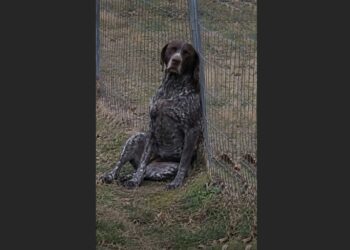
He was a Saint Bernard weighing approximately 110 pounds, with a thick brown-and-white coat, enormous paws, and gentle eyes that made him look almost worried when people passed without stopping.
Whenever someone approached, he would move closer to the gate and carefully push the toy toward the bars.
Sometimes visitors smiled. Sometimes they stopped to admire him.
But almost always, they continued toward the smaller dogs.
After a while, Barnabé would lower the bone, walk back to the rear of his kennel, and rest his heavy head against the wall.
I’d watched him repeat that routine for eighteen months.
Then, one morning around ten, a 69-year-old woman walked into our shelter carrying a stack of worn blankets.
She hadn’t come looking for a dog.
But when she stopped in front of Barnabé’s kennel, he did something I’d never seen him do before.
He dropped his blue bone.
And for the first time in a very long while, someone stayed.
The Giant Dog Who Had Lost His Home
My name is Chloé, and I work as a caregiver at an animal shelter.
Over the years, I’ve met dogs of nearly every imaginable size and temperament. Some are frightened when they arrive. Others are outgoing from the beginning. Many need time to adjust to unfamiliar people, sounds, and routines.
Barnabé was one of the largest dogs in our care.
His former family had surrendered him after moving, explaining that he took up too much space.
I didn’t know every detail of their circumstances. I couldn’t say whether they’d struggled to find housing suitable for a large dog or whether other difficulties influenced their decision.
What I knew was that Barnabé had lost the home he was accustomed to.
And at approximately 110 pounds, he wasn’t the kind of dog every potential adopter felt prepared to accommodate.
Saint Bernards are substantial animals. Their size can make ordinary responsibilities more demanding, from providing enough room to handling veterinary care and daily transportation.
But when I looked at Barnabé, I saw more than his enormous frame.
He was gentle in his interactions with us, responsive to familiar people, and particularly attached to one small object.
A blue rubber bone.
It soon became the first thing I looked for whenever I passed his kennel.
The Blue Bone He Carried Everywhere
I don’t remember exactly when Barnabé began carrying the blue bone to the gate whenever visitors arrived.
But once the habit developed, it became remarkably consistent.
He would notice someone approaching, pick up the toy, and walk toward the bars.
Sometimes he held it in his mouth while watching the person.
Other times, he lowered his head and pushed it gently toward the gate.
I couldn’t know precisely what he intended. Dogs carry familiar toys for many reasons. An object can be associated with play, attention, or simply comfort in an unfamiliar environment.
But Barnabé’s behavior was difficult to overlook.
He seemed particularly interested in showing the toy whenever people came near.
The contrast always made me smile a little.
Here was an enormous Saint Bernard carrying a comparatively small blue rubber bone, presenting it with the careful movements of a dog much smaller than himself.
I sometimes hoped a visitor would recognize the invitation and spend a few minutes getting to know him.
Occasionally, someone did stop.
But those encounters rarely lasted long.
And Barnabé remained at the shelter.
Eighteen Months of Watching People Walk Past
As the months passed, I began noticing a pattern.
Families entered the shelter and walked along the rows of kennels, stopping wherever a dog caught their attention.
Many smiled when they saw Barnabé.
Some commented on his beautiful coat.
Others seemed amazed by his size.
But that same size often appeared to give people pause.
I understood their hesitation.
Adopting a dog is a serious commitment, and a giant breed requires careful consideration. Not every household has the space, resources, or physical ability to care for an animal as large as Barnabé.
I didn’t want someone to adopt him simply because they felt sorry for him.
I wanted him to find a home where his needs could be met for the long term.
Still, it was difficult watching family after family move on.
Barnabé would stand near the kennel gate with his blue bone.
When the visitors disappeared down the hallway, he often remained there briefly before turning away.
Then he’d settle at the back of the enclosure.
His large body filled much of the space, and his head would come to rest against the wall.
I knew better than to assume he understood that people were choosing other dogs.
But I could see that his opportunities for interaction were brief and that he had spent a very long time waiting for a permanent home.
The Part of My Day I Found Hardest
I cared about all the animals at our shelter.
Some needed medical attention. Others needed patient handling or help adjusting to unfamiliar surroundings. Every dog came with individual needs.
But Barnabé became especially memorable to me.
There was something about the regularity of his routine that made his long stay impossible to ignore.
I would see him carrying his toy in the morning.
Later, when visitors arrived, I would watch him move toward the gate.
And by the end of the day, I would often find him resting quietly in the back of his kennel.
I tried to give him attention whenever my responsibilities allowed.
I knew he enjoyed gentle contact and familiar company, and I wanted his days to include more than waiting for visitors.
But shelter care, however devoted, cannot provide every dog with the experience of living in a suitable family home.
There are people coming and going, other animals needing attention, and routines designed to care for many dogs at once.
Barnabé deserved a place where he could settle into the ordinary rhythm of a household.
For eighteen months, we hadn’t found that place.
Then one morning, the front bell rang.
A Woman Arrived With a Stack of Old Blankets
It was around ten o’clock when an elderly woman entered the shelter.
She wore a gray coat and walked with a slight stoop.
In her arms was a stack of worn blankets.
She approached me and held them out.
“I brought these,” she said softly. “My husband always believed in helping animals. I thought they might be useful.”
I thanked her.
Donations like hers were appreciated. Blankets could help provide comfortable resting places for animals in our care, and we were always grateful when members of the community thought of the shelter.
The woman’s name was Béatrice.
She was sixty-nine years old.
There was something quiet and thoughtful about the way she spoke. She didn’t seem to be in a hurry, but she also hadn’t arrived with the enthusiasm of someone planning to adopt a pet.
She had brought something she believed would help.
I offered to show her around the shelter.
At first, she hesitated.
Then she agreed.
I didn’t think much of it at the time.
People sometimes liked to see the animals their donations would support.
I assumed Béatrice would walk through the kennels, meet a few dogs, and return home.
I had no idea that one of our longest-serving residents was about to leave with her.
The Walk Through the Kennels
We began walking along the shelter corridor.
Béatrice moved slowly, stopping at nearly every kennel.
She didn’t rush toward the most excited dogs or focus only on those immediately trying to attract attention.
Instead, she seemed interested in observing them.
Sometimes she stood quietly for a while before moving on.
I told her a little about the animals as we passed.
She listened carefully.
I noticed that she seemed comfortable with silence. She didn’t feel obligated to fill every moment with conversation.
That made the walk feel unusually peaceful despite the familiar activity of the shelter.
As we approached Barnabé’s area, I wondered what she’d think of him.
His size was usually the first thing visitors noticed.
At 110 pounds, he was difficult to overlook, especially when he approached the gate.
And, as always, he had his blue rubber bone nearby.
He noticed us coming.
His tail began moving gently.
Then he picked up the toy.
I had seen the sequence so many times that I could almost predict what he would do next.
But Béatrice wasn’t like most visitors.
When we reached his kennel, she stopped.
And she stayed.
The Moment Barnabé Dropped His Toy
Barnabé approached the gate with the blue rubber bone in his mouth.
He stood in front of Béatrice, watching her.
His tail continued moving.
Normally, this was the moment when he would push the toy toward the bars, almost as though he wanted the visitor to notice what he was carrying.
But Béatrice didn’t simply glance at him and move on.
She stood there looking at him.
Neither appeared in a hurry.
For a moment, Barnabé held the toy between his jaws.
Then he opened his mouth.
The blue rubber bone fell to the kennel floor.
I was surprised.
I had watched him approach visitors hundreds of times, and offering that toy had become such a familiar part of his behavior that I didn’t expect him to abandon it while someone was standing at the gate.
But he seemed more interested in Béatrice than in the bone.
He moved closer and pressed himself gently against the kennel gate.
Béatrice continued watching him.
Then she turned toward me.
“May I meet him?” she asked.
I looked at Barnabé, standing quietly beside the bars.
“Of course,” I told her.
And I opened the gate.
An Enormous Dog Sitting on Her Shoes
Barnabé stepped out slowly.
He didn’t bark or rush forward.
He approached Béatrice with the same gentle manner I’d come to know during his time at the shelter.
She remained still, allowing him to come closer.
Then, to my amazement, he sat directly on her shoes.
His enormous body leaned gently against her legs.
A Saint Bernard of his size could easily overwhelm someone who wasn’t prepared for him, so I watched carefully. But Béatrice appeared comfortable, and Barnabé wasn’t jumping or behaving roughly.
He simply wanted to be close.
Then he raised his head and rested it against her knees.
Béatrice lowered her hand.
Her fingers disappeared into the thick brown-and-white fur around his neck.
Barnabé let out a long sigh.
For several moments, neither moved very much.
I watched them quietly.
It was such an ordinary interaction in one sense: a friendly dog leaning against a person who was petting him.
But after eighteen months of watching Barnabé greet visitors through kennel bars, the sight of him sitting comfortably beside someone felt especially meaningful.
He wasn’t holding his blue bone anymore.
He was simply enjoying the attention.
Forty-Seven Years Together
Béatrice continued stroking Barnabé’s fur.
After a while, she began speaking.
“My husband passed away last autumn,” she whispered.
I looked toward her.
“We were together for forty-seven years.”
Her eyes filled with tears.
I stayed quiet.
Forty-seven years is a long time to share a life with another person.
I couldn’t begin to know all the ordinary experiences and memories that marriage had held for her.
But I could hear how much she missed him.
“Since he died, the house has been so quiet,” she said.
Barnabé remained beside her, his head resting near her knees.
Béatrice continued moving her hand through his coat.
I thought about the blankets she’d brought that morning.
She had said her husband believed in helping animals.
Perhaps donating them had been a way to continue something that mattered to him.
I didn’t ask.
She was sharing something personal, and I wanted to give her room to speak without turning the moment into a series of questions.
Then she looked down at Barnabé.
“He knows what waiting feels like, doesn’t he?”
I nodded.
“He has been here for eighteen months.”
She became quiet again.
A House That Had Become Too Quiet
I could see Béatrice thinking as she continued petting Barnabé.
She had arrived at the shelter carrying old blankets.
She hadn’t asked to see available dogs or mentioned any intention of adopting.
But now she was sitting with an enormous Saint Bernard who appeared perfectly content to remain beside her.
I wondered what she was considering.
Living with a dog Barnabé’s size would require more than affection.
He needed enough room to move comfortably, appropriate exercise, regular grooming, and someone capable of managing the practical responsibilities of caring for a giant breed.
Béatrice was sixty-nine, and she moved carefully.
I didn’t want her to feel pressured into taking home a dog simply because their first meeting had been touching.
But she seemed to be thinking about much more than that brief encounter.
She had told me about the silence in her house after her husband’s death.
Perhaps she was imagining what it might be like to share that house with a companion again.
Barnabé shifted slightly but remained close.
Then Béatrice smiled through her tears.
“My house is much too big for just me,” she said. “But I think it would be perfect for the two of us.”
For a moment, I could hardly believe what I’d heard.
After eighteen months, someone was seriously considering bringing Barnabé home.
The Adoption I Had Almost Stopped Expecting
We talked about Barnabé and what caring for him would involve.
His size was an important consideration, and I wanted Béatrice to understand the responsibilities she would be taking on.
But she didn’t seem frightened by the prospect of sharing her home with such a large dog.
She had met him.
She’d seen how gently he approached her and how comfortable he seemed during their interaction.
And she wanted him to have a place in her life.
I tried to keep my own emotions from getting ahead of the practical arrangements.
There was paperwork to complete and a permanent commitment to consider.
A successful adoption needed to work for both the dog and the person caring for him.
Still, I couldn’t help feeling hopeful.
I remembered the many times I’d watched Barnabé approach the gate with his blue bone, only to see visitors continue down the corridor.
Now Béatrice was staying.
She wasn’t comparing him with the smaller dogs.
She wasn’t asking whether he could become less enormous.
She was looking at the dog in front of her and considering how he might fit into her home.
Once the adoption arrangements were completed, Barnabé was ready to leave with her.
The Day Barnabé Walked Out of the Shelter
When Béatrice left, Barnabé walked calmly beside her.
I watched them go.
For eighteen months, the shelter had been his home.
He’d become familiar with its routines, the people who cared for him, and the kennel where he kept his favorite blue toy.
Now he was leaving that environment for somewhere entirely different.
I hoped the transition would be comfortable for him.
A dog who’s spent a long time in a shelter may need patience while adjusting to the quieter, more personal routines of a household.
There would be new sounds, new places to rest, and a person whose habits he would gradually learn.
But Béatrice had already shown something important during their first meeting.
She wasn’t in a hurry to make Barnabé perform or behave in a particular way.
She was content to sit with him.
And he seemed comfortable doing the same.
I knew that companionship couldn’t remove the grief of losing a husband after forty-seven years together.
But it could bring warmth and familiar company into ordinary days.
That was what I hoped they would find together.
I returned to my work after they left.
Barnabé’s kennel was empty.
For once, seeing it that way made me smile.
The Letter Written in Green Ink
A few weeks later, I received a handwritten letter.
The words were written in green ink.
It was from Béatrice.
I recognized her name immediately and stopped to read.
She wanted me to know how Barnabé was doing.
According to her letter, he had settled beautifully into his new home.
They had developed a comfortable daily routine together.
Each morning, Béatrice woke to the sound of his heavy tail thumping happily against the floor.
I could almost picture him.
That enormous Saint Bernard, once waiting beside his kennel gate with a blue rubber bone, now greeting a familiar person in the morning.
Béatrice wrote about their gentle walks through the garden.
They passed the rosebushes her husband had planted.
That detail stayed with me.
The garden was still part of the life she’d shared with him.
The flowers remained, and she could walk past them while remembering the years they’d spent together.
But now she had company on those walks.
Barnabé followed her through the garden and rested near her chair.
He also enjoyed sleeping peacefully in the shade of the flowers.
I smiled as I read.
It sounded like exactly the kind of quiet home life I’d hoped he would find.
The Rosebushes Her Husband Had Planted
I kept thinking about the garden described in Béatrice’s letter.
Her husband had planted the rosebushes.
After forty-seven years together, those plants must have belonged to a much larger collection of familiar memories.
I imagined how strange the garden might have felt in the months after his death.
The flowers would still grow.
The familiar paths would remain.
But the person who’d helped create that space was no longer there.
I couldn’t know whether Béatrice found those memories comforting, painful, or a mixture of both.
What I knew from her letter was that she had started enjoying walks there with Barnabé.
He didn’t need to understand the garden’s history.
He could simply accompany her.
Dogs can become familiar with walking routes, household routines, and the people who care for them. They can offer companionship through ordinary presence rather than any understanding of human grief.
That was what seemed to be happening.
Béatrice had someone beside her during the morning.
And Barnabé had a garden to explore and a comfortable place to rest.
Neither of them needed a dramatic new beginning.
They needed a daily life they could enjoy.
According to her letter, that was exactly what they were building.
The Blue Bone on the Mantelpiece
Then I reached the part of the letter that made me stop and smile.
Béatrice wrote about Barnabé’s blue rubber bone.
The familiar toy had a new place in her house.
It was resting on the mantelpiece.
She had kept it as a reminder of the day they met.
I looked up from the letter for a moment.
I remembered Barnabé standing in his kennel with the bone in his mouth.
I remembered the enormous dog approaching visitor after visitor, gently pushing the toy toward the bars.
And I remembered the morning Béatrice stopped in front of him.
He’d held the bone briefly, then let it fall to the floor.
At the time, I’d been surprised because it was different from his usual behavior.
Now the object he’d carried through so many shelter mornings had become part of his new home.
Béatrice didn’t need the blue bone to make Barnabé approach her.
He already followed her through the house.
He rested near her chair.
And each morning, his tail greeted her with a familiar thumping against the floor.
The toy could remain on the mantelpiece.
It had become a keepsake of their first meeting.
What Eighteen Months Couldn’t Tell Us
After reading the letter, I thought about how easily people can misunderstand a dog by focusing on one obvious characteristic.
For Barnabé, that characteristic was his size.
He was enormous.
Anyone considering adopting him needed to take that seriously.
But his size wasn’t the whole story.
He was also gentle, affectionate, and comfortable sharing quiet moments with people.
Those were qualities that didn’t always become obvious during a brief walk past his kennel.
A visitor might see 110 pounds of Saint Bernard and immediately think about space, grooming, food, or the difficulty of handling such a large animal.
Those concerns were reasonable.
But they could also overshadow the individual dog.
Béatrice had taken the time to stop.
She watched him.
Then she asked to meet him.
Their interaction didn’t guarantee that every future day would be effortless. Dogs still require care, and large dogs bring substantial responsibilities.
But it gave her the opportunity to see more than his size.
And it gave Barnabé the opportunity to become comfortable with someone who genuinely wanted to know him.
That small decision changed the course of his life.
The Widow Who Came to Give Something Away
There’s another part of this story that I think about often.
Béatrice didn’t enter the shelter intending to adopt a dog.
She came carrying old blankets.
Her husband had believed in helping animals, and she wanted to continue that kindness in a practical way.
She was giving something useful to dogs who needed care.
Then she walked through the shelter and met Barnabé.
He had been there for eighteen months.
He hadn’t been chosen by the families who passed his kennel, and his size had made finding a suitable home difficult.
Béatrice was living with a different kind of absence.
After forty-seven years of marriage, her husband was gone, and the house they’d shared had become painfully quiet.
I would never suggest that adopting Barnabé could replace her husband or erase that loss.
That wasn’t what she described in her letter.
She still remembered him.
She still walked past the rosebushes he had planted.
But now those walks included the gentle company of a large brown-and-white dog.
And Barnabé, who once spent his mornings watching strangers pass, had a person whose familiar routine he could share.
Their needs weren’t identical.
But their companionship seemed to be helping them both.
The Kennel I No Longer Have to Visit
I still remember Barnabé’s old kennel.
For so long, it had been part of my daily routine.
I could picture him near the gate before I even reached that section of the shelter.
There would be the blue rubber bone.
The enormous paws.
The gentle movement of his tail when someone approached.
Then, so often, the familiar sight of him returning to the back of the enclosure after the visitors moved on.
I don’t know whether Barnabé experienced those departures as disappointment in the way a person might.
It wouldn’t be fair to place that kind of human interpretation onto every movement he made.
But he clearly enjoyed familiar attention.
And he had spent eighteen months without the stable home he needed.
Now he wasn’t waiting behind a kennel gate.
He had a comfortable place to sleep.
He had a garden where he could take gentle walks.
And he had a person who enjoyed having him nearby.
Sometimes, during a busy day at the shelter, I remember Béatrice’s letter and feel grateful that she decided to accept my invitation to walk through the kennels.
She could have simply left the blankets and gone home.
Instead, she stopped to meet the dogs.
And one of them went home with her.
Somewhere Beside the Rosebushes
I read Béatrice’s letter twice before putting it away.
The green ink, the details of the garden, and the description of Barnabé’s tail thumping against the floor stayed with me.
But it was the blue bone on the mantelpiece that I remembered most.
For eighteen months, that little toy had been part of nearly every morning I spent caring for Barnabé.
He would carry it toward visitors, and I would hope someone might stop long enough to get to know him.
Eventually, most people moved on.
Then Béatrice arrived.
She was sixty-nine, recently widowed, and carrying blankets she thought might help the shelter animals.
She didn’t need a particular breed or a certain size of dog.
She hadn’t even planned to adopt.
But she stopped in front of Barnabé.
And instead of walking away, she asked to meet him.
Today, according to her letter, their mornings begin with the sound of a heavy tail against the floor.
They walk through the garden past the roses her husband planted.
When Béatrice sits down, Barnabé can rest nearby.
And when the afternoon is warm, he can sleep in the shade of the flowers.
I sometimes picture the enormous Saint Bernard settling into the grass while Béatrice enjoys her garden.
His thick coat, his oversized paws, and that gentle expression I remember so well.
There are no kennel bars separating him from the person who cares for him.
He doesn’t need to carry his blue toy to the gate each morning.
The bone is on the mantelpiece now, a small reminder of a day that began with a donation of old blankets.
And somewhere in the house, Barnabé is enjoying the ordinary life he waited eighteen months to find.
A familiar voice.
A comfortable place to rest.
And a woman who chose him exactly as he was.
Editor’s Note: The characters in this story are fictional. Through these stories, we hope to share the intelligence, loyalty, compassion, and loving nature of dogs with people everywhere.