The first night Titan came into my home, I showed him a large, soft dog bed and said four simple words.
“It’s yours, Titan.”
He didn’t move.
He stood beside the bed, staring at it as though he had no idea what I expected him to do.
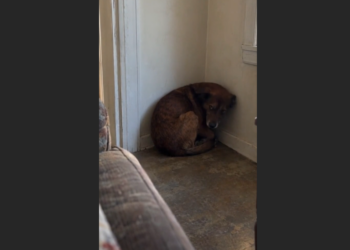
His body was tense. His ears tilted back, and his dark eyes moved between me and the cushion.
Titan had spent ten years living on a chain.
For most of his life, his movements had been restricted to the small area the chain allowed him to reach.
Now he was standing inside a warm house, with a comfortable bed that belonged entirely to him.
But he wouldn’t step onto it.
I knelt several feet away.
I didn’t pull him forward or try to place him on the cushion.
Instead, I rested my hand on the edge of the bed.
“It’s okay, sweetheart,” I whispered. “You can sleep here.”
Titan watched me.
A long moment passed.
Then he cautiously lifted one paw.
He placed it on the cushion.
Stopped.
Looked toward me again.
And slowly placed his second paw beside the first.
I stayed completely still.
At last, the big dog lowered himself onto the soft bed.
He rested his muzzle on his front paws and closed his eyes.
I sat beside him, struggling to hold back tears.
After ten years of being chained, Titan finally had somewhere comfortable to rest.
What I didn’t understand that night was how long it would take him to become comfortable with the ordinary things most dogs experience every day.
A full food bowl.
An open backyard.
A toy.
A place on the couch.
And the simple freedom to walk wherever he wanted.
But over the next two months, Titan began showing me that even after ten years of confinement, he could still learn to enjoy a different life.
The Dog Who Had Known Only a Chain
Before Titan came home with me, his world had been terribly small.
For ten years, he’d lived restrained by a chain.
He couldn’t simply wander across a yard.
He couldn’t choose a different place to rest when he wanted.
And he hadn’t known the ordinary comfort of living inside a caring home.
I knew his adjustment wouldn’t be easy.
An animal who has spent that long in restrictive conditions may need considerable time to become familiar with new surroundings.
But knowing that intellectually and seeing it firsthand are very different things.
The first time I brought Titan inside, I watched him examine the unfamiliar environment.
There were rooms he could enter.
Floors he could walk across.
A doorway leading to the backyard.
And a soft bed waiting for him.
Everything was available.
But Titan approached the house cautiously.
He moved close to the walls.
He seemed uncertain whenever something made an unfamiliar sound.
Even small changes in my position could cause him to stop and watch me.
I wanted him to understand that he was safe.
But I quickly realized that I couldn’t explain safety to him with a few reassuring words.
I would have to show him through the ordinary way I cared for him.
Again and again.
For as long as he needed.
The Bed He Didn’t Know How to Use
The dog bed was one of the first things I prepared for Titan.
I chose a soft cushion large enough for his body.
After so many years of sleeping on hard ground, I wanted him to have somewhere comfortable to rest.
It seemed like such a simple gift.
But when I showed it to him, he stopped at the edge.
I could see that he was interested.
He looked down at the cushion.
Then back at me.
He didn’t appear to understand what to do with it.
I wondered whether he’d ever had access to a soft bed before.
I couldn’t know for certain.
But judging by the way he approached it, the sensation was unfamiliar.
So I knelt nearby.
I placed my hand against the cushion and gave him time to investigate.
For a long while, he simply watched.
Then he took that first step.
One paw on the bed.
Then another.
Finally, he lowered his large body onto it.
I remember how carefully he moved, as though testing whether the cushion would support him.
Once he was settled, he rested his muzzle on his paws.
His eyes gradually closed.
I stayed nearby.
I didn’t want to disturb him.
That night, Titan slept on the soft bed I’d prepared.
And I realized how meaningful an ordinary dog bed could become when an animal had spent so many years without one.
The Morning He Was Still There
The following morning, I approached quietly.
Titan was still lying on the bed.
He was in almost exactly the same position he’d chosen the previous evening.
His breathing was deep and steady.
For a moment, I simply watched him.
The house was quiet.
He had a comfortable place to sleep.
And nobody was asking him to move.
I gently approached and waited until he noticed me.
When Titan opened his eyes, he looked at me cautiously.
The guarded expression I’d seen the night before hadn’t disappeared.
I hadn’t expected it to.
One peaceful night couldn’t erase ten years of difficult experiences.
But he was still resting on the cushion.
He hadn’t spent the night pacing through the room or trying to hide somewhere else.
I was encouraged.
I spoke softly and allowed him to get up when he was ready.
There would be no need to hurry him.
I wanted him to become familiar with the fact that his bed would remain there.
He didn’t have to earn it.
It wasn’t something he could lose because he moved the wrong way.
It was simply a place where he could rest.
And it would be waiting for him again that evening.
The First Breakfast
That morning, I prepared Titan’s breakfast.
I filled his bowl with dog food and added a little warm water.
Then I placed it where he could eat comfortably.
Titan approached slowly.
He seemed interested in the smell.
But when he reached the bowl, he stopped.
His ears moved slightly backward.
He looked toward me instead of lowering his head to eat.
I stood still, giving him room.
He continued watching.
I wondered whether he’d experienced unpredictable feeding routines in the past.
I didn’t know the details of every meal he’d been given during those ten years.
But I knew that regular, dependable access to food was something he needed now.
“Go ahead, Titan,” I said gently. “It’s yours.”
He looked at the bowl again.
Then, slowly, he lowered his head.
At first, he ate cautiously.
He paused occasionally and glanced toward me.
I didn’t approach or interfere.
I simply let him eat.
Gradually, he became more focused on the food.
I felt relieved.
It was only breakfast.
But for Titan, learning that he could eat undisturbed in this unfamiliar house was an important part of settling in.
The Ordinary Sounds That Frightened Him
During the first few days, I began noticing how easily Titan startled.
The sound of a spoon touching a bowl could make him tense.
A door opening unexpectedly caught his attention.
Even the rustling of clothing sometimes caused him to turn quickly toward me.
I tried to become more aware of my movements.
I didn’t want to surprise him unnecessarily.
But I also knew the house couldn’t remain completely silent.
Titan needed time to become accustomed to ordinary household activity.
So I maintained a predictable routine.
I moved calmly.
I avoided forcing contact.
And when he became uncomfortable, I allowed him space.
Sometimes he walked along the edges of a room rather than crossing through the middle.
Sometimes he stopped when I moved.
Other times, he simply watched until he understood what was happening.
I reminded myself not to interpret those behaviors as stubbornness.
He wasn’t refusing to enjoy his new home.
He was learning how to live in an environment unlike the one he’d known for most of his life.
And that process would take patience.
The Rubber Ball
I wanted Titan to have something he could play with.
So I brought him a soft rubber ball.
I placed it on the floor where he could investigate it.
He looked at it.
Then he looked toward me.
I gently moved the ball a little closer.
Titan watched without approaching.
I wondered whether he’d ever been given toys.
Most dogs I’ve known have at least some interest in chasing, carrying, or investigating objects.
But Titan didn’t seem to know what to make of the ball.
He wasn’t ready to play.
And I decided not to pressure him.
I left the toy available.
Perhaps he’d become interested later.
If not, that was all right too.
He had more important things to adjust to.
Regular meals.
Comfortable rest.
The presence of a person who wasn’t going to hurt him.
And the unfamiliar freedom to move through a house without being restrained.
I began understanding that enjoyment couldn’t be demanded.
Titan would explore new experiences when he felt comfortable enough to do so.
The ball could wait.
The First Time I Opened the Back Door
The moment that affected me most during those early days happened in the backyard.
I opened the glass door and allowed Titan to look outside.
Beyond the doorway was green grass.
There was room to walk.
Room to investigate.
And no chain limiting how far he could go.
Titan stepped outside cautiously.
He moved a short distance onto the lawn.
Then stopped.
He lowered his head and looked toward the ground.
I stood nearby, wondering what had caught his attention.
But he didn’t move.
He remained within a small area close to the doorway.
I encouraged him gently.
He looked toward me, then back at the grass.
I realized he seemed reluctant to move beyond a distance that was roughly consistent with the restricted space he’d once been accustomed to.
For ten years, the chain had limited his movements.
Now it was gone.
But he hadn’t yet become comfortable exploring farther.
The yard was open to him.
He simply wasn’t ready to use all that space.
And seeing him stand there, with so much room around him, made my heart ache.
The Invisible Boundary
Titan remained almost motionless on the grass.
I didn’t want to push him.
But I wondered whether having someone familiar farther away might encourage him to explore.
So I carried a chair into the yard.
I placed it some distance from the back door and sat down.
Then I spoke softly.
“Come here, Titan.”
He looked toward me.
I remained seated.
There was no leash pulling him forward.
No command he had to obey.
I simply gave him the opportunity to approach.
For a while, he stayed where he was.
Then he lifted one paw.
He hesitated.
Finally, he placed it farther forward.
Another step followed.
Then another.
I watched quietly.
He continued moving across the grass, stopping occasionally to look around.
It was a small journey in an ordinary backyard.
But for a dog who had spent a decade restrained, it felt significant.
When Titan finally reached me, he sat beside my feet.
Then he rested his large head against my knees.
I laughed softly with relief.
Titan lifted his head and looked at me.
And I gently stroked his fur.
More Than Two Meters
That afternoon, I kept thinking about how far Titan had walked.
It wasn’t a remarkable distance for most dogs.
Just a short walk across a backyard.
But he’d initially stopped within a few feet of the door.
He seemed uncomfortable moving beyond the limited area he’d first chosen.
Then, with time and gentle encouragement, he’d crossed the grass to sit beside me.
I couldn’t know whether Titan was consciously remembering the exact length of his old chain.
And I didn’t want to reduce all his behavior to one explanation.
But his confinement had clearly limited his experience of moving freely.
Now he needed opportunities to discover that he could explore in a safe environment.
I decided to let him continue learning at his own pace.
I didn’t expect him to run across the yard immediately.
I didn’t need him to chase a ball or investigate every corner.
I was happy to see him become comfortable taking a few steps farther.
Over time, those steps could become a walk.
And those walks could become something he enjoyed.
The End of the Second Week
By the end of the second week, I began noticing meaningful changes.
Titan was becoming more comfortable around his food.
He no longer became quite so tense whenever I approached the area near his bowl.
He was settling into the routine of regular meals.
He knew where his bed was.
And he seemed increasingly familiar with the ordinary sounds of my home.
That didn’t mean he had stopped being cautious.
Some noises still startled him.
Unexpected movement could make him retreat.
But the reactions were beginning to become less frequent.
I also started taking him on gentle daily walks.
At first, the experience made him nervous.
There were unfamiliar smells.
Sounds he hadn’t heard from his former confined space.
And other animals moving nearby.
I kept the walks manageable.
I paid attention to his comfort and allowed time for him to investigate when it was safe.
Gradually, he began showing more interest.
He sniffed trees.
Stopped to notice unfamiliar scents.
And occasionally watched other dogs with quiet curiosity.
Sometimes his tail moved slightly.
I found myself looking forward to those outings.
They weren’t long or especially adventurous.
But Titan was beginning to explore a world he’d rarely had the chance to experience.
Discovering the Neighborhood
Our walks became a regular part of Titan’s day.
He began recognizing the routine.
When it was time to go outside, he no longer seemed quite as uncertain.
I still moved at a pace that suited him.
After ten years of confinement, it wouldn’t have been reasonable to expect the stamina or confidence of a dog who’d always had regular exercise.
But he was becoming interested in his surroundings.
He investigated trees and patches of grass.
He noticed the movement of birds.
He stopped to sniff places that seemed ordinary to me but were clearly worth investigating to him.
Occasionally, we passed other dogs.
I made sure interactions remained appropriate and didn’t pressure him to approach.
Sometimes Titan watched quietly.
Other times, his tail gave a small movement.
I liked seeing that curiosity.
He wasn’t simply moving from one place to another because I asked him to.
He was beginning to investigate the environment.
The dog who had once seemed unable to leave a small area of the backyard was now becoming comfortable taking walks with me.
And every time we returned home, his soft bed was waiting.
The Third Week
During the third week, something happened that I’ll always remember.
It was evening.
I was sitting on the couch reading a book.
Titan had been resting nearby.
The house was quiet.
I wasn’t trying to train him or encourage him to do anything.
Then I noticed him approach.
He stopped in front of the couch.
I lowered my book.
Titan looked toward me.
Then toward the empty space beside me.
For a moment, he remained still.
I didn’t call him up immediately.
I wanted him to decide whether he felt comfortable coming closer.
He lifted one front paw and placed it on the cushion.
Then he stopped again.
I smiled.
“It’s okay, Titan.”
He shifted his weight carefully.
Then climbed onto the couch.
I moved slightly to make room for him.
And he settled beside me.
For the first time, Titan had chosen to join me on the couch.
Without being lifted.
Without being coaxed.
He’d simply decided he wanted to rest there.
His Head on My Lap
Once Titan was on the couch, he moved closer.
Then he stretched out beside me.
His large head came to rest on my lap.
I placed my hand gently against his fur.
He released a long breath.
Then closed his eyes.
I sat there for a while, hardly moving.
Three weeks earlier, Titan had stood beside a dog bed, uncertain whether he could step onto it.
Now he was comfortable enough to climb onto the couch and rest against me.
The change felt enormous.
But I reminded myself that it hadn’t happened all at once.
There had been many ordinary days between those moments.
Meals.
Quiet evenings.
Short walks.
And opportunities for Titan to approach me without pressure.
I hadn’t made him trust me through one perfect gesture.
He was becoming familiar with the care I provided.
And he was increasingly comfortable choosing where to rest.
That evening, he chose my lap.
I continued reading with one hand resting lightly on his head.
And when he settled more comfortably, I let him sleep.
The Morning I Found Him on His Back
A few mornings later, I opened the bedroom door and found Titan sleeping in his bed.
But this time, he was in a completely different position.
He was lying on his back.
All four paws were raised.
His belly was exposed.
And he was sleeping deeply.
I stopped in the doorway.
Then I smiled.
For a dog who had initially approached the bed with such hesitation, seeing him sprawled across it was wonderful.
He was no longer lying in the careful, guarded position he’d chosen on his first night.
He appeared comfortable.
I knew that dogs sleep on their backs for several reasons.
Sometimes it’s simply a comfortable position.
Sometimes it helps them regulate their temperature.
It doesn’t necessarily prove that every fear has disappeared.
But in Titan’s case, seeing him sleep so openly was encouraging.
He had become familiar enough with his surroundings to rest in a position I’d never seen him use before.
I let him continue sleeping.
There was no reason to wake him.
And as I quietly closed the door, I thought about that first evening again.
The big dog staring at a soft cushion.
Unsure whether he could lie down.
Now he was stretched across it as though he’d finally discovered just how comfortable it could be.
The Nights That Were Still Difficult
Titan’s progress wasn’t completely smooth.
There were still difficult nights.
Sometimes he woke suddenly.
His breathing became rapid.
He looked startled and uncertain about his surroundings.
I couldn’t know whether he was dreaming about his past.
And I couldn’t know exactly what triggered those moments.
But I could see that he was distressed.
When it happened, I approached calmly.
I didn’t rush toward him or force him to accept contact.
Instead, I sat on the floor nearby.
I spoke softly.
I allowed him time to settle.
Sometimes it took a while.
Gradually, his breathing became steadier.
He would look around the familiar room.
Then, when he was ready, he would rest again.
Those nights reminded me that recovery doesn’t always follow a straight line.
A dog can become comfortable with a bed, enjoy walks, and seek affection while still having moments of fear.
It didn’t mean Titan was going backward.
It meant he continued to need care suited to his history.
I learned not to treat every difficult moment as a failure.
Sometimes the most useful thing I could do was remain calm and give him time.
The Toy He Finally Wanted
Do you remember the rubber ball Titan barely acknowledged during his first days?
I kept it available.
I didn’t try to force him to play.
Over time, as he became more comfortable, Titan began showing more interest in toys.
Eventually, he discovered a stuffed sheep.
That became one of his favorite things.
He liked carrying it.
Sometimes he shook it enthusiastically.
Other times, he settled with it nearby.
It was wonderful to see a dog who had once approached almost everything with caution becoming interested in play.
He also began enjoying retrieving the ball.
At first, his attempts were hesitant.
Then he started participating more willingly.
I laughed the first time he brought it back with that unmistakable look of anticipation.
Here was the same dog who had stood frozen at the edge of his bed.
Now he was showing interest in games.
Of course, I remained mindful of his age and physical condition.
After ten years of confinement, exercise needed to remain appropriate for him.
But seeing Titan enjoy gentle play was one of the happiest parts of our new routine.
Two Months Together
When I first brought Titan home, the arrangement was supposed to be temporary.
I was fostering him.
My responsibility was to provide a safe environment while he adjusted and recovered.
Eventually, the plan was for him to find a permanent home.
At least, that was what I’d told myself.
But after two months together, my feelings had changed.
I knew his habits.
I understood which situations made him uncomfortable.
I recognized when he wanted to rest and when he was interested in going outside.
I knew how much he enjoyed the soft dog bed.
How he sometimes approached the couch in the evening.
And how pleased he could become when I picked up his favorite toy.
Titan had become part of my daily life.
More importantly, I had become responsible for providing the familiar routine he’d gradually learned to trust.
I found myself thinking about what it would mean to move him again.
Another unfamiliar home.
Another set of routines.
Another period of adjustment.
There might have been good families prepared to care for him.
But I realized I was willing and able to make that commitment myself.
I didn’t want Titan to leave.
And I decided he didn’t have to.
“This Is Your Home. Forever.”
One summer evening, Titan and I were sitting together in the garden.
The sun was beginning to set.
He was resting near my chair, comfortable in the familiar yard.
I looked at him.
His coat had improved.
His body was stronger.
And he no longer seemed as uncertain about moving through the grass.
I thought about the two months we’d spent together.
The first night.
The food bowl.
The backyard.
The couch.
And the mornings when I found him sleeping peacefully on his bed.
Then I leaned toward him.
“Titan,” I said softly, “no more moving from place to place. This is your home. Forever.”
He lifted his head.
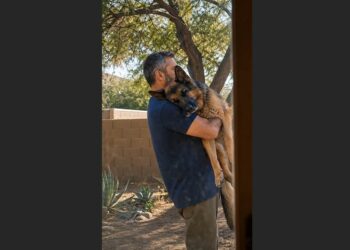
Then moved closer and pressed his shoulder against my knee.
I rested a hand on his back.
I knew he didn’t understand the meaning of permanent adoption in the way I did.
But he knew me.
He knew the house.
And he had become familiar with the routines we’d created.
I hoped he would continue enjoying them for many years.
That evening, the temporary foster arrangement became a permanent home.
Titan was staying.
The Dog Who Grew Comfortable With People
As time passed, I began noticing how much more comfortable Titan had become around familiar people.
During our earliest days, even small household sounds could make him startle.
He moved close to the walls.
He watched my hands carefully.
And he was hesitant about physical contact.
Now he sometimes approached me for affection.
He enjoyed gentle petting.
And he had developed more confidence during our walks.
One day, while we were outside, a woman stopped to admire him.
She spoke to him gently.
I watched Titan closely, making sure he was comfortable with the interaction.
At first, he approached cautiously.
Then he moved a little closer.
And gently licked her hand.
The woman smiled.
I felt a quiet sense of pride.
I remembered how much he had struggled around unfamiliar people.
Now, under appropriate circumstances, he was willing to approach someone new.
I didn’t expect him to greet every stranger.
I would never force him to.
But I was pleased that he could enjoy a gentle interaction without appearing overwhelmed.
It was another sign of how far he’d come.
The Difference I See in His Eyes
Titan looks different now.
His coat is healthier and shinier.
His muscles have become stronger.
And he moves through the house with greater confidence.
But the biggest changes aren’t always physical.
I notice them in the way he responds to familiar routines.
When I prepare his food, he approaches without the same hesitation I saw during his first breakfast.
When I open the back door, he can step outside and explore the yard.
When I sit on the couch, he sometimes comes over and settles beside me.
And when he’s tired, he knows exactly where his bed is.
He no longer needs me to show him.
Sometimes I watch him walk across the grass and remember the first time he stopped only a short distance from the doorway.
Back then, he seemed uncertain about moving farther.
Now he can explore the yard comfortably.
The chain is gone.
And over time, he’s become more accustomed to the freedom that replaced it.
What Ten Years Can’t Be Erased From
I wish I could say that Titan never becomes frightened anymore.
But that wouldn’t be accurate.
He still has moments when something unexpected makes him uneasy.
Sometimes an unfamiliar sound catches his attention.
Occasionally, he needs a little extra time to settle.
I don’t know whether every one of those reactions is connected to his years of confinement.
Dogs can become startled for many reasons.
But his history matters, and I try to remain attentive to what makes him comfortable.
I don’t expect him to behave like a dog who has always lived in a caring home.
He spent ten years in conditions that restricted his movement and opportunities.
Those years were part of his life.
I can’t give them back.
And I can’t change the experiences he had before coming to me.
What I can do is provide dependable care now.
Regular meals.
Comfortable rest.
Appropriate exercise.
Gentle affection.
And the freedom to explore without being forced into situations that frighten him.
I’ve learned that helping Titan doesn’t mean expecting his past to disappear.
It means caring for the dog he is today.
The Soft Bed That Started Everything
Sometimes, when I walk past Titan’s bed, I remember our first evening together.
He stood beside the cushion.
His body was tense.
He watched me carefully.
I remember resting my hand against the fabric and telling him:
“It’s yours.”
It was such a simple thing to say.
I didn’t imagine that those words would become an important part of how I thought about caring for him.
But over the following weeks, I repeated the same idea in different ways.
When I placed food in his bowl.
When I opened the door to the garden.
When I showed him a toy.
And when he approached the couch, uncertain whether he could join me.
I wanted Titan to become comfortable knowing that ordinary things were available to him.
He could rest.
He could eat without being disturbed.
He could explore.
And he could approach me when he wanted company.
No dramatic lesson made those changes happen.
It took repetition.
Patience.
And the willingness to let him move at a pace he could manage.
The First Paw on the Cushion
Of all the moments we’ve shared, I still think about that first paw.
Titan standing beside the bed.
Looking uncertain.
Then slowly lifting one paw and placing it on the cushion.
He paused for what felt like a long time.
Then he placed his other front paw beside it.
I was kneeling nearby.
I didn’t reach for him.
I didn’t try to push him forward.
I simply waited.
Eventually, he settled onto the bed.
He rested his muzzle on his paws.
And closed his eyes.
At the time, I felt that I’d witnessed something important.
Now I understand why.
It wasn’t that Titan had suddenly learned to trust everything around him.
He hadn’t.
But he had been given a new experience.
And he’d become comfortable enough to try it.
The days that followed brought many more moments like that.
Some were small.
Some took weeks.
But together, they gradually changed his daily life.
A Different Kind of Freedom
Before Titan came home, I’d thought about freedom mostly in physical terms.
Removing the chain.
Providing an open yard.
Allowing him to walk and rest where he wanted.
Those things were essential.
But living with him helped me recognize that freedom also requires familiarity and confidence.
A dog can be standing in an open yard and still hesitate to explore.
He can have a comfortable bed and still be uncertain about using it.
He can be offered gentle affection and still need time before approaching.
Titan showed me that removing a restriction doesn’t immediately make the unfamiliar feel safe.
He needed opportunities to become accustomed to his new surroundings.
And he needed those opportunities to be repeated.
At first, he stood near the back door.
Then he walked toward my chair.
Eventually, he explored more of the yard.
The same thing happened inside.
First, he slept on his bed.
Then he became comfortable with ordinary household sounds.
And later, he climbed onto the couch to rest beside me.
Those changes developed gradually.
And each one helped him enjoy a little more of the life that was now available to him.
The Dog Sleeping on His Back
Today, one of my favorite sights is Titan sleeping in his bed.
Sometimes he’s curled comfortably on his side.
Other times, he’s stretched out with his legs extended.
And occasionally, I find him lying on his back with all four paws in the air.
When I see that, I smile.
I remember the dog who once stood at the edge of the same bed, too cautious to step onto it.
The bed hasn’t changed much.
It’s still the comfortable place I prepared for him.
But Titan’s relationship with it has changed enormously.
He knows where it is.
He returns to it when he’s tired.
And he appears comfortable sleeping in whatever position suits him.
There is something deeply reassuring about seeing that.
He doesn’t need to spend every waking moment close to me.
He doesn’t need constant encouragement.
Sometimes he’s content simply being a dog.
Resting.
Stretching.
Playing with his stuffed sheep.
Or investigating the backyard.
That’s the life I wanted him to have.
The Walk We Take Together
These days, Titan and I enjoy our daily walks.
We move at a comfortable pace.
He stops to sniff trees and patches of grass.
Sometimes he watches birds moving nearby.
Sometimes he notices another dog and pauses to observe.
I give him time when it’s safe.
I don’t need every walk to cover a certain distance.
I know he spent ten years unable to move freely.
Now I want our outings to be something he enjoys.
Occasionally, a neighbor stops to admire him.
I explain that he’s an older rescue dog who has made a great deal of progress.
People often comment on his calm manner.
Some notice his shiny coat.
Others smile when he approaches gently for attention.
They see the dog he is today.
They don’t necessarily know about his first days in my home.
The bed he hesitated to use.
The bowl he approached so cautiously.
Or the small area of grass he was initially afraid to leave.
But I remember.
And every time Titan walks comfortably beside me, I’m grateful for the changes we’ve shared.
The Evening He Chose the Couch
Sometimes Titan still climbs onto the couch when I’m reading.
He approaches quietly.
Waits for me to make room.
Then settles beside me.
Often, he rests his head on my lap.
I stroke his fur while I read.
It has become one of our most familiar routines.
But I haven’t forgotten the first time he did it.
During our third week together, Titan approached with obvious hesitation.
He placed one paw on the cushion.
Then looked at me.
He seemed uncertain.
I smiled.
And he climbed beside me.
That was the first time he’d voluntarily chosen to rest so close.
Now the couch is simply another comfortable place in the house.
Sometimes he joins me.
Sometimes he prefers his own bed.
Either choice is fine.
I like knowing he can decide.
For a dog who spent ten years at the end of a chain, that ordinary freedom is something I don’t take for granted.
The Home That Became His
It’s been a remarkable change to watch Titan become comfortable in our home.
When he arrived, even a food bowl could make him hesitate.
Now he approaches mealtimes with interest.
He once seemed uncertain about moving beyond a small part of the backyard.
Now he enjoys exploring the grass and accompanying me on walks.
He didn’t know what to do with a toy.
Now he carries his stuffed sheep and sometimes brings back his ball.
He was frightened by ordinary household sounds.
Now he often remains comfortable while daily life continues around him.
And the dog who once stood beside a soft bed, hesitant to lie down, now sleeps deeply in it.
I don’t believe affection alone caused every change.
He needed consistent care, time, and an environment where his needs were respected.
But our relationship has grown alongside his confidence.
I’ve learned his habits.
He’s become familiar with mine.
And over the past two months, a temporary foster arrangement has become a permanent home.
“It’s Yours, Titan.”
Sometimes I sit outside with Titan in the evening.
The sun begins to set.
The yard becomes quiet.
And he settles beside my chair.
I look down at his large body resting comfortably in the grass.
Then I think about the ten years he spent restrained.
I think about how uncertain he was when I first brought him home.
How he hesitated beside his bed.
How carefully he approached his food.
And how he initially seemed unable to walk farther into the backyard.
There were moments when I wished I could make everything easier for him.
When I wanted him to understand immediately that nobody was going to punish him for stepping onto a cushion or approaching a bowl.
But I couldn’t give him that understanding through words alone.
I had to provide ordinary, dependable care and give him time to become comfortable.
Now Titan has his own bed.
His food.
His toys.
A yard where he can explore.
And a person who intends to care for him for the rest of his life.
Sometimes he comes over and rests his head against my knees.
Other times, he simply lies in the grass and enjoys the evening.
I appreciate both.
I no longer need every moment to be a sign of dramatic progress.
Sometimes it’s enough to see him comfortable.
Ten Years on a Chain. A Lifetime Deserving Better.
I can’t change Titan’s first ten years.
I can’t return the opportunities he missed or undo the conditions he lived through.
And I can’t promise that he’ll never experience fear again.
But I can make sure his life now is different.
When I prepare his breakfast, I give him room to eat comfortably.
When he wants to rest, he has a soft place to sleep.
When we walk outside, I allow him time to investigate the things that interest him.
And when he approaches me for affection, I welcome him gently.
He has become a familiar part of my life.
I recognize his footsteps.
I know where he likes to sleep.
And I smile when he carries his stuffed sheep across the room.
For two months, I watched a dog who had spent a decade chained gradually become more comfortable with ordinary freedom.
Then I realized I didn’t want him to move to another home.
I wanted to continue caring for him.
So I told him he could stay.
Forever.
Tonight, when I finish my day, Titan will have a choice.
He may rest in his comfortable bed.
He may come to the couch and place his head on my lap.
Or he may stretch out somewhere quiet and fall asleep.
Whatever he chooses, I won’t make him move simply because I expect something different.
I still remember the first evening.
The soft cushion.
His uncertain expression.
And the moment he finally placed one paw onto the bed.
Then another.
He lowered himself carefully and closed his eyes.
I whispered, “It’s yours, Titan.”
At the time, I was talking about a dog bed.
Today, those words mean something much bigger.
The bed is his.
The yard is his to explore safely.
The toys are his to enjoy.
And the home where he has learned to rest, eat, play, and seek affection is his too.
After ten years of living at the end of a chain, Titan no longer has to spend his days confined to the same small patch of ground.
He can walk beside me.
Rest comfortably.
And enjoy the ordinary life of a loved family dog.
This is his home.
And he doesn’t have to leave.
Editor’s Note: The characters in this story are fictional. Through these stories, we hope to share the intelligence, loyalty, compassion, and loving nature of dogs with people everywhere.