The first time we placed Milo in the same enclosure as Bruno, I was afraid we’d made a mistake.
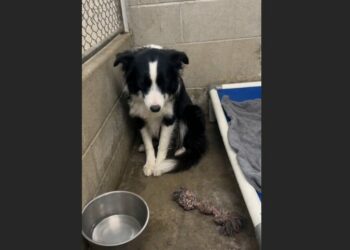
Milo was a six-month-old Pit Bull puppy who had arrived at our shelter deeply frightened of people, unfamiliar sounds, and almost everything around him.
He trembled constantly.
He avoided contact.
And no matter how carefully we approached him, he struggled to settle.
Bruno was an aging Saint Bernard who had spent eight long years at our shelter without finding a permanent family.
He was enormous, with graying fur around his face and joints that had grown stiff with age.
For years, people had walked past his kennel.
Some stopped to admire him.
Others commented on his size.
But nobody took him home.
That evening, we decided to see whether the older dog’s calm presence might help Milo feel more comfortable.
I carefully guided the puppy into Bruno’s enclosure.
The moment the gate closed, Milo pressed himself against the metal bars.
His body trembled.
His head dropped.
And he stood completely still, looking as though he didn’t know where to go.
Bruno was lying on his old blanket at the opposite end of the enclosure.
He lifted his gray muzzle.
Looked toward the frightened puppy.
Then quietly rested his head on his paws again.
He didn’t bark.
He didn’t growl.
He didn’t rush forward.
For a long time, nothing happened.
Then Bruno slowly got up.
He walked toward Milo, stopped beside him, and gently lowered himself onto the floor.
He didn’t demand attention.
He simply lay down nearby.
Several minutes passed.
Then Milo began moving.
He sniffed the older dog’s fur.
Lowered himself cautiously onto the floor.
And settled against Bruno’s warm body.
Twenty minutes later, the puppy who had struggled to relax since arriving at our shelter was sleeping in the middle of the enclosure.
With his head resting beside an old Saint Bernard whom nobody had chosen for eight years.
I stood watching, hardly able to believe the change.
And that was only the beginning.
The Puppy Who Was Afraid of Everything
When Milo arrived at the shelter, he was only six months old.
He should have been at an age when curiosity and play were becoming important parts of his daily life.
But the puppy we met was extremely frightened.
His background involved cruelty and isolation, and his behavior suggested that unfamiliar experiences were difficult for him.
He often kept his body low.
Sudden sounds made him tense.
And when someone approached, he sometimes retreated as far as he could.
His breathing could become rapid when he was overwhelmed.
Even ordinary shelter activity seemed difficult for him to tolerate.
The sound of a kennel door opening.
Footsteps in the hallway.
People speaking nearby.
Other dogs barking.
Things that many shelter animals gradually become accustomed to appeared to unsettle Milo.
We tried to give him quiet spaces and predictable care.
We understood that his recovery would take time and that fearful behavior needed to be managed carefully.
But progress was slow.
Some days, Milo barely wanted to move from the place where he felt most protected.
He wasn’t ready to approach the volunteers who cared for him.
And he frequently remained tense even when nobody was interacting directly with him.
I began worrying about how difficult shelter life was becoming for such a young dog.
Then someone suggested we consider whether a calm canine companion might help.
And I thought of Bruno.
The Saint Bernard Nobody Had Chosen
Bruno had been at our shelter for eight years.
Eight years of seeing other animals arrive and leave.
Eight years of visitors stopping outside kennels, meeting dogs, and eventually choosing someone else.
Bruno was a large Saint Bernard with a gentle disposition.
His face had grown gray.
His movements had become slower.
And his joints were noticeably stiff as he aged.
He spent much of his time resting on an old, comfortable blanket.
He wasn’t the kind of dog who rushed toward the gate whenever a visitor appeared.
He preferred a quieter approach.
When familiar staff members came near him, he generally welcomed their attention calmly.
He seemed to enjoy gentle affection without needing constant activity.
I had always thought he would make a lovely companion for someone prepared to care for a very large, aging dog.
But finding that person had been difficult.
His size intimidated some visitors.
His age discouraged others.
People worried about the responsibilities involved in caring for a senior Saint Bernard.
I understood those concerns.
Large dogs need adequate space, appropriate food, regular veterinary attention, and assistance as their mobility changes.
Not every household is suited to those requirements.
But after eight years, I was beginning to wonder whether Bruno would ever leave the shelter.
I certainly never imagined that a frightened puppy might be the one to change his future.
The Decision to Introduce Them
We knew we had to be careful.
Milo was young, frightened, and easily overwhelmed.
Bruno was large and elderly.
Even a friendly older dog might be uncomfortable with an anxious puppy entering his resting space.
Sharing an enclosure was not something we could treat casually.
Their behavior and compatibility mattered.
We needed to watch for signs that either dog was becoming distressed.
But Bruno had consistently shown a calm manner around familiar people, and we hoped that, with careful observation, his quiet presence might help Milo.
That evening, we arranged for the dogs to spend time together.
I led Milo toward Bruno’s enclosure.
The puppy was already tense.
His paws moved hesitantly, and he repeatedly looked around.
When we reached the gate, I paused.
Bruno was resting on his blanket.
He lifted his head as he noticed us.
I carefully guided Milo inside.
Then I closed the gate.
Milo immediately moved toward the metal bars.
His body became rigid.
He lowered his head and stood trembling.
I stayed close enough to monitor the situation.
I wasn’t sure whether the introduction would help.
And I was prepared to intervene if either dog showed signs that the arrangement wasn’t safe.
The First Few Minutes
Bruno remained on his blanket.
He watched Milo for a moment.
Then he lowered his muzzle onto his front paws.
He didn’t try to approach immediately.
He didn’t stare insistently at the puppy.
And he showed no sign of wanting to challenge him.
Milo stayed against the gate.
His breathing was rapid.
His body trembled visibly.
I could see that he wasn’t comfortable.
The shelter was growing quieter as evening approached.
I dimmed the main hallway light, leaving a small nightlight on.
I should have returned to my office to finish the day’s reports.
But I couldn’t stop thinking about the two dogs.
So I remained nearby, observing through the viewing window and checking the surveillance camera.
For several minutes, Milo barely moved.
Bruno rested.
I wondered whether we’d need to end the introduction and try another approach.
Then the older Saint Bernard lifted his head again.
And slowly, he stood.
When Bruno Walked Toward Milo
Getting up wasn’t easy for Bruno anymore.
His joints were stiff, and he moved carefully.
I watched him rise from the blanket and begin walking toward the puppy.
My attention sharpened immediately.
Milo was already frightened.
I didn’t want the approach of such a large dog to overwhelm him further.
But Bruno moved slowly.
He didn’t charge forward.
He approached from an angle, keeping his head relatively low.
Milo remained against the gate.
He appeared uncertain, and his body stayed tense.
Bruno stopped beside him.
For a moment, neither dog moved.
Then the older Saint Bernard began lowering himself.
He settled onto the floor near Milo.
Close enough for the puppy to investigate him.
But without forcing contact.
Bruno released a long breath and rested.
It was an ordinary movement for a tired older dog.
He had simply chosen another place to lie down.
But the effect on Milo was something I hadn’t expected.
The puppy began looking toward him.
The First Time Milo Rested Beside Another Dog
Milo remained still for several minutes.
He seemed uncertain about what to do.
Then he lowered his muzzle slightly.
He began sniffing the air near Bruno.
The Saint Bernard continued resting.
He didn’t turn suddenly or try to move closer.
Milo shifted his paws.
He investigated the older dog’s fur.
Then, slowly, he lowered himself onto the floor.
I leaned closer to the window.
The puppy settled beside Bruno.
Their bodies were nearly touching.
For a while, Milo remained alert.
But gradually, his trembling appeared to ease.
His breathing became slower.
And instead of retreating to a corner, he stayed beside the old dog.
I kept watching.
I was relieved that the interaction appeared calm.
But I didn’t want to disturb them.
About twenty minutes later, Milo’s eyes closed.
He was asleep.
In the middle of the enclosure.
Beside Bruno.
It was the first time since his arrival that I’d seen him rest so comfortably in an open area rather than pressing himself against a wall.
I stayed nearby until I was satisfied they were both settled safely.
Then I finally left them to rest.
What We Found the Next Morning
The following morning, I returned with one of my colleagues.
I wanted to see how the dogs had managed through the night.
I approached the enclosure quietly.
Then I stopped.
Bruno was lying on his old blanket.
His large body rested on one side.
And Milo was curled close to him.
The puppy’s head lay directly across Bruno’s broad front paws.
Neither appeared distressed.
They were simply resting together.
My colleague stood beside me for a moment without speaking.
Then he leaned closer and whispered:
“For eight years, we thought nobody would choose Bruno. Maybe he was waiting to be chosen by the one who needed him most.”
I understood what he meant.
Of course, we couldn’t know what Bruno had been waiting for.
He hadn’t spent eight years deliberately preparing to help a frightened puppy.
But it was impossible not to appreciate the scene.
The old dog whom so many visitors had overlooked was providing quiet companionship to an animal who’d struggled to relax.
And the frightened puppy had chosen to sleep beside him.
I looked at the two dogs.
For the first time in days, I felt genuinely hopeful about Milo.
A Different Way of Eating
Over the following days, we continued observing their interactions carefully.
Milo’s behavior began changing.
One of the first improvements involved mealtimes.
Before meeting Bruno, he had often been too tense to eat comfortably when there was activity nearby.
He preferred areas where he felt less exposed.
But now he began eating more readily while Bruno was nearby.
The older Saint Bernard approached his own food calmly.
Milo sometimes watched him.
Then the puppy approached his bowl as well.
He gradually became more comfortable eating in the main part of their shared space.
It wasn’t a sudden cure for fear.
Milo could still become unsettled.
There were sounds and situations that made him cautious.
But having Bruno nearby seemed to provide a familiar point of reference.
We continued making sure each dog had appropriate access to food and that neither was pressured by the other.
The change was encouraging.
Milo was eating more comfortably.
And we were beginning to see him participate in ordinary activities that had previously seemed difficult.
The Puppy Who Followed the Old Dog
As the days passed, Milo began following Bruno around.
Not constantly.
But often enough that we noticed a pattern.
When Bruno approached the water bowl, Milo sometimes came along.
When the Saint Bernard moved toward a sunny spot on the floor, the puppy often settled nearby.
If Bruno returned to his blanket, Milo frequently followed.
I enjoyed watching them develop that routine.
Bruno moved at his own pace.
He wasn’t young enough for energetic games, and we made sure Milo’s presence didn’t interfere with his rest.
But the older dog seemed comfortable with the puppy nearby.
And Milo appeared increasingly interested in his surroundings.
Instead of staying frozen in one place, he began moving through the enclosure.
He investigated familiar objects.
He approached his food and water.
And he spent more time resting away from the corners.
There were still difficult moments.
We didn’t expect his fear to disappear completely.
But the difference from his first days at the shelter was noticeable.
Milo was beginning to participate in daily life.
Learning to Approach People
The changes weren’t limited to Milo’s interactions with Bruno.
He also began responding differently to the shelter staff.
Bruno was comfortable around familiar volunteers.
When someone he knew approached, he usually remained relaxed and accepted gentle petting.
Milo often watched those interactions.
At first, he kept his distance.
Then he began staying nearby instead of immediately retreating.
We continued approaching him carefully.
We didn’t assume that because he trusted Bruno, he would automatically become comfortable with people.
Human contact had been difficult for him.
He needed separate opportunities to build familiarity with the staff.
But having Bruno close seemed to make some of those interactions easier.
One morning, I approached with treats.
Milo noticed me.
Normally, he might have hurried toward the back of the enclosure.
This time, he stayed near Bruno.
I stopped at a comfortable distance.
Milo watched me.
Then his tail moved.
Just a little.
I almost missed it.
But it was there.
A small, hesitant wag.
The Morning Milo Wagged His Tail
I remember smiling when I saw that first little movement.
It wasn’t dramatic.
Milo didn’t jump toward me.
He didn’t suddenly become an outgoing, confident puppy.
He simply remained beside Bruno while his tail moved slightly.
But after the fearful behavior I’d seen during his first days, the moment meant a great deal.
I knew one tail wag couldn’t tell us everything about how he felt.
Dogs communicate through their entire bodies, and context matters.
Still, Milo was beginning to approach ordinary interactions with less visible tension.
He was eating.
Exploring.
Resting comfortably.
And showing more interest in familiar caregivers.
Bruno’s presence appeared to be helping him settle, alongside the consistent care and patient handling he received.
I found myself looking forward to checking on them each morning.
There was something reassuring about seeing the two dogs together.
The enormous Saint Bernard resting on his blanket.
And the young Pit Bull curled nearby.
One was in the later years of life.
The other was barely beginning his.
Yet they’d become comfortable sharing the same space.
Eight Years Without a Home
As Milo improved, I kept thinking about Bruno.
He had spent eight years at our shelter.
He’d watched countless visitors walk past his enclosure.
People often looked at him and admired his size.
But when adoption conversations became serious, practical concerns usually took over.
He was a large dog.
He was aging.
And he needed a family prepared for the responsibilities that came with both.
After so many years, we’d almost become accustomed to the idea that Bruno might remain with us permanently.
But I never stopped hoping someone would choose him.
Now, something unexpected was happening.
People were becoming interested in Bruno’s story.
Not simply because he was an elderly Saint Bernard who’d spent years waiting.
But because of his relationship with Milo.
We shared their story on our shelter website.
We explained how the frightened puppy had gradually become more comfortable while spending time near the older dog.
And we made it clear that the two had developed a close relationship.
A few weeks later, a family contacted us.
They wanted to meet Bruno.
The Family Who Came for Bruno
The family had read about Bruno online.
They were moved by the fact that he had spent eight years at the shelter.
They wanted to give the aging Saint Bernard a permanent home.
I was delighted.
After so long, someone was finally interested in adopting him.
But I was also worried.
Bruno and Milo had become closely attached.
The puppy often rested beside the older dog.
He followed him during ordinary activities.
And he appeared more comfortable when Bruno was nearby.
I didn’t want to assume that separating them would necessarily cause the same difficulties we’d seen at the beginning.
But I knew their relationship needed to be considered seriously.
I also knew that an adoption had to be suitable for Bruno.
He deserved a home capable of meeting his needs.
The family arrived to meet him.
We brought them to the area where the dogs were staying.
Bruno was resting.
Milo was nearby.
I began explaining the older dog’s history and care requirements.
The family listened.
They seemed genuinely interested.
And for a moment, I allowed myself to imagine Bruno finally leaving the shelter.
The Moment Milo Moved Toward the Door
The family spent time with Bruno.
The large Saint Bernard responded calmly.
He was familiar with people approaching him gently, and he seemed comfortable with the visit.
Eventually, the father took Bruno’s leash.
The family was preparing to move toward the exit.
That’s when Milo reacted.
The young Pit Bull approached.
Then he positioned himself between Bruno and the doorway.
He sat down.
His head was lowered.
He looked toward the people around him.
I stopped and watched.
I couldn’t know exactly why he’d chosen that place.
Perhaps he wanted to stay close to Bruno.
Perhaps the movement toward the door had made him uncertain.
But I recognized the familiar behavior of a puppy who had become accustomed to staying beside the older dog.
Bruno also remained close to Milo instead of immediately continuing toward the exit.
The mother noticed.
She looked at Milo.
Then at Bruno.
For a moment, the family remained quiet.
I felt torn.
I’d spent years hoping Bruno would find a home.
But now that the opportunity was in front of us, I was worried about the younger dog who had become so attached to him.
“We Can’t Separate Them.”
The mother continued watching Milo.
The puppy remained beside Bruno.
The large Saint Bernard stood calmly, showing little interest in moving away from his young companion.
I began explaining more about their relationship.
How Milo had struggled after arriving.
How he had slept beside Bruno on their first night together.
And how his behavior had gradually improved during the following weeks.
The family listened carefully.
Then the mother looked toward us.
Her eyes were wet.
“We can’t separate them,” she said. “They’ve been through too much together. We’ll adopt both.”
For a moment, I couldn’t speak.
They had come to the shelter intending to adopt one elderly Saint Bernard.
Now they were offering a home to both Bruno and Milo.
I was moved.
But we also needed to consider the practical responsibilities.
A senior Saint Bernard and a young Pit Bull have very different needs.
Bruno required care suited to his age and mobility.
Milo needed patient socialization, training, and ongoing support as he grew.
The family had to be prepared for both.
We discussed those responsibilities before completing the adoption arrangements.
They understood that bringing the dogs home together would require time, space, and attention.
And they were willing to provide it.
Two Dogs Leaving Together
When the adoption arrangements were complete, I watched Bruno and Milo prepare to leave.
I thought about how different they looked from the first evening they’d shared an enclosure.
Milo had been trembling against the metal gate.
Bruno had been lying quietly on his old blanket.
Neither had known what their new arrangement would become.
Now they were leaving with a family.
Together.
For Bruno, it meant something we’d been hoping to see for eight years.
A permanent home.
For Milo, it meant the opportunity to continue living beside the familiar companion who’d helped him become more comfortable.
I watched them make their way toward the exit.
Bruno moved at his slower, careful pace.
Milo stayed nearby.
I felt relieved that we hadn’t been forced to choose between finding Bruno a family and preserving the relationship the dogs had developed.
The family was prepared to care for both.
And that afternoon, two dogs with very different histories left the shelter side by side.
A House With a Fenced Backyard
Today, Bruno and Milo live together in a comfortable home with a large fenced backyard.
Their family provides the care each needs.
Bruno has quiet places to rest and a routine suited to his age.
Milo has opportunities for appropriate activity, training, and continued learning.
The two dogs remain close.
I visit them regularly to see how they’re doing.
Each time I arrive, I’m reminded how much their circumstances have changed.
The shelter kennels are behind them.
They no longer spend their nights surrounded by the sounds of unfamiliar dogs.
They have a family.
A familiar house.
And places where they can rest comfortably.
One of my favorite places to find them is near the large living room window.
There’s a soft rug there.
And more often than not, both dogs are resting on it.
Sometimes Milo is curled close to Bruno.
Other times, they’re simply lying nearby, enjoying the quiet.
It’s an ordinary scene.
But I never get tired of seeing it.
The Puppy Who Grew Up
Milo has grown considerably since those first frightened days.
His body is stronger.
His coat is healthy and shiny.
And his behavior around familiar people has changed.
When I visit, he often approaches me with his tail wagging.
Sometimes he comes over looking for affection.
I can gently pet him, and he seems happy to receive the attention.
It’s difficult not to remember the six-month-old puppy who once trembled so badly he could barely move away from the kennel gate.
He had been frightened of nearly everything.
Even familiar shelter routines were difficult for him.
Now he moves around his home with greater confidence.
That doesn’t mean every effect of his early experiences has disappeared.
He still deserves patient handling and appropriate care.
But he has become more comfortable with people and ordinary daily activities.
And after greeting me, he often does something familiar.
He returns to Bruno.
The Head Against Bruno’s Back
Once the excitement of my arrival has passed, Milo usually settles near the older dog again.
Sometimes he curls up beside him on the rug.
Other times, he gently rests his head against Bruno’s broad back.
Bruno remains quiet.
He is still the same aging Saint Bernard who prefers calm surroundings and comfortable places to sleep.
His movements are slow.
His face has grown grayer.
And he still needs care appropriate for a senior dog.
But he no longer spends his days waiting in a shelter kennel.
He has a home.
He has people responsible for his needs.
And he has a younger companion who often chooses to rest beside him.
I watch them together and think about the first night.
The trembling puppy.
The old dog slowly getting up.
The careful approach.
And the moment Milo finally lowered himself beside Bruno.
Neither dog knew what the future would bring.
But that quiet introduction became the beginning of a relationship that eventually helped both find a permanent home.
What Bruno Taught Me
For years, I thought about Bruno mainly as a dog who had been overlooked.
He was large.
He was getting older.
And families kept choosing younger or smaller animals.
I’d become accustomed to explaining his age and care requirements whenever someone showed interest.
But seeing him with Milo reminded me that a dog’s value isn’t measured by how quickly someone adopts him.
Bruno didn’t need to be young or energetic to offer companionship.
He didn’t need to perform a trick or attract attention at the kennel gate.
He was simply a calm, familiar presence.
And for Milo, that seemed to matter.
I don’t believe Bruno understood the puppy’s past or deliberately set out to help him recover.
But dogs can influence one another’s behavior.
And in this case, Milo appeared to become more comfortable while spending time beside a calm older companion.
The relationship benefited Bruno too.
It brought attention to his story.
And eventually, it helped lead to a family willing to adopt both dogs.
After eight years, Bruno finally went home.
What Milo Taught Me
Milo changed the way I thought about progress in frightened animals.
When he arrived, I desperately wanted to see him become comfortable.
But his fear was intense.
He trembled.
He hid.
He struggled to eat normally during the day.
And he seemed overwhelmed by ordinary shelter activity.
I worried because he was so young.
It felt unfair that a six-month-old puppy had already experienced so much distress.
But his adjustment didn’t happen through one dramatic moment.
The first night beside Bruno was important.
Yet the real progress came afterward.
Through repeated days of familiar routines.
Quiet interactions.
Careful observation.
And opportunities to approach people and explore his surroundings without being forced.
He gradually became more comfortable eating.
He began moving around more freely.
He approached familiar caregivers.
And eventually, he wagged his tail when I came near.
Those changes took time.
Seeing Milo now reminds me that a frightened dog doesn’t need to become confident overnight.
Small improvements matter.
And sometimes, the presence of another suitable dog can be part of that process.
The Night I’ll Never Forget
I still remember standing outside the enclosure that evening.
Milo was pressed against the gate, trembling.
Bruno was resting on his old blanket.
I’d been worried that bringing the two together might be too much for the puppy.
Then Bruno stood.
He crossed the enclosure slowly.
He settled beside Milo.
And waited.
The puppy didn’t immediately relax.
For several minutes, he remained tense and uncertain.
But eventually, he lowered his nose.
Sniffed the older dog.
And lay down beside him.
Twenty minutes later, Milo was asleep.
I remember watching the steady movement of his breathing.
I remember the enormous Saint Bernard resting quietly beside him.
And I remember how relieved I felt that Milo had found a way to settle.
The following morning, my colleague and I discovered them sleeping together on Bruno’s blanket.
Milo’s head was resting across the older dog’s front paws.
My colleague whispered:
“For eight years, we thought nobody would choose Bruno. Maybe he was waiting to be chosen by the one who needed him most.”
I’ve thought about those words many times since.
The Dog Nobody Wanted
Eight years is a long time for an animal to spend in a shelter.
I watched Bruno grow older while other dogs found homes.
I saw visitors admire him and then choose someone else.
I worried about how his increasing age would affect his chances.
And I wondered whether he would spend the rest of his life with us.
Then Milo arrived.
A frightened six-month-old puppy who could barely settle in his kennel.
We introduced them carefully, hoping the calm older dog might make the environment less overwhelming.
To our relief, they became comfortable together.
And over the following weeks, their relationship developed.
Milo followed Bruno.
Rested beside him.
And gradually showed more interest in food, people, and ordinary activities.
We shared Bruno’s story online.
A family read it.
They came to meet him.
And when they saw Milo beside him, they decided they didn’t want to separate the pair.
Bruno had waited eight years for a permanent family.
Milo had arrived frightened and uncertain.
Now both were going home.
Together.
The Home They Share Today
Whenever I visit Bruno and Milo, I like to sit quietly and watch them for a little while.
Milo usually comes toward me first.
He recognizes me now.
His tail moves, and he approaches for attention.
I gently pet him.
Then, once he’s satisfied, he goes back to Bruno.
The old Saint Bernard is often resting on the large rug near the living room window.
Milo settles beside him.
Sometimes he places his head against Bruno’s back.
And the two remain there, comfortable in the familiar room.
I think about the difference between that scene and the shelter enclosure where they first met.
Back then, Milo could barely stop trembling.
Bruno was an aging dog who had spent years without being chosen.
Now there is no kennel gate between them and the family who cares for them.
They have regular meals.
Comfortable places to sleep.
A fenced yard.
And people who understand that a growing young dog and an aging Saint Bernard need different kinds of attention.
It’s the ordinary life we hoped they would find.
And I’m grateful they’re living it together.
Two Dogs Who Changed Each Other’s Future
Working at an animal shelter has taught me that we can’t always predict which animal will connect with which person.
Or which dogs will become comfortable sharing space.
We have to consider safety, temperament, health, and each animal’s individual needs.
Not every frightened puppy will benefit from being placed with an older dog.
And not every senior dog will welcome a young companion.
But Bruno and Milo developed a relationship that seemed to help them both.
For Milo, Bruno became a familiar presence during a difficult period.
For Bruno, their bond eventually brought him to the attention of a family who was willing to provide a permanent home.
I can’t know whether Bruno recognized that the puppy needed reassurance.
And I can’t know exactly how Milo interpreted the old dog’s calm behavior.
But I know what I observed.
A frightened puppy who couldn’t settle gradually became comfortable enough to sleep beside him.
Then eat near him.
Then approach familiar people.
And finally, leave the shelter with him.
That was enough to make their story unforgettable.
The Two Dogs on the Rug
Today, when I walk into their family’s home, I often find the same familiar scene.
Bruno is resting on the soft rug near the living room window.
His large body is relaxed.
His graying face rests comfortably against the floor.
Milo is nearby.
He has grown from a trembling six-month-old puppy into a stronger, more confident young dog.
He may hurry over to greet me.
But before long, he usually returns to the older Saint Bernard.
Then he settles beside him.
Sometimes with his head resting across Bruno’s back.
I remember the night we first introduced them.
How frightened Milo was.
How carefully Bruno stood.
And how the old dog quietly lowered himself beside the puppy without demanding anything in return.
I remember waiting outside the enclosure until I saw Milo finally fall asleep.
And I remember the next morning, when my colleague and I found the puppy resting with his head on Bruno’s broad paws.
For eight years, Bruno had been the dog nobody chose.
Then one evening, a frightened puppy found comfort beside him.
A few weeks later, a family arrived intending to take the old Saint Bernard home.
But when they saw Milo staying close, they made room for both.
Now those dogs share a home, a family, and a comfortable place to rest.
The young one still seeks the older dog’s company.
And the old one no longer has to spend his nights on a shelter floor.
Whenever I see them sleeping together, I think about how their futures changed because we gave them the opportunity to get to know each other.
Bruno didn’t need to become younger to deserve a home.
Milo didn’t need to become fearless to deserve one.
They simply needed people willing to recognize their individual needs and care for them.
After eight years of waiting, Bruno finally found his family.
And Milo, who had arrived afraid of almost everything, found a companion who helped him become comfortable enough to begin exploring the world.
When I look at them now, I don’t see an unwanted old dog and a frightened puppy.
I see two dogs resting peacefully in the home they share.
And I remember the first night, when Bruno slowly lay down beside Milo.
The puppy waited.
Then moved closer.
And finally fell asleep.
It was a small moment.
But it changed where both of them would spend the rest of their lives.
Editor’s Note: The characters in this story are fictional. Through these stories, we hope to share the intelligence, loyalty, compassion, and loving nature of dogs with people everywhere.