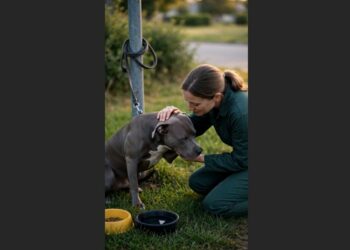
Every dog at the shelter seemed to be trying to get someone’s attention.
Every dog except one.
He was a three-year-old Golden Retriever mix with pale golden fur, darker ears, and a gentle face that most visitors never got close enough to see.
He spent nearly every day lying in the far corner of his kennel.
When families approached, he didn’t stand.
When they called his name, he didn’t wag his tail.
And when someone opened the kennel for cleaning, he made no attempt to come forward.
He simply stayed on his thin blanket, watching the world from the back of the enclosure.
His kennel card described him in three words:
Friendly. Gentle. Needs time.
But time was exactly what most visitors didn’t have.
They stopped.
Called to him.
Waited a few seconds.
Then continued down the aisle to meet the dogs who were more eager to greet them.
Eventually, a volunteer named Emily began noticing something unusual about him.
He wasn’t completely unaware of the people around him.
His eyes followed their movements.
His ears responded to their voices.
But whenever someone stood near his kennel, he seemed reluctant to move.
Then, one afternoon, a man in a gray jacket sat down outside his door.
He didn’t call the dog repeatedly.
He didn’t reach through the gate.
He just waited.
And for the first time since Emily had begun watching him, the Golden Retriever slowly stood up and started walking toward someone.
The Dog Who Stayed in the Corner
Emily was in her late twenties and had been volunteering at the shelter long enough to recognize how differently dogs responded to unfamiliar surroundings.
Some barked constantly.
Some paced.
Others leaned against the kennel gates, eager for attention.
But this Golden Retriever was unusually withdrawn.
His pale coat was slightly uneven, with one side flattened from resting in the same position so often.
He kept his body tucked inward.
His head rested low.
And his eyes remained open, quietly following the activity around him.
Every morning, Emily checked his food and water.
She spoke softly when she passed.
Sometimes she crouched beside his kennel for a minute.
“Hey there, sweet boy.”
He would blink.
Occasionally lift his head.
Then settle again.
He didn’t growl or show aggression.
But he didn’t approach either.
At first, Emily assumed he was still adjusting.
The shelter could be loud and overwhelming, especially for a dog who wasn’t comfortable around unfamiliar people.
But as the days passed, she grew more concerned.
Even when the kennel door was opened during routine care, he remained in the back.
He showed little interest in the leash.
And when visitors offered gentle encouragement, he rarely responded.
Emily began wondering what would help him feel comfortable enough to move.
The Food Bowl
One afternoon, Emily tried a small change.
She moved his food bowl closer to the front of the kennel.
Then stepped back.
The dog watched her.
But he didn’t get up.
She waited quietly.
A minute passed.
Then another.
Still nothing.
Finally, Emily turned to leave.
She’d taken only a few steps when she heard movement behind her.
She glanced back.
The dog had lifted his head.
Then shifted forward toward the bowl.
He began eating.
Slowly, with nobody standing directly in front of him.
Emily continued walking rather than returning to watch.
Over the next few days, she noticed similar behavior.
He was more willing to move when visitors weren’t paying attention to him.
He seemed aware of everyone passing.
But direct attention often made him still.
Emily couldn’t know whether that came from fear, uncertainty, previous experiences, or the stress of being in a shelter.
What she did know was that repeatedly calling him forward wasn’t working.
He needed a different kind of introduction.
Then, late one afternoon, a stranger stopped outside his kennel.
The Man Who Didn’t Ask for Anything
The man looked to be in his mid-thirties.
He wore a simple gray jacket, with his hands tucked into his pockets.
He walked through the shelter quietly.
When he reached the Golden Retriever’s kennel, he stopped.
The dog remained in the back.
His head was low.
His body still.
Most visitors would have crouched immediately, called to him, or reached toward the gate.
But this man didn’t.
He stood there for a moment.
Then slowly lowered himself onto the floor.
Not directly in front of the kennel.
A little to the side, where he wouldn’t block the dog’s view or path.
He rested one arm loosely on his knee.
And said nothing.
Emily watched from several feet away.
The dog didn’t move.
The man stayed seated.
Around them, the shelter continued its usual afternoon routine.
Dogs barked.
A cart rolled past.
Staff members spoke in the hallway.
The stranger didn’t seem distracted.
He simply remained where he was.
After a while, the dog shifted his eyes toward him.
Then lifted his head slightly.
The man noticed.
But he didn’t move closer.
Instead, he spoke quietly.
“Hey… it’s okay.”
Then he waited again.
One Small Step
The Golden Retriever watched him.
His ears moved forward.
His head lifted a little higher.
Emily had seen him make small movements before, but rarely while someone remained nearby.
She stayed quiet.
Then one of the dog’s front paws slid forward.
Just an inch.
He stopped.
Looked down.
Then looked toward the man again.
The stranger didn’t react.
He didn’t praise the movement or encourage another step.
He kept his shoulders relaxed.
His hands remained still.
After another moment, the dog shifted his weight.
He pushed himself up a little farther.
Then moved forward again.
For the first time that afternoon, he was no longer pressed into the back corner.
Emily watched carefully.
She didn’t want to mistake a few steps for complete trust.
But she was encouraged.
The man lowered one hand to the floor beside him, keeping it well away from the kennel entrance.
His palm rested open against the concrete.
The dog noticed.
He looked at the hand.
Then at the man’s face.
The stranger spoke again.
“You don’t have to rush.”
And that seemed to be exactly the approach this dog needed.
The Walk to the Door
With Emily supervising, the meeting continued.
The dog took another cautious step.
Then stopped.
He looked toward the kennel entrance.
The man remained seated to one side.
He didn’t lean forward.
Didn’t try to coax him with food.
Didn’t make sudden movements.
Slowly, the Golden Retriever approached the front of his kennel.
Emily had been waiting a long time to see him do that voluntarily.
He stood near the threshold for several seconds.
Then, with the door open for the supervised meeting, he placed one paw onto the concrete outside.
He paused.
Nothing happened.
Nobody grabbed his collar.
Nobody pulled him forward.
The man simply waited.
The dog moved his other paw.
Then took another careful step.
He was outside the kennel now.
Standing quietly near the entrance.
His body remained low and cautious.
But he’d crossed the distance he had avoided for so long.
Emily felt a rush of relief.
She knew he might retreat again.
He might still struggle with future visitors.
But this was progress.
And the man had given him the opportunity to make it without being rushed.
The First Touch
The Golden Retriever stood a short distance from the stranger.
Close enough to approach.
But the man still didn’t reach for him.
He let the dog decide.
After several seconds, the Golden Retriever leaned forward.
His nose moved toward the man’s hand.
He sniffed.
Then gently brushed his nose against the stranger’s fingers.
The contact lasted only a moment.
But Emily had never seen him initiate a greeting like that before.
The man closed his eyes briefly.
When he opened them, the dog was still there.
He slowly raised his hand.
Then gently touched the side of the Golden Retriever’s neck.
The dog didn’t flinch.
He remained still for a moment.
Then leaned his head slightly into the man’s hand.
And his tail moved.
Once.
Then again.
It wasn’t a big, excited wag.
He didn’t jump up or suddenly become playful.
He simply allowed the stranger to pet him.
After a while, he stepped a little closer.
Then lowered himself onto the floor beside the man.
Not back in his usual corner.
Not behind the kennel gate.
Right beside the person who had waited for him.
The stranger kept one hand resting gently against his neck.
And the Golden Retriever stayed.
What Emily Understood That Afternoon
Emily had spent days trying to understand why the dog wouldn’t approach anyone.
Visitors had interpreted his stillness in different ways.
Some thought he wasn’t interested in people.
Others assumed he was too withdrawn to make a good companion.
Most simply moved on.
But that afternoon suggested there was more to him than his kennel behavior revealed.
He had noticed the man.
Watched him.
Considered approaching.
And slowly made the decision to come forward.
He hadn’t needed louder encouragement or repeated commands.
He needed time, space, and a person who wouldn’t demand an immediate response.
That didn’t mean all his difficulties had disappeared.
A single successful meeting couldn’t explain his entire history or guarantee he would adjust easily to a new home.
He might still need behavioral support.
A patient adopter.
A predictable routine.
And continued care from people familiar with his needs.
But Emily had seen something important.
The dog who seemed unwilling to approach people was capable of seeking contact when the interaction felt manageable.
And the man in the gray jacket had helped her see that.
Not by forcing anything.
But by being willing to wait.
The Dog Who Finally Came Forward
The shelter continued moving around them.
Other dogs barked.
Visitors came and went.
Metal gates opened and closed.
But near the last kennel, the Golden Retriever rested quietly beside the stranger.
His body appeared more relaxed.
His head remained close to the man’s hand.
And he showed no immediate interest in returning to the far corner.
Emily stepped back to give them space.
She didn’t know whether the man would adopt him.
There were still questions to ask, procedures to follow, and decisions to make.
And she didn’t want to turn a promising first meeting into a promise about the dog’s future.
But she was grateful someone had stopped.
For so long, visitors had walked past the kennel because the dog wouldn’t greet them.
This man had walked up, sat down, and allowed the dog to approach when he was ready.
The difference wasn’t dramatic at first.
A lifted head.
A movement of the ears.
One paw sliding forward.
Then another.
Until a dog who had spent his days lying in the back corner finally reached the open doorway.
He touched the stranger’s hand.
Accepted gentle contact.
And settled beside him.
The man didn’t make a speech.
He didn’t celebrate or turn toward the watching volunteers.
He simply remained seated.
For the first time in days, Emily could see the Golden Retriever resting comfortably near a visitor.
And she hoped whoever eventually brought him home would understand what this stranger had shown her.
Sometimes a quiet dog isn’t asking to be left alone forever. He may simply need someone who gives him enough space and time to feel safe.
That afternoon, the Golden Retriever finally approached the kennel door.
And when he reached it, someone was still there.
Waiting for him.
Editor’s Note: The characters in this story are fictional. Through these stories, we hope to share the intelligence, loyalty, compassion, and loving nature of dogs with people everywhere.