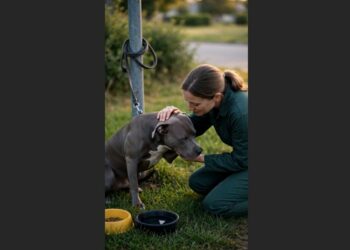
I’ve made more traffic stops than I can count during my years as a police officer.
Most eventually fade together.
The headlights. The paperwork. The conversations at the driver’s window. The long hours spent making sure an impaired driver doesn’t hurt somebody before reaching home.
But there’s one stop I remember as clearly as the night it happened.
A gray sedan had been swerving along the road.
The driver, Darren Mills, was impaired.
My fellow officer, Luis Ramirez, was helping secure the scene when I heard something coming from the rear of the vehicle.
It was faint.
So faint that I almost dismissed it as another sound from the car.
Then I heard it again.
A small, weak whimper.
When I opened the trunk, my flashlight revealed something I wasn’t prepared to see.
A brown-and-white mother dog was lying on filthy towels in the darkness.
She was terribly thin.
Her ribs and hips stood out beneath her dirty coat.
And pressed tightly against her body were four tiny puppies.
There was no water bowl.
No food.
And no adequate ventilation.
The mother raised her head when the light reached her.
Even in her weakened condition, she curved one front leg protectively around her puppies.
I crouched beside the trunk.
“Hey, mama,” I whispered. “I see them.”
She growled.
It was a weak warning, barely audible over the noise of the roadside.
But I understood.
She was frightened, exhausted, and trying to protect the only things she had left.
I lowered my flashlight.
Backed away a few inches.
And waited for animal control.
I’d started my shift expecting to take another impaired driver off the road.
Instead, I found myself staring into a dark trunk, counting four tiny puppies pressed against their starving mother.
I didn’t know it then, but those five dogs would become part of my life for the next ten years.
And the story wouldn’t end when we got them out of that car.
The Mother Who Wouldn’t Leave Her Puppies
Luis secured Darren while I remained near the open trunk.
The driver was becoming increasingly agitated.
He insisted the animals belonged to him.
He claimed he was moving them.
He said they’d been fed.
Then he said they were fine.
But nothing about the condition of those dogs suggested they were fine.
The mother was a medium-sized dog, possibly a pit bull and hound mix, with brown-and-white fur, folded ears, and a narrow white marking between her eyes.
She appeared to weigh around thirty pounds, although her build suggested she should have been considerably heavier.
Her body showed the effects of prolonged poor nutrition.
She had been nursing four puppies while struggling to meet her own basic needs.
The puppies were weak.
Two barely moved.
The smallest was so quiet that I found myself watching his chest to make sure he was still breathing.
Every time Darren raised his voice, the mother flinched.
Sergeant Karen Whitfield arrived shortly afterward.
She looked into the trunk.
Then turned toward Luis.
“Animal control?”
“On the way.”
“Emergency vet?”
“Dispatch is contacting one.”
She looked back at the animals.
“Add animal cruelty to the list.”
Darren began arguing again.
Luis moved him farther away from the car.
I was grateful.
The mother dog didn’t need another reason to be afraid.
I photographed the scene.
The dirty towels.
The confined space.
The lack of food and water.
And the condition of the dogs.
I hated taking those pictures while the animals needed help.
But proper documentation would matter later.
A cruelty investigation requires evidence, and I wanted every detail recorded accurately.
Then Animal Control Officer Renee Lawson arrived.
She brought crates, towels, gloves, and the calm approach of someone experienced with frightened animals.
She took one look inside the trunk.
“We need to move them together,” she said.
I looked at the mother.
“She’s guarding them.”
Renee nodded.
“She should be.”
That was when I knew the dogs were in good hands.
Five Lives in One Blanket
Renee approached slowly.
She placed a clean towel close to the mother without reaching over the puppies.
The dog watched her.
Her body trembled.
When Renee moved a little closer, the mother growled again.
Renee stopped.
Waited.
Then continued carefully.
“We don’t want to separate her from the babies,” she explained. “We need to keep them warm and as close together as possible.”
I crouched beside her.
Sergeant Whitfield held the light steady.
The mother kept her head raised, watching every movement.
Renee gently eased the first puppy closer to the mother’s chest.
Then the second.
The third.
And the fourth.
I spoke softly.
“No one’s taking them away from you, mama. We’re getting all of you out.”
I don’t know whether she understood anything beyond the calmness of our voices.
She might simply have been too weak to resist.
But she allowed Renee to bring the puppies together.
Then we carefully lifted the family in one supported bundle.
As the cold night air reached them, the mother made a low whining sound.
I took off my patrol jacket and wrapped it around the towels to help shield them from the cold.
Sergeant Whitfield glanced at me.
She didn’t say anything.
Renee carried the dogs toward the animal control van while I walked beside her.
The mother was so light.
The puppies were frighteningly small.
At the van, the tiniest puppy opened his mouth.
No sound came out.
I leaned closer.
His chest moved.
Barely.
I looked back toward Darren’s gray sedan.
Then at the five animals being prepared for emergency transport.
I’d begun the night thinking about a drunk driver.
Now I was worried whether five dogs would survive long enough to reach the veterinary hospital.
The Nurse Who Named Her Grace
From the parking lot of Franklin Emergency Veterinary Hospital, I called my wife, Megan.
She was a registered nurse and had just finished a twelve-hour shift at the county hospital.
She answered sounding exhausted.
“What happened?”
“I stopped a DUI.”
There was a pause.
“That doesn’t sound like why you’re calling.”
I told her about the trunk.
The mother.
The four puppies.
And how badly they needed help.
She listened quietly.
Then asked, “Where are you?”
“Emergency vet.”
“I’m coming.”
“Megan, you just finished your shift.”
“I’m coming.”
That was my wife.
She had spent the day caring for people.
Now she was driving across town because five animals needed help too.
Inside the clinic, Dr. Hannah Patel and veterinary technician Jordan Miles were working to stabilize the dogs.
Dr. Patel examined the mother while Jordan helped warm the puppies.
The assessment was serious.
The mother was severely underweight and dehydrated.
She had pale gums, paw abrasions, and a mild skin infection.
Her body was exhausted from nursing under terrible conditions.
She needed carefully managed fluids, blood work, small controlled meals, and rest.
The puppies were cold, dehydrated, and malnourished.
Two appeared stronger than the others.
Two were in concerning condition.
And the smallest male was critical.
I remember that word.
Critical.
He was so small I could barely imagine him surviving another night.
Megan arrived while the clinic team continued working.
She stood beside me, looking through the glass.
The mother dog was lying near her puppies.
Whenever one made a sound, she tried to lift her head.
Megan placed her hand lightly against the glass.
“Oh, mama.”
“She hasn’t taken her eyes off them,” I said.
Megan watched her for a moment.
Then I mentioned that the mother needed a name for her records.
Megan didn’t hesitate.
“Grace.”
I looked at her.
“Grace?”
“Because she kept those babies alive in that trunk. And because she deserves something better than being identified by a case number.”
So Grace became her name.
And the puppies received names too.
Molly was the black female with a white chin.
Tucker was the tan male with floppy ears.
June was the brown-and-white female.
And the smallest puppy, black and tan, was named Bean.
Megan chose that last name.
She said something so little deserved a name everyone would remember.
The Puppy We Were Afraid to Lose
We remained at the clinic long after we should have gone home.
Renee documented the animals’ transfer.
Sergeant Whitfield handled the necessary evidence and custody arrangements.
Luis continued dealing with the arrest.
Darren was booked on impaired-driving and animal-cruelty-related charges.
But none of that paperwork could tell us whether Bean would survive.
Late that night, Luis sent me a message.
All five still alive?
I replied.
Yes.
He answered:
Good. I was afraid to ask.
So was I.
At around two in the morning, Dr. Patel allowed Megan and me a few minutes near the recovery area.
Grace was lying on a clean, thick blanket.
She had an IV line.
Her puppies were being kept warm and closely monitored.
Because Grace was too weak to nurse them adequately, the veterinary team was providing supplemental feeding.
But whenever possible, they kept the puppies close enough for her to see and smell them.
Megan sat on the floor several feet away.
Grace watched her.
The room was quiet except for the small sounds of the clinic.
Then Bean made a faint noise.
Grace lifted her head immediately.
Megan turned toward me.
“They shouldn’t just be scattered somewhere after this.”
“We don’t know what’s going to happen yet,” I said.
“I know.”
She looked back at the mother.
“But we need to think about what happens when they’re strong enough to leave.”
I understood.
We’d come to the hospital worried about whether the dogs would survive.
Now we were thinking about the homes they might eventually need.
At that point, nothing was certain.
Grace was very ill.
Bean was still critical.
The other puppies needed intensive care.
But for the first time that night, I allowed myself to imagine all five making it.
The Spare Room
The first week became a blur of police reports, veterinary updates, and visits to the clinic.
Grace slowly stabilized.
The puppies improved, although not all at the same pace.
Molly was the first to produce a surprisingly loud little bark.
Tucker developed a habit of climbing over his siblings.
June usually stayed close to Grace.
And Bean remained the smallest, requiring the most careful monitoring.
The clinic staff worked tirelessly.
Jordan seemed especially pleased whenever Bean gained weight.
Megan visited after her hospital shifts.
I went whenever my patrol schedule allowed.
Luis stopped by with coffee for the veterinary team.
Sergeant Whitfield found reasons to check on Grace.
And Renee continued coordinating their care through animal control.
Everyone was becoming attached.
But the next question was difficult.
Where would the dogs go once they were stable enough to leave the clinic?
Grace needed a calm foster home.
The puppies still required feeding schedules, warmth, weighing, and close monitoring.
Local foster homes and rescues were already stretched.
One evening, Megan and I sat at our kitchen table discussing the situation.
She looked toward the hallway.
“We have a spare room.”
I looked at her.
“We do.”
“We could set it up for Grace and the puppies.”
I reminded her that we both worked long shifts.
She worked at the hospital.
I worked patrol nights.
We were already tired.
Megan listened.
Then she said, “Grace is more tired.”
I didn’t have much of an argument against that.
After the appropriate arrangements were made, our spare room became a temporary recovery area.
Washable rugs.
Puppy pads.
A low bed for Grace.
Veterinarian-approved warming equipment.
Feeding charts.
A small scale.
Medication schedules.
And a baby gate.
Our elderly cat, Eleanor, examined the doorway.
Then turned around and walked away.
I took that as her official objection.
The First Day Grace Came Home
Grace arrived on a Wednesday afternoon.
Renee helped transport the puppies.
Dr. Patel provided detailed care instructions.
Megan had already organized enough supplies to stock a small veterinary office.
Grace was still weak.
I carried her carefully into the house.
As soon as she heard the puppies behind us, she lifted her head.
That was the part I remember most.
Even after everything she’d experienced, she remained attentive to them.
Once inside the recovery room, Grace slowly investigated the space.
Then she returned to the puppies.
She sniffed Molly.
Tucker.
June.
And Bean.
Only after checking all four did she lie down.
Megan watched from the doorway.
“She checks every one of them.”
“She does.”
The first few weeks were exhausting.
We followed the veterinary team’s instructions carefully.
Grace needed controlled meals while her body recovered from severe malnutrition.
The puppies required supplemental feeding and weight checks.
Bean needed the most attention.
Megan organized their care schedules with the precision of someone accustomed to hospital work.
I learned how to prepare puppy formula in the middle of the night.
How to weigh a puppy who wouldn’t stop moving.
And how much laundry four growing dogs could generate.
I also learned that Grace ate more comfortably when she could keep the puppies in view.
She still startled at sudden noises.
And when someone raised their voice, she sometimes lowered her body and became tense.
We never rushed her.
She’d been through enough.
Our responsibility was to provide consistency, food, medical care, and a place where she could rest.
The First Time Grace Wagged Her Tail
By the third week, Grace was gaining strength.
She was eating better.
Her body was beginning to recover.
And the puppies were becoming increasingly active.
One morning, I entered the spare room carrying her food.
Grace looked up.
Then her tail moved.
Just once or twice.
It wasn’t an excited greeting.
She didn’t jump up.
She didn’t run across the room.
But she’d begun recognizing me as someone familiar.
Someone who brought meals.
Someone who helped care for her puppies.
Someone who didn’t frighten her.
I placed the bowl down and sat nearby.
“You’re looking better, mama.”
She watched me for a moment.
Then returned to her food.
I stayed on the floor a little longer than necessary.
There was something moving about seeing her begin to relax.
I remembered her first warning growl in the trunk.
How frightened she’d been.
How her body had curved protectively around those tiny puppies.
Now she was resting on a clean bed in our house.
Her puppies were warm.
And she was finally receiving the care she’d needed for so long.
It wasn’t a miraculous overnight transformation.
It had taken weeks of professional treatment and patient attention.
But she was improving.
And that mattered enormously.
Four Puppies, Four Very Different Personalities
By the fourth week, the recovery room had become much noisier.
Molly was bold.
She seemed determined to investigate everything.
Tucker had strong opinions about meal times and wasn’t shy about expressing them.
June was quieter, often watching before joining her siblings.
Bean was still smaller than the others, but he was becoming stronger.
He seemed especially interested in Megan.
During feedings, he’d move toward her sleeve and sometimes fall asleep near her wrist.
At night, I occasionally sat outside the baby gate after returning from patrol.
The puppies would be sleeping.
Grace would rest nearby.
And for a few minutes, the house felt wonderfully peaceful.
Then one of the puppies would wake up.
And the chaos would begin again.
Our spare room became a place of feeding bottles, clean towels, tiny paw prints, and constant activity.
Megan and I were exhausted.
But we’d also grown attached.
One evening, Bean waddled toward me, stumbled over my boot, and fell asleep against it.
Megan stood nearby with a mug of tea.
“You know we can’t keep all five,” she said.
“I know.”
“But they can’t just go anywhere.”
“No.”
She sat beside me.
Then she looked toward Bean.
“What if we kept one?”
I looked down at the tiny puppy sleeping against my boot.
“Just one?”
She smiled.
“Let’s start there.”
Neither of us realized how many other people had already begun thinking about adoption.
The Police Department That Fell in Love With Five Dogs
Word about Grace and the puppies spread through our department.
At shift changes, people asked for updates.
Dispatch wanted pictures.
Officers brought blankets, toys, and supplies.
Sergeant Whitfield placed a photograph of Grace and the puppies in the break room.
Then pretended she hadn’t.
Officer Dana Miller sent puppy food.
Officer Ben Carter arrived with toys.
Luis kept asking about Molly.
The dogs became known around the station as the “trunk family.”
I wasn’t particularly fond of that name.
I didn’t want their lives defined entirely by the worst thing that had happened to them.
But Megan offered a different perspective.
“Maybe someday,” she said, “the trunk will be remembered as where their rescue began, not where their story ended.”
As the puppies grew healthier, adoption planning became possible.
Dr. Patel wanted each transition handled carefully.
Grace was still recovering from severe neglect.
The puppies had endured deprivation early in life.
They would need appropriate care, patience, and stable homes.
Megan wanted the family to remain connected if possible.
Not because puppies must stay physically together forever.
But because the people already involved cared about them and could support one another.
That was when the plan began taking shape.
Instead of searching for five unrelated adopters, we realized that several people in our own circle were ready to provide homes.
One Mother, Four Puppies, Five Homes
Megan and I adopted Bean.
He’d been the smallest puppy in the trunk.
The one whose breathing had frightened me most that first night.
Now he was growing stronger and following Megan around whenever he had the chance.
He belonged with us.
Luis and his wife, Sofia, adopted Molly.
She was the bold black puppy with a white chin.
Luis said she would fit perfectly into their busy household.
Sofia laughed and suggested Molly might be the one running the house before long.
Officer Dana Miller adopted June.
Dana worked with children as a school resource officer and appreciated the quieter puppy’s observant nature.
June soon became her constant companion.
Ben Carter adopted Tucker.
For weeks, Ben had insisted he wasn’t ready for a dog.
Then Tucker grabbed his shoelace during a visit, dragged it across the floor, and promptly fell asleep against his foot.
The next day, Ben bought a dog bed, bowls, a crate, and a stuffed duck.
Tucker had apparently made the decision for him.
That left Grace.
And, to my surprise, Sergeant Whitfield wanted to adopt her.
Perhaps I shouldn’t have been surprised.
She’d visited Grace regularly during her recovery.
Never making a fuss.
Never expecting affection.
She’d sit nearby and speak in the same steady voice she used during difficult calls.
Grace had gradually become comfortable around her.
One afternoon, she rested her head against the sergeant’s knee.
Sergeant Whitfield looked at me.
“Don’t make a big thing out of this.”
I promised I wouldn’t.
But I was smiling all the way home.
Five dogs.
Five homes.
All within a circle of people who already knew their story.
The Day Grace Left Our House
Before the adoptions, we agreed to stay connected.
We would share photographs.
Help one another if questions arose.
And arrange safe, appropriate visits once the puppies were old enough and their veterinary care allowed it.
Nobody wanted an adopter to struggle silently and reach a crisis point.
We called the arrangement the Family Watch.
It wasn’t an official program.
Just a promise among friends.
On the day Grace left with Sergeant Whitfield, I wondered how she would respond.
She’d spent weeks recovering in our spare room.
She knew Megan and me.
And her puppies had been with her throughout that time.
I expected the transition to be difficult.
Grace approached the puppies.
She sniffed Molly.
Then Tucker.
June.
And Bean.
She checked each one before moving away.
Then she walked toward Sergeant Whitfield.
At the car, she paused and looked back.
Megan stood in the doorway.
“You did your job, mama,” she whispered.
Grace’s tail moved.
Then she climbed into the car.
We watched them leave.
Megan was quiet for a long time afterward.
So was I.
The room that had once contained five dogs was suddenly almost empty.
But that evening, our phones began filling with photographs.
Molly asleep on Sofia’s lap.
June beside Dana.
Tucker chewing the stuffed duck Ben had just bought.
Grace resting on a clean bed in Sergeant Whitfield’s home.
And Bean, curled near our bedroom, beginning his new life with us.
Megan looked at the pictures.
“All five,” she said.
I nodded.
“All five.”
They’d survived.
And they were home.
The First Family Reunion
The first time the entire dog family came to the police station, Sergeant Whitfield described it as a controlled visit.
That was optimistic.
Grace arrived beside her.
Bean came with Megan and me.
Luis brought Molly.
Dana brought June.
And Ben appeared with Tucker, who was carrying what remained of his stuffed duck.
The moment the puppies noticed their mother, the plan for an orderly photograph began falling apart.
All four wanted to approach her.
Grace lowered her head and sniffed each one.
Molly.
Tucker.
June.
Bean.
Then her tail began moving.
A few officers standing in the hallway grew suspiciously quiet.
It was moving to see the family together again.
Then Tucker relieved himself on the floor.
That brought everyone back to reality.
From then on, the dogs became part of our unofficial station family.
Not police dogs.
Not trained therapy animals.
Just rescued pets whose lives had brought a group of people together.
Photographs of them appeared in the break room.
Officers asked about them during difficult shifts.
And gradually, the story became part of the department’s history.
It had begun with a traffic stop.
But it had become something much larger.
What Happened to Darren Mills
The criminal case took time.
We had photographs from the vehicle.
Animal control records.
Veterinary reports.
And evidence documenting the condition in which the dogs had been found.
Darren eventually pleaded guilty to impaired-driving and animal-cruelty charges.
His sentence included jail time, fines, probation, restrictions on animal ownership, and restitution for veterinary expenses.
People sometimes ask me whether the punishment was enough.
I don’t know that there’s a simple answer.
No sentence could give Grace back the weight she’d lost.
No fine could erase Bean’s early malnutrition.
And no court decision could undo the hours those five animals spent confined in a dark trunk.
But accountability mattered.
The legal process recognized that their suffering was serious.
And the documentation we’d gathered that night helped establish what had happened.
I was grateful we’d taken the time to do things properly.
Most of all, I was grateful that the dogs were no longer in danger.
Grace was recovering.
Her puppies were growing.
And every one of them had someone responsible for their care.
The Family Dinners
As time passed, our backyard became the regular gathering place.
We called the visits family dinners.
The people cooked and shared food.
The dogs received appropriate treats.
And everyone spent time catching up.
At first, the reunions involved cautious sniffing and supervised introductions.
Later, as the puppies grew into adult dogs, they became much more active.
Molly wanted to investigate everything.
Tucker was usually the loudest.
June preferred watching before joining in.
Bean had developed a habit of staying near Megan unless I happened to be holding something edible.
Grace often watched the others from a comfortable place.
Sometimes she joined them.
Other times, she remained in the shade.
She was never pressured to participate.
Sergeant Whitfield understood her well.
Grace had become a quiet, affectionate companion who liked staying near her.
The other dogs had settled into equally different lives.
Molly was confident and energetic in Luis and Sofia’s home.
June became deeply attached to Dana and eventually accompanied her to approved school activities after appropriate training.
Tucker kept Ben busy and frequently stole his socks.
And Bean became part of our household in ways neither Megan nor I had anticipated.
Each dog was different.
But they were all healthy, cared for, and loved.
That was the part I treasured most.
Six Months After the Trunk
One evening, about six months after the traffic stop, we were hosting another gathering.
The dogs had been playing.
The officers were talking.
And Megan was carrying drinks out to the porch.
I was sitting when Grace approached.
She walked slowly toward me.
Then rested her head against my knee.
I stopped talking.
For a moment, I was back beside that gray sedan.
I remembered the flashlight.
The dirty towels.
The four puppies.
And the weak growl she’d given when I came too close.
Now she was standing beside me in our backyard.
Her body was stronger.
Her coat was healthier.
And she was comfortable enough to seek contact.
I rested my hand gently against her head.
“You look good, mama.”
Her tail moved.
Then Bean appeared, determined not to miss an opportunity for attention.
He squeezed between us.
Grace sniffed his head and stepped aside.
Later, Megan looked toward her.
“She remembers,” she said.
I considered that.
I couldn’t know exactly what Grace remembered.
Dogs don’t recall events in the same way we describe our own memories.
But she recognized familiar people.
She had become comfortable with the voices, scents, and routines of the people who’d helped her recover.
And seeing her approach me willingly meant more than I could explain.
How Five Dogs Changed Our Department
Police work can make certain days blur together.
You respond to calls.
Write reports.
Manage difficult situations.
And eventually return home, hoping the next shift will be quieter.
But some incidents remain with you.
That traffic stop changed how many of us thought about animal welfare.
We began paying closer attention to animals affected by emergencies.
Pets left without care during a family crisis.
Animals at risk during extreme weather.
And cases where someone needed veterinary help before the usual arrangements could be made.
Our department strengthened its relationships with local animal organizations.
There were pet food drives.
Community education.
And practical efforts to help officers respond when animals were in danger.
Megan helped organize an animal first-aid workshop.
Sergeant Whitfield helped establish a small assistance fund through the police association.
It supported urgent animal-welfare needs when ordinary resources weren’t immediately available.
We called it the Grace Fund.
Sergeant Whitfield wasn’t thrilled about the name.
Grace, naturally, had no opinion.
She was much more interested in snacks.
The fund couldn’t solve every problem.
But it helped with temporary boarding, emergency veterinary assessments, and supplies for families facing difficult circumstances.
All because one night, we found five dogs in the trunk of a car.
The Smallest Puppy Became My Biggest Comfort
Of all the dogs, Bean remained especially close to me.
He never became particularly large.
But he grew into a sturdy, affectionate dog.
He loved Megan.
Followed her around the house.
And waited for her after long hospital shifts.
When I returned from patrol, he’d often come to greet me.
Some nights, I was tired and had little energy left.
Bean never needed much.
He’d settle beside me.
Rest against my leg.
And remain there.
One winter morning, years after the traffic stop, I came home from a fatal DUI crash.
I won’t describe it.
Some things are difficult enough without repeating the details.
I came inside after sunrise.
Megan was asleep.
The house was quiet.
I took off my duty belt and sat at the kitchen table without turning on the light.
For a while, I simply sat there.
Then I heard Bean coming down the hallway.
He approached.
Looked at me.
And climbed into my lap.
By then, he was much bigger than the tiny puppy we’d once struggled to keep alive.
He settled awkwardly against me and rested his head near my chest.
I put my arms around him.
And I cried.
I don’t know how long we sat there.
But I remember the weight of him against me.
Warm.
Alive.
And completely familiar.
Years earlier, I’d watched a veterinarian fight to stabilize his tiny body.
Now he was the one keeping me company during one of the hardest mornings of my career.
That moment changed how I understood our relationship.
I’d helped rescue Bean.
But he’d become an important source of comfort in my own life too.
The Years Passed
The annual reunions continued.
Some years, we gathered in our backyard.
Other years, we met at the station.
The dogs grew older.
Their habits became familiar.
The people who had adopted them changed too.
Families grew.
Careers continued.
There were hard years and good years.
And through all of it, the story of Grace and her puppies remained part of our lives.
At the first reunion, some of us cried.
By the second, we laughed more.
Eventually, the gathering became a tradition.
Each year, the dogs were photographed together.
The results were never especially orderly.
Tucker was usually trying to move.
Molly wanted attention.
June often remained still until something distracted her.
Bean stayed near Megan.
And Grace occupied the middle when she was comfortable doing so.
As she aged, her muzzle turned increasingly white.
Her movements became slower.
She needed more rest.
But Sergeant Whitfield continued caring for her with the same steady patience she’d shown from the beginning.
Whenever the dogs gathered, Grace greeted them.
One by one.
We loved watching that familiar routine.
It reminded us of the mother we’d found in the trunk.
The dog who had been so weak she could barely lift her head.
And who had still kept her four puppies pressed against her body.
Ten Years Later
On the tenth anniversary of the traffic stop, we gathered behind Station 4.
It was a bright spring day.
The officers who had helped with the rescue were there.
So were their families.
Megan.
Luis and Sofia.
Dana.
Ben.
Sergeant Whitfield.
And some of the people who had helped care for the dogs during their earliest weeks.
Grace was very old now.
Her face was white.
Her steps were careful.
And she needed help getting comfortably into position for the group photograph.
Her four puppies were grown dogs, aging themselves.
Molly approached first.
Then Tucker.
June.
And Bean.
Grace lowered her head and sniffed each one.
She took her time.
There was no frantic excitement.
No need for a dramatic reunion.
Just an elderly mother dog greeting four familiar adult dogs.
I watched from a short distance away.
The sight brought back a memory I hadn’t thought about in years.
Grace lying in the trunk.
One thin front leg curved around her puppies.
Her eyes watching every movement.
And the sound of that first warning growl.
Now she was standing in the grass, surrounded by the animals who had survived with her.
Every one of them had a home.
Every one had someone who loved them.
I felt my throat tighten.
Then Grace turned toward me.
“You Made It, Mama.”
I lowered myself carefully beside her.
My knees weren’t what they had been ten years earlier.
Grace stood quietly.
I held out my hand.
She moved closer and touched it with her nose.
I remembered how she’d reacted to that same gesture during the roadside rescue.
Back then, she’d been frightened.
Exhausted.
Protective.
And far too weak to defend herself or her puppies if someone had wanted to hurt them.
I’d backed away because she’d told me, in the only way she could, that she needed space.
Now she was approaching me voluntarily.
I gently rested my hand near her head.
“You made it, mama,” I whispered.
She remained close.
Behind me, somebody took a photograph.
In that picture, I’m kneeling beside Grace.
Bean is pressed against my leg.
The other dogs are gathered nearby.
Megan is smiling through tears.
And a group of officers stands behind us.
It’s not a perfect photograph.
Not everyone is looking toward the camera.
One dog is moving.
Another is distracted.
But I wouldn’t change a thing about it.
Because every life in that picture was connected to one night when a faint sound came from the trunk of a swerving car.
The Photograph in the Station
The photograph from our tenth anniversary now hangs at the police station.
Beneath it is a small plaque Sergeant Whitfield arranged.
It reads:
One DUI stop. Five lives saved. One family made.
I pass that picture often.
Sometimes I’m in a hurry.
Sometimes I’m finishing a difficult shift.
And sometimes I stop long enough to look at the dogs.
Grace in the middle.
Molly beside Luis.
Tucker looking as though he’s about to cause trouble.
June sitting calmly.
And Bean leaning against me.
People occasionally ask about the photograph.
New officers.
Visitors.
Or someone who has heard part of the story.
I tell them how it began.
A swerving gray sedan.
A driver named Darren Mills.
A faint noise from the trunk.
And five dogs lying on filthy towels without adequate food, water, or ventilation.
But I always tell them that opening the trunk wasn’t the entire rescue.
It was only the beginning.
What Saving Them Really Took
Grace and her puppies survived because many people did their part.
Luis helped secure a dangerous roadside scene.
Sergeant Whitfield made sure the animals’ condition was properly documented.
Renee handled a frightened mother dog with patience and helped move all five safely.
Dr. Patel and Jordan provided the emergency veterinary care the dogs desperately needed.
Megan organized feeding schedules and supported their recovery after working long hospital shifts.
The animal control team made the foster arrangements possible.
Then five families opened their homes.
Luis and Sofia welcomed Molly.
Dana welcomed June.
Ben welcomed Tucker.
Sergeant Whitfield took Grace.
And Megan and I adopted Bean.
We helped each other as the dogs grew.
We shared photographs.
Arranged reunions.
And remained available when one of the families needed support.
Over the years, those dogs changed our lives.
Grace became Sergeant Whitfield’s steady companion.
Molly brought excitement to Luis and Sofia’s household.
June became a calm presence beside Dana.
Tucker made Ben’s home considerably louder.
And Bean gave Megan and me a kind of companionship we hadn’t known we were missing.
It wasn’t one heroic gesture that created those outcomes.
It was years of ordinary care.
Feeding.
Cleaning.
Veterinary appointments.
Patience.
And people honoring the commitments they’d made.
The Mother in the Dark
Even after ten years, I can still picture the trunk.
The flashlight illuminating the dirty towels.
The mother dog’s thin body.
Her folded ears.
The white marking between her eyes.
And the four tiny puppies pressed close against her.
She was frightened when I approached.
She had every reason to be.
She didn’t know who I was.
She didn’t know that animal control was coming.
And she couldn’t know that a veterinarian, a nurse, several police officers, and their families would soon become part of her life.
She only had the experience of that moment.
A confined space.
A stranger approaching.
And four vulnerable puppies against her body.
She growled.
I stopped.
And for a few seconds, we watched each other.
I sometimes think about how easily the entire incident could have gone differently.
If Darren hadn’t swerved.
If the traffic stop had ended without anyone noticing the sound.
If we’d failed to investigate the trunk.
Or if the puppies had remained silent just a little longer.
There are things I can’t know.
And after years in law enforcement, I’ve learned not to dwell too long on every possible outcome.
But I do know what happened.
We heard something.
We checked.
And we found five animals who needed immediate help.
The Five Lives That Followed Us Home
The night we found Grace, I was focused on getting her and the puppies safely to the emergency clinic.
I didn’t know whether they’d survive.
I didn’t know whether there would be homes available.
And I certainly didn’t expect that a decade later we’d be gathering behind the police station for an anniversary photograph.
At the time, I only knew that the mother was starving.
Her puppies were weak.
And the smallest one was barely breathing.
But those animals survived.
Grace recovered enough to enjoy years in a stable home.
Molly grew into a confident dog.
Tucker became a constant source of laughter.
June developed into a gentle companion.
And Bean, the puppy we were most afraid of losing, became the dog who climbed into my lap when I came home from one of the hardest calls of my career.
I often think about how close all five came to never having those lives.
Not because dogs understand our legal system.
Not because they know how to ask for help in words.
But because they depend on people noticing when something is wrong.
And acting.
The Last Time I Looked at Grace
At the tenth-anniversary gathering, Grace rested quietly after greeting her grown puppies.
She was older now.
Her muzzle had turned almost entirely white.
And she was content to remain near Sergeant Whitfield while the others moved around the yard.
I sat beside her for a while.
I didn’t ask anything of her.
She didn’t need to stand for another photograph.
She didn’t need to approach everyone who wanted to meet her.
She’d earned the right to rest.
Bean came over and settled nearby.
I looked at him.
Then at Grace.
I remembered the emergency clinic, where Bean had been so weak that we watched every breath.
I remembered Megan pressing her hand against the glass and naming Grace.
The spare room.
The feeding charts.
The late nights.
And the day we watched Grace leave for her new home.
All those moments felt connected.
None of us had expected one traffic stop to become ten years of friendship, shared responsibility, and family gatherings.
But that was what happened.
Grace lifted her head briefly.
I offered my hand.
She touched it with her nose.
And I smiled.
“Good girl, mama.”
One DUI Stop. Five Lives Saved. One Family Made.
People sometimes tell me I saved five lives that night.
I appreciate what they mean.
But I always think of the people who came afterward.
The animal control officer who knew how to handle a frightened mother without separating her unnecessarily from her puppies.
The veterinary team who stabilized five severely neglected animals.
My wife, who spent her days nursing people and her nights helping feed puppies.
The officers who brought supplies.
And the families who opened their homes.
I opened the trunk.
That mattered.
But it wasn’t enough by itself.
Those dogs needed far more than one moment of rescue.
They needed medical care.
Food.
Warmth.
Safety.
And homes where they could spend the rest of their lives.
They received those things because people worked together.
And in return, those five dogs became an important part of our lives.
I still remember Darren Mills saying they were “just dogs.”
I’ve thought about those words more times than I can count.
Because when I look at the photograph hanging in our station, I don’t see five animals who were simply found in a car.
I see Grace, the mother who survived severe neglect and finally had a comfortable place to rest.
I see Molly, Tucker, and June, each living with people who love them.
And I see Bean.
The smallest puppy.
The one whose breathing was barely visible.
The dog who grew strong enough to become my constant companion.
The one who rested against me when I came home and couldn’t hold back my tears.
Ten years after that traffic stop, I still carry the memory of the mother dog’s eyes in the dark.
And I still think about the moment she finally allowed us to lift her puppies close against her and carry them out.
She couldn’t know where we were taking them.
She couldn’t know how many people would help.
But she survived long enough for that help to arrive.
And then we made sure it continued.
At Station 4, beneath a photograph of five aging dogs and the people who love them, there’s a little plaque.
One DUI stop. Five lives saved. One family made.
Every time I read it, I remember that small whimper from the trunk.
The sound that made me stop and listen.
And the five lives waiting on the other side.
Editor’s Note: The characters in this story are fictional. Through these stories, we hope to share the intelligence, loyalty, compassion, and loving nature of dogs with people everywhere.