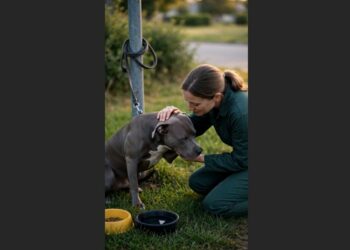
The man who had fired at me was still approaching with a gun.
I couldn’t get to my weapon. I could barely move, and the pain in my chest made breathing almost impossible.
Then I saw Hero.
My seventy-five-pound German Shepherd came running from the back of my patrol vehicle. He had been trained to apprehend dangerous suspects, and I expected him to go directly toward the armed man.
Instead, he ran to me.
He grabbed the emergency drag handle on the back of my vest and began pulling.
Forty-seven feet.
That’s how far he dragged me across the parking lot toward the protection of my patrol vehicle.
During those forty-one seconds, another bullet struck Hero in his right hindquarter.
He kept pulling.
What happened afterward would earn him the highest K9 honor our department could give.
But to understand why that moment means so much to me, I need to tell you about a small German Shepherd puppy who was the last of twelve to be chosen.
And about something my father told me shortly before he died.
The Puppy Nobody Picked
My name is Brennan Vasiliev. I’m a K9 officer in Ohio, and Hero has been my partner for most of his life.
In April 2020, I went to Riverstone Kennels to select a puppy for our department’s K9 program.
There were twelve puppies in the litter.
By the time I arrived, eleven had already been chosen.
The only one remaining was the smallest.
He hadn’t been selected by any of the handlers who came before me, and because I was last in the rotation, he became my dog.
I named him Hero.
At the time, I couldn’t have known what sort of working dog he would become.
He was smaller than the other puppies, but size alone couldn’t tell me whether he’d have the temperament, motivation, physical ability, and discipline needed for police work.
I knew he would have to prove himself through training, just like every other dog in the program.
I also remembered something my father used to tell me.
He believed that being overlooked didn’t mean someone had less to offer.
I had heard that lesson throughout my childhood, particularly when I was the last child chosen for something.
By the time Hero came into my life, Dad was gone.
He had died six months earlier.
I didn’t realize then how often I would think about his words while raising that little German Shepherd.
Nine Months That Changed Everything
Hero and I began formal K9 training in June 2020.
The program ran through February 2021 and covered the skills our department required for working police dogs.
We trained in obedience, tracking, building searches, narcotics detection, handler protection, and suspect apprehension.
It was demanding work.
A police dog has to do much more than respond enthusiastically to a command. He must distinguish between situations, work in distracting environments, and remain responsive to his handler even when excitement and stress are high.
Hero was smaller than most of the other working-line German Shepherds in our class.
He weighed twelve pounds less than the group average.
But as training progressed, his performance began attracting attention.
His tracking score was 98 out of 100.
His narcotics detection score was a perfect 100.
And his suspect apprehension score was 99.
He missed one point because he took 0.4 seconds longer than the permitted time to disengage from a training decoy after receiving my recall command.
Our training officer, Lieutenant Marisol Cabrera, had spent twenty-two years working in the field.
She believed Hero’s brief delay reflected how closely he was focused on the protective exercise.
In her certification report, she wrote:
“This dog’s only flaw is excessive concern for his handler’s safety. We are recommending the standard be reviewed.”
The standard wasn’t changed.
Hero kept his 99.
I’ve kept a copy of that report ever since.
February 11, 2021
Hero completed his certification on February 11, 2021.
I was thirty-three years old.
He was just under a year old and weighed seventy-three pounds.
The puppy who had seemed so small beside his littermates had developed into a strong, capable working dog.
His oversized ears finally looked more proportionate to his head, and his shoulders had filled out.
He was still smaller than some of the other Shepherds.
His sister, Hera, who worked with a department three counties away, outweighed him by twenty-two pounds.
But Hero had earned the highest aggregate certification score among the dogs trained at our facility that year.
I was proud of him.
And I was proud of the relationship we’d built during those nine months.
Working with a K9 requires consistency and mutual familiarity. I had to learn Hero’s responses and understand how he communicated through movement, attention, and behavior.
He had to learn to respond reliably to me.
By graduation, we’d spent countless hours working together.
The dog nobody had selected was now one of the strongest performers our program had produced.
But his certification scores would eventually become only a small part of the reason I remembered that training period.
The real test was still four years away.
Four Years on Patrol Together
For the next four years, Hero and I worked patrol together five days a week in central Ohio.
By then, our partnership had become familiar in ways that went beyond formal training.
I knew how he responded when he detected a scent, how his attention changed during a search, and how to recognize the difference between ordinary curiosity and a trained alert.
He knew my commands and routines.
During those four years, Hero was involved in 218 narcotics discoveries, including heroin, fentanyl, cocaine, methamphetamine, and prescription painkillers.
We participated in forty-seven building searches that resulted in suspects being apprehended or surrendering.
We also tracked twenty-three missing people.
Twenty-one were found alive. The other two were elderly people with Alzheimer’s disease, and we reached them in time for their families to say goodbye.
Some assignments ended well. Others stayed with me long after our shifts finished.
Through it all, Hero remained responsive to his training.
He had never bitten someone inappropriately. He engaged when properly directed and released when commanded.
He was a dependable working partner.
But after our shifts, he was also my dog.
Every night, he slept at the foot of my bed.
Always on the left side.
I never knew why he preferred that particular spot.
It was simply where he settled, night after night.
And when I remember what happened on April 14, 2025, that small habit has become one of the details I cherish most.
Monday, April 14, 2025
That morning began like hundreds of other workdays.
I was assigned to the 7 a.m. to 3 p.m. shift.
The weather was clear, approximately sixty-two degrees, with a light wind from the west.
Hero was riding in the rear compartment of my patrol vehicle.
At 11:23 a.m., we were traveling southbound on Interstate 71 near the southern county line.
We were roughly a mile north of the Marathon gas station at the State Route 41 interchange.
A silver Chevrolet Malibu passed me in the left lane, traveling approximately ninety-two miles per hour in a sixty-five-mile-per-hour zone.
I checked the registration.
The vehicle was registered to Damian Rork, a thirty-four-year-old man from southern Indiana.
The information returned an outstanding warrant for failure to appear in connection with armed robbery and felonious assault charges arising from a July 2024 incident at an Indiana convenience store.
I activated my emergency lights.
The driver didn’t pull over.
Instead, he took the State Route 41 exit at high speed, went through a red light at the bottom of the ramp, and entered the Marathon gas station.
He stopped near pump four and got out.
I was approximately fifteen seconds behind him.
At that point, I knew I was dealing with a driver who had ignored an attempted traffic stop and had an outstanding warrant.
I didn’t know that within moments, both Hero and I would be fighting for our lives.
The Man Waiting Beside Pump Four
When I pulled into the gas station parking lot, Damian Rork was standing beside his Malibu.
My dashcam captured him near pump four.
He had a handgun in his right hand.
I would later learn that the weapon was a Glock 19 that had been illegally modified for automatic fire.
But I didn’t know those details then.
I saw the gun.
Then I saw him raise it.
Everything happened quickly.
I activated the emergency release for Hero’s compartment, which allowed him to exit the patrol vehicle.
Then I opened my own door and tried to move toward the front of the cruiser, where the engine block could provide some protection.
I didn’t get there.
Rork began firing before I had fully cleared the driver’s seat.
Three rounds struck my protective vest.
The impacts knocked me down onto the asphalt between my patrol vehicle and the gas pump island.
My firearm was still in its holster.
I hadn’t had time to draw it.
For a few moments, I struggled to breathe.
The pain across my chest was severe, and I couldn’t move effectively.
I remained conscious enough to see Rork approaching with the gun.
I knew I was in serious danger.
And then Hero came out of the patrol vehicle.
Hero Didn’t Run Toward the Gunman
I saw Hero emerge from the open rear door.
He was a seventy-five-pound black-and-tan German Shepherd, trained to respond to dangerous situations alongside me.
Given the circumstances, I expected him to approach the armed man.
But Hero did something different.
He ran directly toward me.
He positioned himself near my body, between me and the approaching threat.
Then he grabbed the emergency drag handle attached to the back of my protective vest.
I couldn’t fully understand what he was doing at the time.
My chest hurt, my breathing was impaired, and I was struggling to remain aware of everything happening around me.
Three weeks later, while recovering in the hospital, I watched the dashcam footage.
That’s when I could see the sequence more clearly.
Hero had reached me within moments of leaving the patrol vehicle.
Rather than immediately engaging Rork, he began pulling me away from the open area near the pumps.
His grip was on the reinforced handle of my vest.
He leaned backward and used his body weight to move me across the asphalt.
I was wearing my protective vest and full duty equipment.
Together, my body and gear weighed approximately 220 pounds.
Hero weighed seventy-five.
Yet he kept pulling.
Forty-Seven Feet Across the Asphalt
According to the dashcam timestamps, Hero moved me forty-seven feet in forty-one seconds.
He couldn’t simply lift me or drag me smoothly in one continuous movement.
He pulled in short bursts, adjusting his grip as needed.
Twice, he released the handle briefly to reposition himself.
Then he resumed.
His hind legs pushed against the pavement as he leaned backward, using his strength to move me toward the other side of the cruiser.
I was conscious during parts of what happened.
I could see movement, but I was unable to help him.
I couldn’t stand up.
I couldn’t get to my weapon.
And I couldn’t effectively call for backup.
The video later showed what I hadn’t been able to take in clearly at the time.
Hero was trying to get me behind the engine block, the same protective position I’d been attempting to reach when the shooting began.
He continued working as Rork approached.
Then more shots were fired.
Two rounds struck the side of my cruiser.
Another struck Hero in his right hindquarter.
He had been wounded.
But the footage showed him continuing to pull.
The Last Twelve Feet
I still find it difficult to watch that part of the recording.
Hero’s right hind leg had been struck, but he continued moving me toward the vehicle.
The final twelve feet brought us behind the engine block.
It was the cover I’d been trying to reach before the first three bullets struck my vest.
Hero finally stopped pulling.
He had moved me out of the exposed area.
The footage shows him releasing the vest handle and turning back toward Rork.
By then, the armed man was still a threat.
Hero had already sustained an injury, but he moved toward him.
He crossed the distance between my position and Rork, who was approximately thirty feet away.
The video showed Hero favoring his injured hind leg.
Even so, he continued.
Rork attempted to raise the handgun.
Hero made contact with him, and the man fell backward onto the asphalt.
The weapon came out of Rork’s hand and slid beneath the Malibu.
Hero then maintained a trained hold on his right forearm.
He remained with the suspect until backup arrived.
I learned much of that sequence from the recording because my memory of the incident was fragmented by pain and the concussion I had sustained.
But I will never forget seeing Hero continue to work despite his injury.
“Brennan. Tell Him to Come.”
Backup arrived approximately two minutes and eighteen seconds after Hero engaged Rork.
Deputy Anya Patel and Sergeant Joaquin Reyes responded.
They secured the scene and arranged emergency medical assistance for both of us.
Sergeant Reyes came over to me while I was lying on the asphalt.
Later, he told me that one of the first things I asked was about Hero.
“Sarge. Where’s my dog? Where’s Hero?”
Reyes told me that Hero was alive.
He was still holding the suspect and needed to be recalled.
Sergeant Reyes put a hand on my shoulder.
“Brennan. Tell him to come.”
I could barely speak.
My chest was injured, and breathing remained painful.
But I managed to give the command.
“Hero. Aus. Come.”
Aus was the German release command we used in our K9 training.
On the recording, Hero released the suspect and returned toward me.
He was limping from the injury to his hindquarter.
When he reached me, he looked toward my face.
Then he licked my chin once.
And he lay down across my left foot.
The same place he had chosen every night at home.
He remained there until the emergency medical team needed to move me onto a stretcher.
Two Hospitals, Two Injured Partners
I was transported to Mount Carmel East Hospital in Columbus.
The full medical assessment showed three broken ribs, a hairline fracture of my sternum, two large chest hematomas caused by the impacts against my vest, and a moderate concussion from striking my head when I fell.
I remained hospitalized for six days.
Hero was taken to MedVet Columbus, an emergency veterinary hospital approximately twenty minutes away.
He had a bullet lodged in the muscle of his right hindquarter.
Fortunately, it had missed the major blood vessels and bones.
Dr. Patrice Okonkwo operated on him that same afternoon, April 14, and removed the bullet.
Hero stayed at MedVet for four days.
My wife, Annika, spent those days moving between the two hospitals.
She was thirty-six and worked as a labor and delivery nurse at OhioHealth.
She understood the seriousness of our injuries, but that didn’t make the experience any easier for her.
For four days, she visited me and checked on Hero.
She brought me video updates of his condition through FaceTime.
She also took a sock that smelled like me to Hero, hoping the familiar scent would provide some reassurance while he recovered away from home.
Annika barely slept during those first days.
I knew how much she was carrying.
And I knew that neither of us would feel fully relieved until Hero was safely recovering.
April 18: Hero Comes to My Hospital Room
On the morning of April 18, Dr. Okonkwo discharged Hero from MedVet.
He was receiving pain medication and had strict activity restrictions while his surgical wound healed.
He needed rest, minimal movement, and careful supervision during recovery.
That same morning, Annika brought him to see me.
The hospital had granted special permission for the visit.
The chief nursing officer, Mrs. Yelena Markovich, had personally approved the arrangement.
Hero entered my room on a leash.
He was wearing a soft protective cone and moving with a noticeable limp.
I was lying in the hospital bed when he saw me.
He moved toward the bed, showing clear interest in reaching me.
Because of his injury and the cone, he couldn’t safely jump onto the mattress.
I patted the bed.
Annika helped lift him carefully, mindful of his recovering hindquarter and my own chest injuries.
Once he was on the mattress, Hero moved toward my left side.
Then he lowered himself onto the blanket.
His body settled across my left foot.
I looked at Annika.
She knew exactly what I was thinking.
After everything we’d been through, Hero had returned to the same familiar resting position he had chosen since he was young.
The Place He Always Chose
During the remainder of my hospital stay, Hero continued seeking that familiar spot beside me.
He remained closely attached to my presence.
He showed little interest in leaving and needed encouragement for ordinary care activities.
Annika and the hospital staff had to remain attentive to his veterinary restrictions, ensuring that his desire to stay close didn’t interfere with his recovery.
I understood that he was still injured.
He needed proper rest and medication.
But I was deeply moved by the way he kept returning to my left side whenever he was able to settle beside me.
For years, he’d slept at the left foot of my bed at home.
I’d never given much thought to why.
Now, recovering from serious injuries myself, I found comfort in the familiarity of his presence.
I could feel the weight of him resting there.
It reminded me of countless ordinary evenings before the shooting, when Hero had finished his day and settled down without any fuss.
Those memories had nothing to do with medals, certifications, or arrests.
They were simply part of sharing my life with a dog I loved.
After the incident, that familiar routine meant more to me than ever.
Hero eventually returned home.
And when I came home too, he resumed sleeping at the left foot of my bed.
He still does.
Six Weeks Later, We Stood Before Two Hundred People
Approximately six weeks after the shooting, the Franklin County Sheriff’s Office held its annual awards ceremony at its headquarters in Columbus.
Around two hundred people attended, including deputies, family members, county officials, and members of the press.
I was still on light duty.
My ribs had improved, but my sternum remained tender.
Hero had progressed through veterinary recovery and physical therapy and had returned to working patrol with me four days a week.
Sheriff Damon Hartwell stood at the podium holding a small black velvet box.
He introduced the K9 of the Year award.
Then he read the citation describing what Hero had done on April 14.
The room became very quiet.
The citation recognized Hero’s response during the shooting, his effort in moving me to safety, his continued work despite being wounded, and his apprehension of the armed suspect.
It was the highest honor our department could give a K9 officer.
The Sheriff called Hero forward.
I walked him to the front of the room.
He wore his patrol vest, and a small bandage remained over the area of his right hindquarter.
Sheriff Hartwell knelt and attached a bronze medal to his vest collar.
It was the Franklin County Sheriff’s Office K9 Excellence Award.
Then the Sheriff stood, shook my hand, and asked whether I wanted to say anything.
I hadn’t prepared a speech.
But I knew what I needed to tell the room.
“Hero Was the Last. Today He Is the First.”
I walked to the podium with Hero at my left side.
He stood in his usual position, looking up toward me.
I told the audience about Riverstone Kennels.
I explained that five years earlier, I’d arrived to choose a puppy from a litter of twelve.
By then, eleven puppies had already been selected.
Hero was the only one left.
He was the smallest puppy in the litter, and no one before me had chosen him.
I told them how he’d gone through training, completed his certifications, and become my patrol partner.
Then I said something that had been on my mind since the day of the shooting.
“Hero was the last. Today he is the first.”
The room was silent.
I continued.
“My father died six months before I got Hero. The last thing he ever told me was, Brennan, pick the dog nobody else wants. He will be the best one.”
Dad had repeated variations of that advice throughout my childhood.
He wanted me to understand that being overlooked didn’t determine anyone’s worth.
Now, standing in front of two hundred people, I could see how much those words had shaped my life.
I looked down at Hero.
“Sometimes the one nobody wants is the best one. My father said that. My father was right.”
Then I stepped away from the podium.
Sheriff Hartwell began clapping.
The room rose in applause.
I cried that day.
Annika was sitting in the front row, and she was crying too.
Hero remained beside my left leg, looking up at me.
His tail moved twice.
My Father’s Words Were Written Into the Official Report
The after-action report for the April 14 shooting was filed on May 28, 2025.
It was seventeen pages long.
Most of it documented the incident in procedural detail: the timeline, radio traffic, dashcam analysis, witness accounts, and medical information.
But I included a personal note in the final paragraph.
I explained that Hero had been the last puppy selected from his litter at Riverstone Kennels in April 2020.
His assignment to me hadn’t been a deliberate strategy.
He was the only puppy remaining when my turn came.
Five years later, his performance during the gas station incident had exceeded the department’s previous documented K9 performance measures for a single event.
I believed that was worth recording.
The final observation in my report was simple:
“Sometimes the dog nobody wants is the best dog.”
Lieutenant Marisol Cabrera approved the report without changes.
She added a note in the margin encouraging me to keep writing.
The report was forwarded to Sheriff Hartwell.
He also made a notation, indicating that the department would consider changes to the way K9 puppies were selected.
The experience had raised a question.
Should the smallest puppies automatically be the ones left for the last handlers in the selection rotation?
Or should every puppy be considered according to his individual potential rather than assumptions based on size?
In August 2025, the department changed its selection policy.
Under the new directive, the smallest puppy in each litter at Riverstone Kennels would be offered to handlers first.
The policy became informally known as the Hero Rule.
The Father Who Came From Belarus
My father, Aleksandr Vasiliev, came to the United States from Belarus in 1981.
He understood what it meant to begin somewhere with little certainty about how life would unfold.
He had experienced difficult periods himself, and he didn’t want me growing up believing that a person’s value depended on being chosen first.
When I was young, whenever I felt overlooked, he reminded me to pay attention to people and animals others might dismiss.
He used to tell me that the one nobody wanted might turn out to be the best one.
I didn’t always appreciate that advice as a child.
When you’re young, being chosen last can hurt.
You don’t necessarily want a lesson about character. You want someone to choose you.
But Dad kept repeating it.
Over time, I began understanding that he wasn’t telling me that being overlooked automatically made someone exceptional.
He was telling me not to confuse other people’s choices with actual ability or worth.
Dad died in 2019.
He never met Hero.
He never saw him complete K9 training, work patrol, or receive a medal.
And he never saw the dashcam footage from that gas station.
I often wish I could have told him about it.
Instead, I visit his grave once a year.
And I bring Hero with me.
November 11, 2025
My father is buried in a small Eastern Orthodox cemetery in southeast Ohio, approximately two hours from my home.
His grave has a bronze marker bearing his name in English and Cyrillic.
ALEKSANDR ИВАНОВИЧ ВАСИЛЬЕВ.
1962–2019.
Beloved husband. Beloved father.
Every November 11, I visit.
I sit on the grass beside his grave and talk to him.
I tell him about my work, my family, and the things that have happened since my previous visit.
Hero usually sits beside me.
Always on my left.
On November 11, 2025, I brought a small bouquet of yellow flowers from Annika.
It had been about seven months since the shooting.
I sat beside Dad’s grave with Hero close to me and thought about everything that had happened that year.
Then I began speaking aloud.
“Dad. I want you to know something.”
I told him about April 14.
I told him how I had been shot, how Hero had been wounded, and how the dog he’d encouraged me to choose had dragged me forty-seven feet across a parking lot.
I told him that Hero had stopped an armed man from continuing toward me.
And I told him that the small puppy nobody wanted had become an extraordinary working dog.
“You were right, Dad,” I said. “The one nobody picks is the best one.”
I told him how much I missed him.
I thanked him for the advice he had given me.
And I told him that I didn’t believe I’d be there without the choices those words had influenced.
Hero was sitting beside me.
At some point, he rested his head on my left thigh.
I looked down.
He looked up toward me and moved his tail twice against the grass.
I stayed there for a while longer.
The Scar Beneath Hero’s Fur
Hero is six years old now.
There’s a little gray beginning to show around his muzzle.
His right hindquarter has healed, although a small scar remains beneath the fur.
If you part the hair carefully, you can still feel where the injury was.
He’s not quite as fast as he once was.
His tracking performance has slowed slightly, although he continues working patrol with me four days a week.
I pay attention to his physical condition and what he needs as he gets older.
He’s an experienced working dog now, and I know the years ahead will bring changes.
He won’t work forever.
There will come a time when his active service ends and his days become quieter.
But right now, we still work together.
Annika has a standing joke about our sleeping arrangements.
She says the left side of me belongs to Hero, particularly my left foot, and that she’s responsible for everything from my right side upward.
I laugh every time she says it.
Because she’s right about one thing.
Hero has claimed that spot since he was young.
I never trained him to sleep there.
He simply chose it.
And after everything that happened, I can’t imagine asking him to move.
The Last Puppy and the Life That Followed
Sometimes I think about how differently things might have turned out if I’d arrived earlier at Riverstone Kennels.
I might have chosen another puppy.
Someone else might have taken Hero.
And the partnership that became so important to both of us might never have existed.
I can’t know what would have happened under different circumstances.
Perhaps another dog would have served me well.
Perhaps Hero would have become an excellent partner for someone else.
What I do know is what happened in our lives together.
I arrived after eleven other puppies had been selected.
I took home the smallest one remaining.
We trained for nine months.
He became an outstanding working dog.
For four years, we completed assignments together, searched for missing people, and worked through situations that required discipline and trust.
Then, on April 14, 2025, I was seriously injured during an armed encounter.
Hero came to me.
He moved me away from danger while wounded himself.
And after the situation was brought under control, he returned and lay across my left foot.
That moment is part of our lives now, just as much as the quiet evenings when he sleeps at the end of my bed.
I don’t believe Hero understands everything I’ve been through.
He doesn’t know about my father’s immigration from Belarus or the advice Dad gave me before he died.
He doesn’t know why the department changed its K9 selection policy.
But he knows our routines.
He knows my voice and commands.
And after years of working and living together, we have a familiarity I wouldn’t trade for anything.
The Left Foot of My Bed
Annika and I have been talking about having children of our own.
Someday, when we have them, I want to tell them about their grandfather.
I want them to know that Aleksandr Vasiliev came to America in 1981 and built a life here.
I want them to hear about the advice he gave me whenever I felt overlooked.
And I want them to know about Hero.
Not just the shooting.
Not just the medal or the official report.
I want them to understand what it meant to spend years training and working with a dog who depended on me as much as I depended on him.
I’ll tell them about the twelve puppies at Riverstone Kennels.
I’ll tell them how Hero was the last one remaining.
I’ll explain that he wasn’t chosen because someone had already identified him as exceptional.
He was assigned to me because I was the last handler in the rotation.
And I’ll tell them that what followed was years of work, training, companionship, and trust.
I may show them the photograph of Hero wearing his medal.
I may show them the report that helped change our department’s selection policy.
But there’s another image I’d like them to remember.
It’s the one I see every night.
Hero settling onto the left foot of my bed.
His coat is beginning to gray, and he no longer moves with quite the same youthful energy.
But he still chooses that familiar spot.
Sometimes, after a long shift, I look down at him and think about the day I first brought him home.
He was the smallest puppy in a litter of twelve.
No one else had selected him.
Five years later, I was lying on a gas station parking lot, unable to breathe properly, while that same dog pulled me toward safety.
We both survived.
And tonight, Hero is sleeping on my left foot again.
My father’s words still come back to me when I look at him.
“Pick the dog nobody else wants. He will be the best one.”
I can still hear Dad saying it.
Then I look down at Hero, resting quietly where he’s slept for years.
And I think about how glad I am that I was the last person to arrive at Riverstone Kennels that morning.
Editor’s Note: The characters in this story are fictional. Through these stories, we hope to share the intelligence, loyalty, compassion, and loving nature of dogs with people everywhere.