For six years, my son Eli had never put his arms around another person.
Not me, his mother. Not Daniel, his father. Not anyone.
Eli is autistic, and physical contact has always been difficult for him. My husband and I learned long ago to respect that boundary. We never ask him for hugs or reach toward him without permission.
Then one Saturday morning, we visited the Three Rivers Animal Shelter outside Pittsburgh.
At the back of the last kennel on the left was a fifty-pound Pit Bull named Bishop. His blue-gray coat bore old scars, one ear was permanently misshapen, and he had spent eighteen months avoiding nearly every attempt at human contact.
Eli stopped in front of his kennel.
He sat down on the concrete floor without saying a word.
For several minutes, the boy and the dog watched each other through the chain-link gate.
Then Bishop stood up.
The shelter worker beside us caught her breath.
She whispered that the dog hadn’t approached the gate for anyone in a year and a half.
What happened after that left her crying in the hallway.
And it changed something I had believed about my son for his entire life.
The Boy Who Spoke in Exact Sentences
Before I tell you about Bishop, you need to understand something about Eli.
He’s six years old, small for his age, with his father’s dark eyes and a stubborn cowlick at the back of his head that refuses to stay flat.
He likes things arranged in predictable ways.
His toy cars, crayons, and even the apple slices on his plate often end up in carefully organized lines.
Some people mistake that for stubbornness. But I’ve watched him long enough to understand how much comfort he finds in order.
The world can be noisy and overwhelming for Eli. Familiar patterns help him navigate it.
He also has a remarkable memory for things that interest him.
When he was five, he learned the names of every bone in the human hand from a book. He still recites them sometimes, quietly, almost the way another child might hum a favorite song.
Eli doesn’t speak in long, elaborate sentences.
His language is precise.
When he says something, he generally means exactly what he has said.
I have learned to listen carefully because his words are often fewer than mine, but they are rarely without purpose.
And I have learned not to mistake his quietness for a lack of feeling.
The Day Eli Told Us About Marigold
Our elderly neighbor once had a cat named Marigold.
When Marigold died, Eli didn’t respond in the way people often expect a grieving child to behave.
He didn’t cry.
He didn’t ask a long series of questions or want to talk about the loss.
Instead, he stopped eating dinner.
For two days, he showed almost no interest in the evening meal.
Then, on the third day, he said something into the quiet room.
“Marigold is not coming back.”
Afterward, he ate his dinner.
That was how Eli expressed what he was experiencing.
His grief was real even though it didn’t look like mine.
I’ve remembered that experience whenever someone has assumed that Eli doesn’t understand emotion because he expresses it differently.
I’m an occupational therapist. My professional experience gives me a framework for understanding sensory differences and communication.
But being Eli’s mother has taught me things no textbook could.
I have learned that affection doesn’t always arrive as a hug.
Sometimes it appears in the way a child remembers a small detail.
Sometimes it is expressed through a carefully chosen sentence.
And sometimes, with Eli, the deepest feelings are the ones he takes the longest to reveal.
The Rule Daniel and I Made When Eli Was Two
My husband, Daniel, teaches physics at a high school.
He’s a patient man, both in his classroom and at home.
For six years, he has loved our son without ever receiving a hug from him.
I know that people sometimes find that difficult to understand.
They imagine a parent opening his arms and a little boy running toward him.
But that has never been our family.
When Eli was two, Daniel and I agreed on a rule that we have followed ever since.
We would not initiate physical contact with him.
No unexpected hand on his shoulder.
No casual kiss on his forehead.
No reaching for him simply because we wanted affection.
Touch would be Eli’s decision.
That rule wasn’t about keeping our distance emotionally. It was about giving our son control over something that had always been difficult for him.
We wanted him to know that home was a place where his boundaries would be respected.
Daniel and I have never considered our love for Eli dependent on whether he hugs us.
We speak to him in ways he understands.
We learn his preferences.
We celebrate the things that interest him.
And when he doesn’t want to be touched, we accept it.
By the morning we visited the shelter, I had long since stopped expecting a hug.
I certainly didn’t imagine he would offer one to a dog he’d never met.
A Saturday Morning at Three Rivers Animal Shelter
I had called the Three Rivers Animal Shelter before our visit.
It was a large municipal shelter on the edge of Pittsburgh, and I wanted to make sure Eli wouldn’t be overwhelmed.
I explained that he needed a quiet environment.
Crowds could be difficult for him, and sudden changes sometimes meant we needed to leave sooner than planned.
The woman on the phone listened carefully.
Her name was Carmen.
She offered us the first appointment on Saturday, before the shelter opened to the public.
“We’ll do the first slot Saturday, before we open to the public. You’ll have the place to yourselves.”
When we arrived, Carmen was waiting at the front desk.
She looked about fifty, with silver-streaked hair pulled back and a large collection of keys hanging from a lanyard.
Her forearms suggested years of physical work.
She crouched to Eli’s level but didn’t reach toward him.
I noticed that immediately.
She had listened to what I’d told her.
“Hi. I’m Carmen. Would you like to see the dogs?”
Eli didn’t answer.
He was looking at the keys.
Carmen followed his gaze.
“I have a lot of keys. Twenty-two of them open kennels. The rest open other things.”
For a brief moment, Eli looked at her face.
I could see that Carmen had found a way to connect with him without demanding anything in return.
Then she led us toward the kennels.
The Dogs Along the Central Aisle
The building was quieter than it would have been during public visiting hours.
We could still hear dogs moving and barking in their enclosures, but there were no crowds passing through the aisles.
Eli walked between Daniel and me.
His hands remained close to his chest, and his eyes moved from kennel to kennel.
Some of the dogs were excited to see visitors.
A large Labrador in kennel three barked and spun around energetically.
Eli became still and tense.
We recognized that response and continued past the enclosure without lingering.
He seemed more interested in the quieter dogs.
Those were the ones he watched for longer.
I didn’t try to encourage him toward any particular animal.
We had come simply to look.
There was no plan to adopt a dog that morning, and I hadn’t imagined Eli would want to make physical contact.
Then we reached the last kennel on the left.
Eli stopped.
He didn’t take another step.
Inside was a blue-gray Pit Bull, curled against the back wall.
The Scarred Dog Who Stayed Against the Wall
The dog was stocky, weighing approximately fifty pounds, and appeared to be four or five years old.
His name was Bishop.
Even from the aisle, I could see the scars.
A long, healed mark crossed the bridge of his nose.
On his left shoulder, the fur had grown back unevenly over an area of old damage.
One ear was thickened and misshapen.
As an occupational therapist, I’ve spent years observing how injuries affect the body. Bishop’s scars immediately caught my attention, although I couldn’t determine their cause from appearance alone.
Later, Carmen would tell us that he’d been involved in an animal cruelty case.
At that moment, I only knew that he carried visible evidence of serious injuries.
Bishop was lying at the back of his kennel, his body curled close to the wall.
His chin was lowered, but his eyes remained open.
He watched us.
He didn’t bark.
He didn’t approach.
And he didn’t wag his tail.
Carmen quietly explained that Bishop had been at the shelter for a year and a half.
He had come from a difficult situation and had remained extremely uncomfortable with human contact.
“He’s not aggressive,” she told us.
He simply preferred to stay away from people.
Carmen began suggesting that we look at an older hound a couple of kennels away, a friendly dog who was more comfortable meeting visitors.
But before she finished speaking, Eli said something.
“His Ear Is Hurt”
Eli looked through the chain-link gate.
“His ear is hurt.”
Carmen answered gently.
“Yes. His ear is hurt, sweetheart. It happened a long time ago.”
Eli studied the dog for another moment.
Then he said, “It happened on purpose.”
The three adults fell quiet.
I looked at Bishop’s damaged ear and the scars along his face.
Eli couldn’t have known the dog’s full history simply by looking at him. But his observation was striking, especially because Carmen would later explain the circumstances of Bishop’s rescue.
My son hadn’t asked why the dog wasn’t approaching.
He hadn’t demanded that Bishop come to the gate.
He simply looked at the injuries and spoke about what he saw.
Then Eli walked closer.
He stopped about a foot from the chain-link gate.
He didn’t put his fingers through the fence.
Instead, he slowly lowered himself onto the concrete floor, crossed his legs, and rested his hands in his lap.
Then he became completely still.
I recognized that behavior immediately.
I’d seen Eli do it countless times.
The Boy Who Knew How to Be Quiet
When Eli feels overwhelmed, he often becomes very still.
It’s one of the ways he manages situations that contain more noise, movement, or uncertainty than he can comfortably process.
He doesn’t always want conversation.
He doesn’t always want reassurance.
Sometimes he needs space and quiet.
As I watched him sitting outside Bishop’s kennel, I realized he was giving the dog that same space.
He wasn’t calling to Bishop or asking him to come closer.
He simply sat quietly on the concrete floor.
His hands remained in his lap.
The dog watched him from the back of the kennel.
A minute passed.
Then another.
Nobody spoke.
I glanced toward Carmen.
She was watching Bishop closely.
The Pit Bull lifted his head.
He remained still for a moment longer.
Then he began to stand.
I saw Carmen’s expression change.
She knew this dog far better than we did, and something about his movement clearly surprised her.
Bishop took a few cautious steps away from the wall.
Then he continued across the kennel.
Slowly, he approached the chain-link gate.
He lowered himself onto the floor directly opposite Eli.
The two sat facing one another, separated by about eight inches and a metal barrier.
The First Time Bishop Came to the Gate
Carmen reached toward my arm.
Her hand was trembling.
“He came to the gate,” she whispered.
I looked at her.
She seemed almost unable to believe what she’d just witnessed.
“He has not come to the gate for anyone in a year and a half.”
I turned back toward Eli.
He was still sitting cross-legged on the floor.
He hadn’t moved closer.
He hadn’t put his hands against the chain-link or tried to touch the dog.
Bishop remained on the other side, watching him.
It was a quiet encounter.
Nothing about it resembled the enthusiastic greetings we’d seen from other dogs in the shelter.
There was no barking or excited jumping.
Just a small boy sitting on one side of the gate and a scarred dog resting on the other.
But for Carmen, it was clearly extraordinary.
She had watched Bishop keep his distance from people for eighteen months.
Now, without being coaxed or physically guided, he had chosen to approach.
I understood why she was moved.
Still, I didn’t yet understand the full significance of what had happened.
That would come later.
When Carmen Opened the Kennel
After a while, Eli looked up at me.
He didn’t say anything.
But I had been his mother for six years, and I recognized that he wanted to ask something.
I looked toward Carmen.
She understood too.
Before opening the gate, she spoke directly to Eli.
“I’m going to open the gate. You can go in and sit with him. But you go slow, and you let Bishop decide. Okay? You let Bishop decide everything.”
Eli repeated her instructions.
“I let Bishop decide everything.”
Carmen opened the gate.
I was conscious of how carefully the encounter needed to be handled. Bishop had a long history of avoiding touch, and a single positive interaction through a barrier didn’t establish that close contact would be safe.
But Carmen was familiar with his behavior, and she watched closely as Eli entered.
Daniel and I remained nearby.
Eli moved slowly.
He didn’t walk directly toward Bishop or reach for his head.
He stopped near the middle of the kennel and lowered himself onto the floor.
Then he crossed his legs.
Bishop was about two feet away.
Eli waited.
And once again, the dog made the first move.
The Two Feet Bishop Chose to Cross
Bishop stood.
He looked toward Eli and slowly crossed the small distance between them.
Then he sat down beside my son.
I felt Daniel become very still next to me.
For eighteen months, this dog had avoided close human contact.
He had stayed toward the back of his enclosure, keeping his distance from people who wanted to help him.
Now he was sitting immediately beside a six-year-old boy.
Eli didn’t move at first.
He seemed to be allowing Bishop time to settle.
Then my son raised both arms.
I had never seen him make that gesture toward another living being.
For a moment, I couldn’t understand what I was watching.
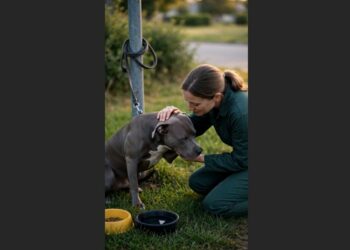
Eli placed his arms around Bishop’s neck and rested his face against the dog’s shoulder.
It was the shoulder where the fur had grown back unevenly over the old scar.
I held my breath.
The dog remained calm.
He closed his eyes, lowered his head, and rested part of his face against Eli’s back.
Then he let out a long breath.
My son held him.
And Bishop stayed beside him.
The First Hug I Had Ever Seen Him Give
For six years, Eli had never hugged me.
He had never hugged Daniel.
We had always respected that boundary, and neither of us had tried to change it by asking him to tolerate contact he didn’t want.
Yet there he was, sitting on the concrete floor with his arms around a dog he’d met only minutes earlier.
I don’t know how long the embrace lasted.
I remember standing beside Daniel, hardly daring to move.
I remember Eli’s small arms resting around Bishop’s neck.
And I remember the dog remaining calm, his scarred face resting against my son’s back.
I was moved by what I saw, but I was also aware that it was an unusual interaction requiring care.
Bishop was a frightened shelter dog with a complicated history. Eli was a young child. Neither of them should have been expected to tolerate contact they didn’t want.
That morning, however, the interaction remained calm.
Both had approached on their own terms.
Then I heard crying behind me.
It was Carmen.
Her hands were pressed over her mouth.
She was crying so hard that I couldn’t understand why.
I knew she was moved by what had happened.
But I hadn’t yet heard the full story of Bishop’s eighteen months at the shelter.
What Carmen Told Us in the Front Office
Eventually, Eli released Bishop.
He stood up in the abrupt, matter-of-fact way that was so familiar to us.
Then he announced, “I am going to come back and see Bishop again.”
He walked out of the kennel and returned to stand between Daniel and me.
For Eli, the visit had reached its natural end.
Carmen led us back to the front office.
Her eyes were still red.
She began explaining Bishop’s history, occasionally stopping to collect herself.
He had arrived at Three Rivers eighteen months earlier as part of an animal cruelty case.
The injuries he’d sustained had been deliberately inflicted by people over an extended period.
Carmen didn’t tell us every detail.
I didn’t ask her to.
The scars on Bishop’s body and the behavioral difficulties he’d experienced were enough to help me understand how serious his situation had been.
Two behavioral specialists had evaluated him after his arrival.
Both had expressed concern that he might never become comfortable with human touch again.
Carmen wanted us to understand something important.
Bishop wasn’t considered aggressive.
His problem wasn’t that he tried to harm people.
It was that he was profoundly uncomfortable allowing them close.
And for eighteen months, the shelter staff had struggled to help him feel safe enough to accept physical contact.
Eighteen Months Without a Human Hand Against His Fur
Carmen told us how carefully the staff had managed Bishop’s daily care.
He usually waited until people moved away before eating.
When he needed medication, it was hidden in food that could be passed through the kennel gate.
Only one volunteer had been able to walk him regularly.
That volunteer had spent four months gradually building enough familiarity to handle his lead.
Even then, physical contact remained limited.
According to Carmen, no person had been able to place a bare hand directly against Bishop’s fur in the eighteen months since his arrival.
The staff had stopped expecting him to become comfortable with ordinary affection.
They weren’t giving up on his care.
But they had begun reconsidering what kind of future would suit him best.
Instead of searching for a typical family adoption, they were looking into a quiet sanctuary placement.
They wanted him to have space, stability, patient caregivers, and no expectation that he would have to become an affectionate household pet.
Carmen had come to believe that such an arrangement might be the most realistic option for him.
Then Eli had arrived.
He had sat quietly outside the kennel and waited.
Bishop had approached.
And later, when Eli entered, the dog had voluntarily crossed the space between them.
For Carmen, that was a development she hadn’t expected to witness.
“They Speak the Same Language”
Carmen looked at Daniel and me.
She addressed me as Mrs. Okafor.
Then she said something I have remembered ever since.
“They speak the same language.”
She explained what she meant.
Both Eli and Bishop were highly sensitive to unwanted physical contact.
Both seemed more comfortable when they could decide how close someone came.
And that morning, each had approached the other without being pressured.
Carmen believed that Eli’s quiet, patient behavior had helped Bishop feel comfortable enough to move toward him.
Her words affected me deeply.
I didn’t believe Eli and Bishop had identical experiences.
My son was autistic. Bishop was a dog who had endured deliberate cruelty.
Those were very different circumstances, and I wouldn’t want to confuse them.
But there was a meaningful similarity in how we needed to approach them.
Neither benefited from forced affection.
Both needed their boundaries respected.
And both had shown that they could initiate contact when the circumstances felt right.
Carmen also said something else that stayed with me.
She believed Eli had offered Bishop an experience the staff had struggled for eighteen months to provide: the chance to approach another living being and remain comfortable during gentle physical contact.
That morning didn’t erase Bishop’s history.
But it suggested that some of the possibilities the staff had nearly stopped considering might still be open.
We Didn’t Adopt Bishop That Day
After hearing Carmen’s explanation, Daniel and I wanted to explore adopting Bishop.
But we didn’t take him home immediately.
And I’m grateful Carmen didn’t allow the emotional intensity of that first meeting to become the basis for a rushed decision.
A frightened dog with Bishop’s history needed careful assessment before moving into a household.
The fact that he had accepted contact from Eli on one occasion didn’t guarantee that every future interaction would be safe or comfortable.
I understood that particularly well because of my own work as an occupational therapist.
I wanted to support Eli’s connection with Bishop, but I wasn’t willing to romanticize the encounter at the expense of my son’s safety or the dog’s welfare.
So we returned to the shelter.
The following Saturday, we arrived during the quiet hour before opening.
And we came back the Saturday after that.
Then the next.
Each visit gave Eli and Bishop another opportunity to spend time together.
Some mornings, Eli sat quietly beside him.
On others, the two shared gentle physical contact.
There was no requirement that every visit end in a hug.
That mattered to me.
The connection had to remain something both could choose.
Eleven Weeks of Careful Decisions
The process lasted eleven weeks.
Carmen observed the visits and helped us understand Bishop’s needs.
One of the behavioral specialists who had assessed him previously returned to watch two of the meetings.
There were home visits.
We discussed what it would mean to bring a dog with Bishop’s history into our household, particularly with a six-year-old child.
We talked seriously about supervision, boundaries, predictable routines, and the possibility that Bishop might never become comfortable with ordinary affection from the rest of the family.
I wanted everyone involved to understand that one touching moment at the shelter didn’t establish a lifelong relationship.
We needed to know whether Eli and Bishop could interact comfortably over time.
We also needed to consider what would happen if either became overwhelmed.
There were practical questions about managing the dog’s needs and supporting Eli’s autonomy.
Carmen didn’t rush those conversations.
Neither did Daniel or I.
During the eleven weeks, we continued observing how Bishop responded to Eli’s presence.
The visits were not identical.
Sometimes they remained close without touching.
Sometimes Eli chose to hug him.
The connection continued developing, but we allowed it to proceed gradually.
Eventually, with the assessments and adoption arrangements completed, Bishop was approved to come home with us.
Bishop Came Home in July
We brought Bishop home in July.
I remember how different the decision felt from the moment we first saw him at the shelter.
Back then, he had been lying against a concrete wall, watching us from the far end of his kennel.
He had avoided close human contact for eighteen months.
Now we were welcoming him into our family, fully aware that adjusting to a new environment would require patience.
We didn’t expect him to become an affectionate, outgoing dog simply because he had formed a connection with Eli.
His history hadn’t disappeared.
He still needed to feel comfortable choosing when to approach people.
Daniel and I had already learned, through raising our son, how important it was to respect another living being’s boundaries.
We brought that same principle into our relationship with Bishop.
He was given his own bed on the floor beside Eli’s bed.
The arrangement allowed him a familiar resting place near the child with whom he’d developed a connection.
We continued treating the relationship carefully.
Both needed the freedom to rest without being disturbed.
Both needed predictable surroundings and the ability to decline interaction.
And all of us needed time to learn what living together would be like.
Five Months With a Dog Who Still Needs Space
Bishop has been living with us for five months now.
He is not a dog who greets everyone with enthusiasm.
He doesn’t rush toward visitors or eagerly seek affection from every member of the family.
He remains cautious with Daniel and me.
For a long time, even gentle physical contact from us seemed uncomfortable for him.
We’ve learned to respect that.
We don’t demand that he approach or insist on petting him when he’d rather remain where he is.
Gradually, he has become more comfortable with our presence.
One of the most encouraging changes has been the way he sometimes leans against Daniel’s leg in the evenings.
It isn’t a dramatic gesture.
Bishop doesn’t jump into his lap or ask to be held.
He simply chooses to stand close enough to make contact.
When Carmen heard about that change, she considered it significant.
I understood why.
The dog who had spent eighteen months avoiding human touch was beginning to approach another familiar person voluntarily.
That doesn’t mean he’ll eventually become comfortable with everyone.
We have no reason to expect that.
But he is showing us his preferences, and we are learning to appreciate the ways he expresses affection.
The Morning Routine in Eli’s Bedroom
The most familiar part of Bishop’s new life happens in Eli’s bedroom.
Bishop sleeps on his own bed on the floor, close to Eli’s.
In the morning, when Eli wakes, he often sits up and looks toward the dog.
Then he lowers himself from his bed.
He approaches Bishop in the same quiet, deliberate way I remember from their first meeting.
When the dog is comfortable receiving him, Eli puts his arms around his neck.
Bishop remains settled.
He often closes his eyes and rests his scarred face against Eli’s back.
The first time I saw that happen, I was standing in a kennel aisle at Three Rivers Animal Shelter, trying to understand what I was witnessing.
Now it has become part of our household routine.
I still find it moving.
But I don’t treat each hug as proof that something about Eli has been fixed.
There was never anything wrong with the way my son loved us.
Nor does Bishop’s willingness to accept affection from Eli mean his difficult history has been erased.
They are both the same individuals they were before.
What has changed is that they’ve developed a relationship in which certain kinds of contact are comfortable for them.
And as their family, we make room for that.
I Still Haven’t Been Hugged by My Son
There is something I want to say plainly.
Eli still doesn’t hug me.
He doesn’t hug Daniel either.
I know some people might hear this story and imagine that after embracing Bishop, Eli began hugging everyone in the family.
That would make for a neat ending.
But it isn’t what happened.
My son still has the same boundaries around physical contact that he had before we visited the shelter.
He still prefers predictable routines.
He still speaks in precise sentences.
And when he doesn’t want to be touched, we continue respecting that.
His relationship with Bishop hasn’t changed the way he expresses affection toward his parents.
What it has changed is my understanding of the possibilities.
For years, I knew Eli loved us, but I hadn’t imagined him choosing the kind of physical embrace I saw in that kennel.
I didn’t need him to hug me to prove his affection.
Yet seeing him voluntarily put his arms around Bishop was a new experience, and I won’t pretend it meant nothing to me.
It showed me another way Eli might express closeness under circumstances that felt comfortable to him.
And it reminded me that his preferences can be more specific than any general expectation about how an autistic child will respond to touch.
He doesn’t want to hug everyone.
He wants to hug Bishop.
That distinction matters.
The Dog With the Damaged Ear
Sometimes I think back to the moment Eli first stopped outside Bishop’s kennel.
The scarred Pit Bull was curled against the back wall, his chin lowered and his eyes watching the unfamiliar people standing nearby.
Carmen had warned us that he rarely approached visitors.
She had been preparing to suggest another dog.
Then Eli noticed his injured ear.
“His ear is hurt.”
Those four words began an encounter none of us expected.
Eli sat down.
He waited.
Bishop approached the gate.
Then, after Carmen allowed the next interaction, Bishop crossed the small distance between himself and my son.
That was the part I keep remembering.
Bishop moved toward Eli.
He made a choice.
And Eli, who had spent his entire life protecting his own boundaries around touch, was allowed to make a choice too.
They didn’t need to become different versions of themselves to share that moment.
Eli didn’t suddenly become a child who enjoyed constant physical affection.
Bishop didn’t become a dog who welcomed every stranger.
But each found something comfortable in the other’s presence.
That was enough to begin a relationship neither family nor shelter staff had anticipated.
The Love That Doesn’t Need to Look the Same
Being Eli’s mother has taught me to question many of the assumptions I once held about affection.
Before he was born, I probably imagined the usual things.
A small child running into his mother’s arms.
A sleepy hug before bed.
A little hand reaching out for comfort.
Our life has been different.
Daniel and I have learned to recognize love in Eli’s own ways.
We know his expressions, his interests, and the quiet moments when he wants to share something with us.
We understand that his refusal of unwanted touch is not rejection.
It is a boundary.
And because we respect it, he knows he doesn’t have to defend himself against us.
That foundation hasn’t changed since Bishop came home.
I don’t look at their morning embraces and wonder when it will be my turn.
I simply appreciate the relationship my son has chosen.
Bishop has his own complicated relationship with touch.
He accepts affection from Eli that he may not welcome from other people.
Daniel and I can live with that.
We aren’t measuring our success as a family by how often the dog approaches us or how many hugs our son gives.
We’re trying to provide a home where both feel comfortable and where affection is offered freely rather than demanded.
The Two Who Found Each Other
Bishop is asleep on the floor of Eli’s room now.
His bed rests beside my son’s.
The scars across his nose are still there.
His damaged ear hasn’t changed.
And the patch of fur on his shoulder still grows unevenly over the old injury.
Those parts of his body carry a history we cannot erase.
Eli is sleeping nearby.
His cowlick will probably be standing up again when he wakes tomorrow.
He’ll still be the child who likes his belongings arranged carefully and who remembers the names of every bone in the human hand.
He’ll still prefer his own way of communicating.
And he still won’t want Daniel or me to hug him without permission.
But in the morning, he’ll look toward the dog beside his bed.
If Bishop is comfortable, Eli will sit down near him and put his arms around his neck.
Bishop will rest his scarred face against my son’s back.
I may see them from the doorway, the same way I watched their first encounter at the shelter.
And I’ll remember Carmen standing in that hallway, her hands trembling as she whispered that Bishop had finally approached the gate.
Eighteen months of keeping his distance.
Six years of a little boy who had never offered anyone a hug.
And one quiet Saturday morning when both chose to move a little closer.
I still haven’t been hugged by my son.
I may never be.
But I know he loves me, and I know he doesn’t have to express that love through physical contact.
Now I also know that there’s one scarred, blue-gray dog who sometimes receives the kind of embrace Eli has never wanted to give anyone else.
Bishop is sleeping beside him tonight.
Tomorrow, if they both want it, they’ll share that familiar morning hug.
And Daniel and I will continue loving them exactly as they are.
Editor’s Note: The characters in this story are fictional. Through these stories, we hope to share the intelligence, loyalty, compassion, and loving nature of dogs with people everywhere.