Six Years Had Passed, but James Had Never Really Come Home
For six years, James Collins had tried to build a life that no longer revolved around war.
On paper, the transition had already happened. He was forty-eight now, no longer deploying, no longer sleeping with equipment within reach, and no longer waking to orders that could change before sunrise.
His body carried visible reminders of Afghanistan.
There was metal in one leg from an old injury. Pale scars crossed his arm, and chronic pain made some mornings harder than others.
The damage people could see, however, was not what troubled him most.
Sleep came in short stretches. Sudden noises could send his attention toward exits before he had time to think. Crowded places exhausted him, so he gradually stopped going to many of them.
Alcohol had become an unreliable way of dulling evenings.
It never solved anything.
Eventually, his therapist suggested something James had not considered seriously before: spending time around retired military working dogs.
James resisted at first.
Then one morning, with little confidence that it would help, he drove to a program that worked with former service dogs needing permanent homes.
That was where he met Kaiser.
The Old Shepherd Stayed at the Back of His Kennel
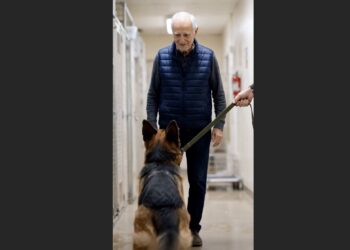
Kaiser was an eleven-year-old German shepherd.
Age had changed him considerably.
Gray had spread around his muzzle. Old scars marked one side of his face, and damage from a previous injury had left him blind in one eye.
He was also difficult to place.
A staff member explained that Kaiser tolerated a few familiar handlers but generally avoided strangers.
“He doesn’t like people getting into his space,” she told James. “Don’t reach for him. Just let him decide.”
James understood that instruction.
He sat outside the kennel.
Kaiser did not approach.
For several minutes, neither seemed particularly interested in forcing the situation forward.
The old dog watched him from a distance.
James kept his hands to himself.
Something about Kaiser’s posture felt familiar. The shepherd remained still, but his attention never stopped moving. A door opened at the end of the building, and one ear shifted toward it. Footsteps passed behind James, and Kaiser tracked them.
He appeared to notice everything.
James had spent years doing much the same thing.
That similarity did not mean the dog understood him.
Still, it made silence between them surprisingly comfortable.
He Went Back the Next Day
James had not intended to adopt a dog during his first visit.
He returned anyway.
Once again, he sat outside Kaiser’s space without trying to touch him.
The dog stayed several feet away.
On the third visit, Kaiser came closer.
He sniffed near James’s shoes and retreated.
A few days later, he accepted a treat placed on the ground.
Progress remained slow, which suited both of them.
James did not need Kaiser to perform affection. Kaiser did not need James to prove anything through forced contact.
Eventually, the staff began discussing whether an adoption might work.
There were practical questions.
Kaiser was a senior dog with an injury history. He would need regular veterinary care. His vision loss required consideration, and his age meant that mobility could decline.
James also had physical limitations of his own.
They talked about flooring, exercise, transportation, vet expenses, and whether James could manage a large German shepherd safely.
After several visits and careful planning, the adoption went forward.
James brought Kaiser home.
The First Three Months Were Mostly Quiet
Nothing miraculous happened.
Kaiser did not cross the threshold and suddenly become a relaxed family pet.
James did not stop having difficult nights because a dog now lived in the house.
They simply learned each other.
Kaiser chose to sleep near the front door.
From there, he could monitor most movement through the house.
If a vehicle stopped outside, his head came up.
When someone knocked, his entire body became alert.
Toys received almost no attention.
A tennis ball could roll across the floor and stop beside him without earning more than a glance.
James did not insist.
He fed Kaiser at the same times each day. Walks followed predictable routes. Because the dog could not see from one side, James learned not to approach suddenly from that direction.
Over time, Kaiser learned the layout of the house.
He memorized furniture positions and moved confidently through familiar rooms.
Blindness in one eye did not make him helpless. Hearing, scent, memory, and his remaining vision allowed him to navigate well.
Meanwhile, James became accustomed to another living creature moving through the house.
For nearly three months, that was enough.
They Both Slept Lightly
Their similarities became easiest to notice at night.
Kaiser rarely seemed completely relaxed.
He might lie down, but certain noises brought him upright immediately.
James understood.
Some nights he woke after only an hour or two of sleep and found Kaiser already watching him.
Other times, James paced into the kitchen and discovered the shepherd lying near the hallway.
Neither needed much from the other.
James sometimes sat on the floor a few feet away.
Kaiser occasionally moved closer.
There were no speeches about what either of them had endured.
Dogs do not understand combat trauma as humans do, and James knew better than to imagine Kaiser was analyzing his moods.
Yet companionship changed the shape of those hours.
An empty house had made every sound feel larger.
With Kaiser nearby, James was no longer awake alone.
That did not remove the memories.
It simply gave the present more weight.
One Evening, James Opened an Old Storage Box
The box had followed him through several moves.
James rarely touched it.
Inside were old photographs, paperwork, patches, folded documents, and small objects from his years in uniform.
One evening, after an especially restless day, he carried it into the living room.
He sat on the floor and began sorting through it.
Photographs came first.
There were pictures of men standing beside vehicles, photographs taken at bases, landscapes washed in dust, and informal snapshots from moments between assignments.
Kaiser remained across the room.
Then James placed several photographs on the floor.
The shepherd stood.
James barely noticed at first.
Kaiser approached slowly, his nose working as he investigated the unfamiliar objects.
He smelled one photograph, then another.
His tail moved once.
James looked up.
“Well, that got your attention.”
Kaiser continued sniffing.
Of course, a dog examining photographs did not mean he understood the images printed on them. Old paper could carry interesting smells, and James had handled many of those photographs years earlier.
Still, the behavior made him curious.
He picked up one picture.
Then he stopped.
There Was a German Shepherd in the Photograph
The photograph showed James with several members of his unit in Afghanistan.
Beside them stood a German shepherd.
The dog in the picture was much younger than Kaiser.
His body was lean and heavily muscled, his ears upright, his face still dark rather than gray.
James stared at the photograph.
Military working dogs had passed through different parts of his deployment. At the time, he had not memorized every dog or handler he encountered.
Yet something in the animal’s markings bothered him.
He looked at Kaiser.
Then back at the photograph.
A patch near the shoulder appeared familiar.
So did the shape of the face.
James told himself that German shepherds could resemble one another, especially after many years had changed coat color, muscle tone, and posture.
Then he remembered the documents in the box.
He began searching.
Kaiser remained nearby.
One Line Changed the Meaning of the Photograph
Near the bottom of the box was paperwork James had barely looked at since returning home.
He unfolded several pages.
Most contained details that meant little to anyone outside the military system.
Then one entry stopped him.
The record referenced an operation dated September 12, 2016.
James read the line again.
A military working dog named Kaiser had been injured during the same explosion that injured James Collins.
James stayed on the floor.
For a few seconds, he simply stared at the name.
Kaiser.
He checked the identifying information again.
Age.
Unit information.
Injury history.
The facial damage.
Pieces began aligning.
The old, scarred dog standing in his living room was not merely another German shepherd who happened to resemble the dog in the photograph.
According to the records, Kaiser had been there.
The same dog had survived the same explosion.
James Remembered Only Pieces of That Day
Memory did not return like a movie.
That was not how James experienced it.
Instead, fragments surfaced.
Noise.
Dust.
A violent pressure that seemed to erase everything around him.
His leg failing beneath him.
Voices that sounded strangely distant.
Then one image that had never made complete sense.
A dog.
James remembered seeing a German shepherd moving through the confusion after the blast.
The animal appeared injured.
For years, James had never known whether that memory was accurate or something his mind had assembled afterward.
Emergency evacuation had separated people quickly.
James had been moved for medical treatment.
He never learned what happened to the dog.
Now an official line in an old file connected the memory to Kaiser.
The shepherd had been injured in the same blast.
According to the account James pieced together, Kaiser had moved toward the area where James lay before responders separated them during the evacuation.
Calling that an intentional attempt to “save” him would have required knowing more about Kaiser’s task and handler cues than the records could prove.
Still, James finally knew the dog he remembered had been real.
And he was standing in the room.
Kaiser Could Not Tell Him What He Remembered
James began crying.
The reaction surprised him with its intensity.
He had spent years trying not to revisit that day. Now the past had walked into his home without either of them recognizing the connection at first.
Kaiser approached.
The dog sniffed James’s hands.
Then he pressed the scarred side of his muzzle against one of them.
James closed his fingers gently over the fur.
It would have been tempting to believe Kaiser had suddenly remembered everything too.
No one could know that.
Dogs can retain long-term associations with people, scents, environments, and experiences. However, there was no way to ask Kaiser what he connected to James or whether he recognized him from Afghanistan.
Perhaps familiar scent or voice had contributed to the ease that slowly developed between them.
Perhaps it had not.
For James, certainty about Kaiser’s thoughts was unnecessary.
The record itself was enough.
They had been in the same place.
They had both been injured.
Years later, without James knowing any of that, he had chosen Kaiser’s kennel.
The Discovery Did Not Cure Either of Them
The next morning, James still had pain in his leg.
Kaiser was still eleven years old and blind in one eye.
James’s trauma symptoms did not disappear because he had discovered a connection to his past.
Kaiser did not suddenly become playful.
Healing, when it came, was much less dramatic.
James became more consistent about his own treatment.
He drank less.
Walks with Kaiser created structure, even when they were short.
On nights when sleep was difficult, James worked on techniques his therapist had taught him rather than trying to numb everything.
Kaiser changed gradually too.
One afternoon, he picked up a toy for the first time.
He dropped it after several seconds.
A week later, he carried the same toy across the room.
Eventually, he stopped sleeping directly against the front door every night.
Sometimes he chose the foot of James’s bed instead.
These were small changes.
They mattered precisely because nobody forced them.
James Began Understanding Kaiser as an Old Dog, Not a Symbol
Once the story of their shared deployment became known, people tended to focus on the remarkable coincidence.
James understood why.
Still, daily life with Kaiser remained practical.
The old shepherd needed veterinary appointments.
His joints had become stiffer.
James placed rugs across slippery floors and kept furniture in predictable locations so Kaiser could move safely.
Walks became slower.
Because Kaiser had only one functional eye, James used his voice before touching him from the blind side.
The dog also needed rest.
He had already spent much of his life working.
James did not expect him to continue behaving like the young military dog in the photograph.
That photograph eventually went into a frame.
Kaiser, meanwhile, preferred sleeping beneath the window.
The younger shepherd in the picture and the senior dog on the floor were the same animal.
James learned to honor both without pretending age had not changed him.
Kaiser Eventually Began Visiting Other Veterans
The idea developed slowly.
James noticed that Kaiser often settled quietly when trusted visitors came to the house.
At a veterans’ gathering, the old shepherd seemed comfortable lying near a group of men who were talking.
Someone suggested Kaiser might be suitable for structured therapy work.
James did not simply put a vest on him and declare him a therapy dog.
Kaiser’s age, temperament, health, and comfort around unfamiliar people all had to matter.
After appropriate evaluation, preparation, and supervised work, he was eventually cleared for visits.
The assignments were very different from the work of his younger years.
There was no detection task.
No patrol.
No operational command.
Mostly, Kaiser entered a room and stayed there.
Sometimes that was enough.
Some Veterans Talked More Easily With the Dog Nearby
At veterans’ centers, Kaiser never performed miracles.
A man who had not spoken much did not suddenly reveal everything because a German shepherd walked into the room.
Instead, conversations often began with the dog himself.
“How old is he?”
“What happened to his eye?”
“Was he really deployed?”
Those questions could lead elsewhere.
A former service member might talk about a dog his unit had known.
That memory might lead to a place.
A place might lead to a person.
Eventually, a story that had remained untouched for years sometimes found its way into the room.
Kaiser did not provide therapy in place of trained professionals.
His presence supported the work already happening.
For some veterans, touching the thick fur along his neck made it easier to sit through a difficult conversation.
Others simply appreciated having an animal nearby that did not ask questions.
James understood that feeling particularly well.
Their Nights Became Quieter
Back home, James and Kaiser continued their routine.
Dinner.
Medication when needed.
A slow evening walk.
The same familiar rooms.
Some nights remained difficult.
James still woke occasionally from dreams he would rather not remember.
The difference was what happened afterward.
He no longer automatically reached for a bottle.
Often, Kaiser was at the foot of the bed.
James would sit up and place his feet on the floor.
Sometimes the shepherd lifted his head.
Sometimes he slept through the entire thing.
Either way, James had a reason to remain in the present.
There was water to refill in the morning.
There would be breakfast.
An old dog would need his walk.
Recovery did not mean forgetting Afghanistan.
For James, it meant learning that memory no longer had to control every hour afterward.
The Photograph Still Sits Where James Can See It
The old photograph eventually found a permanent place in the house.
In it, Kaiser is young.
His ears stand high, his coat is dark, and there is no gray around his muzzle.
James looks younger too.
Neither carries the visible injuries they would later bring home.
Beside that photograph sits a newer one.
Kaiser’s face is scarred now.
James’s arm is too.
The differences between the two pictures tell a story neither could have understood while it was happening.
James does not claim the dog came back to finish some mission.
He does not believe Kaiser was sent to heal him.
Their reunion required no supernatural explanation.
A retired Marine walked into a program for former working dogs.
A senior German shepherd needed a home.
Only later did an old military record reveal that their lives had crossed long before either became what the other needed in retirement.
That truth was remarkable enough.
Two Veterans Finally Learned How to Rest
Kaiser is older now, and James knows their time together cannot last forever.
That knowledge has made him more protective of ordinary days.
He no longer expects the shepherd to move quickly.
There is no need.
When Kaiser pauses on a walk, James pauses too.
When the dog chooses to sleep for much of the afternoon, James lets him.
Their lives are quieter than the one they once shared without knowing it.
There are no helicopters overhead.
No ruined buildings.
No emergency evacuation separating them.
At night, Kaiser often sleeps near the bed.
James sleeps better than he once did, though not perfectly.
The distinction matters.
Neither war trauma nor grief yields to a simple story about loyalty.
James still uses the skills and support that helped him rebuild his life. Kaiser still carries the effects of age and old injuries.
Yet companionship has become part of that recovery.
When James talks about the old shepherd now, he rarely calls him a hero.
He calls him Kaiser.
His dog.
His former fellow serviceman.
And sometimes, when people ask what changed after that night with the photographs, James gives them a quieter answer.
“I didn’t heal alone,” he says. “I just had to find the one who had been through the same storm.”
Then he looks toward the old German shepherd sleeping nearby.
This time, neither of them is standing watch.
Editor’s Note: The characters in this story are fictional. Through these stories, we hope to share the intelligence, loyalty, compassion, and loving nature of dogs with people everywhere.